Has DeepSeek V4 Closed the Loop for Domestic AI?
 04/27 2026
 453
453
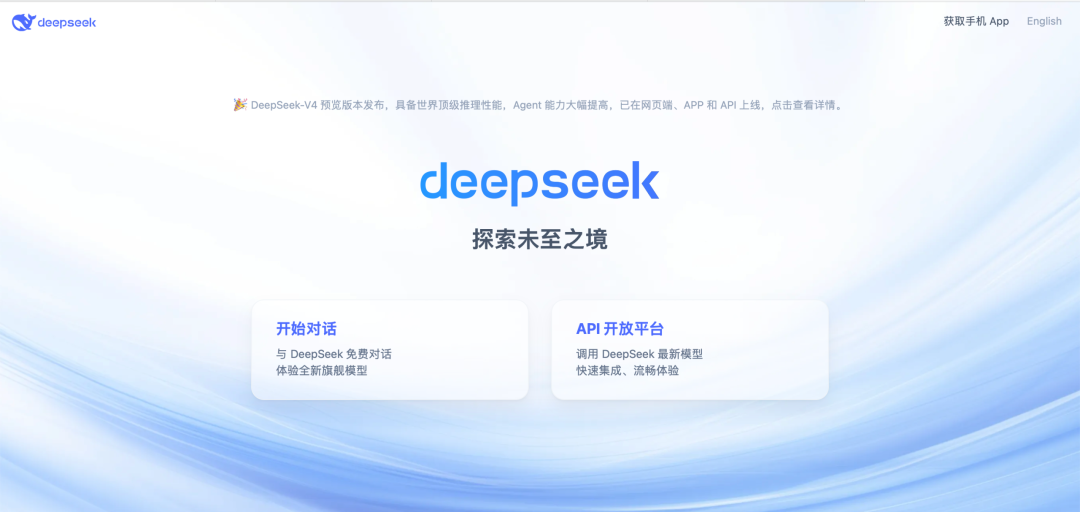
On April 24, DeepSeek’s official website showed that the “DeepSeek-V4 Preview” was now online and available via web, app, and API endpoints. Its API documentation lists two model versions—deepseek-v4-flash and deepseek-v4-pro—supporting capabilities such as 1M context windows, up to 384K output, JSON Output, and Tool Calls.
According to DeepSeek, the Pro version outperforms other open-source models on global knowledge benchmarks, falling just short of Google’s closed-source Gemini 3.1 Pro. Meanwhile, V4 also offers a lower-cost Flash version.
In the past, China’s AI market focused on “catching up” in model development. Now, DeepSeek V4 pushes the discussion to a more fundamental level: Can domestic models run on domestic chips? Can cloud providers distribute them at scale? Can inference costs be reduced to a level where enterprises are willing to adopt them continuously? Can this support a new valuation of China’s AI industrial chain in the capital markets?
In other words, DeepSeek V4 is not just an isolated model release—it is a stress test for China’s AI ecosystem.

The most obvious signal for capital markets from DeepSeek V4 remains pricing.
According to DeepSeek’s API documentation, deepseek-v4-flash costs $0.028 per million input tokens with cache hits and $0.14 without, with output priced at $0.28. For deepseek-v4-pro, input costs are $0.145 (cache hit) and $1.74 (miss), with output at $3.48. Both versions offer compatibility with mainstream large model interfaces, minimizing migration costs for developers.
The capital market implications are clear: DeepSeek maintains a low-cost entry point with Flash while meeting high-performance needs with Pro, further reducing trial-and-error costs at the application layer. For AI-powered office tools, programming, intelligent customer service, enterprise knowledge bases, data analysis, and marketing content generation, lower costs make it easier for businesses to move from “pilot” to “large-scale adoption.”
However, low prices do not guarantee a viable business model. Falling model prices first compress margins for model developers, then force cloud providers, application companies, and computing service providers to redistribute value chain profits. Capital markets must look beyond “cheap API calls” and ask: How will model developers make money? How will cloud providers retain customers? Can application companies turn low costs into high retention and average revenue per user (ARPU)?
This is where DeepSeek V4 holds the most practical significance. It expands the reach of domestic models while pushing the industry from “benchmarks and rankings” to “unit economics.”

If we focus solely on model capabilities, DeepSeek V4 remains part of the model competition. But if subsequent progress in Ascend chip compatibility and large-scale service deployment materializes, it will become more than a model release—it could trigger a reevaluation of China’s AI infrastructure.
Huawei stated that its Ascend super-nodes, powered by the Ascend 950 AI chip, will fully support DeepSeek V4 models. Earlier, on April 3, media reported that DeepSeek V4 would run on Huawei’s latest chips, with Chinese tech giants Alibaba, ByteDance, and Tencent placing orders totaling tens of thousands of units for Huawei’s upcoming chips. DeepSeek was also reported to be collaborating with Huawei and Cambricon to rewrite underlying code for better compatibility with domestic hardware. However, these orders and partnerships remain based on media reports from unnamed sources and are not confirmed by official announcements.
This matters more than a simple “rally in domestic computing power stocks.” The AI industry has long relied on the CUDA ecosystem, where the challenge lies not just in chip performance but in system-level coordination among models, compilers, operator libraries, communication networks, memory management, and parallel training and inference frameworks. If DeepSeek V4 can deliver stable, large-scale inference services on the Ascend platform, it would signal that China’s AI ecosystem is moving beyond “having models and chips” toward “optimized coordination among models, chips, and software stacks.”
The corresponding investment opportunities extend beyond AI chip companies. They spill over into servers, super-node switching, optical communications, CPO/high-speed interconnects, advanced memory, advanced packaging, liquid cooling, power supplies, computing power scheduling, and cloud services. 21st Century Business Herald reported that after DeepSeek-V4’s preview launch, the A-share GPU index surged, with domestic computing power and semiconductor stocks rising, including Hygon Information, Loongson Technology, SMIC, Tongfu Microelectronics, Cambricon, and Moore Threads.
But caution is warranted. Stock prices reflect expectations first; earnings depend on orders, deliveries, utilization rates, and margins. The domestic computing power chain cannot justify valuations simply by associating with DeepSeek. The real questions are whether chips can be supplied stably, whether super-nodes can be delivered at scale, whether software stacks can reduce migration costs, and whether customer usage can translate into sustained revenue.

DeepSeek V4 also impacts another dynamic: cloud providers’ battle for market entry points.
Tencent and Alibaba are reportedly discussing an investment in DeepSeek, which is seeking financing at a valuation exceeding $20 billion. However, this information has not been independently verified, and funding amounts and valuations remain subject to change.
If this potential financing materializes, the focus will not just be on DeepSeek’s valuation but on who needs DeepSeek.
For cloud providers like Alibaba Cloud, Tencent Cloud, Huawei Cloud, and Volcano Engine, large models have become a new gateway for selling cloud resources. In the past, cloud providers sold computing power, storage, and databases; now, they sell “models + computing power + development tools + application templates + industry solutions.” Whoever secures a strong model can more easily retain enterprise customers on their MaaS (Model as a Service) platform.
This explains why Alibaba and Tencent might invest in DeepSeek—not just as financial investors but as strategic ecosystem partners. If DeepSeek maintains strong model capabilities and low-cost API access, it becomes a critical asset for cloud providers competing for developers and enterprise clients.
But beyond market entry, the real question is revenue sharing.
If DeepSeek integrates into cloud providers’ MaaS platforms, its commercial value may not be limited to API call fees. More critical are questions like: Who do enterprise customers ultimately pay? Who recognizes the revenue? Where do the margins accrue? Model providers supply capabilities; cloud providers offer computing power, billing systems, and account infrastructure; application companies control scenarios, data, and delivery relationships. Final profit distribution may depend less on which model is most hyped and more on who can convert usage into recognizable revenue, customer renewals, and cash flow.
Capital markets must recognize that such partnerships will reshape value allocation. Model companies may not naturally capture the largest profits. Cloud providers control customers, billing systems, computing resources, and industry solutions; application companies control scenarios and data; hardware companies control supply bottlenecks. The stronger DeepSeek becomes and the more active China’s AI ecosystem grows, the less profit may concentrate within DeepSeek alone.
This is especially important for evaluating publicly traded companies. While model announcements boost sentiment across the industrial chain, what ultimately matters for valuations are orders, revenue, margins, and cash flow.

The excitement around DeepSeek V4 is understandable. However, from a capital market perspective, China’s AI ecosystem must still address three critical challenges.
The first is computing power supply. Media reports, citing DeepSeek, note that Pro version throughput is currently limited by high-end computing power supply. If Huawei’s Ascend 950 super-nodes launch at scale in the second half of the year, Pro version prices could decline. This highlights a key point: While domestic model capabilities have advanced, supply-side bottlenecks remain. Computing power is not just about “domestic substitution” on paper—it requires chip production capacity, cluster stability, network interconnects, energy efficiency, cooling, operations, and high-concurrency service capabilities. The sustainability of valuations in China’s computing power chain depends on whether these links can transition from thematic trading to revenue realization.
The second challenge is energy and data centers. Ultra-large-scale clusters comprising tens of thousands of high-performance AI chips are not just a chip procurement issue but also a power, cooling, and data center infrastructure issue. At the end of the computing power chain lies electricity. Cheaper inference services and higher-frequency API calls demand greater stability in data center power supply, higher rack power density, advanced liquid cooling systems, network scheduling, and operational capabilities. This is an often-underestimated aspect of China’s AI ecosystem. Models can become cheaper, and APIs can proliferate, but if power capacity, liquid cooling infrastructure, data center upgrades, and cluster scheduling cannot keep pace, call costs will struggle to decline further. Future competition in China’s computing power chain will extend beyond chip performance to data center infrastructure, energy management, and resource utilization.
The third challenge is application monetization. DeepSeek’s API documentation shows that V4 supports Tool Calls, JSON Output, long contexts, and thinking mode—capabilities aligned with enterprise-grade agents and complex workflows. Its Chat Completion interface supports both deepseek-v4-flash and deepseek-v4-pro, with adjustable reasoning_effort (high/max). This suggests models are evolving from “Q&A tools” to “task execution systems.” However, enterprises will not adopt models solely because they are cheap. Concerns include permissions, data security, system integration, stability, observability, private deployment, response latency, and error liability. The real investment opportunities at the application layer lie not in “chatbot wrappers” but in companies that embed models into real-world processes like finance, R&D, customer service, sales, coding, and industrial operations.

DeepSeek V4 provides a new lens for observing China’s AI industrial chain, but this narrative differs from the “hundred-model wars” of previous years.
The earlier market rally was driven by model quantity and parameter hype; this time, the focus should be on ecosystem viability. A viable ecosystem means real commercial flows among models, chips, clouds, and applications: models drive API calls, calls drive computing power consumption, consumption drives hardware orders, hardware supply reduces model costs, and lower costs expand application adoption.
This is the industrial landscape that makes DeepSeek V4 most relevant for capital markets.
From an investment perspective, the first layer is domestic computing hardware, including AI chips, servers, advanced packaging, high-speed interconnects, liquid cooling, and power supplies. The second layer is cloud and MaaS platforms—those that can package DeepSeek-like models into stable enterprise services stand to benefit from growing call volumes. The third layer is vertical applications, particularly companies tied to industry-specific data and workflows. Only the fourth layer involves pure model company valuations.
However, the long chain also means prolonged risk. If model performance fails to stay ahead, entry-point value declines. If domestic computing power delivery delays occur, the ecosystem strains at the infrastructure level. If cloud providers engage in MaaS price wars, unit call margins may compress. If application companies lack real-world scenarios, they risk becoming mere pass-through entities for lower API costs.
Thus, while DeepSeek V4 can elevate attention toward China’s AI industrial chain, it cannot substitute for earnings validation. Capital markets may grant thematic premiums but must eventually return to fundamentals: Are orders materializing? Is revenue growing? Are margins sustainable? Is cash flow improving? Are customers willing to pay continuously?
The true significance of DeepSeek V4 lies not in generating buzz but in pushing China’s AI competition to a deeper level.
Models must coordinate with chips, chips with cloud platforms, cloud platforms with application scenarios, and application scenarios with enterprise budgets. Digging further, chips must also coordinate with power, liquid cooling, data centers, and operational systems. Only when all these layers align can China’s AI advance beyond technical breakthroughs to industrial viability.
For markets, DeepSeek V4 marks a new starting point: China’s AI is moving from “models that work” to “ecosystems that make economic sense.” Going forward, the focus will not be on who tells the biggest story but on who can link API calls, computing orders, infrastructure costs, and enterprise payments into a coherent financial narrative.
Sources
This analysis is based on publicly available information, including DeepSeek’s official website and API documentation, Reuters reports, 21st Century Business Herald coverage, and market reactions to DeepSeek V4 Preview’s launch, API models and pricing, Huawei Ascend 950 super-node support, potential Tencent and Alibaba investments, and A-share industrial chain movements.
Disclaimer
This article is solely for financial commentary and industry research purposes and does not constitute any investment advice, legal opinion, or financial recommendation. The content involving financing negotiations, chip orders, model adaptations, price changes, and impacts on the industrial chain is partially derived from media sources citing insiders or statements from the companies involved. Such information should still be subject to subsequent company announcements, regulatory disclosures, and official technical documents. Investment involves risks, and decisions should be made with caution.
Note: This article is based on the analysis and integration of publicly available information. If there are any errors, please contact us promptly for corrections.
-
![]()
Tesla Restructures Its Balance Sheet
-
![]()
Accelerating the High-Speed Interconnection Upgrade of AI Computing Clusters! JONHON Releases ELSFP External Light Source Optical Connectors
-
![]()
Breaking the overseas blockade of volumetric holographic materials, this optical enterprise secures nearly 100 million yuan in financing!
-
![]()
Why Does Jensen Huang So Openly Praise China’s AI?
-
![]()
"Wudang" Unveiled: Arm China's Next-Gen AI VPU Redefines Video Encoding
-
![]()
From Energy Conservation and Carbon Reduction to AI Decision-Making: GECON East Intelligence and Chery Group Explore a New Green and Smart Paradigm for Automobile Manufacturing
-
![]()
WAIC 2026 Observation | AI Accelerates Towards the Core of Industries, Industrial AI Enters a Critical Phase
-
![]()
Volkswagen China Fires the First Shot in Foreign-Funded 'White Box Delivery'!