Qianxun Secures 3 Billion Yuan in 30 Days, Zhiyuan Rolls Out 10,000 Units, and Unitree Files for IPO: The Embodied AI Sector's 'Survival Race' is Underway
 04/30 2026
 685
685
Produced by | He Xi
Layout by | Ye Yuan
At CATL's Zhongzhou Base battery production line, a robot named 'Xiaomo' is precisely inserting high-voltage test plugs into battery packs with hundreds of volts. It boasts a 99% success rate and can handle the workload equivalent to three human workers in a single day.
This scenario, which was merely a laboratory demonstration two years ago, has now become a hot topic for financing roadshows in the embodied AI sector.
Qianxun Intelligence, the company behind 'Xiaomo,' raised 3 billion yuan in just 30 days. Lei Jun and Jack Ma came together at the same investment table, a rare sight, propelling the company's valuation beyond 20 billion yuan.
Almost simultaneously, Zhiyuan Robotics announced the production of its 10,000th mass-produced unit. It took just over three months to scale from 5,000 to 10,000 units.
Unitree Technology also unveiled its IPO prospectus: 1.7 billion yuan in revenue, 5,500 units shipped, and a valuation of 42 billion yuan, aiming to become the 'first humanoid robot stock' on the A-share market.
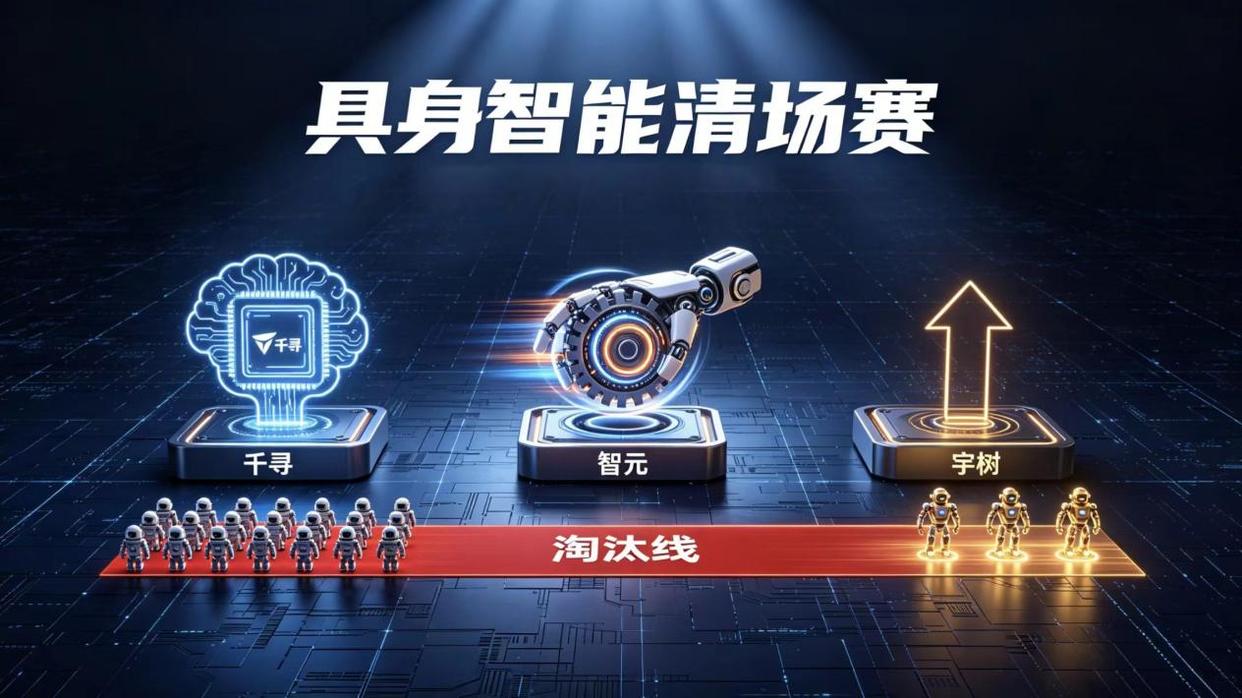
Three companies, three strategies, but all competing in the same sector. The 'billion-yuan club' in embodied AI is rapidly growing—this is not a celebration of diversity but a ruthless 'survival race.' Many mid-tier companies have already seen their financing windows close, and even the opportunity to participate is fading.
Multiple indicators suggest that a 'two-tier market' structure is emerging in embodied AI.
Below, the author will use the three most representative examples—Qianxun, Zhiyuan, and Unitree—to discuss the entry requirements and survival thresholds in this 'survival race' for embodied AI. We will also analyze the current 'two-tier market' structure from three perspectives:
First, the financing entry requirements—how the billion-yuan valuation threshold is established;
Second, the scale of survival thresholds in mass production—whether production capacity can be translated into actual productivity;
Third, the final outcome—who meets the entry requirements and who can truly stay in the competition.
01
Entry Requirements: The Origin of the Billion-Yuan Valuation
Let's first examine the financing landscape of embodied AI.
A billion-yuan valuation is becoming the 'price of admission'—a multifaceted reflection of financing capability, technical prowess, and industrial resources, not just a numerical target.
In Q1 2026, the embodied AI sector disclosed over 50 financing rounds, with more than 30 companies receiving investments, totaling approximately 20 billion yuan in cumulative financing, a nearly 60% year-on-year increase, setting a new historical high. Currently, over a dozen companies, including Unitree Technology, Yinhe General, Zhiyuan Robotics, Xinghai Tu, Qianxun Intelligence, and Zhipingfang, have reached the billion-yuan valuation club. Capital is flowing at an astonishing rate toward the top, and the first shot of the survival race has been fired.
Qianxun Intelligence Case Study: 3 Billion Yuan Raised in 30 Days, Lei Jun and Jack Ma 'Share the Spotlight'
On April 7, Qianxun Intelligence announced the completion of a new round of 1 billion yuan in financing, co-led by Shunwei Capital (Lei Jun) and Yunfeng Capital (Jack Ma). After raising nearly 2 billion yuan in February, the company accumulated 3 billion yuan in financing within 30 days, setting a new industry record for financing speed and pushing its post-investment valuation beyond 20 billion yuan.
What's noteworthy is not the amount but the investor composition. Shunwei is one of the earliest domestic first-tier venture capital firms to heavily invest in embodied AI, while Yunfeng leans toward 'large-scale late-stage + industrial synergy.' Industrial capital (TCL Ventures), state-owned capital (Chongqing Industrial Mother Fund, Hangzhou Gold Investment), Sequoia China, and others have joined in, with industry players like JD.com and CATL also deeply involved.
Founder Han Fengtao holds a Ph.D. from Huazhong University of Science and Technology and is a co-founder of Luoshi Robotics. Co-founder Gao Yang is an assistant professor at Tsinghua University. In collaboration with CATL, its 'Xiaomo' robot achieves a stable success rate of over 99% in inserting plugs on the battery production line, with a daily workload equivalent to three humans.
Zhiyuan Robotics Case Study: Industrial Backing Behind 10,000 Units of Mass Production
Zhiyuan's founder, Deng Taihua, explicitly proposed the '358 Vision'—achieving 1 billion yuan in revenue within 3 years of establishment (already realized in 2025), targeting 10 billion yuan within 5 years, and 100 billion yuan within 8 years. Zhiyuan's 'XYZ Curve' clearly outlines the evolution path from development and exploration to deployment and growth, and finally to widespread adoption. Supporting this curve are not just presentations but firm procurement orders Zhiyuan has secured from industries such as automotive manufacturing, 3C electronics, and logistics warehousing.
The 'Targeted Investment' Effect of Capital
The embodied AI industry is characterized by 'accelerating consensus, intensifying differentiation, and narrowing windows,' with capital flowing toward the top and financing channels for mid-tier companies rapidly shrinking. In the second half of 2025, the number of financing events in the industry decreased by 31.7% year-on-year, but the average amount per financing round increased by 46.8% year-on-year, with 'large funds surging toward the top' becoming evident.
Wang Qian, founder of Zibianliang Robotics, predicts that the industry landscape will inevitably consolidate, with core technologies, scenario implementation, and capital advantages continuing to concentrate at the top. A billion-yuan valuation is not just proof of financing capability but also the 'price of admission'—it reflects not the valuation itself but whether a company has been selected by industrial capital and national teams. The rules of the survival race are simple: without this admission, you don't even qualify to compete.
02
Survival Thresholds: Mass Production Capacity and Real-World Scenario Penetration
After discussing financing entry requirements, let's now talk about mass production—after 10,000 units, who holds real value, and who is just creating 'hype' with production capacity.
Entering the billion-yuan club only gets you an 'admission ticket.' Whether you can cross the survival thresholds of mass production and scenario implementation is the core of the survival race. If the closed loop of 'financing-mass production-scenario implementation' cannot be completed, companies will be rapidly eliminated.
Zhiyuan's '10,000 Units' Milestone
From January to December 2025, Zhiyuan achieved a leap in mass production from 1,000 to 5,000 units; from December 2025 to March 2026, it took just over three months to break through from 5,000 to 10,000 units. Deng Taihua's goal is to reach 100,000 units of mass production by the end of 2027.
The significance of 10,000 units lies in the fact that Zhiyuan has established a standardized supply chain system for embodied AI robots, with an order-driven flexible production and delivery capacity of over 100,000 units per year. In March 2026, Zhiyuan released seven major productivity solutions, including production line loading and unloading, industrial handling, logistics sorting, guided shopping, service retail stations, security patrols, and industrial and commercial cleaning.
Real-World Scenario Penetration: Longqi Technology Production Line Case
In October 2025, Zhiyuan secured a hundreds of millions of yuan order from Longqi, taking about four months to complete concept verification. By April 2026, four Elf G2 robots had been stably operating at Longqi's Nanchang factory, with plans to expand to 100 units in Q3 2026.
For Zhiyuan, the success on Longqi's production line is highly significant—it is the first benchmark case where an embodied robot has penetrated a real 3C electronics production line, received payment from a client, and completed a return on investment cycle. Zhiyuan's partner, Yao Maoqing, revealed that the cost of loading and unloading per robot is now lower than that of manual labor. Deployed robots have already been paid for by clients, and the return on investment cycle has become calculable. Yao Maoqing predicts that once robots achieve ultra-large-scale deployment, the data shortage problem plaguing embodied model training will also be resolved.
Qianxun Intelligence's Scenario Implementation Progress
By the end of 2025, 'Xiaomo' was officially deployed on the battery production line at CATL's Zhongzhou Base, responsible for complex tasks such as inserting high-voltage test plugs. It achieved a stable success rate of over 99%, with operational efficiency comparable to that of skilled workers, and a threefold increase in daily workload.
In March, Qianxun signed a strategic cooperation agreement with JD.com, and its self-developed Moz robot has been fully integrated into the smart retail scenarios at JD MALL. Qianxun's founder, Han Fengtao, predicts that the real window for large-scale deployment may come in the second half of 2027 to 2028.
Standard Thresholds and Intelligence Inflection Points in Industrial Scenarios
According to the 'Standards System for Humanoid Robots and Embodied AI' released by the Ministry of Industry and Information Technology in 2026, industrial-grade humanoid robots must have a Mean Time Between Failures (MTBF) of ≥5,000 hours. Based on the success rates and cycle times achieved by Zhiyuan and Qianxun on production lines, the technology is now ready for real factory deployment. However, there is still a significant gap between 'being able to work' and 'full production line coverage.'
Deng Taihua predicts that the inflection point will occur when 'sufficiently large sales volume can dilute unit R&D costs'—using scale to achieve an economic model that works. Mass production of 10,000 units is not just a milestone but the starting point for a new round of competition. In the survival race, companies that cannot cross this survival threshold will quickly fall behind.
03
Final Outcome: Three Paths, Who Will Remain Competitive?
After discussing the thresholds for mass production and scenario implementation, let's now look at the path choices of these three leading companies and where the real challenges lie in the survival race.
Qianxun, Zhiyuan, and Unitree represent three distinct competitive paths in the embodied AI sector. Whoever can cross the inflection point of unit R&D costs before 2027 will become the true player in the final round.
Path 1: Qianxun Intelligence—'High-Concentration Data + Deep Integration with Industrial Scenarios'
Qianxun Intelligence's core strength lies in data. The company has accumulated over 200,000 hours of diverse real-world interaction data, aiming to exceed 1 million hours by 2026. Its self-developed wearable data collection device has been iterated to the 5th generation, reducing collection costs to one-tenth of traditional methods.
Han Fengtao explicitly states that the company will not rush to pursue scaled revenue but will focus on improving model performance, aiming to become a global top-three player in embodied AI brains, with a revenue target of just 100 million yuan. Through embedded deployment on CATL's Zhongzhou Base production line and full-process data collection in JD.com's smart retail scenarios, Qianxun has established a closed loop for 'data collection and model iteration.' Large-scale commercial deployment is expected to begin in the second half of 2027 to 2028.
Path 2: Zhiyuan Robotics—'Mass Production Drives Intelligence'
Zhiyuan's core logic is to 'scale real-world scenario deployment to acquire data.' Zhiyuan's partner, Yao Maoqing, emphasizes that when robots enter new roles, about 95% of their capabilities can be reused from existing development outcomes, requiring only minor training adjustments and workstation adaptations in a few specific areas.
Scaled deployment not only enhances productivity but, more critically, provides a continuous stream of large-scale real-world physical data for model training. Deng Taihua explicitly states, 'We want scale, not immediate profitability,' with the inflection point occurring when 'sufficiently large sales volume can dilute unit R&D costs.'
Path 3: Unitree Technology—'Leading in Mass Production Profitability, Facing Off Against Industrial Barriers'
In 2025, Unitree achieved 1.708 billion yuan in revenue, with core net profit exceeding 600 million yuan, shipping over 5,500 humanoid robots and maintaining a gross margin of 62.91%. However, true industrial application revenue accounted for only 9% of the total. According to the prospectus, about 50-70% of its industrial application revenue came from enterprise guided tour scenarios, while smart manufacturing and other industrial scenarios contributed only about 2.7-4.5%.
Unitree still has room to improve its real-world penetration in industrial scenarios. If the proportion of industrial application revenue can increase to over 20% in the next 2-3 years, its valuation logic will officially shift to that of a growth stock.
Core Variables Determining the Final Outcome
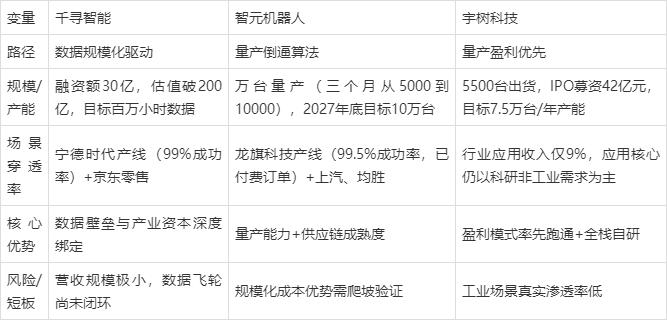
Comparatively, each of the three paths has its strengths, weaknesses, and limitations. 2026 is the year for entering the billion-yuan club, while 2027 will be the true watershed in the survival race—who can secure sustained bulk orders from industrial clients, whose unit R&D costs can be diluted through scale, and whose real-world physical data can form a closed loop will determine who stays in the final round.
Conclusion
The 'two-tier market' in embodied AI has clearly emerged, and the survival race is accelerating.
The first tier consists of top players with billion-yuan valuations—they have obtained the ammunition and endorsements to cross the survival thresholds through support from industrial capital and national teams. Qianxun, Zhiyuan, and Unitree each have their paths, strengths, and weaknesses.
The second tier is composed of mid-tier companies that are still grappling with the challenge of shrinking financing opportunities. These firms may soon find themselves propelled out of this intense 'clearance race'.
However, possessing an entry ticket does not guarantee safety. The true watershed lies in the elimination threshold within industrial scenarios of smart manufacturing. After achieving mass production of 10,000 units, the key factors determining who will ultimately prevail in 2027 include whether production capacity can be effectively translated into real productivity, whether unit R&D costs can be sufficiently diluted through economies of scale, and whether real-world physical data can form a closed feedback loop.
Ultimately, time will reveal which path will be the first to surpass these thresholds and who will emerge as the leader in embodied AI, marking their 'iPhone moment'. One thing, though, is crystal clear: 2026 will not witness a flourishing of diverse approaches; instead, it will see a convergence towards a singular path. The clearance race has commenced, and there's no turning back now.
Whoever can secure a steady stream of bulk orders from industrial clients before 2027 will be the first to conquer this challenging peak.
-
![]()
Tesla Restructures Its Balance Sheet
-
![]()
Accelerating the High-Speed Interconnection Upgrade of AI Computing Clusters! JONHON Releases ELSFP External Light Source Optical Connectors
-
![]()
Breaking the overseas blockade of volumetric holographic materials, this optical enterprise secures nearly 100 million yuan in financing!
-
![]()
Why Does Jensen Huang So Openly Praise China’s AI?
-
![]()
"Wudang" Unveiled: Arm China's Next-Gen AI VPU Redefines Video Encoding
-
![]()
From Energy Conservation and Carbon Reduction to AI Decision-Making: GECON East Intelligence and Chery Group Explore a New Green and Smart Paradigm for Automobile Manufacturing
-
![]()
WAIC 2026 Observation | AI Accelerates Towards the Core of Industries, Industrial AI Enters a Critical Phase
-
![]()
Volkswagen China Fires the First Shot in Foreign-Funded 'White Box Delivery'!