What new AI applications emerged in April?
 05/07 2026
 496
496
In 2026, global AI will bid farewell to the era of 'parameter comparison and ranking competition' and enter the deep-water zone of technological implementation, ecological closed loops, and commercial scalability. In the first four months, overseas tech giants have been sprinting in computational power arms race, intelligent agents, and multimodal capabilities, while China's domestic AI has seen a qualitative leap in April, leading across the board from models to applications and from consumer (C) to business (B) ends, delivering a highly distinctive 'spring report card.'
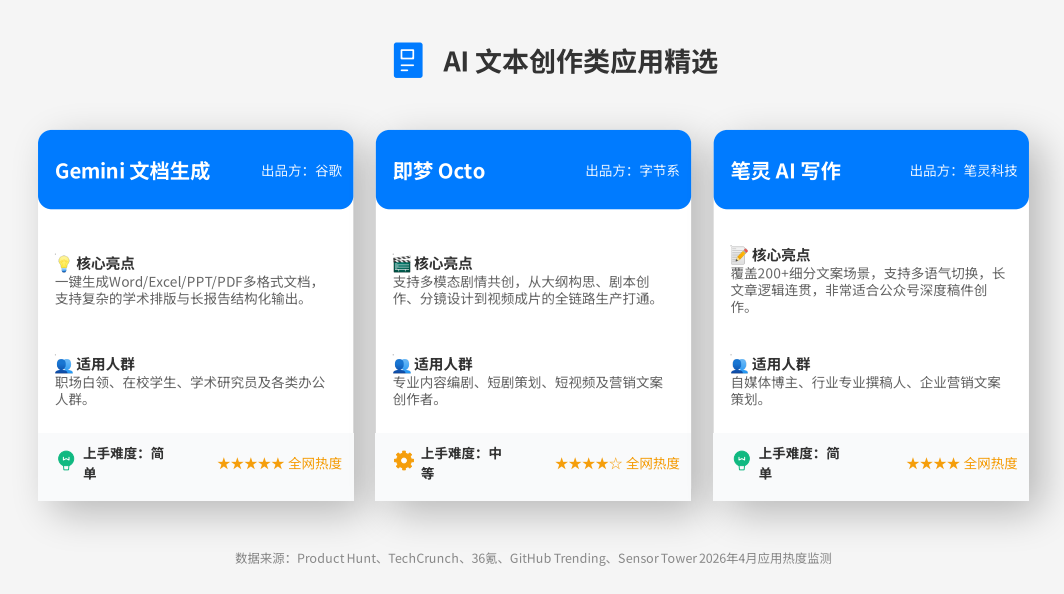
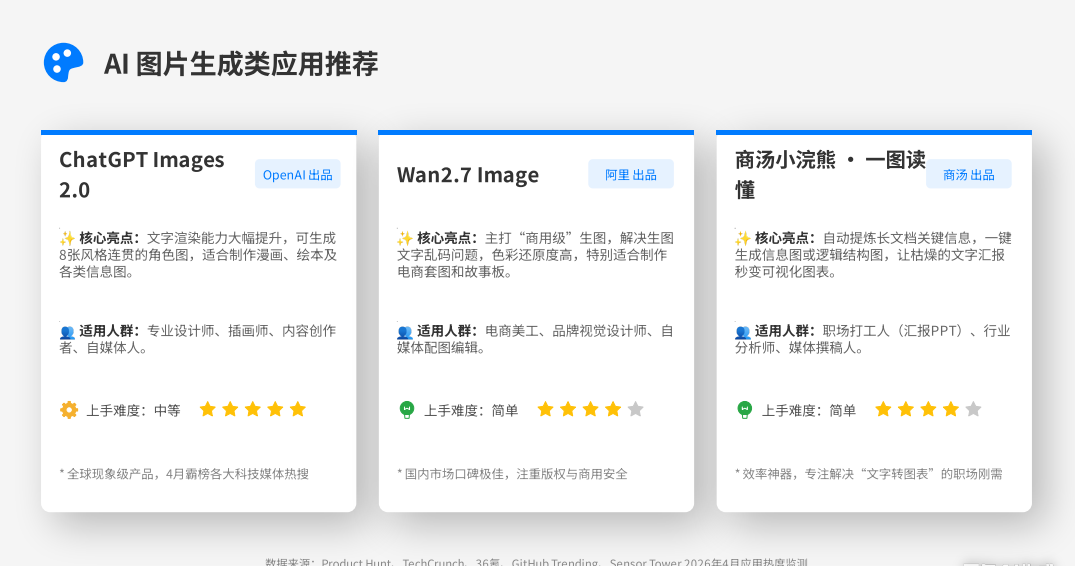
This April has undoubtedly been a breakthrough month for domestic large-scale AI models. DeepSeek-V4 went open-source, featuring a trillion-parameter MoE architecture, million-level context support, significantly reduced inference costs, and full compatibility with domestic computational power. Tongyi Qianwen 3.6 series iterated three times in three weeks, topping domestic comprehensive performance rankings. Kimi K2.6 introduced 'Swarm Mode,' enabling coordination among hundreds of agents and breaking new ground in long-text and real-time search capabilities. The application side surged, with C-end adoption becoming universal and B-end industrialization accelerating.
Meanwhile, overseas AI competition has surged toward computational power arms race. OpenAI, Google, and xAI have initiated a hundred-billion-dollar capital expenditure race, shifting computational power from 'sufficient' to a 'strategic barrier,' with space-based computational power and heterogeneous clusters emerging as new frontiers. While the U.S. pursues closed-source, high-price routes overseas, China rapidly captures global usage with open-source models and high cost-effectiveness. On platforms like OpenRouter, domestic models dominate in usage volume.


I. Overall Landscape: Dual Leaders, Stable Verticals, Domestic Players on Global Fringe
In Q1 2026, the global generative AI application market remained highly stable, characterized by 'one superpower, one strong contender, three strong verticals, and high concentration.'
ChatGPT maintained its lead but with slowing growth, entering maturity.
Meta AI surged with high growth Relying on social ecology , becoming the only super-app threatening ChatGPT.
Perplexity, Claude, and MidJourney firmly led in AI search, enterprise AI, and text-to-image, respectively.
The global TOP5 was nearly monopolized by U.S. companies, with Chinese AI apps not yet in the top tier.
II. Core Data Overview (Jan-Apr, North America MAU)
Headline Players: ChatGPT Holds Firm, Meta AI Closing In
January: ChatGPT (108M) > Meta AI (79M) > Perplexity > Claude > MidJourney
February: ChatGPT (112M) > Meta AI (87M) > Perplexity > Claude > MidJourney
March: ChatGPT (115M) > Meta AI (94M) > Perplexity > Claude > MidJourney
April: ChatGPT (109M) > Meta AI (78.5M) > Perplexity > Gemini > Claude
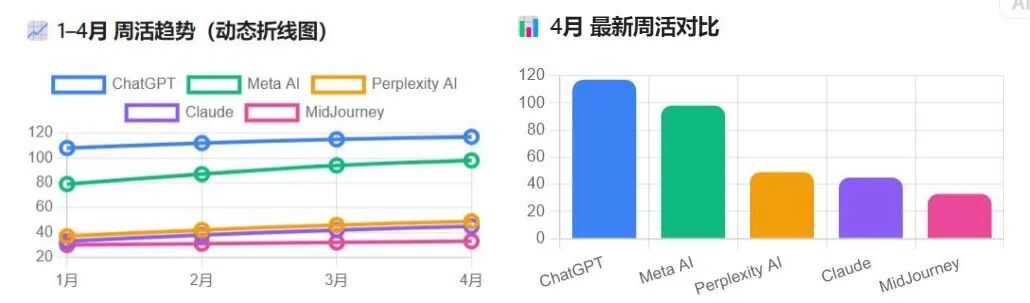
Growth Comparison
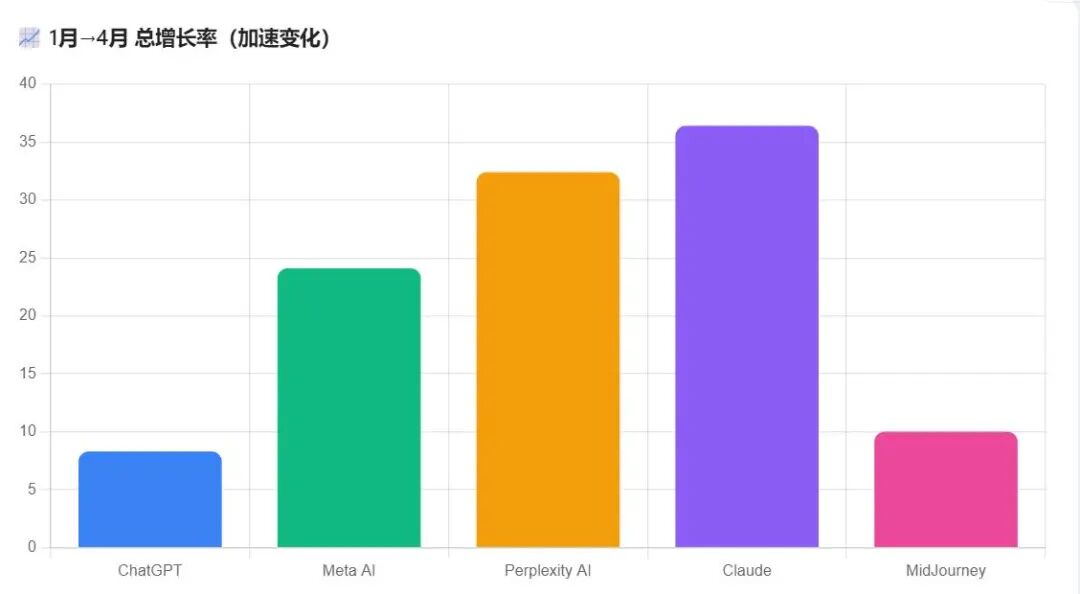
Meta AI: Q1 MoM +8%~10%, strongest growth among top players.
Perplexity: AI search boom, Q1 MoM +24%.
Claude: New growth with v3.5 update, Q1 MoM +27%, April MoM +12.4%, fastest growth, high premium user share.
ChatGPT: Growth slowed to <3%, entering retention phase.
MidJourney: Stable with minor fluctuations.
III. Deep Dive into Core Players
ChatGPT (OpenAI): Absolute Leader, But Growth Capped
Position: Global user mindshare leader, C-end benchmark.
Jan-Apr Strategy: Shifted from user acquisition to paid conversion, enterprise edition, API ecosystem.
Concerns: User growth peaked, reliant on Rate improvement, mounting competitive pressure.
Meta AI: Social Empire's Dimensional Strike
Core Strength: Embedded in Facebook/Instagram/WhatsApp, natural traffic pool + zero barrier to entry.
Performance: Q1 net gain of 15M weekly actives, growth far exceeding ChatGPT.
Trend: Likely to become the world's top weekly active AI app in Q2 2026.
Perplexity AI: New King of AI Search
Positioning: Focuses on 'real-time, cited sources, search-based AI dialogue.'
Highlights: Rapid user growth, high penetration among professionals and students.
Landscape: Strongest general-purpose AI product in user awareness after ChatGPT.
Claude (Anthropic): Strong in Enterprise and Long Text
Strengths: Ultra-long context, security, enterprise services.
Driver: Claude 3.5 release boosted both user and client base.
Positioning: More B-end and professional-focused, limited C-end mass penetration.
MidJourney: Image Generation Monopoly
Position: World's largest AI text-to-image platform by user base.
Performance: Steady growth, extremely high user stickiness, mature commercialization.
Landscape: No rivals yet threaten its top position.
IV. Three Global AI App Trends
Trend 1: C-End Shifts from 'Growth War' to 'Retention and Monetization War'
Mass AI user penetration nears ceiling; industry now competes on Rate , ARPU, enterprise subscriptions, and ecological barriers.
Trend 2: 'Gateway-Level AI' Landscape Forms
Standalone Apps: ChatGPT, Perplexity.
Super-App Embedded: Meta AI. Future AI will be system-level, social-level functionality, not just standalone tools.
Trend 3: Chinese AI Not Yet Truly 'Globalized'
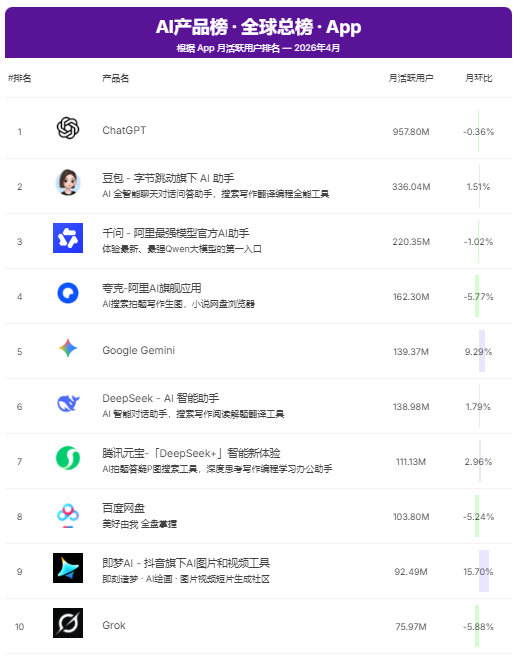
Doubao, Tencent Yuanbao, Wenxin Yiyan scale only domestically.
Lack overseas awareness, user base, and localized operations; not yet in global TOP20.
Chinese AI going overseas is still in early stages, with vast future potential.
(Global AI Product Rankings updated in real-time, as of May 6)

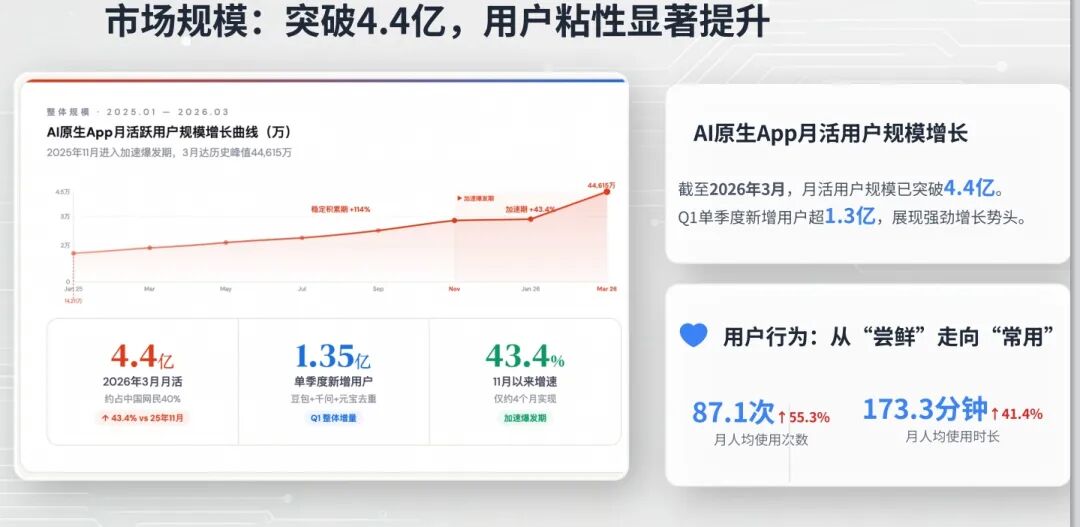
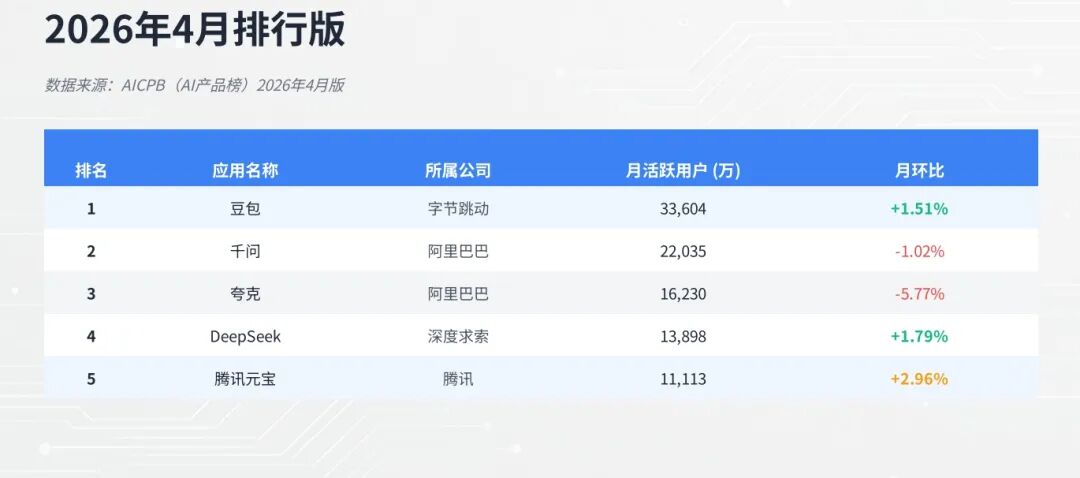
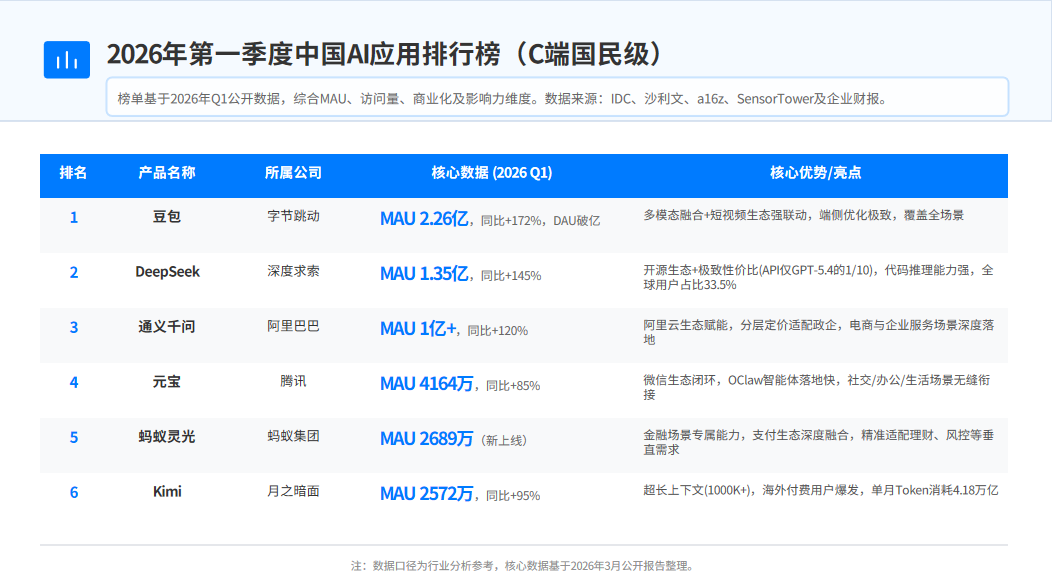
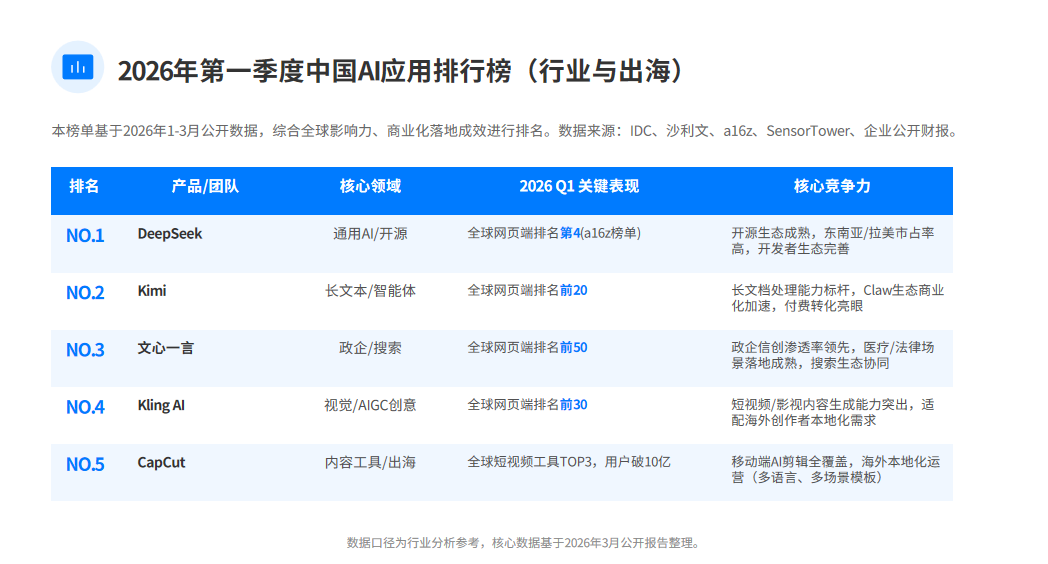
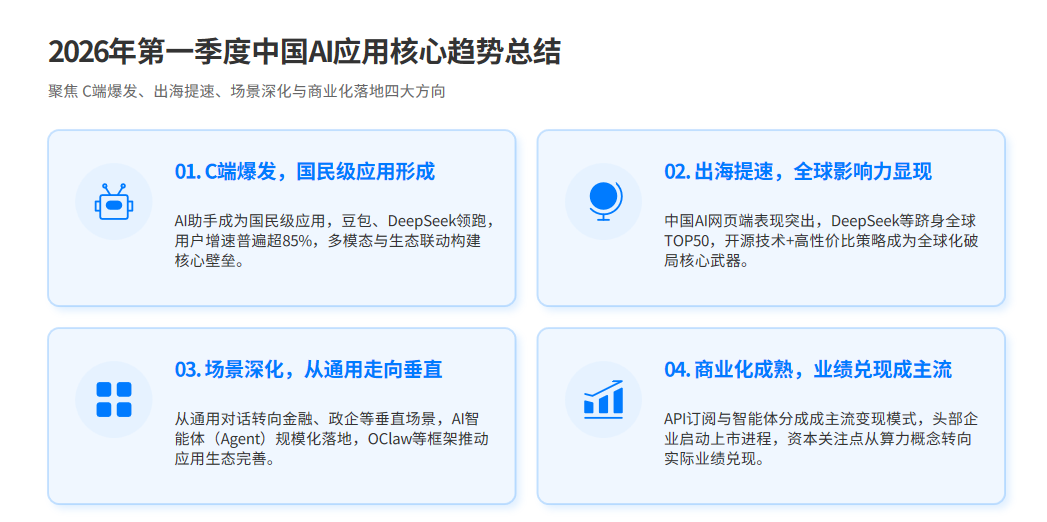

China's AI apps hold core potential in six domestic-advantage sectors and four overseas golden fields, supported by strong policy and market backing as well as technological and cost barriers, following a growth path of 'deep domestic cultivation, vertical breakthroughs, global cost-effectiveness.' Chinese AI does not compete head-on with the U.S. in general-purpose dialogue but builds irreplaceable global advantages in verticals like industry, healthcare, education, content, and enterprise services through 'scenarios + cost-effectiveness + engineering.'
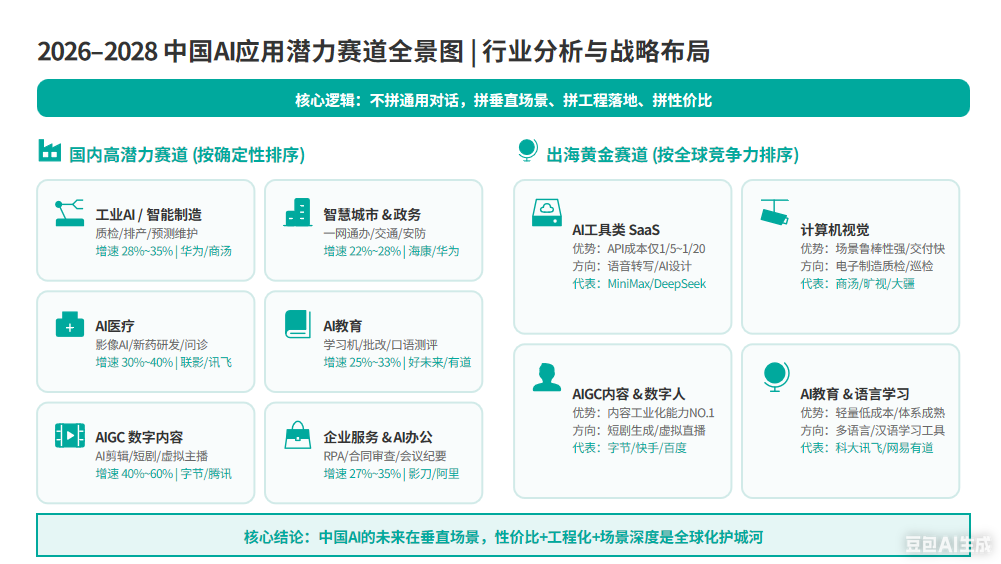
I. Domestic Market: Six High-Certainty Potential Fields (Policy + Market Dual Drive)
Smart Manufacturing/Industrial AI (Top Certainty Sector)
Core Strengths: China is the world's largest manufacturing nation, with the most complex industrial scenes, richest data, and most urgent needs.
Potential Areas:
AI Quality Inspection (Computer Vision): Defect detection rate 99%+, efficiency boost 300%+
Predictive Maintenance, Intelligent Scheduling, Digital Twins, Industrial Robots
Policy: '15th Five-Year Plan' explicitly supports AI + Manufacturing, with annual penetration growth >10%.
Representatives: SenseTime, Megvii, Huawei Cloud, Foxconn Industrial Internet
AI Healthcare (Driven by Rigid Demand, Policy, and Aging Population)
Core Strengths: Uneven medical resources, aging population, and healthcare cost control make AI's inclusive value extremely strong.
Potential Areas:
Medical Imaging AI (Lung Nodules, Fundus, Pathology): Market share >40%
AI-Driven Drug Discovery (AI4S), Intelligent Consultation, Prescription Review, Rehabilitation Robots
Representatives: United Imaging, iFlytek, Infervision
AI Education (K12 + Vocational, Rapid Penetration)
Core Strengths: Uneven educational resources, high family emphasis, policy support for 'personalized teaching.'
Potential Areas:
Personalized Learning, AI Homework Grading, Oral Assessment, Intelligent Teaching Aids, Vocational Training
Covers >80% of primary/secondary schools in China, #1 in AI learning machine market.
Representatives: iFlytek, TAL Education, NetEase Youdao
Smart Cities/Government AI (National-Level Projects, Largest Scale)
Core Strengths: Urbanization, digital government, and safe city initiatives advance comprehensively.
Potential Areas:
Traffic Management (92%+ accuracy in congestion prediction), Public Security, Smart Energy, Environmental Monitoring
Government Services (One-Net-Through, AI Approval, Public Opinion Analysis)
Representatives: Huawei, SenseTime, China TransInfo, Hikvision
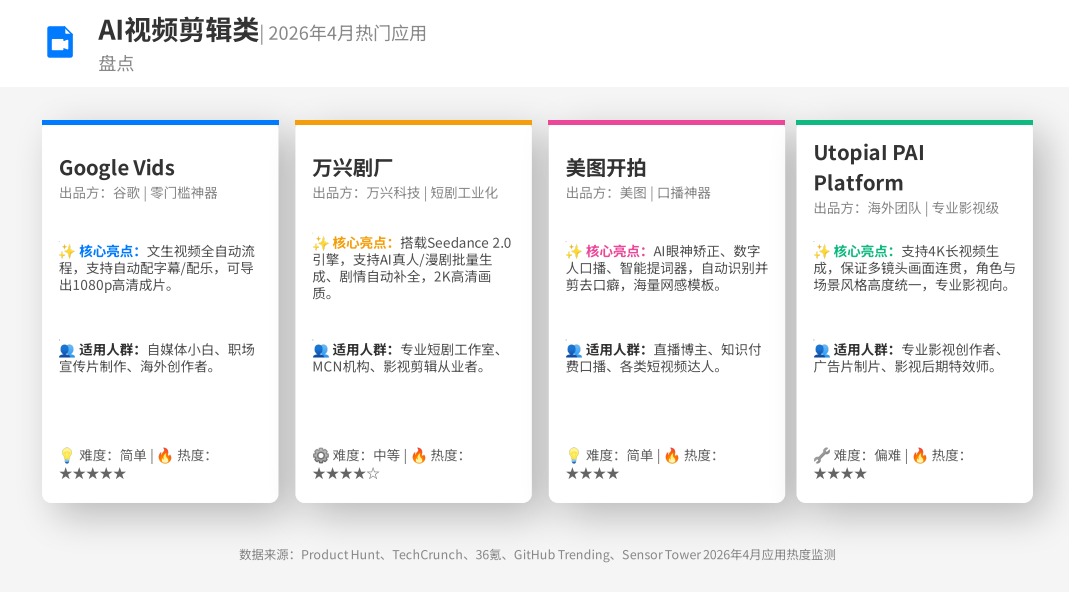
AIGC + Digital Content (Fastest Commercialization, Largest User Base)
Core Strengths: World's largest content consumption market (short videos, livestreaming, online literature, short dramas).
Potential Highlights:
Short videos/live streaming AI (editing, subtitles, virtual anchors): Penetration rate over 70%
AI painting/writing/music, virtual humans, interactive short dramas, AI-generated games
Representatives: ByteDance (CapCut), Baidu Wenxin, Tencent Hunyuan
Enterprise Services/AI-Powered Office (Standard for all employees, efficiency revolution)
Core Strengths: Essential for digital transformation, large base of SMEs.
Potential Highlights:
AI customer service, RPA automation, meeting minutes, contract review, data insights
Embedded in Feishu, DingTalk, WeCom, WPS, with rapidly increasing penetration
Representatives: Yingdao RPA, Baidu Intelligent Cloud, Alibaba Tongyi
2. Global Expansion: 4 Most Competitive Areas (Cost-Effectiveness + Scenarios + Engineering)
Chinese AI struggles against the US in general-purpose conversations (ChatGPT/Meta AI) but leads globally in four areas: vertical scenarios, cost-effectiveness, hardware+software integration, and cultural adaptability.
AI Tool SaaS (Global 'Price Dominator,' Unmatched Cost-Effectiveness)
Core Strengths: API prices are just 1/5 to 1/20 of US counterparts, with comparable performance.
Potential Segments:
Speech-to-Text (Notta, iFlytek Voice): Error rates 1.8% lower than Google's
Customer service RPA, marketing automation, data labeling, AI development platforms
Business Model: Freemium + paid subscriptions, with over 90% renewal rates
Representatives: MiniMax, DeepSeek, Yingdao RPA
Computer Vision/Industrial Vision (Global Leader in Technology + Engineering)
Core Strengths: 99.7%+ robustness in complex scenarios, low costs, and rapid deployment.
Expansion Hotspots:
Quality inspection in electronics manufacturing in Southeast Asia/Middle East, automotive part inspection
Drone inspections in Europe/Latin America (forest fire prevention, power line inspections)
Representatives: SenseTime, Megvii, DJI
AI Education + Language Learning (Cultural + Scenario Advantages)
Core Strengths: Chinese language education, multilingual support, lightweight, and low-cost.
Potential Markets:
Southeast Asia (Chinese language craze), Middle East, Africa: AI language learning, K12 tutoring
Business Model: Integrated hardware (learning devices) + software + content
Representatives: iFlytek, TAL Education
Digital Entertainment/AIGC Content (New Cultural Export Vehicle)
Core Strengths: Strong industrial capabilities in short videos/dramas/games, mature multimodal generation.
Potential Segments:
AI video creation (CapCut ranks top 3 globally), virtual idols, AI narrative games
AI-generated web novels/comics, interactive short dramas, AI live streaming
Representatives: ByteDance (CapCut), Tencent, Kuaishou
3. Core Competitiveness of China's AI Applications
Unmatched Cost-Effectiveness: Computing/power costs are just 1/4 to 1/5 of the US, API prices 1/6 to 1/20
Scenario Engineering: Strong implementation in complex scenarios (e-commerce, industry, live streaming) with rapid iteration
Data Flywheel: 515 million generative AI users, 1 billion internet users, enabling closed-loop iteration
Open-Source Ecosystem: 41% of Hugging Face downloads (surpassing US at 36.5%)
Full-Stack Industrial Chain: Complete closed loop from models—computing—hardware—applications—data
4. Key Predictions for the Next 3 Years
Domestic: Industrial AI, healthcare AI, and smart cities will exceed RMB 1 trillion first, becoming the core of new quality productivity (Xinhuanet)
Global Expansion: Vertical SaaS, computer vision, education, and content will capture over 20% global market share
Landscape: US leads in general-purpose large models (ChatGPT/Meta); China leads in vertical applications, cost-effectiveness, and engineering
Breakthrough: Transition from 'tools' to AI Agents capable of task execution, automation, and closed-loop operations (Xinhuanet)
-
![]()
Tesla Restructures Its Balance Sheet
-
![]()
Accelerating the High-Speed Interconnection Upgrade of AI Computing Clusters! JONHON Releases ELSFP External Light Source Optical Connectors
-
![]()
Breaking the overseas blockade of volumetric holographic materials, this optical enterprise secures nearly 100 million yuan in financing!
-
![]()
Why Does Jensen Huang So Openly Praise China’s AI?
-
![]()
"Wudang" Unveiled: Arm China's Next-Gen AI VPU Redefines Video Encoding
-
![]()
From Energy Conservation and Carbon Reduction to AI Decision-Making: GECON East Intelligence and Chery Group Explore a New Green and Smart Paradigm for Automobile Manufacturing
-
![]()
WAIC 2026 Observation | AI Accelerates Towards the Core of Industries, Industrial AI Enters a Critical Phase
-
![]()
Volkswagen China Fires the First Shot in Foreign-Funded 'White Box Delivery'!