Why Manus Became the First AI Foreign Investment Acquisition to Be Suspended
 05/07 2026
 586
586

Author|Zhang Qian
Editor|Hu Zhanjia
Operations|Chen Jiahui
Produced by|LingTai LT (ID: LingTai_LT)
Header Image|Publicly available online
On the afternoon of April 27, 2026, a notice appeared on the website of the NDRC's Foreign Investment Security Review Mechanism Office, stating that Meta's acquisition of Butterfly Effect, the parent company of Manus, had been prohibited and the transaction was ordered to be "undone."
To this day, the homepage of Manus's official website still displays the line of text, "Manus is now part of Meta." What was once a badge of honor now seems like a poor joke.
Just eight months prior, the company basked in the glory of being "the world's first general-purpose AI agent." Four months ago, Mark Zuckerberg personally offered over $2 billion. Now, this deal—touted as Meta's third-largest acquisition in history—has been reduced to legally meaningless paper.
Founder Xiao Hong is barely in his thirties. Insiders refer to him as "Xiao Hong." From enjoying Northeastern Chinese cuisine in a rent-free office in Wuhan's Optics Valley to having Silicon Valley's hottest venture capitalists knocking at his door, and now to this acquisition being halted, these past four months have likely provided him with enough material to ponder for the rest of his life.

Xiao Hong graduated from Huazhong University of Science and Technology, and the company's headquarters is located in Optics Valley, just across the street from his alma mater.
In 2015, the year he graduated, he founded "Nightingale Technology," developing efficiency tools for the WeChat ecosystem, such as Yiban Assistant and Weiban Assistant, both of which were later sold. In 2022, he registered Butterfly Effect in Beijing, with its core product being Monica—an AI plugin for browsers targeting overseas users. At that time, domestic large language model (LLM) startups were booming, with Baidu's ERNIE Bot and Alibaba's Tongyi Qianwen taking center stage. Products like Monica, which merely "wrapped" existing models, were largely overlooked.
"Wrapping" is somewhat of a derogatory term. Manus never concealed its technical foundation—it didn't develop its own LLM but instead integrated and scheduled mainstream models like Gemini, ChatGPT, Claude, and Qwen. When questioned, Xiao Hong responded bluntly: "Wrappers have their uses."
Those words later proved to be prophetic.
On March 6, 2025, Manus officially launched on X, labeling itself as the "world's first general-purpose AI agent." Its demo video garnered 200,000 views in 20 hours, invitation codes were resold for $50,000 to $100,000 on secondary markets, and the waitlist surpassed 2.6 million by late March. Wuhan offered rent-free office space, special funds, financial subsidies, and even certified it as a "leading enterprise." One state-backed investor later recalled, "It was surprising to see an AI application company in Wuhan—we rarely looked at such firms."

The money followed suit.
In 2023, ZhenFund led a seed round, valuing the company at approximately $14 million. In November 2024, Sequoia China and Tencent joined the Series A round, pushing the valuation to $85 million. Wang Huiwen also appeared on the shareholder list. Xiao Hong began frequently appearing in the media, mentioning details like reading The Remains of the Day by the West Lake—emulating Jeff Bezos—and recalling how he earned enough money in college to "treat classmates to Northeastern cuisine every day."
He became known for a bold statement: "Today's Chinese entrepreneurs should pursue globalization more aggressively." Another, even more ambitious, declaration: "For Manus to survive long-term, there's only one possibility—becoming a world-class company."
At that time, Xiao Hong probably felt everything was going according to plan.

The turnaround came faster than anyone expected.
Financing records from Tianyancha show that in April 2025, Silicon Valley's top venture firm Benchmark led a $75 million Series B round, pushing Manus's valuation to nearly $500 million. Who is Benchmark? The firm that invested in Uber, Twitter, and Snapchat. This investment carried far more weight than the numbers suggested.
However, Benchmark's investment came with a condition that almost all media overlooked: it placed Manus under a new U.S. government review mechanism—Reverse CFIUS, or the "Reverse Committee on Foreign Investment in the United States," formally known as the U.S. Outbound Investment Security Program. Enacted in January 2025, it targeted national security risks posed by U.S. capital investing in China's sensitive technology sectors. In other words, the U.S. was building a wall to prevent its money from flowing into Chinese technologies it deemed dangerous.
The review process closed like a gate. Multiple U.S. venture firms exited subsequent funding negotiations over fears of regulatory scrutiny. Worse, Manus's product logic relied heavily on closed-source state-of-the-art (SOTA) models—Gemini, ChatGPT, and Claude—all core assets of U.S. companies. Rejecting U.S. capital meant product suicide; accepting it meant entering another regulatory crosshairs. There was no right answer, only fewer wrong ones. A former Manus employee later posted on X, still feeling the suffocation: "That inquiry nearly pushed Manus to the brink."
Last May, the three co-founders flew to Singapore. In June, they announced the relocation of their headquarters to Singapore, changing the operating entity to Butterfly Effect Pte. Ltd., while opening offices in San Francisco and Tokyo. The domestic team of 120 was reduced to about 40 relocating to Singapore, with 80 laid off. Chinese social media accounts were wiped clean as if they never existed, the official website blocked Chinese IP addresses, and entering a domestic address yielded only a blank screen.
The strategic partnership with Alibaba's Qwen naturally fell through. That collaboration had been seen as a crucial endorsement of Manus's "localization" efforts—after all, it relied heavily on external models, and binding with domestic LLM firms seemed a smart move. But now, that card held no value.
In venture circles, this became known by an unflattering term: "Singapore washing." Essentially, it meant repackaging core products, teams, and engineering capabilities developed in China with an overseas registration wrapper, then selling to U.S. giants to cash out.
The former employee's critique was sharper: "Manus set a terrible example, with a wave of companies rushing to register in Singapore."

In mid-December 2025, Meta came knocking.
Zuckerberg personally led negotiations, which were finalized in just over ten days. The deal exceeded $2 billion, making it Meta's third-largest acquisition after its $19 billion purchase of WhatsApp and its investment in Scale AI.
Zuckerberg and several Meta executives were reportedly longtime users of Manus. Xiao Hong was set to become a Meta vice president. Structurally, the deal featured a Silicon Valley-popular variant of "acqui-hire"—no business acquisition, no intellectual property buyout, and no dissolution of the acquired company's legal entity. Media later dubbed this approach the "Three Nos." Meta spokesperson Andy Stone explicitly stated: After the deal, Manus would have "no Chinese ownership interests."
On paper, it seemed flawless. But as one lawyer later analyzed, "substance overrides form"—it didn't matter what label you wore; what mattered was your true nature.
On December 30, 2025, Meta announced the acquisition. Eight days later, on January 8, 2026, China's Ministry of Commerce stated it would launch an evaluation. In March, the NDRC summoned executives from both sides. On April 27, the Foreign Investment Security Review Mechanism Office officially issued the ban.
This marked the first publicly halted foreign acquisition in China's AI sector since the 2021 implementation of the Measures for the Security Review of Foreign Investments.
So, why Manus?

To grasp the significance of this halt, one must look back at history.
In 2005, U.S. private equity giant Carlyle Group attempted to acquire Xugong Group, sparking a years-long tug-of-war. That battle directly led to the creation of China's foreign investment security review system, with six ministries, including the Ministry of Commerce, jointly issuing Order No. 10 in 2006—installing the first gate for foreign mergers and acquisitions. In the following two decades, publicly halted deals remained rare—the system existed, but the "nuclear button" was rarely pressed.
Another frequent comparison is Wingtech's acquisition of Nexperia, where technology and control rights were hotly contested in the semiconductor sector. Meanwhile, in the U.S., CFIUS's demand for ByteDance to divest TikTok remains mired in legal proceedings, resembling an endless war of attrition.
But the Manus case differs—and critically so.
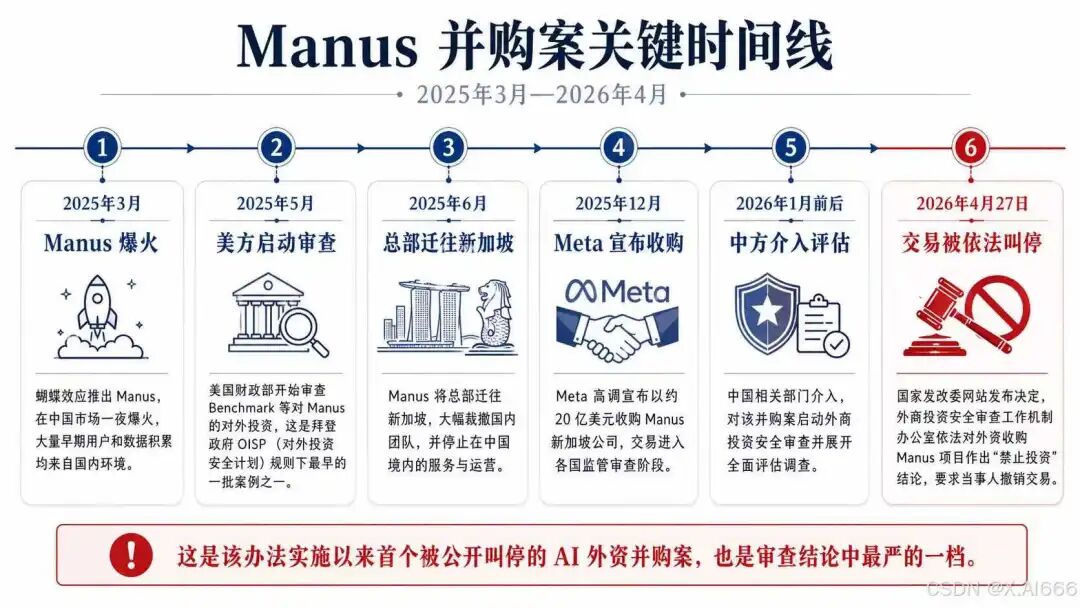
The Carlyle-Xugong case occurred during the infancy of the review system, when rules were still testing boundaries. The TikTok case unfolded on U.S. soil, with China largely in a defensive posture. Manus marked China's first use of its own regulatory framework to halt a completed cross-border AI acquisition. The deal closed in December 2025, but the ban came four months later—regulators weren't rushed; they waited for a complete evidence chain and a moment to deter future imitators.
Lawyer Wu Zhenhua put it bluntly: "Changing the shell doesn't evade regulation." Relocating registration doesn't grant regulatory immunity; the technology's origin and true ownership don't automatically shift with a Singaporean company registration. Lawyer You Yunting highlighted another deadlock from a technical perspective—knowledge, once shared, cannot be erased. After the deal's revocation, money can be returned, and employees can be let go, but Meta's engineers had already seen Manus's algorithms and technical architecture. How do you "return" that? Future verification revealing continued use of these details would constitute theft.
The logic is cold and clear: Foreign investment security reviews protect not just individual technologies or data but control over critical sectors and national capability security. When a company that accumulated its core strengths in China attempts to "de-Sinicize" through registration changes, social media purges, and IP blocks, regulators can pierce these legal shells to reach the technology's true ownership.

Manus's story is a microcosm of the past two years in AI agent entrepreneurship.
Tech commentator Li Xiangyang offered a harsh judgment: "Meta never came to empower Manus—it came to digest it." He listed a roster: Inflection's core team was gutted by Microsoft, Character.AI's technical talent was poached by Google, and Adept became a shell after selling to Amazon. The past two years of AI agent acquisitions by giants read like an obituary for independent companies.
Manus was poised to be the priciest name on that list. At $2 billion, it surpassed the lifetime valuation ceilings of most AI startups. And its commercialization data was impressive—within eight months of launch, it achieved annualized revenue exceeding $125 million, processed over 147 trillion tokens, and created over 80 million virtual computers, making it one of the fastest startups to reach $100 million in annualized revenue from scratch.
These numbers would make any investor's eyes light up in a pitch deck. But in today's context, they feel like a cruel irony: You did well enough for Zuckerberg to show up at your door—but precisely because you were taken seriously, the deal turned to ash.
Xiao Hong and his team, reduced from 120 to 40, now occupy an awkward position. Retreating to China is impossible—they've burned their bridges by clearing Chinese social media, blocking IPs, and laying off 80% of domestic staff. Advancing toward Meta is blocked by an unyielding ban, with no room for negotiation.
There's no going back.
What's more absurd is that Manus's once-mocked "wrapper" label now appears to be its most valuable asset. It didn't own an LLM but possessed an agent layer closer to users and commercialization than LLMs themselves. While Kimi and DeepSeek focused on coding, Doubao launched an agent specializing in mobile operations, and OpenAI and Google pushed LLM capabilities toward agentic systems—giants hunted, domestic firms competed, and the AI agent battlefield ran red with blood. Manus's emergence in this landscape proved its unique value.
At the heart of this value lies precisely the control layer that many overlook. The base model is the 'brain,' and the Agent is the 'limbs.'
No matter how intelligent the brain is, without limbs, it can only solve math problems on a server. Meta already has Llama, so why spend $2 billion to acquire a 'rebranded' product? Because what Zuckerberg needs is not another model but an operating system capable of transforming models into productivity, user engagement, and a viable business model. This logic is fundamentally the same as when Microsoft acquired GitHub or Google bought DeepMind—what was purchased was not just code but a strategic position.

Looking back in the spring of 2026, Manus has at least redefined three invisible boundaries.
The most pivotal question revolves around identifying the most critical asset in the AI landscape. While many might instinctively point to model parameters, training datasets, and computing clusters, the Manus incident reveals a different reality: the true linchpin lies in the control layer—the Agent layer—that orchestrates human resources, data flows, tools, and business processes. This layer doesn't rely on proprietary large models but instead positions itself as the central hub of control, surpassing any individual large model in strategic importance. What Meta is acquiring, ostensibly, is Xiao Hong and his team, but in essence, it's gaining the comprehensive capability to manage 147 trillion tokens and oversee 80 million virtual computing instances.
Another boundary that has been redefined pertains to the 'capital shortcut' that countless entrepreneurs have pursued. The traditional route—conducting product validation and technical development in China, rebranding under an overseas entity, and ultimately selling to a U.S. tech giant—was once considered a viable strategy. Until 2025, this approach was not widely perceived as carrying structural risks. However, the Manus case has fundamentally altered the valuation of this path.
A further boundary concerns the patience and reach of regulatory oversight. There was once an implicit understanding within the industry: by acting swiftly, relocating operations sufficiently far afield, and maintaining a clean social media footprint, deals could be concluded before regulators intervened. The Manus case disproves this assumption. A four-month window may seem brief for a $2 billion transaction, but it provides ample time for national security reviews. Moreover, even after a deal is finalized, there remains the possibility of being required to unwind it.
Beneath these developments lies a more profound transformation. In the era of the Carlyle-Xugong deal, regulatory scrutiny primarily focused on tangible industrial assets—machine tools, factories, and market share. In contrast, the AI era has ushered in a shift towards intangible assets. Model parameters can be hosted in the cloud, algorithmic innovations can reside in engineers' minds, and user data can be instantaneously synchronized across global servers. The traditional approach of 'banning asset sales' appears inadequate in the face of such technological fluidity. The strategy employed in the Manus case—penetrating legal shells, tracing technological ownership, and reversing completed transactions—is testing the boundaries of a new regulatory paradigm.
Dr. Xu Shan from the China Academy of Information and Communications Technology has authored an analytical report on the matter. Academically speaking, such cases involve relocating headquarters and actual control outward in terms of capital and governance while concentrating valuable technological activities in Singapore for R&D purposes. In simpler terms, Manus was not the first team to consider this strategy, but it was the first to be publicly halted. The cost of this 'first' is the $2 billion deal that now exists only on paper.
The Northeastern Chinese restaurant in Wuhan continues to operate, but the rent-free office in Optics Valley has likely been taken over by a new occupant. Xiao Hong, in his early thirties, has experienced both the thrill of success and the agony of defeat. His story lacks a neat resolution—and perhaps it always will.
The statement on Manus's official website remains unchanged: 'Manus is now part of Meta.'
This assertion is not entirely inaccurate. Manus nearly became part of Meta—and it's precisely this narrow margin that compels all AI entrepreneurs in China contemplating overseas exits to reevaluate their strategies. The path remains open, but the cost of traversing it has fundamentally shifted.
-
![]()
Tesla Restructures Its Balance Sheet
-
![]()
Accelerating the High-Speed Interconnection Upgrade of AI Computing Clusters! JONHON Releases ELSFP External Light Source Optical Connectors
-
![]()
Breaking the overseas blockade of volumetric holographic materials, this optical enterprise secures nearly 100 million yuan in financing!
-
![]()
Why Does Jensen Huang So Openly Praise China’s AI?
-
![]()
"Wudang" Unveiled: Arm China's Next-Gen AI VPU Redefines Video Encoding
-
![]()
From Energy Conservation and Carbon Reduction to AI Decision-Making: GECON East Intelligence and Chery Group Explore a New Green and Smart Paradigm for Automobile Manufacturing
-
![]()
WAIC 2026 Observation | AI Accelerates Towards the Core of Industries, Industrial AI Enters a Critical Phase
-
![]()
Volkswagen China Fires the First Shot in Foreign-Funded 'White Box Delivery'!