Cash Flow Hits a New High: What Increments Has iFLYTEK's Integrated Software-Hardware Strategy Brought?
 05/08 2026
 566
566
The domestic AI industry typically requires a certain amount of time for payment collection, especially for enterprises focused on G-end projects, which may face lengthy acceptance processes and fiscal disbursement cycles. This is reflected in financial reports as a persistent "time lag" between revenue growth and improved cash flow.
For a long time, iFLYTEK was also troubled by this issue, but recent financial reports have shown some notable changes: In 2025, iFLYTEK achieved annual revenue of 27.105 billion yuan, a year-on-year increase of 16.12%. Meanwhile, its total sales collections exceeded 27.4 billion yuan, and its net operating cash flow reached 3.208 billion yuan—both setting new historical highs.
The market is accustomed to attributing such changes to the "commercialization of large models taking effect," but a closer look reveals that the truth goes beyond that.
【Cash Flow Improves as B&C-End Businesses Quietly Take the Lead】
To understand why cash flow has improved, we must first examine changes in revenue composition.
In the past, iFLYTEK's revenue relied heavily on G-end projects, which involved complex acceptance processes and payment schedules largely beyond its control. Payment terms were calculated not by months but by years—or even longer. However, since 2025, growth in its B-end and C-end businesses has significantly outpaced that of the G-end.
Financial reports show that in 2025, the proportion of iFLYTEK's G-end revenue in total revenue dropped from 29% to 26%, while the C-end share rose from 29% to 32%, and the B-end remained stable at 42%. In the first quarter of 2026, B-end and C-end business revenue grew by 26.27% year-on-year, while G-end business experienced a temporary decline due to the delayed Spring Festival holiday and project initiation timing.
This does not mean the G-end has become insignificant—its annual business opportunity reserves still grew by 33% year-on-year, indicating a solid foundation. However, the revenue base is shifting from a few large projects to a large number of dispersed end-users. When more revenue comes from households, workplace users, and enterprise clients, the payment collection logic changes.
Consider this: When households purchase AI learning tablets on Tmall or JD.com, workplace users buy office notebooks or translation devices, and enterprises procure intelligent grading machines in bulk or subscribe to SaaS services annually, payments are nearly instantaneous. Compared to the multi-month payment cycles typical of G-end projects, AI hardware sold through online e-commerce and offline stores—along with channel sales payment arrangements—results in significantly shorter overall payment terms and much greater controllability.
As a result, iFLYTEK not only set new historical highs for total sales collections and operating cash flow indicators in 2025, with profit growth far outpacing revenue growth, but in the first quarter of this year, its collections reached 5.7 billion yuan, again exceeding same period (same-period) revenue with a 14.12% year-on-year increase.
So, what are the specific drivers behind the rapid growth of B-end and C-end businesses? The answer may lie in the "integrated software-hardware" approach.
Compared to relying solely on API calls or customized projects, AI hardware and integrated software-hardware products more easily establish clear user entry points, standardized delivery, and sales collections.
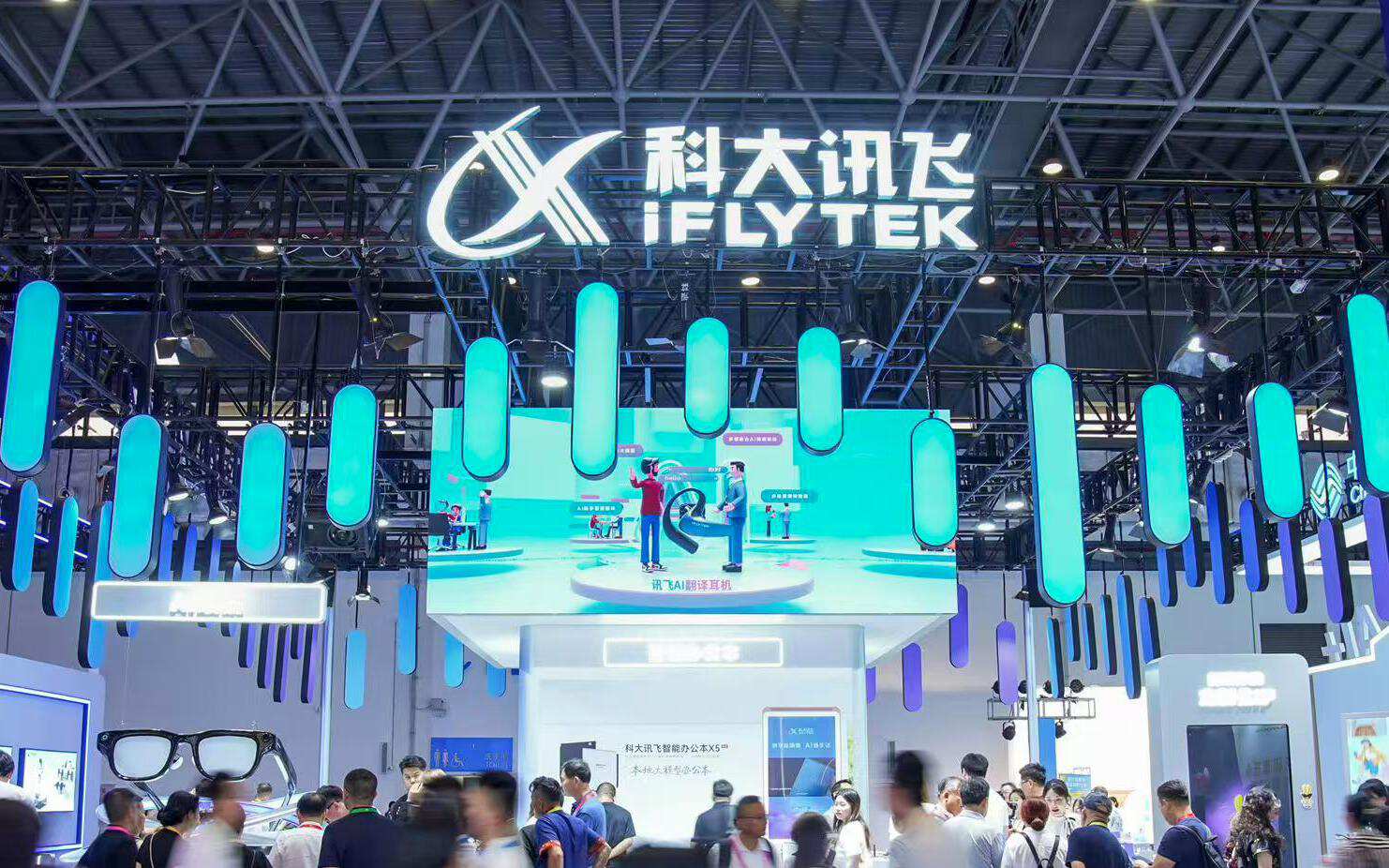
Currently, iFLYTEK's AI learning tablets, AI office notebooks, translation devices, voice recorders, Xinghuo intelligent grading machines, AI glasses, and other products essentially encapsulate large model capabilities into standardized hardware, selling directly to individual users or enterprise clients. Hardware serves as the entry point, while software and model capabilities enhance the user experience.
Take the iFLYTEK AI learning tablet as an example: Empowered by large models for Q&A tutoring, precision learning, and AI interaction, it continuously improves autonomous learning outcomes. It has won the full-cycle sales championship in the learning tablet category for three consecutive years during JD.com and Tmall's 618 and Double 11 e-commerce festivals, with its Net Promoter Score (NPS) consistently ranking first in the industry.

▲Source: iFLYTEK 2026 Spring New Product Launch
When the same revenue shifts from government projects to consumer hardware sales, payments become faster and more certain, strengthening the company's cash flow resilience.
This represents the first layer of increment brought by the integrated software-hardware strategy to iFLYTEK. It may not be explicitly highlighted in a single quarter's profit statement, but it is fundamentally transforming the company's operational foundation.
【Delivery Models Evolve: From "Project-Based" to "Product-Based"】
Traditionally, the dominant business model in China's AI industry has been project-based. A client proposes a requirement, and the company assembles a team for development, with cycles ranging from six months to a year—often accompanied by repeated demand changes and adjustments.
Even more resource-intensive is the fact that each project requires redoing similar foundational work: the same speech recognition, the same semantic understanding, the same data analysis—just with different clients or interfaces. The core technologies involved do not fundamentally differ. Especially after the emergence of large models, the shortcomings of this model became more pronounced.
Because models themselves require substantial training investment, yet customization for each client becomes necessary. This drags down per-project gross margins, consumes R&D personnel's energy in repetitive tasks, and leaves little time for genuine technological innovation. This dilemma faces nearly all vertical-industry AI enterprises.
In response, iFLYTEK's integrated software-hardware productization path transforms large model capabilities from "customized-on-demand" projects into "packaged-delivery" product lines.
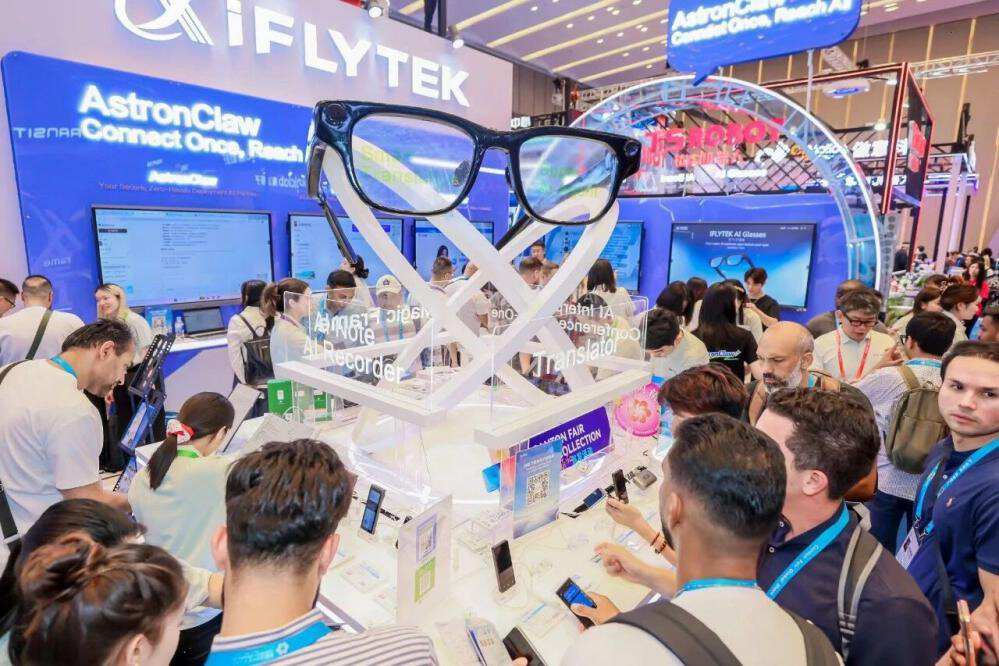
For instance, the iFLYTEK office notebook incorporates an octagonal microphone array and 360° sound source localization technology, turning complex far-field speech recognition in challenging scenarios into a product-level universal capability—ready for use without requiring separate deployment of collection equipment for each enterprise. The AI glasses, GlassClaw, weigh just 40 grams and consolidate translation, information assistance, and environmental perception capabilities into a single wearable device, enabling instant access to functions upon hardware use.
▲Source: iFLYTEK Group
The T90 series learning tablet absorbs a decade of teaching data and algorithmic accumulation, transforming universal capabilities like error cause analysis, knowledge point diagnosis, and personalized question recommendation into standard modules. These are not customized for specific schools or regional exam syllabi but cover textbook versions nationwide through software iterations.
This "upfront R&D" logic involves refining and optimizing core algorithms during the product definition stage, before large model capabilities are polished. The remaining work becomes standardized software-hardware integration.
This means users purchase not a customized solution requiring lengthy demand analysis and deployment but a complete product ready for use straight out of the box. Delivery cycles shorten, and payment collection rhythms naturally change.
More importantly, product iterability opens new commercial imagination spaces.
Traditionally, after project delivery, the client relationship largely ends, and the next collaboration requires re-bidding and re-entry. However, the logic of integrated software-hardware products is different: Hardware sales mark just the starting point. Systems continue updating, data keeps accumulating, and subsequent software services and model iterations represent the true commercial value.
Thus, the second increment from the integrated software-hardware strategy is not about how dazzling any single hardware product's sales are but a fundamental shift in delivery logic. It pushes large model capabilities from a linear model of "long cycles, heavy customization, and starting from scratch for each project" toward an exponential model of "standardization, scalable replication, and continuous value addition through software."
The operational efficiency gains from shifting from one-time delivery to reusable scenarios and from project-based to product-based approaches may matter more than the sales of any single blockbuster product.
【The Dual Sides of Strategy: Overseas Validation and Profit Growing Pains】
If iFLYTEK's integrated software-hardware strategy had only been validated in the domestic market, its persuasiveness would remain limited. What truly clarifies the universality of this model is its performance overseas.
Financial reports show that iFLYTEK's overseas revenue grew by 167% year-on-year in the first quarter of 2026. Moreover, this growth did not come from a single product or market but formed two clear, complementary paths: In ASEAN, growth is driven by developer ecosystems, API calls, and education businesses, reflecting the export of large model capabilities and solutions; in Japan, growth is led by consumer hardware like office notebooks, which topped historical crowdfunding platform rankings immediately after launch.
On one side are models, on the other, hardware—but behind both lies the same "integrated software-hardware" capability foundation. This demonstrates that iFLYTEK's accumulated productization capabilities withstand the test of different cultural and linguistic markets.
However, every coin has two sides.
The first-quarter report for 2026 shows the company reported a net loss attributable to shareholders of listed companies, excluding non-recurring items, of 430 million yuan. iFLYTEK explained in its financial report that R&D expenses and selling expenses increased by a combined 349 million yuan.
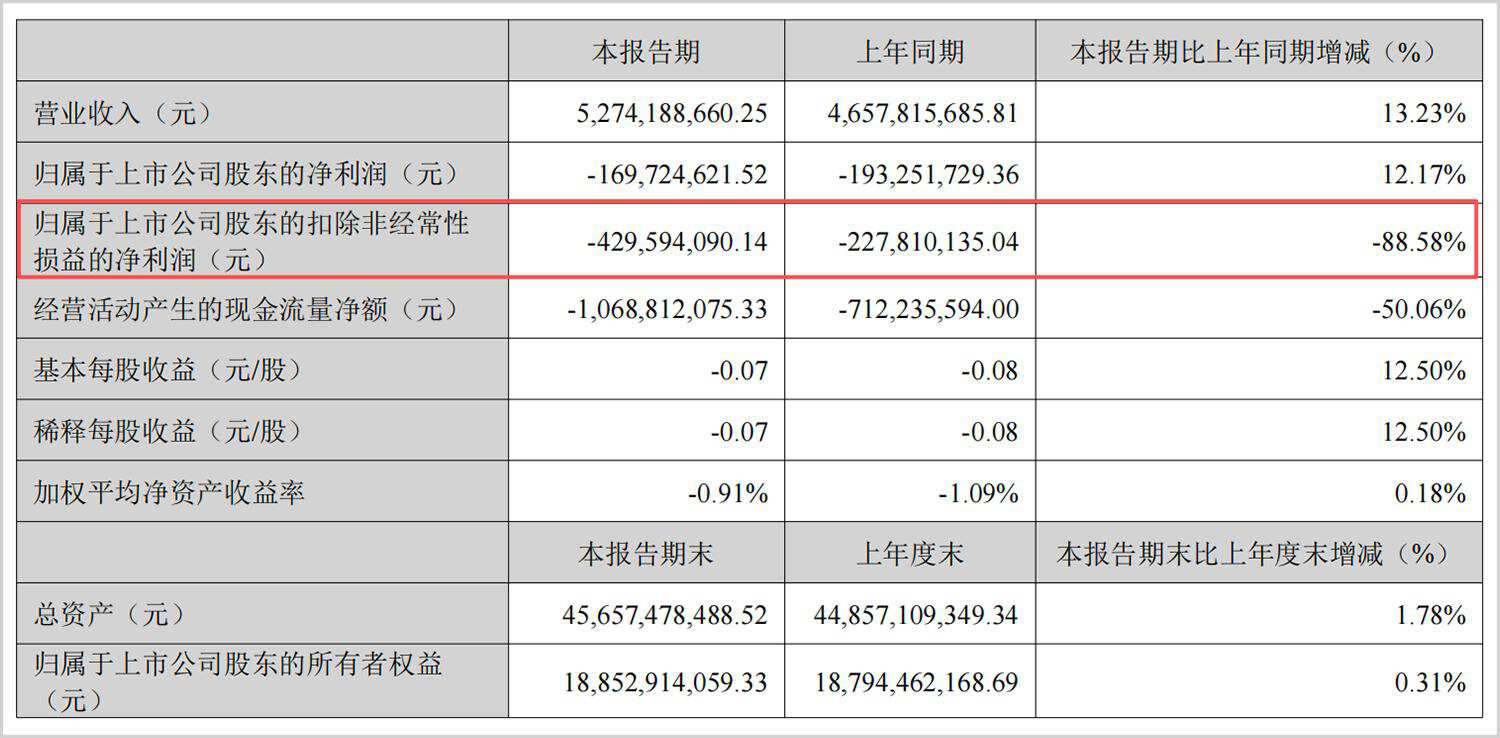
▲Source: iFLYTEK Q1 2026 Financial Report
Where exactly was this money spent?
On one hand, to safeguard domestic computing power. iFLYTEK is the only major Chinese large model company insisting on full-stack model training using entirely domestic computing power. The Ascend 910B chip lags behind NVIDIA's H200 in memory capacity and bandwidth, but training efficiency has improved from just 30% of A800 clusters initially to 84% or even 93%— behind (behind which) lies substantial algorithmic and engineering breakthroughs.
On the other hand, funds went toward model iteration itself. The Xinghuo X2 flash, released on April 29, is a 30B medium-sized model whose agent and coding capabilities already rival or surpass international mainstream models of the same size, while consuming less than one-third of the tokens required by large-parameter models.
iFLYTEK's investments in these areas did depress short-term profits, but they pave a broader path for next-generation products. According to plans, iFLYTEK will release China's first flagship large model rivaling the industry's most advanced mainstream models in October this year, based on the Ascend 950 platform. Only then will current investments truly convert into revenue momentum.
In summary, when large model capabilities are embedded into standardized hardware and high-frequency scenarios, commercialization no longer relies solely on heavy-delivery projects but can form a more stable operational closed loop through product sales, channel collections, software services, and scenario reuse. This distinguishes iFLYTEK from pure model vendors and represents its fundamental reason for long-term observation.
Moreover, the ultimate goal of iFLYTEK's integrated software-hardware productization path is to use hardware to secure scenarios, scenarios to lock in data, and data to feed back into models. This closed loop (closed loop) has a long cycle, but once operational, competitors will find it difficult to breach its barriers by simply deploying a stronger model—because the barrier lies not in the model itself but in the strong associative experience between the model, hardware, scenarios, and users.
For now, sustained cash flow improvement indicates that iFLYTEK's model has begun Benign operation ( benign operation) and provides a more solid foundation for further strategic implementation.
Disclaimer
The content related to listed companies in this article reflects the author's personal analysis and judgments based on publicly disclosed information (including but not limited to interim announcements, periodic reports, and official interaction platforms) as required by law. The information or opinions herein do not constitute any investment or other commercial advice, and Market Value Observer assumes no liability for any actions taken based on this article.
——END——
-
![]()
Tesla Restructures Its Balance Sheet
-
![]()
Accelerating the High-Speed Interconnection Upgrade of AI Computing Clusters! JONHON Releases ELSFP External Light Source Optical Connectors
-
![]()
Breaking the overseas blockade of volumetric holographic materials, this optical enterprise secures nearly 100 million yuan in financing!
-
![]()
Why Does Jensen Huang So Openly Praise China’s AI?
-
![]()
"Wudang" Unveiled: Arm China's Next-Gen AI VPU Redefines Video Encoding
-
![]()
From Energy Conservation and Carbon Reduction to AI Decision-Making: GECON East Intelligence and Chery Group Explore a New Green and Smart Paradigm for Automobile Manufacturing
-
![]()
WAIC 2026 Observation | AI Accelerates Towards the Core of Industries, Industrial AI Enters a Critical Phase
-
![]()
Volkswagen China Fires the First Shot in Foreign-Funded 'White Box Delivery'!