With 350 Million MAUs, Is Doubao's Charging Model a Calculated Risk?
 05/08 2026
 642
642
By Wang Huiying
Edited by Ziye
ByteDance Initiates Monetization Strategy for Doubao
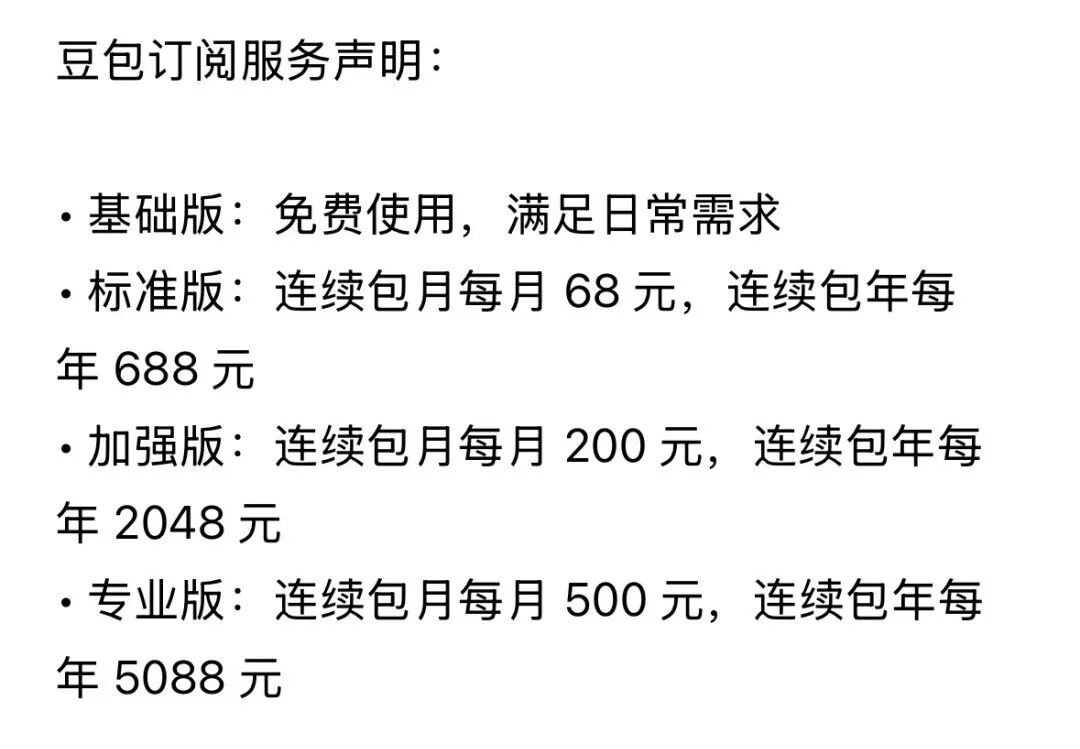
On May 4, 2026, as a multitude of users updated Doubao via the App Store, a “Paid Service Statement” quietly emerged: the Standard version is priced at 68 yuan/month, the Enhanced version at 200 yuan/month, and the Professional version at 500 yuan/month. The basic free service remains intact.
The moment this news broke, the topic “Doubao Charging” quickly became a trending sensation across major platforms. This was not Doubao's inaugural foray into commercialization; however, it marked the first instance where it directly placed a “paid” label on the screens of C-end users.
For the industry, this move felt like a depth charge: the AI app boasting the largest monthly active user base and highest user engagement in China was now implementing charges. Is this a sign that the commercialization of AI apps is accelerating?

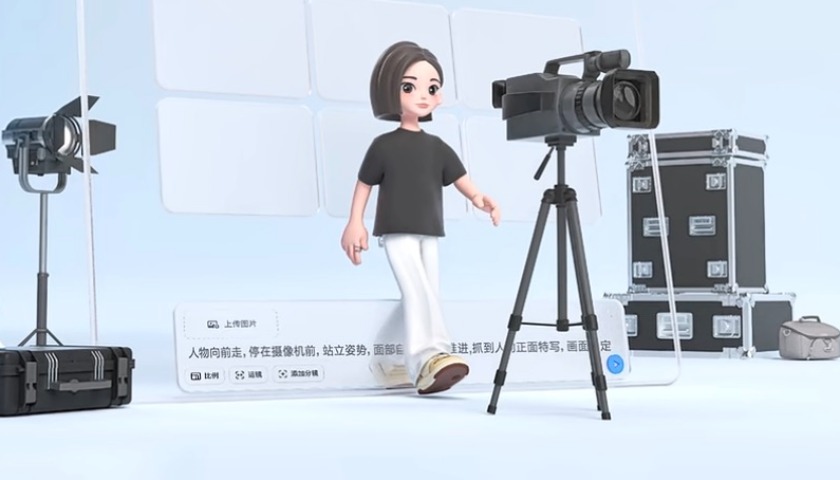
Image source: Doubao's WeChat official account
Over the past two years, China's large language model (LLM) industry has found itself in a precarious stalemate. On one hand, daily token consumption has surged a thousandfold, leaving companies grappling with overwhelming computing bills. On the other hand, intense homogenized competition has compelled LLM providers to tread cautiously in their monetization efforts to retain users.
Doubao has consistently been a disruptor in the market. It once set an API price “99.3% lower than the industry average,” pushing price wars to their limits. Additionally, it broke new ground for AI apps by collaborating with ZTE to launch the AI hardware “Doubao Phone.”
This time, while most domestic players are still cautiously approaching AI app commercialization, Doubao's C-end monetization experiment appears somewhat daring.
To comprehend the rationale behind this charging model, we must delve deeper than just the price tags. We need to dissect Doubao's product strategy, user scale, and cost structure, then juxtapose it with the global AI paid trend to grasp the true implications of this gamble.
1. Doubao Charging: Who Uses Computing Power, Who Pays?
In December 2025, Doubao's daily active users surpassed 100 million, making it the fastest product in ByteDance's history to achieve this milestone with the lowest promotional expenditure.
Amidst the fiercely competitive AI app market, Doubao has carved out its unique growth trajectory, leveraging a personified image and the robust support of ByteDance's ecosystem.
Nearly six months later, ByteDance anticipates Doubao to transition from a cost-saving entity to a revenue-generating powerhouse.
Let's scrutinize the specific plan. Doubao now offers three paid tiers: the Standard version at 68 yuan/month (688 yuan/year with an annual subscription), the Enhanced version at 200 yuan/month, and the Professional version at 500 yuan/month.
According to Yicai, Doubao's paid features will primarily focus on complex tasks and productivity scenarios, such as PPT generation, data analysis, and video production. The basic version remains free, catering to casual chats, simple Q&A, and basic translations without any impact.
Doubao officials later clarified that free services will always be available. Building on this foundation, Doubao is exploring additional premium services, with details still undergoing testing.
Notably, the three paid functions share a common characteristic: high token throughput. Generating a 30-page PPT with dynamic charts may consume hundreds of times more tokens than daily conversations. Similarly, producing a three-minute high-quality AI video requires hundreds of model inferences to ensure visual coherence and stylistic consistency.
Now, consider casual chat scenarios. According to QuestMobile, Doubao boasted 345 million MAUs in Q1 2026. Every conversation between these 300 million-plus users and Doubao consumes tangible computing resources.
Visualize this: A casual user engaging in 20-30 rounds of chat daily consumes negligible tokens—a scenario easily accommodated by the free tier. However, a professional user generating an in-depth research report may burn tens of millions of tokens in one go. The GPU costs and electricity bills associated with this could cover the annual free quota of several casual users.
Without a paywall for high-consumption scenarios, power users could potentially exhaust Doubao's computing budget, thereby degrading the experience for free users.
More critically, persisting with a fully free model essentially forces low-consumption casual users to subsidize the computing costs of high-consumption professionals—a commercially unsustainable model.
Thus, Doubao's paid feature design adheres to one fundamental principle: token-intensive, rather than simply feature-based. The free version remains Doubao's traffic foundation, while the paid version acts as a filter, directing high-consumption needs to users who are both willing and able to pay.
In essence, Doubao isn't merely collecting fees—it's managing costs. It presents not just a simple price hike narrative but a resource allocation logic: “Who consumes computing power, who pays.”
Placing Doubao's pricing within a global context elucidates this logic further. ChatGPT offers five subscription tiers: Free, Go ($8/month), Plus ($20), New Pro ($100), and Advanced Pro ($200).
Comparatively, Doubao's 68 yuan Standard version aligns with GPT Plus ($20), the 200 yuan Enhanced version with GPT Pro ($100), and the 500 yuan Professional version with GPT Advanced Pro ($200). Across all tiers, Doubao charges significantly less than GPT.

However, when compared to domestic peers, this pricing strategy appears aggressive. Kimi's top tier costs just 99 yuan/month, while Zhipu's VIP monthly subscription is a mere 39 yuan. Doubao's 500 yuan top tier redefines domestic AI app pricing.
Revisiting ByteDance's logic of making Doubao profitable, it's not merely a product-centric approach—it's rooted in token economics.
Earlier, Tan Dai, head of ByteDance's Volcano Engine, stated in an interview that token price differentials essentially reflect capability differentials. “Next-gen models are more powerful, so per-token costs rise, but the economic value they create increases proportionally. Price hikes driven by model intelligence upgrades essentially mean greater value for clients.”
This implies that users pay for Doubao based on token consumption—ultimately, the cost depends not on the vendor's desired earnings but on the user's token burn rate.
This AI app experiment sends a clear signal to the industry: LLM monetization should not rely on harvesting casual users but on creating irreplaceable productivity value for high-value users.
2. After 345 Million MAUs, Doubao Must Learn to Generate Revenue
Reflecting on Doubao's journey, reaching 345 million MAUs marked a pivotal commercialization turning point.
QuestMobile's latest data reveals that as of March 2026, Doubao had 345 million MAUs, approximately 140 million DAUs, and 54.8 monthly uses per user. Combined, Qianwen and DeepSeek's MAUs pale in comparison to Doubao's.
Moreover, Doubao stands as China's only independent AI app with over 100 million DAUs, granting it a substantial lead over competitors.
These numbers reflect a fundamental shift in user behavior—the core premise for Doubao to initiate charging. Early users engaged casually, infrequently, and with low consumption. Now, usage has transitioned from entertainment to productivity needs.

Deep integration with Douyin (TikTok's China version) opened a traffic valve. Users can now @Doubao in Douyin comments to receive video summaries, tapping into Douyin's billion-plus user pool like a continuous blood transfusion.
This omnichannel penetration has created high user migration barriers for Doubao. In March 2026, Citigroup Research surveyed 1,800 respondents, finding Doubao's user penetration in China's AI app market reached 79%, with 63% naming it their “most-used product.”
Behind this lies Doubao's consistent, high-frequency model upgrades over two-plus years. The AI product monetization logic is straightforward: users pay for added value, and continuous tech iteration is Doubao's key to creating irreplaceable value.
Over the past 18 months, Doubao's LLM has advanced from 1.5 to 2.0. Its Doubao-Seed-2.0-pro, released in February 2026, topped SuperCLUE's math reasoning global rankings. In April, its visual-language model scored 90.66, surpassing Google Gemini to rank first among 17 mainstream models. Its video generation model, Seedance 2.0, has been dubbed “director-level AI” by insiders.
By user scale and model capability, Doubao appears poised to accelerate commercialization. More importantly, with scaling users, computing costs have skyrocketed—Doubao must generate revenue.
According to Volcano Engine, Doubao's LLM daily token calls exceeded 120 trillion by March 2026. Three months prior, it was 60 trillion; in May 2024, when the model launched, it was just 12 billion. A staggering 1,000x surge in 22 months.
These costs manifest as tangible computing expenses on ByteDance's financials. In late 2024, Zheshang Securities reported ByteDance's 2025 capex at approximately 160 billion yuan, with around 90 billion earmarked for AI computing and 70 billion for IDC infrastructure and network equipment (e.g., optical modules, switches).
When Doubao's MAUs hit 100 million last year, 36Kr reported internal concerns at ByteDance about unclear monetization paths and inference costs pressuring profits.
AI apps are unique: more users equate to higher token consumption and costs for LLM providers. The scale effects of the internet era do not apply here—marginal costs do not decline with user growth; they rise with token consumption.
Reality compels Doubao to become self-sustaining.
Prior to this C-end charging initiative, Doubao had been exploring monetization avenues for years and had established a comprehensive B-end commercial loop:
1. Opening its main LLM APIs via Volcano Engine, attracting tens of thousands of enterprise clients such as Geely, OPPO, and vivo.
2. Deep integration with Feishu (ByteDance's workplace app) to offer AI office solutions for SMEs, embedding Doubao's LLM capabilities across Feishu's meeting, document, and project management scenes.
3. Extending to smart hardware by opening Doubao Assistant APIs and dev kits, partnering with phone, automotive, and smart home manufacturers for a software+hardware ecosystem layout.

Image source: Doubao's WeChat video channel
B-end monetization has validated Doubao's tech value and commercial viability. This C-end charging initiative extends the value-based, consumption-based logic from enterprises to individual users, seeking a sustainable monetization outlet for its 345 million users.
For Doubao, commercialization is no longer optional—it's imperative.
3. Will AI Paid Models Become the Norm?
Globally, AI paid models are already mainstream.
ChatGPT offers five tiers ranging from $8 to $200, Claude launched a $100 Max plan, and Google Gemini has introduced paid tiers.
According to the Financial Times, OpenAI's 2025 annual revenue reached approximately $13 billion, with 70% derived from $20/month subscribers.
Overseas, the AI industry concurs: international AI pricing is shifting toward value-based and consumption-based models. Free tiers serve merely as temporary acquisition tools; paid tiers signify industry maturity.
In China, the path to paid AI has been more tumultuous.
Looking back, the industry has navigated three waves of trials:
1. Around July 2022, when the first domestic LLMs launched, Baidu's ERNIE Bot and Zhipu's Qingyan initially implemented charges.
Back then, no consensus existed on whether users would pay for AI. By late 2024, Baidu ERNIE attempted again with a professional version priced near 500 yuan/month, but market willingness was weak, and the plan faded into obscurity.

2. The only C-end noise came from Kimi in Q4 2025. Instead of a paywall, Kimi introduced a tipping system starting at 9.9 yuan. Meanwhile, Zhipu raised API prices three times in three months in early 2026 while launching a 39 yuan/month VIP. In contrast, DeepSeek slashed API prices by 75% to attract developers.
These opposing moves—price hikes and cuts—reflect domestic LLM providers' collective anxiety over monetization paths. No one was certain if China's market would embrace paid AI.
Doubao's own commercialization pace was measured. Launched in August 2023 with a free strategy, it entered the market late but acquired users at the fastest rate.
Now, shifting from free to paid—even with industry experience—the 500 yuan/month top tier remains a bold gamble.
The adventure lies first and foremost in the cognitive gap. Doubao has long been perceived as free, leaving users with the impression that it is convenient and easy to use. Although ByteDance's Seed series models have performed well in evaluations, the perception among consumer-end users is not significant. Once the post-payment experience fails to meet corresponding psychological expectations, unsubscribing or even uninstalling becomes inevitable.
Deeper risks stem from user loyalty amidst fierce market competition. After three years of intense competition among numerous models, homogenization in basic Q&A and text processing is inevitable. The first to charge may become the one defining pricing power or the first to take the risk.
The market is clear that in the short term, achieving commercial closure in the domestic AI market through scaling up paying users is a probabilistic event. Whether the paid model can truly succeed and achieve a healthy closure is fraught with uncertainty.
In the long run, Doubao's success hinges not only on the continuous upgrading of its model capabilities but also on how ByteDance can truly integrate its ecological advantages with Doubao
-
![]()
Tesla Restructures Its Balance Sheet
-
![]()
Accelerating the High-Speed Interconnection Upgrade of AI Computing Clusters! JONHON Releases ELSFP External Light Source Optical Connectors
-
![]()
Breaking the overseas blockade of volumetric holographic materials, this optical enterprise secures nearly 100 million yuan in financing!
-
![]()
Why Does Jensen Huang So Openly Praise China’s AI?
-
![]()
"Wudang" Unveiled: Arm China's Next-Gen AI VPU Redefines Video Encoding
-
![]()
From Energy Conservation and Carbon Reduction to AI Decision-Making: GECON East Intelligence and Chery Group Explore a New Green and Smart Paradigm for Automobile Manufacturing
-
![]()
WAIC 2026 Observation | AI Accelerates Towards the Core of Industries, Industrial AI Enters a Critical Phase
-
![]()
Volkswagen China Fires the First Shot in Foreign-Funded 'White Box Delivery'!