Unusual Trend: Elite CTOs Leave Top Positions to Code at Leading AI Firms
 05/08 2026
 464
464
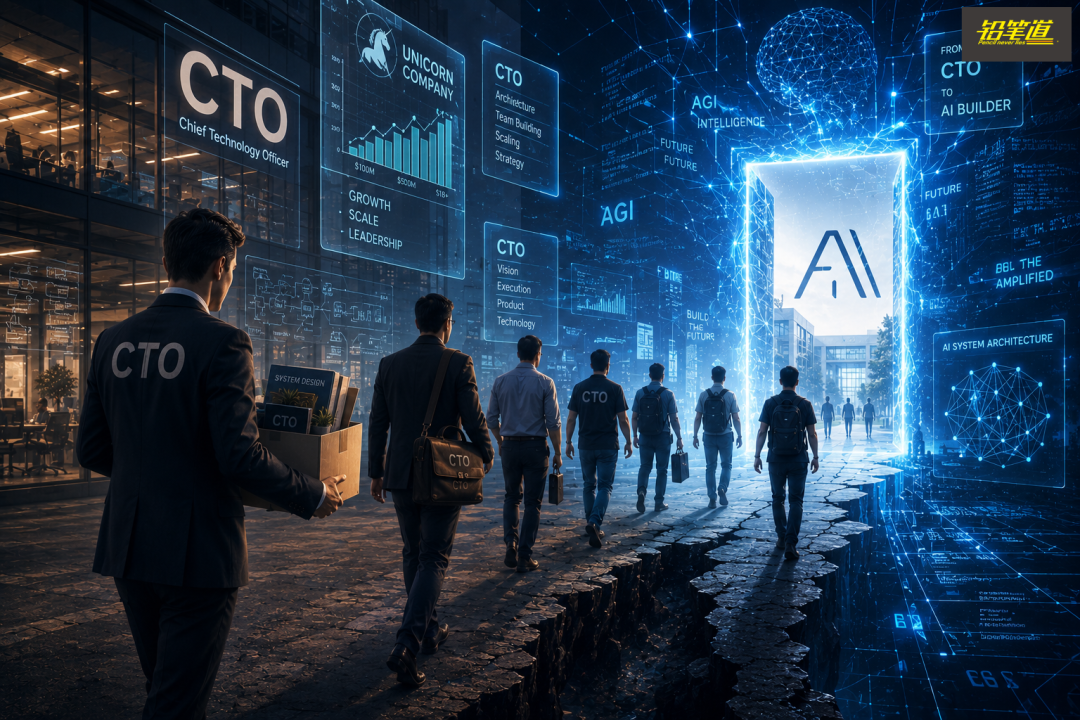
Cover Image | Generated by ChatGPT
Silicon Valley is witnessing an extraordinary shift: Several chief technology officers (CTOs) from unicorn startups are stepping down to take on programming roles at major tech companies.
The company attracting these top-tier talents is Anthropic.
This development was first brought to light by a former CTO from one of these unicorn companies.
Henry Shi, previously the CTO of super.com, joined Anthropic in October of the previous year as Chief Technical Advisor.
Recently, he took to X (formerly Twitter) to list fellow CTOs who, like him, have transitioned from leading unicorn startups to working on the technical frontlines at Anthropic.
Why would these CTOs willingly accept what could be seen as a 'demotion'? Is it for financial gain, or is it driven by a higher purpose?
Interviews conducted by Pencil News with several domestic tech experts shed light on the deeper motivations behind this trend.
- 01 - Not Wanting to Miss the AI Revolution
Let's first delve into Henry Shi's own perspective.
He previously worked at super.com, a budget hotel booking platform that also offered a range of money-saving services, including credit card cashback, shopping discounts, and cash advances.
 Super.com website page
During his eight-year tenure, super.com secured over $150 million in funding, growing from scratch to achieve annual revenues exceeding $200 million, annual gross merchandise volume (GMV) surpassing $1 billion, and amassing a user base of over 50 million, all while achieving profitability across multiple revenue streams.
Once he had guided the company onto a stable growth trajectory, he began exploring new avenues in his career.
Super.com was one of Anthropic's earliest clients, and Henry Shi witnessed firsthand the company's rapid growth, with model capabilities evolving on a monthly basis.
When ChatGPT was released in November 2023, he had a hunch: this could mark the starting point of the most significant technological revolution since the advent of the internet.
How could he be part of this AI revolution? At the time, he had two options: become a venture capitalist (VC) or start another company.
He dismissed both: VC could wait; he was still young and eager to pursue more ambitious endeavors. If he started an AI application company, it would essentially involve leveraging someone else's model and wrapping it in a polished interface. The next API update from OpenAI or Anthropic could render his efforts obsolete.
He recounted the story of an entrepreneur who spent months prototyping a complex problem, progressing with difficulty. Then, after Claude Opus was released, a single prompt solved his entire application scenario.
What if he joined one of the major model companies directly? Being closest to the models meant being at the forefront of AI.
Henry Shi was well-acquainted with Anthropic's co-founder Ben Mann (one of the earliest authors of the GPT-3 paper) and maintained regular contact.
During one conversation, Mann argued that 'economic AGI (economic Artificial General Intelligence, referring to small-scale general AI)' would likely emerge between 2027 and 2028, providing a logical argument to support his claim.
Henry Shi decided to join Anthropic: if AGI truly arrived in 2027 or 2028, he would be at the forefront of the AI lab, witnessing it firsthand from the front row. Even if it didn't happen, he would at least gain a true understanding of why not and where AI's actual capabilities lie.
Either outcome would be extremely valuable for Henry Shi.
In 2025, he resigned from super.com to work at Anthropic. While others were chasing model capabilities externally, he was already defining them internally.
- 02 - Amplifying One's Capabilities
Now, let's examine the profiles of other CTOs who have joined Anthropic as regular technical members.
Mike Krieger, the former CTO of Instagram, oversaw technology and product engineering as Instagram's user base grew from a few million to 1 billion monthly active users.
Peter Bailis, the former CTO of Workday, a cloud-based financial management and human capital management software provider, is an expert in data analysis and became a professor in Stanford's computer science department at the age of 25.
Bryan McCann was the CTO of AI search company You.com and a highly regarded natural language processing (NLP) researcher in Silicon Valley's AI circle.
Niki Parmar, the CTO of agent company Adept AI, was one of the eight authors of the paper proposing the Transformer architecture.
If Henry Shi hopes to witness AGI, why are so many other brilliant minds forgoing managerial roles to code at Anthropic?
"The core reason is that with AI coding, one person can accomplish the work of a team, eliminating the need for large execution teams. Continuing in a startup no longer makes sense for them," explained Chen Qiuwu, CTO of Kouding Intelligence, in an interview with Pencil News. He added that CTOs at Silicon Valley unicorns possess strong technical skills but may lack execution abilities. They start companies to have teams complement their efforts. Now that they can do it themselves, they're eager to strike out independently. "Moreover, in many Silicon Valley startups, CTOs don't necessarily wield significant influence. Often, they can't pursue their true visions."
Why are they willing to work on the frontlines at Anthropic?
"Anthropic is a global tech hub. Being there amplifies one's value exponentially. They've calculated this," said Chen Qiuwu. He explained that these CTOs understand that combining their architectural, design, and validation skills with Anthropic's AI coding capabilities generates multiplicative or even exponential value.
Chen Qiuwu cited Kouding Intelligence as an example. "For a current project with a major company, it's essentially me plus Claude and an AI coding model. Originally, Redis QPS was only 60,000; I achieved 6.5 million Redis QPS."
Li Yachong, founder of Putao Technology, told Pencil News that many highly skilled CTOs are willing to return to frontline work, a feat previously impossible. AI coding has made this achievable.
"In the past, CTOs spent most of their time managing: replicating their abilities to strengthen the team, conducting scheme reviews, and even career planning. Then came architectural selection and process standardization. This differed greatly from pure frontline work. Returning to the frontlines was extremely difficult for CTOs. Now, managing AI is much easier," he said.
Besides personal fulfillment, financial considerations are also a significant factor.
These individuals previously worked at unicorns or companies acquired by tech giants, earning substantial salaries and equity—not astronomical, but significant nonetheless.
Compared to Anthropic's potential returns, these pale in comparison.
According to a blog post by Ken Qi, a Silicon Valley entrepreneur, the base annual salary for senior MTS at Anthropic ranges from $300,000 to $405,000. With stock options and performance bonuses, total annual compensation easily exceeds $1 million. Not a meager sum by any means.
More importantly, Anthropic's valuation is rising rapidly. Reports suggest it's securing a new $50 billion funding round, aiming for a $900 billion valuation (approximately 6 trillion RMB). Ken Qi calculated: "For early core technical employees, the future potential gains from equity far exceed the lifetime earnings of most CTOs at small and medium-sized unicorns."
Previously, Pencil News reported that top large model companies offer salaries to researchers comparable to those of football and basketball superstars. (See: AI Talent War: Fresh Ph.D. Graduates Earn $5 Million Annual Salaries)
- 03 - Spring for Tech Enthusiasts
Will similar events occur in China in the future?
Unlikely, according to multiple technicians and entrepreneurs interviewed by Pencil News.
"First, salaries make it impossible. Chinese companies have heavy management hierarchies, with management (and its salary premiums) accounting for 50-60%. Meanwhile, execution staff salaries are actually low, with poor incentives," a technician with years of experience at multiple leading companies told Pencil News.
Second, China doesn't lack frontline workers. "Even if you're the CTO of a high-profile startup, joining a major company doesn't guarantee special treatment. They value your management skills over your frontline abilities," the technician explained.
Additionally, he noted that many older programmers abroad remain highly skilled despite aging. "In China, many programmers' skills decline after their mid-30s."
Chen Qiuwu emphasized that the more relevant takeaway for China is how 'one-person companies' and 'super individuals' rise with AI coding capabilities.
"This is essentially 'human + AI' replacing purely human organizational structures. When models generate most code, execution is no longer the core issue. The fundamental question is how CTOs' abstraction abilities can be amplified by AI," he said. He predicts that with powerful AI coding, a CTO plus a few engineers and marketers could match the capabilities of a 100-person company today.
Chen Qiuwu also judged that this talent flow in Silicon Valley might signal a shift in entrepreneurial paradigms in the AI era.
"In the past, products led. Many tasks could be accomplished by throwing manpower at them. Apps like Douyin and Kuaishou relied on massive teams to build infrastructure. But the AI era is different. Technology now redirects the course. Product managers understand user needs but may not know technology's next developmental stage. Those who can deduce the 'second, third, and fourth steps' of large models are actually CTOs and technicians," he explained.
- 04 - Conclusion
The scene unfolding in Silicon Valley isn't entirely unprecedented.
When Southern Metropolis Daily was founded, many deputy editors-in-chief and chief reporters from other media outlets abandoned their positions to work as ordinary reporters/editors at 289 Guangzhou Avenue Central, lured by the broader, more responsible platform offered by Southern Metropolis Daily, which enabled them to produce reporting that influenced social progress. This also marked the golden age of China's media industry.
Now, CTOs joining Anthropic to code—does this herald the golden age of AI in the United States?
This article does not constitute any investment advice.
-
![]()
Tesla Restructures Its Balance Sheet
-
![]()
Accelerating the High-Speed Interconnection Upgrade of AI Computing Clusters! JONHON Releases ELSFP External Light Source Optical Connectors
-
![]()
Breaking the overseas blockade of volumetric holographic materials, this optical enterprise secures nearly 100 million yuan in financing!
-
![]()
Why Does Jensen Huang So Openly Praise China’s AI?
-
![]()
"Wudang" Unveiled: Arm China's Next-Gen AI VPU Redefines Video Encoding
-
![]()
From Energy Conservation and Carbon Reduction to AI Decision-Making: GECON East Intelligence and Chery Group Explore a New Green and Smart Paradigm for Automobile Manufacturing
-
![]()
WAIC 2026 Observation | AI Accelerates Towards the Core of Industries, Industrial AI Enters a Critical Phase
-
![]()
Volkswagen China Fires the First Shot in Foreign-Funded 'White Box Delivery'!