Doubao Begins Charging Fees: Zhang Yiming Learns to Weigh Costs
 05/08 2026
 681
681
Text by Jingjing
In May 2024, the Doubao large model sparked a price war in China's AI large model market by setting its API pricing at 99.3% lower than its competitors.
Exactly two years later, on May 4, 2026, Doubao quietly posted a paid service announcement on its Apple App Store page, unveiling three subscription tiers: Standard at 68 RMB/month, Enhanced at 200 RMB/month, and Professional at 500 RMB/month, with an annual subscription capped at 5,088 RMB.
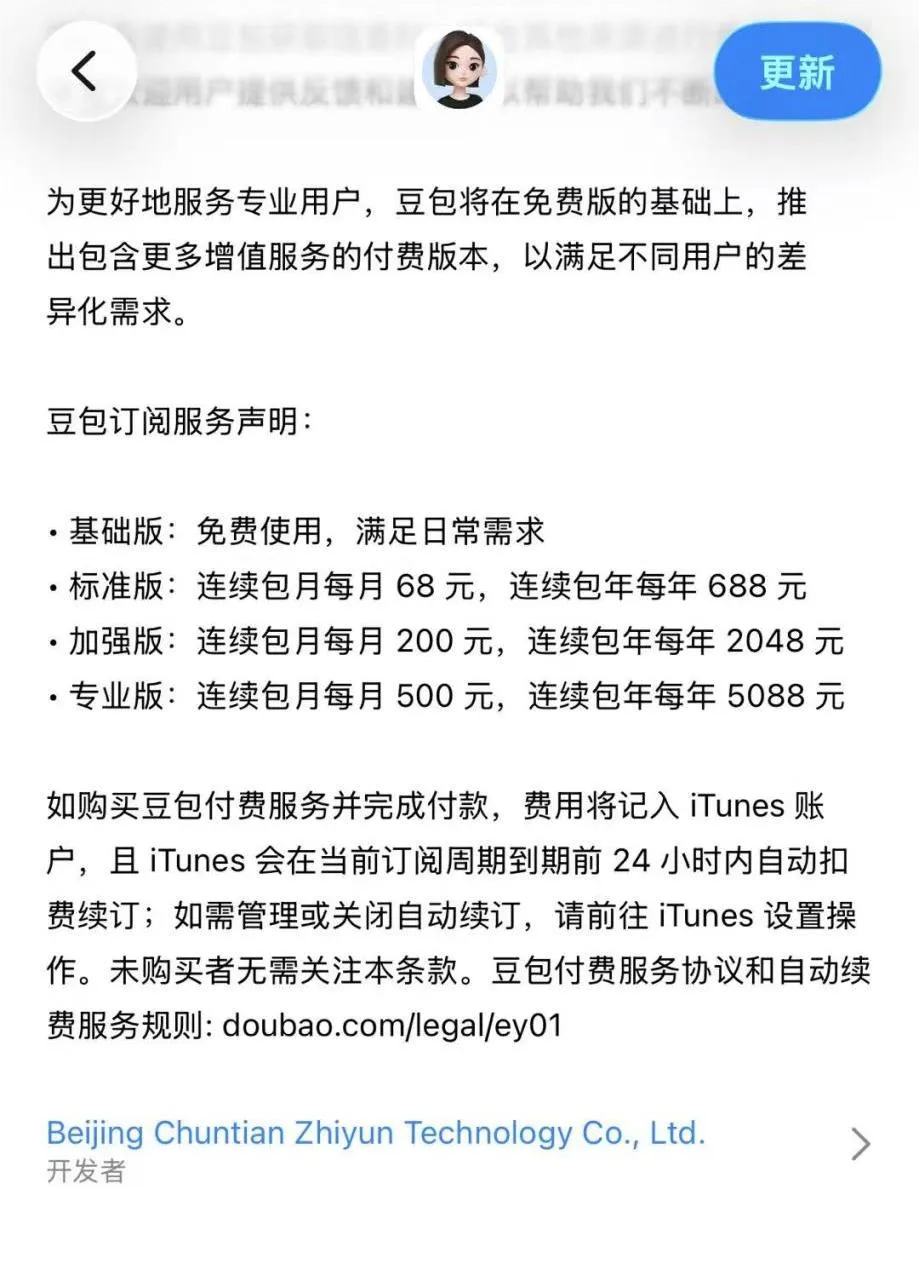
(Image sourced from the Apple App Store)
Doubao's official response clarified that basic features would remain permanently free, while paid value-added services, currently under exploration, would target productivity scenarios. Subscription details are still being refined. According to "Intelligent Era AGI," Doubao is set to roll out its first paid monthly subscription product, "Doubao Membership," by mid-to-late May. As of the publication date, ByteDance and Volcano Engine have yet to issue an official announcement.
The news has sparked polarized reactions: some have questioned Doubao's pricing strategy, while others view it as an inevitable trend for large models to start charging fees. From a 99% price reduction to the subtle introduction of charges, this free AI extravaganza has reached a crossroads, demanding a strategic shift.

(Image sourced from Doubao's official WeChat account)
However, beneath the surface controversy, this shift appears inevitable. The more users Doubao acquires, the greater the financial strain on ByteDance. With 345 million monthly active users and 120 trillion daily token calls, each conversation increases computing power consumption—a cost the company is no longer willing to shoulder alone.
Thus, ByteDance is pursuing a dual strategy: on the consumer side, Doubao is testing paid services to shift computing costs to heavy users; on the business side, ByteDance is investing heavily in revamping its chip supply chain. In late April 2026, ByteDance confirmed a $5.6 billion procurement order for Huawei Ascend chips, securing approximately 350,000 Ascend 950PR units—Huawei's newly mass-produced inference chips launched that month, setting a record for domestic AI chip procurement.
From voluntary price reductions to covert charging, and from relying on NVIDIA to shifting to Huawei, Doubao's focus remains steadfast on computing power.
01
345 Million Monthly Active Users, but Doubao's Costs Soar with Growth
Consider these figures. QuestMobile data reveals that as of March 2026, Doubao had 345 million monthly active users, surpassing the combined total of second-place Qianwen (166 million) and third-place DeepSeek (127 million). During the 2026 Spring Festival, Doubao's daily active users peaked at 145 million, making it China's most widely used AI-native application.
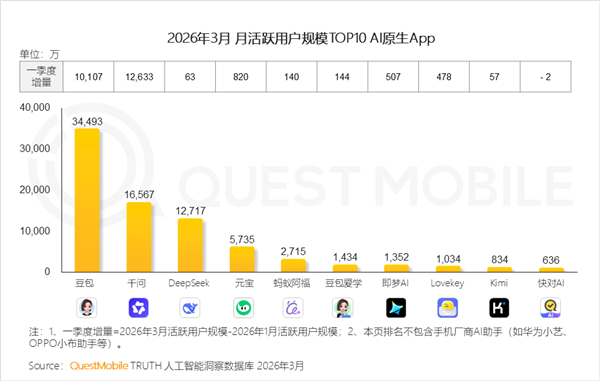
(Image sourced from a QuestMobile report)
However, user growth does not directly translate into revenue. "National Business Daily" previously reported that internal voices at ByteDance acknowledged a lack of clear commercialization paths for Doubao, with high inference costs exerting significant pressure on profits.
This pressure stems from two primary sources:
The first is the surge in computing power consumption. Volcano Engine revealed that as of March 2026, Doubao's large model exceeded 120 trillion daily token usage, doubling in three months and growing 1,000-fold since its May 2024 launch. A technical breakdown report on CSDN noted that hardware depreciation accounts for 58% of Doubao's single-inference costs, with electricity accounting for 29%. Each additional conversation incurs tangible expenses.

The second is ByteDance's overall financial strain. Undoubtedly, ByteDance is one of the highest-revenue internet companies, but securities firms' data shows its 2025 capital expenditures reached approximately 150 billion RMB, with about 90 billion RMB allocated to AI computing power procurement. In 2026, it plans to invest around 160 billion RMB, with approximately 85 billion RMB earmarked for AI chip purchases.
On April 20, 2026, rumors circulated on social media that "ByteDance's 2025 net profit fell by over 70%." Multiple media outlets, citing informed sources partially confirmed by company executives, reported that ByteDance's 2025 net profit declined by more than 70% year-on-year, with a sharp drop in profit margins.
Li Liang, Vice President of Douyin Group, swiftly responded, stating that the specific net profit decline included non-operational factors such as preferred stock and option costs, and the actual drop was far less exaggerated. However, he acknowledged pressure on operating profits.
For any commercial company, a model where more users and contributions lead to greater losses is unsustainable.
02
Tiered Pricing: Cost Shifting Becomes Inevitable
Now, let's delve into Doubao's pricing strategy.
The three subscription tiers are: Standard at 68 RMB/month, Enhanced at 200 RMB/month, and Professional at 500 RMB/month. These price points act as a sieve, precisely stratifying heavy users.
According to sources close to Doubao, the paid version will focus on complex tasks and productivity scenarios, such as PPT generation, data analysis, and film production, while the free version will retain basic functions like daily chat, copywriting, and information queries.

In essence, casual users will still have free access, while heavy users who frequently consume complex computing resources will bear the costs.
According to Morgan Stanley estimates, even with a mere 1% conversion rate to paid subscriptions, Doubao could generate over 2 billion RMB in annual subscription revenue.
This approach is not unique to ByteDance. Since 2026, Kimi and ERNIE Bot have also launched paid plans. For example, Kimi introduced a comprehensive subscription system with four tiers ranging from 49 RMB to 699 RMB, stratified by Agent quota multiples, while ERNIE Bot launched a professional membership plan.
(Image sourced from KIMI's official WeChat account)
Domestic leading AI applications have nearly simultaneously completed their commercial transitions. The "free basic + paid professional" model is becoming China's standard commercial framework for large models.
The underlying logic is straightforward: Tokens are evolving into a new foundational resource, and surging usage volumes mean computing power has transformed from a money-burning expense into a rigid cost.
Doubao's charging strategy aims to distinguish between light and heavy users among its vast user base, making the latter pay for their high-frequency, energy-intensive demands. This common tiered monetization approach seeks to transfer computing costs from ByteDance to users.
When viewed in a broader context, ByteDance's financial strategy is far more pressing than it appears. No matter how profitable Douyin is, the ballooning costs of computing power are nearing a breaking point.
ByteDance is a typical attention-monetization engine, with 2025 revenue exceeding $200 billion. However, advertising revenue grows with impressions, while Doubao's expenses grow with inference volumes—the latter's growth rate far outpaces the former. The revenue stream from this powerful attention-extraction machine is severely misaligned with Doubao's cost curve.
Industry insiders told "Yunyong Business" that Doubao's AI costs remain high due to its reliance on NVIDIA GPUs, resulting in ongoing losses despite massive investments. Now that user acquisition is largely complete, charging fees has become necessary to balance costs.
Of course, Doubao is not the first to charge, nor will it be the last. Volcano Engine data shows exponential growth in token consumption, rapidly amplifying computing cost pressures. The Stanford AI Index report notes that the gap between Chinese and U.S. models has narrowed to approximately 2.7%, with Chinese AI products now technically capable of charging fees. Huatai Securities' 2026 outlook predicts this year will mark a critical inflection point for AI commercialization, with the industry transitioning from model availability to value realization.
Doubao's paid testing may represent a concrete step toward this inflection point.
03
Doubao Cuts Costs While Exploring New Revenue Streams
While testing paid services on the consumer side, ByteDance is pursuing another strategy on the business side: switching chips.
In 2026, ByteDance plans to invest approximately 40 billion RMB in procuring Huawei Ascend series chips, primarily for AI large model inference scenarios, effectively "cutting costs" at the chip procurement level. According to media reports, ByteDance has secured 250,000 Ascend 950PR chips, with an order value of approximately 29.7 billion RMB ($5.6 billion), locking down nearly half of Huawei's 2026 production capacity.
(Image sourced from ByteDance's official website)
The Ascend 950PR, launched in Q1 2026, is Huawei's AI inference-optimized chip.
Zhang Dixuan, President of Huawei's Ascend Computing Business, introduced at a partner conference that the Atlas 350's single-card computing power reaches 2.87 times that of NVIDIA's H20, making it the only domestic product supporting FP4 low-precision inference. Priced at around 70,000 RMB for the HBM-equipped high-end version, it costs roughly one-third of NVIDIA's H200, offering significantly better cost-effectiveness.
Besides ByteDance, Alibaba procured 150,000 units, while Tencent and Baidu jointly purchased over 50,000 units, with orders from leading companies accounting for over 70% of annual production capacity.
Mass adoption of domestic chips directly slashes computing costs at the hardware level. Hardware depreciation constitutes a major portion of large model inference's marginal costs, and domestic chips' superior computing power-to-price ratio enables ByteDance to reduce inference costs without sacrificing performance.
The high-priced procurement essentially reflects ByteDance's fundamental strategy: shifting computing power reliance from a high-cost, low-efficiency supply chain to a cost-effective domestic alternative, creating space for sustainable price reductions without incurring losses.
Cost-cutting and revenue exploration are two sides of the same strategic coin.
The end of free lunches does not mean Zhang Yiming can no longer afford them; rather, the ledger is now on the table. AI cannot rely on free offerings to survive until the second half of this game.
The question now is whether this strategy can pave a profitable path for China's AI industry.
04
The "Free Era" of China's Large Models May Be Drawing to a Close
Looking back, Doubao's charging strategy reflects not just ByteDance's commercial choices but also signals the end of the "free era" for China's AI large model industry.
From the "All in AI" frenzy during the 2023 hundred-model competition to the current deep dive into commercialization validation, all players face the same challenge: AI cannot win through mere money-burning; it must ultimately sustain itself. The free money-burning war is unsustainable, as computing costs and the nature of AI competition force vendors to find internal revenue-generating mechanisms.
Analysts told "Yunyong Business" that as AI large models increasingly become critical supports for internet commercialization, tiered pricing is inevitable, serving as both a reasonable allocation of computing costs and a prerequisite for industry sustainability.
Doubao has taken the first step: the free version remains open to lifestyle users, while the paid version undergoes testing among productivity users. Whether this path can truly succeed and balance user experience with vendor profitability remains to be seen.
However, one certainty exists: everyone hopes Doubao's experiment will help China's AI industry complete the full loop from technology to commerce.
-
![]()
Tesla Restructures Its Balance Sheet
-
![]()
Accelerating the High-Speed Interconnection Upgrade of AI Computing Clusters! JONHON Releases ELSFP External Light Source Optical Connectors
-
![]()
Breaking the overseas blockade of volumetric holographic materials, this optical enterprise secures nearly 100 million yuan in financing!
-
![]()
Why Does Jensen Huang So Openly Praise China’s AI?
-
![]()
"Wudang" Unveiled: Arm China's Next-Gen AI VPU Redefines Video Encoding
-
![]()
From Energy Conservation and Carbon Reduction to AI Decision-Making: GECON East Intelligence and Chery Group Explore a New Green and Smart Paradigm for Automobile Manufacturing
-
![]()
WAIC 2026 Observation | AI Accelerates Towards the Core of Industries, Industrial AI Enters a Critical Phase
-
![]()
Volkswagen China Fires the First Shot in Foreign-Funded 'White Box Delivery'!