Doubao's Paid Services: Why 'Free' Can Be the Costliest Choice
 05/08 2026
 552
552

AI stands apart from all previous internet offerings—it doesn't adhere to the marginal efficiency model where 'more users lead to lower costs.' Instead, it's a computing power arms race where 'more users mean higher costs.' Charging for resource-intensive, high-computing tasks is entirely justifiable.
Author | Liu Shanshan
Editor | Cindy
If you ask Doubao, it likely didn't anticipate the uproar this move would cause.
The situation is straightforward. Recently, Doubao updated its App Store description, announcing the launch of premium paid services alongside its free offering, with three tiers: Standard at 68 RMB/month, Enhanced at 200 RMB/month, and Professional at 500 RMB/month. Officials clarified that it's still in testing, with a formal rollout date pending, and the free version will persist.
Nevertheless, the announcement sparked controversy. Some view it as a necessary step for AI commercialization, while others criticize it as 'overpriced' or 'exploitative.' Concerns also arose about the potential end of the 'free lunch' era.
At its core, this conflict stems from the clash between commercial realities and user expectations. Moreover, in the age of AI large models, how should we truly assess the interplay between costs, value, and user experience?
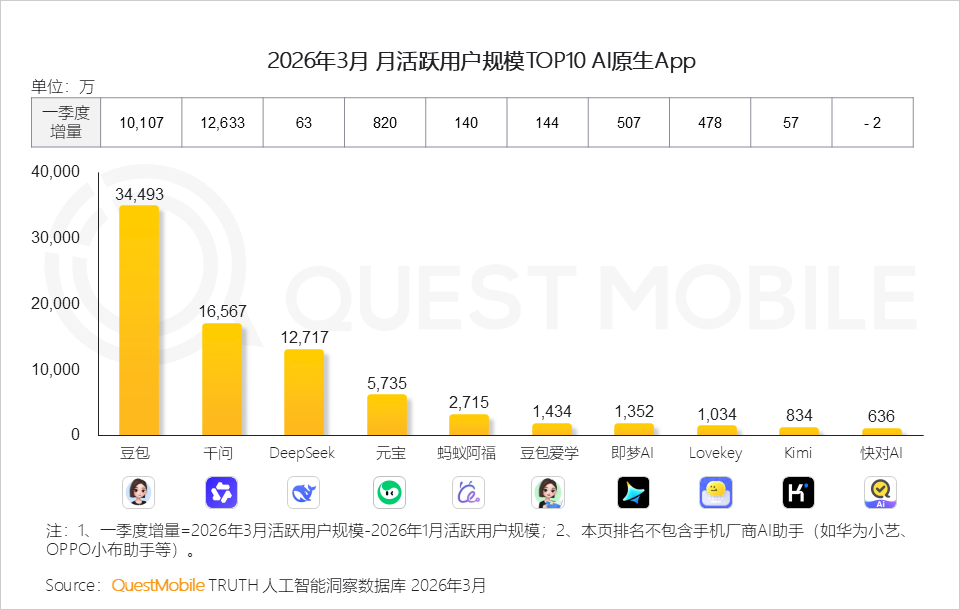
As is well-known, Chinese internet users have long been accustomed to free services—free e-commerce, free antivirus, free search, free social media, etc. With competitors like Qianwen, Yuanbao, and DeepSeek not yet charging, Doubao's sudden monetization push faced initial backlash.
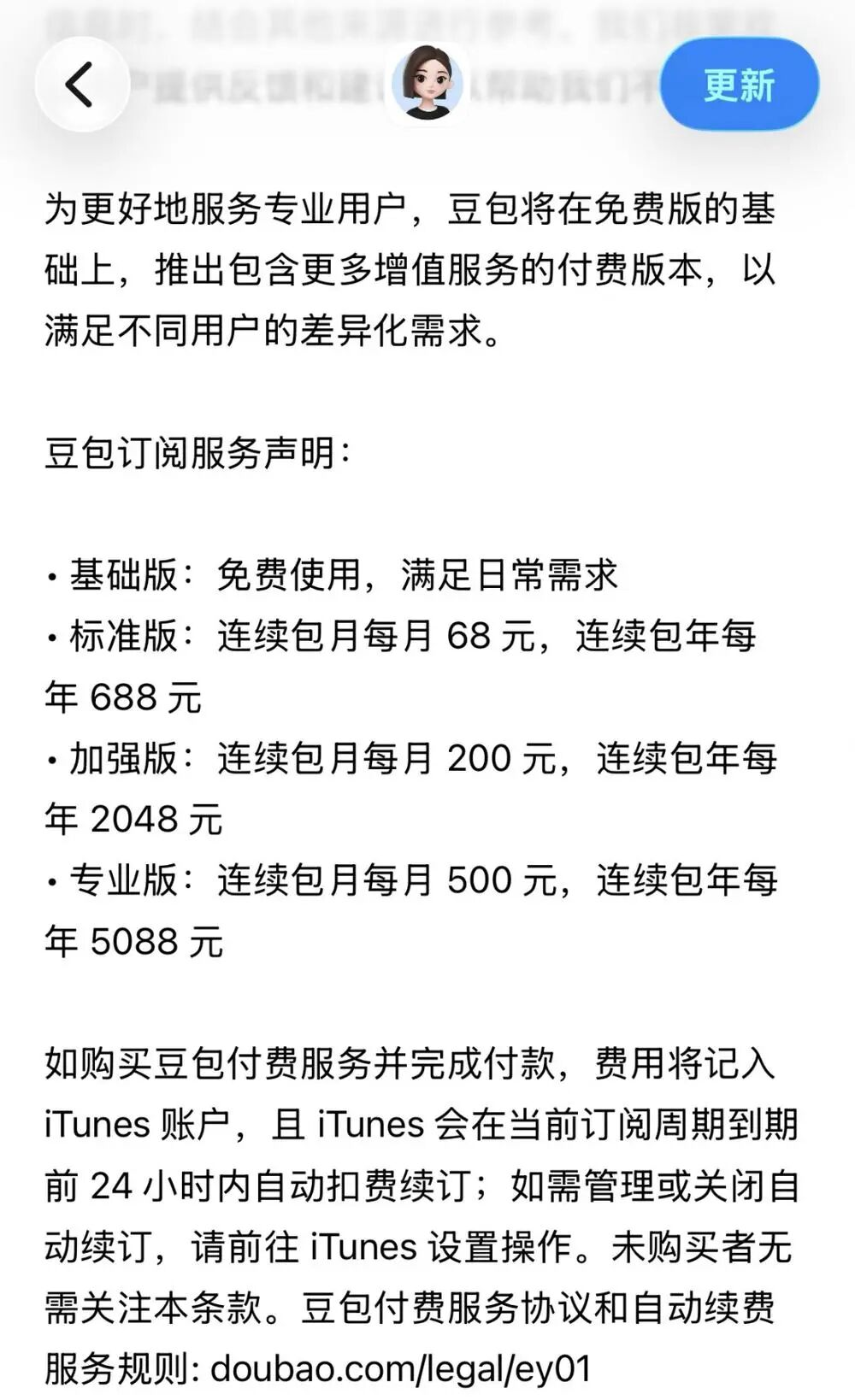
In reality, AI is unlike any previous internet product. It doesn't operate under the marginal efficiency principle of 'more users, lower costs.' On the contrary, it's a computing power race where 'more users, higher costs.' Charging for time-consuming, high-computing tasks is perfectly logical.
More critically, many overlook that 'free' has often proven a deceptive concept in the internet sector: the 'free' option frequently ends up being the most expensive.
1
Free: The Biggest Scam in Disguise
For most internet products, 'marginal effects' drive the business model. Take WeChat, with over 1.4 billion monthly active users—regardless of user growth or feature additions, it merely requires a few extra servers, with costs nearly negligible.
This underpins the internet industry's 'winner-takes-all' mentality—burn money to acquire users early, then leverage zero marginal costs to maximize profits later.
But AI large models operate under entirely different logic.
Computing power, servers, and electricity—none come cheap. Every AI interaction involves hardware depreciation and real monetary costs in computing resources. Ordinary chats are manageable, but complex tasks like PPT generation, data analysis, and video production consume tens or even hundreds of times more computing power than casual conversations.
Take Doubao, now with 345 million monthly active users. Volcano Engine data reveals that as of March this year, Doubao's large model daily token usage surpassed 120 trillion, soaring 1,000-fold since its release. ByteDance's AI capital expenditures for 2026 are estimated at 160 billion RMB, with 85 billion earmarked for AI chips alone, directly causing a net profit decline of over 70% year-on-year in 2025.
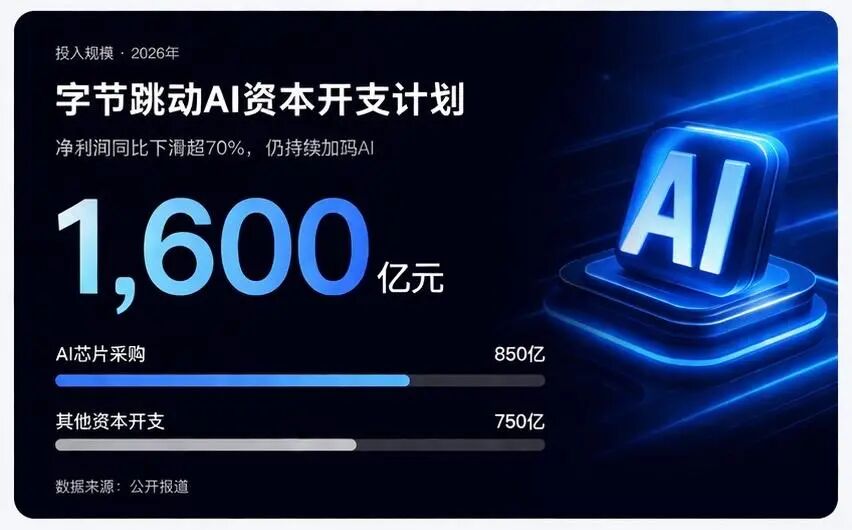
The larger the scale, the steeper the losses. This holds true not just for Doubao but for the entire large model sector.
Thus, before Doubao, many AI tools on the market had already started charging. ChatGPT starts at $20/month, Baidu's ERNIE Bot Professional costs 49.9 RMB/month, and Kimi offers subscriptions from 49 RMB/month. After Doubao, more AI-native applications will likely follow suit with paid models.
The truly overlooked issue is that 'free' is never truly costless.
Free video streaming platforms insert 120-second ads at the start of each episode and interrupt viewing with additional ads. Free cloud storage users face speed limits of a few dozen KB/s, taking days to download a 2GB file. E-commerce's 'cut-a-dollar' promotions always leave users 0.01% short, forcing them to harass all their friends for hours, only to find success perpetually out of reach.

These tactics follow a consistent pattern—users think they're getting a bargain, but in reality, their time, attention, and social relationships are all being monetized by the platform.
AI-native applications harbor similar concerns. The free version provides basic Q&A capabilities but requires queuing during peak hours, with slower responses and superficial answers. For complex questions, free models take shortcuts to save computing power, delivering 'good enough' answers. Users then need to follow up, revise, and correct, turning a ten-minute task into a half-hour ordeal.
Even more problematic is inaccurate information. A model's 'hallucinations' are directly tied to computing power investment. To serve billions of users, free versions must use low-cost generation paths, resulting in a higher likelihood of nonsense.
2
What Do Users Actually Gain by Paying?
Returning to Doubao's decision to charge, many perceive paid services as 'paying for something that was free'—a misunderstanding.
Doubao officials clarify that the free version remains, with paid features targeting complex tasks like PPT generation, data analysis, and video production. Daily chats, research, and copywriting remain free.
From this perspective, as a leading AI-native app, Doubao at least conducts itself more honorably than video streaming, cloud storage, or e-commerce platforms. It doesn't bombard users with ads, cripple free version features, or force friend referrals. Instead, it explores a new model: free for daily use, paid for heavy lifting.
Simply put, if users need research, chats, or summaries, it remains free. Only when using AI as a productivity tool to earn money do they need to pay.
What exactly do users gain by paying?
First, priority computing power. No queuing during peak hours, with guaranteed responsiveness. For those racing against deadlines, the value of 'no waiting' far exceeds a few dozen RMB.
Second, value creation. AI tools now deeply integrate into production workflows across industries, but their ability to create greater value through high computing power consumption remains underexplored.
Observer Liu Run cites examples: consultants having AI read 200-page reports to generate 50-page PPTs, programmers using AI to inspect thousands of lines of code and fix bugs. These tasks consume computing power hundreds or thousands of times greater than ordinary chats but create value equivalent to thousands in outsourcing fees, ten hours of labor, or even hundred-thousand-dollar orders.
Third, more accurate information. Paid versions aren't infallible, but they allocate more computational resources to reduce errors and enhance logical consistency. Users pay for the model's ability to 'think a few seconds longer and check a few more times.'
For users treating AI as a productivity tool, these are the core values unlocked by payment.

In any sector, commercialization is necessary to motivate companies to improve products; otherwise, industry development stagnates. But there's a deeper layer many overlook: only when more users pay can the majority continue enjoying better free services.
Of course, whether this cycle can start, how fast it runs, and whether it creates a capability gap before competitors react remains uncertain. After all, in business, 'logical' and 'actual' outcomes are separated by countless variables.
3
The Calculus Depends on Users
The biggest controversy centers on ordinary users: will they be affected?
There's little need for anxiety. For daily use—research, emails, copy editing, brainstorming—the free version suffices. If users don't need daily PPT generation, complex data analysis, or video production, the strategy is simple: use free for daily tasks, and spend a few dozen to hundred RMB on a monthly subscription for critical projects to save time and improve results—a clear bargain.
But a prerequisite exists: platforms must not deliberately cripple free features to push paid options.

Users fear this most—free versions frequently crashing, slowing down, or restricting basic functions. If platforms degrade free services to force upgrades, that's not selling services but extortion. Commercialization is fine, but not at the expense of inclusivity. Maintaining the free version's core capabilities is the platform's bottom line for earning user trust.
Currently, Doubao appears committed to this. Officials state the free version will remain, with no reduction in capabilities, ensuring lightweight users notice no changes. The final verdict depends on actual execution after the official launch.
Some users argue that AI large model training and computing costs could be covered through advertising, APIs, or enterprise versions, eliminating the need for high C-end subscriptions. However, this raises questions: Is an ad-based model feasible? How many users tolerate ads? Will ads pollute Doubao's tokens? Is this healthier for industry development?
Another wave of doubts would surely follow.
From an industry perspective, bidding farewell to the purely free era will become a global consensus for AI. Doubao's paid experiment will serve as a litmus test for willingness to pay for domestic AI models. If successful, it bodes well for China's C-end AI commercialization. Relying on capital infusions, free user acquisition, and selling computing power to B-end clients isn't sustainable. Only when users pay for value can the industry truly thrive, much like the music industry's shift to paid models.
Ultimately, it boils down to this: Users must not let 'free' hold them hostage. The cost of 'free' often hides in users' time, personal data, attention, and decision-making risks. The value of paid services manifests in results.
The choice—and the calculus—rests with users.
END
-
![]()
Tesla Restructures Its Balance Sheet
-
![]()
Accelerating the High-Speed Interconnection Upgrade of AI Computing Clusters! JONHON Releases ELSFP External Light Source Optical Connectors
-
![]()
Breaking the overseas blockade of volumetric holographic materials, this optical enterprise secures nearly 100 million yuan in financing!
-
![]()
Why Does Jensen Huang So Openly Praise China’s AI?
-
![]()
"Wudang" Unveiled: Arm China's Next-Gen AI VPU Redefines Video Encoding
-
![]()
From Energy Conservation and Carbon Reduction to AI Decision-Making: GECON East Intelligence and Chery Group Explore a New Green and Smart Paradigm for Automobile Manufacturing
-
![]()
WAIC 2026 Observation | AI Accelerates Towards the Core of Industries, Industrial AI Enters a Critical Phase
-
![]()
Volkswagen China Fires the First Shot in Foreign-Funded 'White Box Delivery'!