Apple feeds Hynix and wants to earn more too
 05/08 2026
 463
463

Source: YuanSight
As he prepares to step back, Cook plans to once again demonstrate what true supply chain management artistry looks like.
According to multiple foreign Apple news sources such as 9to5Mac and MacRumors, citing supply chain and analyst reports, Apple will make a series of strategic adjustments to the iPhone 18 series this year to enhance the overall market competitiveness of its smartphone lineup.
Specifically, as Apple has recently extended the production capacity arrangement for the iPhone 17, analysts infer that the company will continue to focus on selling the base model of the iPhone 17 this year, while delaying the release of the base model of the iPhone 18 until next spring. This move leverages the mature production capacity of the iPhone 17 to address pricing and sales pressures arising from rising supply chain costs.
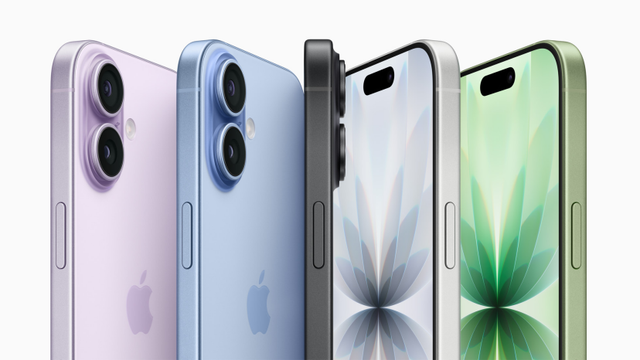
Illustration: iPhone 17 | Source: Apple's official website
Meanwhile, Apple will still introduce three new smartphone models at its product launch event in September this year: the iPhone 18 Pro/Max and the rumored new Apple foldable device. Notably, amid the recent widespread price hikes in consumer electronics, Apple plans to adopt an aggressive pricing strategy to assert its product authority. It intends to keep the starting price of the entry-level iPhone 18 Pro at 8,999 yuan unchanged while significantly raising the prices of higher-end versions to maintain overall hardware gross margin performance.

Source: Securities Times
Behind this unconventional move lies Apple's precise positioning amid the smartphone industry's downturn. While the industry grapples with cost and sales anxieties, this tech giant has begun leveraging its brand and supply chain advantages to consolidate its market position while further squeezing the living space of competitors through subtle adjustments to product lifecycle and pricing strategies.
01
Apple Doesn't Target the Less Affluent
One fears not Apple's innovation but its serious foray into a 'price war.'
In early April this year, multiple media outlets cited Korean supply chain sources stating that Apple was acquiring available DRAM memory at high prices. Earlier, in February, Apple was reported to have accepted NAND flash memory quotes from Samsung Electronics' semiconductor division at a 100% premium.

Source: Jiemian News
Analysts believe that by sacrificing some operating profits to purchase memory chips at high prices, Apple aims not only to meet the production capacity needs of its new devices but also to seize the opportunity to prevent competitors from obtaining sufficient memory chip supplies.
With the latest pricing strategy for the iPhone 18 Pro series exposed, Apple's actions to address rising supply chain costs seem more aggressive than expected.
Amid the smartphone industry's downturn, Apple plans to use the 8,999 yuan 'budget' iPhone 18 Pro to stabilize new device shipments and market share while significantly raising the prices of higher-end versions to distribute memory chip cost pressures to versions with stronger pricing power.
This subtle pricing maneuver, which 'doesn't target the less affluent,' stems from Apple's positive shipment expectations for the iPhone 18 Pro series. Moreover, with the imminent release of Apple's new foldable device, sales of Apple's models priced above 10,000 yuan are expected to reach new heights, further boosting hardware gross margins.
This 'budget model defends territory, high-end model boosts profits' strategy not only ensures the stability of Apple's overall sales and hardware gross margin levels but also significantly hits the Achilles' heel of current high-end flagship models from Chinese Android manufacturers.
With intensifying industry competition and upstream cost pressures in recent years, Chinese smartphone brands have begun accelerating the development of high-end flagship models to enhance product pricing power. The starting prices of several new Chinese models, including the Xiaomi 14 Ultra and OPPO Find X9 Ultra, have already surpassed the 6,000-7,000 yuan range, directly competing with the iPhone Pro series.
Facing this new competitive landscape, Apple has chosen to 'not raise prices' to strengthen the price moat of its Pro product line, effectively blocking competitors' breakthroughs in their high-end product lines.
To address the ongoing supply chain cost crisis, Apple has another ace up its sleeve: delaying the release of the base model of the iPhone 18.
Following its regular update cycle, Apple would typically release the entire iPhone 18 series in September this year. However, according to current supply chain reports, Apple will continue producing the iPhone 17 series and delay the release of the base model of the iPhone 18 until next spring.
Analysts expect this to be a comprehensive adjustment of Apple's product priorities, concentrating core resources on the Pro/Max series and new foldable models with higher hardware gross margins, sacrificing short-term sales data to pursue profit maximization.

Concept image of Apple's new foldable device | Source: Internet
This unusual release schedule may further alter the current landscape of the Chinese smartphone market. Apple's dense (intensive) release of high-end models in the second half of the year will cover the 8,000-20,000 yuan price range, squeezing the living space of Chinese high-end flagships. Meanwhile, the delayed release of the base model of the iPhone 18 will create a staggered competition with mainstream models from Chinese brands next spring, disrupting competitors' product rhythms.
02
The Confidence Behind Counter-Trend Growth
Apple's confidence in making these strategic adjustments stems from its recent strong financial performance and market presence.
On April 30, Apple released its financial results for the second quarter of fiscal year 2026 (ending March 28, 2026). The data showed that the company achieved revenue of $111.184 billion in the quarter, up approximately 16.6% year-over-year, with net income of $29.578 billion, up about 19.4% year-over-year. Revenue from all regions achieved double-digit growth, which Cook described as Apple's best quarterly performance ever.
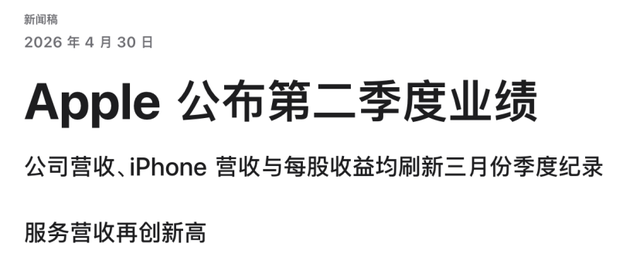
Source: Apple's official website
Notably, iPhone sales increased from $46.841 billion in the same period last fiscal year to $56.994 billion, setting a quarterly revenue record.
From the perspective of market shipments, Apple's iPhone sales have shown counter-trend growth. Omdia reported that global smartphone shipments reached 298.5 million units in the first quarter of 2026, with Apple shipping 60.4 million units, up 10% year-over-year, making it the brand with the highest growth among the Top 5. Focusing on the Chinese market, Apple ranked second with a 19% market share, achieving a remarkable 42% year-over-year increase.
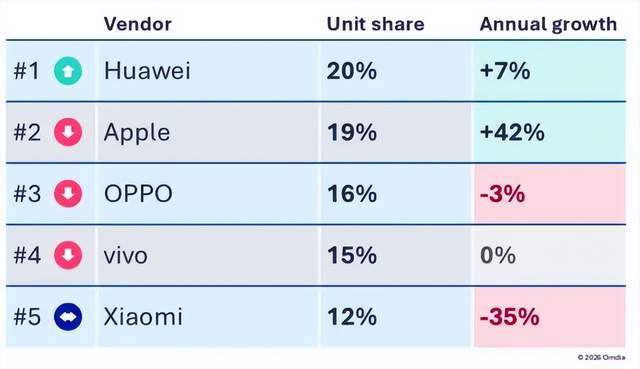
Source: Omdia
Counterpoint's recently released list of the top 10 best-selling smartphones globally in the first quarter of this year further demonstrates the strong market performance of the iPhone 17 series. The data shows that the iPhone 17 became the best-selling model globally this quarter, accounting for 6% of total sales, followed closely by the iPhone 17 Pro Max and iPhone 17 Pro in second and third place, respectively.
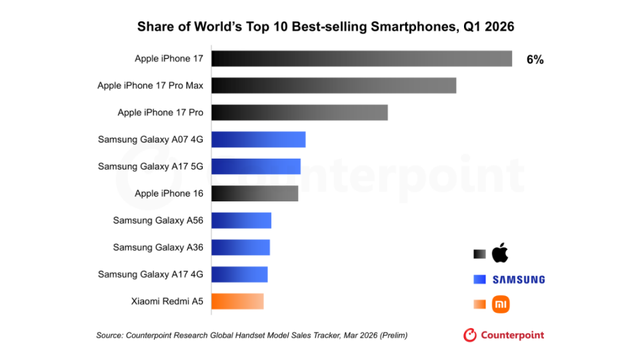
Source: Counterpoint
A senior analyst at Counterpoint stated that the market performance of the iPhone 17 far exceeds that of its predecessors. Its base storage, camera resolution, and screen refresh rate have all been upgraded, significantly narrowing the configuration gap with the Pro versions and offering higher product value for the mass market.
The report further indicates that iPhone 17 sales achieved double-digit year-over-year growth in core markets such as China and the United States in the first quarter, with sales in South Korea tripling compared to the previous generation.
The record-breaking revenue performance of the iPhone business and the sustained strong sales of the iPhone 17 series in the high-end market provide Apple with sufficient room for maneuver in its next-generation product release strategy.
Amid the supply chain cost crisis, profound changes are occurring in the global smartphone terminal market, and Apple is clearly one of the few beneficiaries of this transformation. Facing industry-wide downward revisions in shipment expectations and slowing growth, Apple has absorbed most of the cost pressures through its supply chain advantages while further consolidating its strengths by maintaining its pricing strategy and product iteration rhythm. In the long run, this advantage will translate into more direct market share gains.
Apple's accelerated expansion also highlights another harsh reality: the market space left for Chinese smartphone brands is being further compressed.
03
Storage Giants Revel While Smartphone Manufacturers Struggle
Apple's counter-trend growth cannot conceal the fact that the global smartphone industry is still caught in a storage supercycle.
According to SemiAnalysis data, mobile LPDDR5 memory prices have surged threefold since the first quarter of 2025, currently standing at around $10/GB under contract, with double-digit price increases expected in 2027.
The latest financial reports from storage giants further demonstrate the power of this supercycle.
In the first quarter of 2026, storage chip giants such as Samsung Electronics and SK Hynix delivered their strongest quarterly results ever. Samsung Electronics reported total operating revenue of 133.9 trillion won and operating profit of 57.2 trillion won, up 69.16% and 756.1% year-over-year, respectively. Its single-quarter profit surpassed the total for all of 2025, with its semiconductor business scale expanding nearly 50-fold over the past year.
SK Hynix, meanwhile, reported revenue of 52.58 trillion won in the first quarter of this year, up 160% sequentially and 298% year-over-year. Operating profit reached 37.61 trillion won, up 196% sequentially and 505% year-over-year, with a corresponding operating profit margin of 72%, setting a new single-quarter record.
At the root, this storage supercycle stems from the combined effects of explosive demand for AI servers and contraction in upstream supply. With the global AI business still expanding, it indicates that the storage price surge has not yet peaked.
Facing this supply chain reality, Chinese smartphone manufacturers are reducing their reliance on Samsung and SK Hynix by increasing cooperation with domestic storage manufacturer (manufacturers) such as Yangtze Memory Technologies and ChangXin Memory Technologies. At the same time, major brands are continuously optimizing their product mix, such as reducing storage configurations in mid-to-low-end models and adjusting pricing for high-end models, to disperse (disperse) upstream cost pressures.
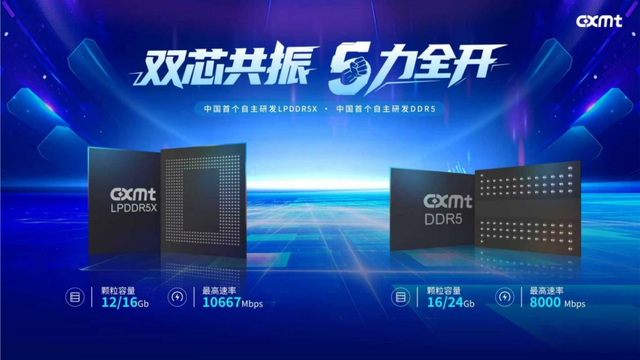
ChangXin Memory Technologies recently unveiled its self-developed LPDDR5X | Source: ChangXin Memory Technologies
In the long run, the smartphone industry will still face a prolonged adjustment period. IDC previously predicted that global smartphone shipments are expected to decline by 13% year-over-year in 2026, decreasing by approximately 160 million units to around 1.1 billion units in total. A supply chain-driven transformation is reshaping the global smartphone industry's competitive landscape.
Currently, Apple continues to deepen new product moats during the industry downturn by leveraging its comprehensive advantages in branding, supply chain, and pricing. For Chinese smartphone brands, which have traditionally relied on cost-effectiveness, there is a need to accelerate technological innovation, product differentiation, and supply chain management to find new breakthroughs and offset upstream cost pressures.
Some images are sourced from the internet. Please inform us for removal if there is any infringement.
-
![]()
Doubao's Upcoming Subscription Model: Without Transparent Pricing, There's No Room for Competition
-
![]()
"Strongest Body" QKing Robotics Strengthens Its "Brain" to Move from Competence to Capability
-
![]()
Apple feeds Hynix and wants to earn more too
-
![]()
What Other Big Moves Is Zhejiang Making Besides Unitree and DeepSeek?
-
![]()
Exchanging Profit for Growth: Insta360 Has No Retreat
-
![]()
After Doubao, OpenAI Turns Its Attention to AI Smartphones—A Bold Move with High Risks
-
![]()
Leapmotor Achieves Record Sales but Faces Challenge of Shedding 'Budget-Friendly' Image | Auto Circle
-
![]()
Observation | ByteDance's 842 Billion Baht AI Data Center Investment in Thailand: Facing a Funding Gap, Why Double Down?