After Doubao, OpenAI Turns Its Attention to AI Smartphones—A Bold Move with High Risks
 05/08 2026
 379
379

The launch of Doubao AI smartphones late last year captured the imagination of both the industry and the general public. Last month, TF International Securities analyst Ming-Chi Kuo disclosed that OpenAI, a global leader in large AI models, is also preparing to enter the AI smartphone market. The company is ramping up its AI smartphone project, aiming for mass production in the first half of 2027. OpenAI plans to collaborate with MediaTek and Qualcomm on custom chip development, with Luxshare Precision handling the manufacturing. This news has left many questioning why large AI model companies are so eager to dive into the smartphone business. In my opinion, whether it's ByteDance's Doubao or OpenAI, their underlying motivation for actively pursuing AI smartphones is remarkably similar: they aspire to transcend being mere applications on iOS or Android and instead become the operating system that orchestrates everything. Specifically, four key reasons cannot be overlooked:
1. Fully Unleashing the Potential of AI Agents
Current smartphone operating systems are not tailored for AI agents, with stringent permission sandboxes that limit AI's ability to collaborate across different applications. The advantages of developing one's own smartphones are evident: they allow for a complete overhaul of the operating system, placing AI at the core. This enables direct hardware and application scheduling, realizing the ultimate vision of 'completing complex tasks with a single command'.
2. Capturing the Super Gateway of the AI Era
In the foreseeable future, smartphones will continue to be the intelligent devices with the largest user base and the most diverse usage scenarios. This makes AI smartphones the ideal platform for large AI models to directly reach consumers. Controlling smartphones provides access to the most critical app distribution platform and traffic gateway in the AI era, with the ultimate aim of replacing traditional app ecosystems with AI agents.
3. Overcoming the Data Bottleneck for AI Training
As internet text data reaches its peak, smartphones, acting as 'electronic organs,' are the perfect devices for collecting multi-dimensional user data (such as location, schedules, visual information, etc.). Having control over hardware terminals can assist large AI model companies in compliantly gathering vast amounts of real-world data to train smarter, more user-aware next-generation models.
4. Achieving a Flawless Commercial Closed Loop
The commercialization of AI smartphones offers immense potential. From API subscriptions to selling hardware bundled with services, it enhances profit margins and user loyalty, creating a flawless commercial closed loop. In the long run, AI smartphones can also provide a compelling narrative for ByteDance's ecological expansion and OpenAI's path to going public.
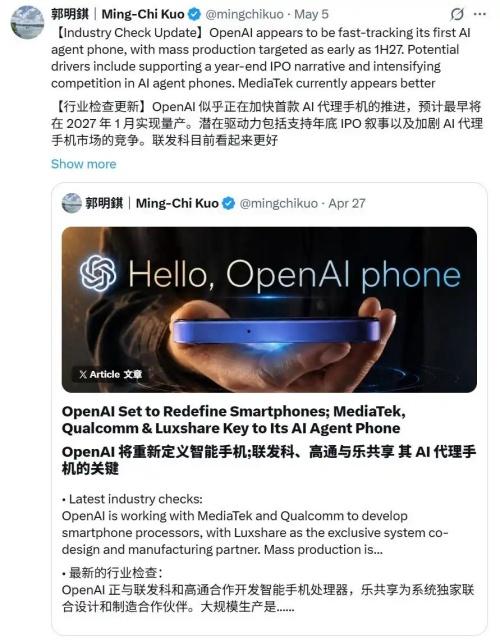
According to Ming-Chi Kuo, the AI smartphone envisioned by OpenAI features a highly disruptive interaction model, potentially eliminating the need for traditional apps. In other words, this phone will herald a shift from app-based to agent-based interactions: future phone interfaces may no longer be cluttered with app icons, and users won't need to actively search for and open applications. Instead, they will interact with AI through natural language. For instance, when a user says, 'I'm hungry, I want to eat Sichuan cuisine with a budget of 50 yuan,' the AI will automatically invoke backend services to complete ordering, payment, and other operations without the user needing to know which specific app was used. Meanwhile, the phone's hardware will be deeply customized for AI computing, meaning hardware specifications are designed specifically for AI. Thus, you'll see:
① Processor: Custom-developed in collaboration with MediaTek, utilizing TSMC's advanced 2nm process and featuring a unique dual-NPU architecture to support collaborative local and cloud inference. This balances daily task fluidity, privacy security, and powerful computing for complex tasks.
② Storage and Memory: Adopting an LPDDR6 + UFS 5.0 combination to meet the massive data read/write demands generated by continuous AI agent operation, preventing memory bandwidth bottlenecks.
③ Security Solutions: Employing technologies like pKVM (platform-based virtual machines) to isolate AI inference tasks in independent secure environments, addressing privacy challenges arising from AI's need to access user screen information.
Despite its ambitious vision, OpenAI's foray into smartphones is destined to encounter numerous challenges, primarily facing three major hurdles:
① Supply Chain and Manufacturing: Smartphone manufacturing involves hundreds of suppliers and thousands of processes, posing a significant challenge for OpenAI, which lacks hardware experience. Faced with daunting issues like product yield and production ramp-up, this newcomer may inevitably pay a 'learning fee'.
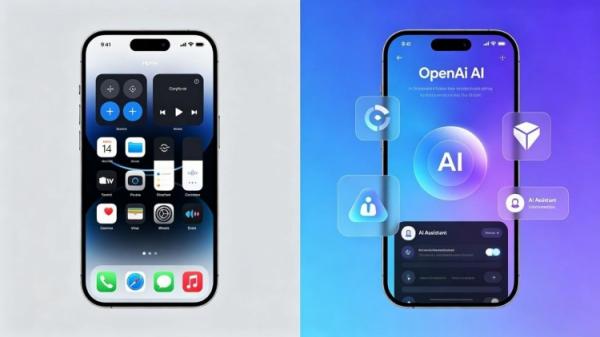
② Market Competition: The global smartphone market is a fiercely competitive arena dominated by Apple, Samsung, and domestic players. Meanwhile, companies like ByteDance, Google, and Apple are also accelerating the integration of AI and hardware. OpenAI's entry is not early, and its differentiated competitive advantage is not immediately apparent.
③ Privacy and Regulation: AI requires deep access to user data to provide personalized services, which will face stringent data regulations and user privacy concerns in European and American markets with higher corporate compliance requirements.
In summary, OpenAI's venture into smartphones is not a mere trend-following move but a high-stakes gamble. Its goal is not to carve out a share of the existing market but to create an entirely new arena, betting on the AI-native computing era. This is not just commercial competition but a battle over who defines the interaction model of the next-generation computing platform. Its success or failure will profoundly influence the future direction of AI technology development and the global tech industry landscape. In essence, both ByteDance and OpenAI are striving to prove a developmental trend—AI is no longer just a feature of smartphones but their future. What are your thoughts?
-
![]()
Doubao's Upcoming Subscription Model: Without Transparent Pricing, There's No Room for Competition
-
![]()
"Strongest Body" QKing Robotics Strengthens Its "Brain" to Move from Competence to Capability
-
![]()
Apple feeds Hynix and wants to earn more too
-
![]()
What Other Big Moves Is Zhejiang Making Besides Unitree and DeepSeek?
-
![]()
Exchanging Profit for Growth: Insta360 Has No Retreat
-
![]()
After Doubao, OpenAI Turns Its Attention to AI Smartphones—A Bold Move with High Risks
-
![]()
Leapmotor Achieves Record Sales but Faces Challenge of Shedding 'Budget-Friendly' Image | Auto Circle
-
![]()
Observation | ByteDance's 842 Billion Baht AI Data Center Investment in Thailand: Facing a Funding Gap, Why Double Down?