Yu Hao: The Ubiquitous Force
 05/15 2026
 564
564

Yu Hao, a prominent figure on the internet, consistently showcases his independent spirit.
I vividly recall a recent in-depth interview with DJI's Frank Wang by LatePost, which left a lasting impression.
Wang discussed DJI's contemplation of entering the automotive industry but ultimately concluded that they lacked the necessary capabilities.
What DJI didn't pursue, Dreame did.
At the recent Beijing Auto Show, Dreame's booth featured a car that caught everyone's attention.
Shortly after Wang's interview, LatePost also conducted an interview with Yu Hao.
In the interview, Wang expressed his strong opinions and did not shy away from addressing critical issues.
He also evaluated Yu Hao, describing him as a "rare entrepreneur" of this era.
Conversely, in Yu Hao's interview, perhaps due to my limited perspective and understanding, I did not find solutions to core issues.
However, he exuded confidence, aligning with the external perception of his image.
Of course, this does not diminish Yu Hao's uniqueness.

Image Source: AI
An entrepreneur who posts dozens of videos daily and promptly responds to trending controversies is indeed a rare sight.
Someone in my WeChat circle mentioned that whenever they had time to browse videos, Yu Hao's content kept appearing. When opening subscribed accounts, a continuous stream of news about Dreame and Yu Hao would show up.
Yu Hao has effectively occupied my fragmented time.
01
Dominating Screens and Rankings
In 2026, whether in the tech or finance circles, Dreame founder Yu Hao will be the most contradictory business icon.
On January 19th of this year, I woke up to find that I had gained a follower named Yu Hao on Douyin and Xiaohongshu.
He was the founder of Dreame.
Later, I noticed Yu Hao frequently appearing in the comment sections of various self-media articles, always timely at crucial moments.
"Isn't Dreame's boss overloaded with work?" I occasionally wondered.
But unexpectedly, his output, ranging from product videos to personal recordings, kept increasing, sometimes with dozens of updates daily.
In the business circle, Yu Hao is undoubtedly the most diligent video producer.
A media friend joked: If any media or self-media video team had such productivity, they could become the local Murdoch.
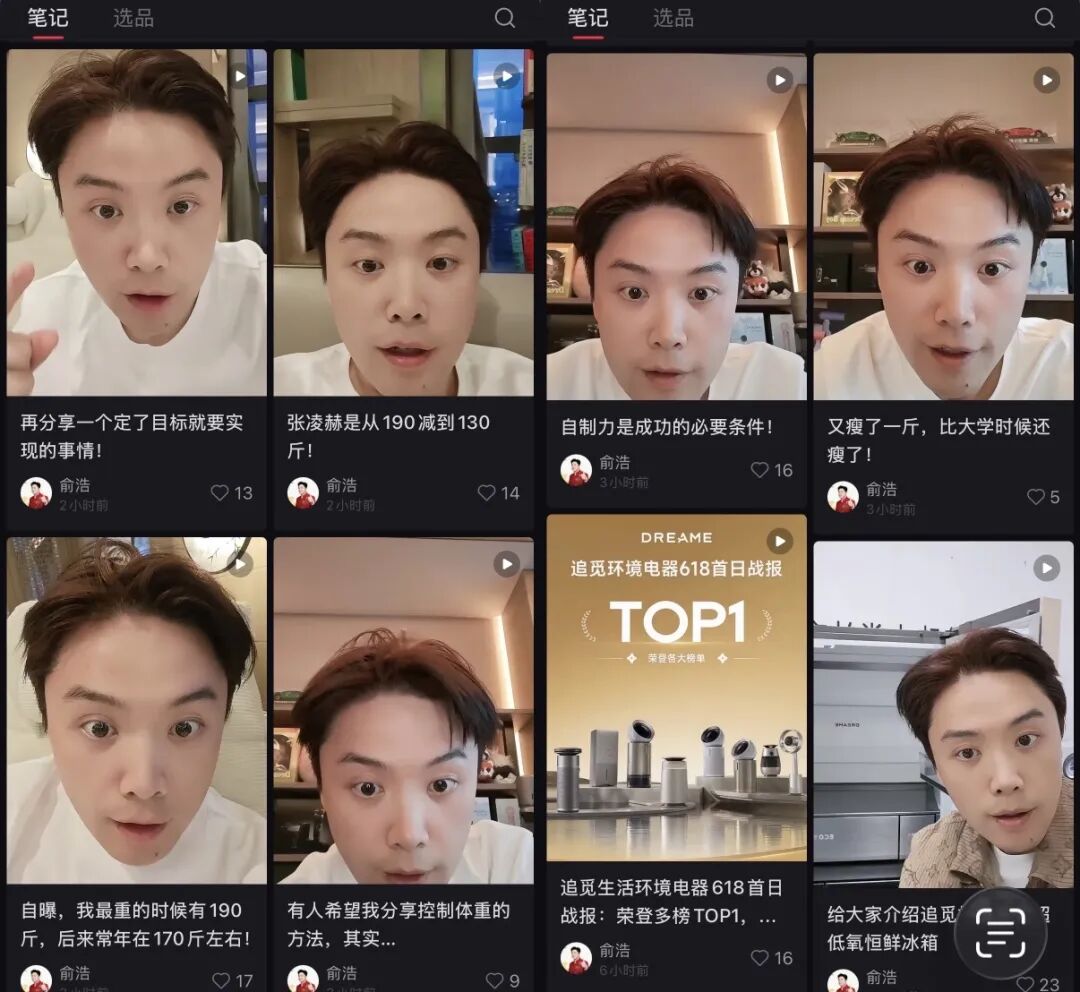
Image Source: Screenshot from Xiaohongshu
Not long ago, Insta360 CEO Liu Jingkang posted on WeChat, "Why do I see that man on every video platform? He's not even a female CEO, so why the constant screen dominance?"
Liu soon received a response from Yu Hao, who not only shared a screenshot of Liu's post but also paired it with a photo of himself AI-transformed into a female image.
The caption read: "Heard a famous tech tycoon likes beautiful women. Here you go."
To paraphrase a common Bilibili comment, CEO Yu's creativity knows no bounds.
On platforms like WeChat Channels and Weibo, his update frequency is truly boundless.
During peak creative periods, he posts content every five minutes on average, with up to 75 social media updates in a day.
Moreover, his content is diverse, lacking a fixed formula.
Sometimes he showcases Dreame products, dissecting technical highlights; other times, he shares lab experiences from his Tsinghua days or casual life snippets, even playing with trending AI memes.
Through a highly shareable influencer-style approach, he organically penetrates users' smartphone screens on short video platforms.
02
From Personal Approach to Company Matrix
In April, Yu Hao publicly criticized Xiaohongshu.
Before everyone could react, Dreame sued over 100 accounts across Douyin, Kuaishou, Xiaohongshu, and WeChat.
Subsequently, he assigned tasks to Dreame employees, transforming this screen-dominating strategy into a company-wide initiative.
He required all employees to open social media accounts, amplifying brand presence through personal channels, with rewards based on follower counts.
Dreame employees must post three videos daily, earning 10,000 yuan for 10,000 genuine followers and 100,000 yuan for 100,000 followers.
I've come across their videos too.
Suddenly, Dreame employees' content flooded major platforms, synergizing with Yu Hao's personal account to form an extensive brand communication matrix.
The name "Dreame" reached more users in the lightest possible way.
03
Rapidly Expanding Business Lines
Yu Hao's "ubiquity" is also evident in Dreame's expanding business lines.
Although he missed the San Francisco product launch and spoke for only three minutes at Shanghai's AWE Household Appliances Exhibition (Home Appliance Expo), Dreame's expansion never halted.
He harbors grand commercial ambitions.
Dreame's expansion began with its core cleaning appliance business.
As a company starting with robotic vacuums and floor washers, Dreame surged in the cleaning sector.
According to IDC, Dreame's shipments even surpassed Ecovacs in the second half of 2025, ranking second globally.
Dreame even adapted automotive LiDAR for lawnmower scenarios, solving core industry challenges in perception and algorithms.
While competitors slashed prices to $499, Dreame's similar products sold for $1,999 and remained popular, securing a foothold in the high-end European and American markets through differentiated innovation and finding a new second growth curve for the company's subsequent expansion.
But Yu Hao is clearly not satisfied with just the cleaning appliance market. He led Dreame into a comprehensive category expansion, embarking on a "borderless sprint."
In the major appliance sector, Dreame ventured into kitchen appliances, refrigerators, air conditioners, washing machines, and more, recruiting industry veterans from LG, Hisense, Bosch Siemens, and other giants. They compressed the traditional two-to-three-year iteration cycle to one generation per year.
They aim for "non-incremental innovation," equipping first-generation products with top-tier functions and quickly achieving autonomous innovation breakthroughs in the second generation.
In the smart hardware sector, Dreame's expansion speed is astonishing.
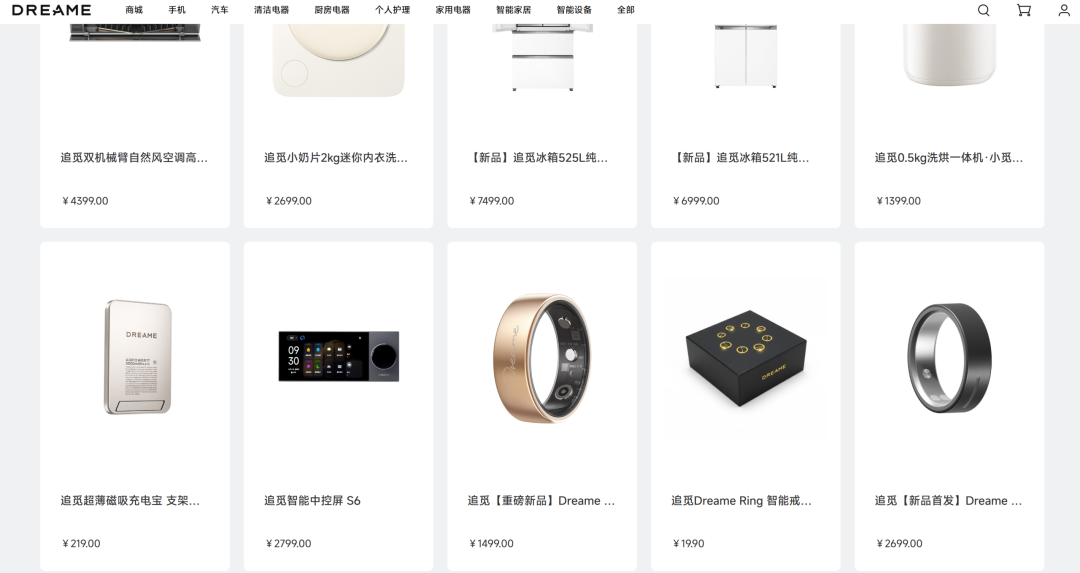
Image Source: Screenshot from Dreame's official website
The AI pendant project team, with only 14 members, initiated the project in one month, launched the "Voice Business Card" for commercialization trial in three months, and plans subsequent Pro versions and AI pendant products;
The AI glasses project, initiated in February, manually assembled the first engineering prototype from scratch in under 90 days, entered design verification in May, and plans to launch by late June. Even before the first-generation product's release, development of the second generation had already started.
But this did not satisfy Yu Hao; he wanted more.
Dreame also ventured into smartphones and intelligent concept vehicles. At the San Francisco product launch, a concept car featuring rocket thruster designs debuted.
This represents Dreame's ambition to enter the "human-vehicle-home smart ecosystem," building a product matrix covering all life scenarios.
Some compare Dreame's expansion to LeEco's "ecosystem chemical reaction," considering the San Francisco launch venue was the same as LeEco's "Big Bang" event a decade ago.
04
Core Support for Expansion
In the LatePost interview, Yu Hao mentioned Jia Yueting.
He believes they are fundamentally different: LeEco relied on capital infusions and never achieved true profitability;
Dreame, from the start, focused on profitability, with core businesses generating sustained revenue and new businesses required to achieve self-sufficiency quickly, rather than relying solely on conceptual hype.
Supporting Dreame's rapid expansion is Yu Hao's "Incubator + BG + BU" organizational model and his "N+1" innovation theory.
The "Incubator + BG + BU" model is essentially an internal entrepreneurship platform where new businesses can quickly form BUs or BGs, with teams independently securing resources and external financing. Dreame only provides the starting line, not long-term support;
According to Huxiu, Dreame has no cumbersome project approval processes; "If you want to do it, just say so." However, all businesses face strict evaluation criteria.
Sometimes, Yu Hao allocates less than a minute for monthly reports, asking only four core figures: current month's revenue, profit, and next month's projected revenue, profit.
A BU has a 3-6 month window to meet expectations; otherwise, it faces rapid adjustments or personnel/strategy changes.
Whenever Dreame enters a new sector, it doesn't start from scratch but builds on industry maturity to quickly create premium-priced products. This is the core support enabling Dreame's rapid entry into multiple sectors.
Such rapid commercial expansion exceeds common understanding.
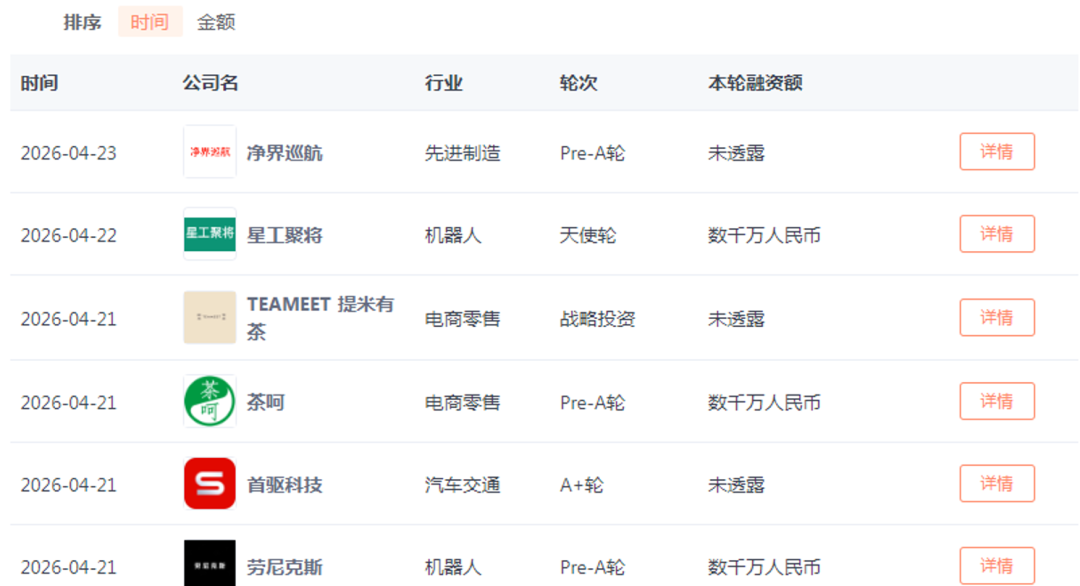
Image Source: IT Juzi
Yu Hao is not unaware of external doubts.
In the interview, he said, "You think I'm gambling because I set a goal that seems difficult to you."
Yu Hao doesn't consider himself a gambler; he claims to dislike risks, citing his approach with vacuum cleaners, hair dryers, and robotic vacuums—he didn't bet on a single category but pursued all.
Another source of confidence is Dreame's stable core business, which grows 100% annually and remains profitable.
Regarding grand goals, Yu Hao believes that by seeing the underlying laws of things and deducing the future based on them, while others lack this insight.
"They can't see the future, so they think I'm crazy."
05
Business Model Validation Needed?
Yu Hao's confidence stems from his business model and theories, evident from previous interviews.
First, he mentioned the "Four Quadrants":
1. What are the most successful companies in the industry doing? They learn existing knowledge and try to innovate and add value;
2. What are innovative companies in the industry doing? They learn from or avoid them;
3. Cross-industry transplantation: Adopt proven effective strategies from other sectors;
4. First principles: Start from demand and rethink.
Then, there's the N+1 method, which he believes offers ten times greater commercial value than traditional approaches.
This is also a concrete understanding of the four quadrants.
By achieving "N" (what the world's most advanced products do) and adding "+1"—something consumers can perceive and appreciate—it can command high premiums.
Conversely, "N-1" companies are destined to compete only in local markets like China;
They have little chance to become "Apple-level" entities, whose commercial value is several times that of runners-up; competitors are scarce.

Image Source: Taken by the author
Yu Hao believes this is a business model no one else has mastered, but it can't be proven correct yet.
Because only when he reaches the finish line can he prove himself right, and he's just started.
As Yu Hao himself said, "Money never lies."
Whether Dreame's expansion can sustain? Whether Yu Hao's business logic holds?
Ultimately, the market and financial data will provide the answers.
But for now, the "ubiquitous" Yu Hao serves as both a signal of Dreame's expansion and a unique label for the company.
In the interview, Yu Hao discussed the integration of physics and the business world.
"Failure only occurs because you haven't grasped the law. Once you truly understand it, success is inevitable."
But ultimately, it requires commercial proof.
-
![]()
From Dominance to Just One Slot: Fuel Vehicles Fully 'Marginalized'
-
![]()
Doubao Goes Premium, Wukong Goes for Volume: The Divergence of AI Assistants
-
![]()
Yu Hao: The Ubiquitous Force
-
![]()
The Honda that Did Everything Itself is Gone for Good
-
![]()
Why Pocket 4 is in Short Supply and OV is Making a Strong Entry: Why Pocket Gimbal Cameras Have Suddenly Become a New Battleground
-
![]()
Doubao Embraces Premium Tier, Wukong Expands: The Divergence Paths of AI Assistants
-
![]()
China Holds the Key to Success or Failure, BMW's New CEO Faces a Do-or-Die Battle
-
![]()
Holding Similar AI “Passes,” Alibaba and Tencent Have Transformed Beyond Recognition