Global Stock Markets Surge in AI-Driven Structural Boom
 05/18 2026
 401
401

Real Value Versus Speculative Bubbles
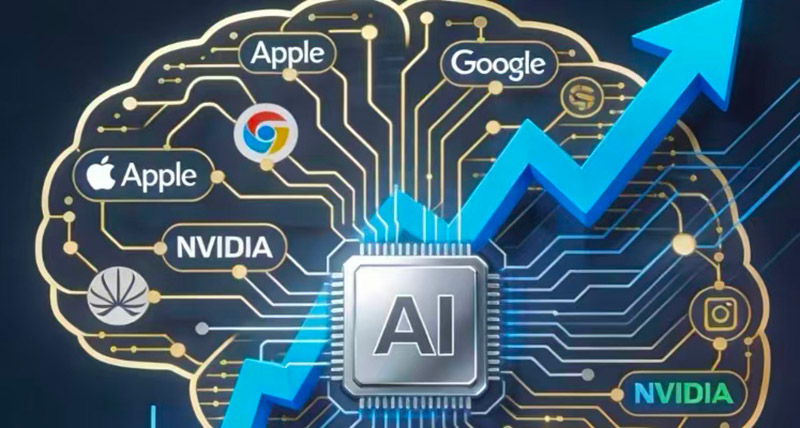
Since the start of the year, global capital markets have witnessed an unprecedented structural divergence. The S&P 500 and Nasdaq indices have repeatedly reached all-time highs, while the Shanghai Composite Index in A-shares has returned to the 4,000-point level for the first time in a decade. However, behind this index-driven prosperity lies the near-monopoly of market gains by the AI industry chain.
Sengma Finance has observed that leading financial institutions, including JPMorgan Chase and Deutsche Bank, have issued frequent warnings, stating that this rally has evolved into a "rare structural frenzy in capital market history," with polarization even surpassing that of the 2000 dot-com bubble. So, what significant events have unfolded in global capital markets, and how long can this AI-fueled structural rally, spanning multiple markets since the beginning of the year, persist?
Extreme Differentiation Amidst Index Exuberance
As of the market close on May 12, 2026, major global stock indices have shown broad-based strength: the S&P 500 closed at 7,398.93 points, up 7% year-to-date; the Nasdaq at 26,247.08 points, up 12% year-to-date; and the Philadelphia Semiconductor Index surged 65% year-to-date, marking a record for rare consecutive gains.
The A-share market also reflects a tech-centric landscape, with the STAR 50 Index up over 30% year-to-date, while traditional sectors such as consumer goods, financials, and real estate continue to consolidate sideways.
The defining characteristic of this bull market is extreme structural polarization. JPMorgan Chase's May 2026 "Global Market Structural Risk Report" clearly indicates that since the release of ChatGPT, just 42 AI-related companies have contributed 65%-75% of the S&P 500's earnings, profits, and capital expenditures. Excluding these 42 stocks, the S&P 500 would actually be in decline.
The total market capitalization of the "Magnificent Seven" U.S. tech stocks (Apple, Microsoft, Nvidia, Google, Amazon, Meta, and Tesla) has surpassed $20 trillion, roughly equivalent to the entire A-share market's total capitalization. Among them, Nvidia's market cap reached $5.23 trillion, up 15% year-to-date.
At the valuation level, signs of a market bubble are already apparent. As of May 11, the S&P 500 Shiller Cyclically Adjusted Price-to-Earnings (CAPE) ratio reached 39.5 times, with a historical percentile around 98%, marking the second-highest level in 155 years, second only to the 44.2 times peak during the 2000 dot-com bubble.
The polarization phenomenon in the A-share market is equally pronounced. First-quarter 2026 data shows that net profits in the computer (AI software) sector surged 121.58% year-on-year, while the electronics (semiconductor/computing hardware) sector grew 73%. In contrast, the agriculture, forestry, and fisheries sector swung to a loss, and several leading companies in the photovoltaic sector reported substantial losses. Active equity funds have allocated 31.5% of their portfolios to AI hardware, an overweight of 17.7 percentage points, surpassing the peak level of the "Ning Combination" in 2021.
The Underlying Logic of AI-Driven Market Trends
This AI-dominated structural bull market is not merely fueled by speculative hype but is the result of a profound convergence of industrial, earnings, and capital forces.
On the industrial front, a historic AI arms race has commenced globally. The four major cloud computing providers—Microsoft, Amazon, Meta, and Google—are expected to spend a combined $725 billion on AI capital expenditures in 2026, a 77% surge from $410 billion in 2025. Morgan Stanley recently predicted that global AI data center investments will reach $2.8 trillion from 2026 to 2028, with a compound annual growth rate of approximately 33%.
OpenAI plans to invest $1 trillion in building the world's largest data center cluster, creating a virtuous cycle where unlimited capital investment drives computing demand, boosts earnings, and triggers further capital inflows.
On the earnings front, the profit explosion in the AI industry chain provides short-term valuation support. CICC research shows that S&P 500 earnings growth reached 28% in the first quarter of 2026, the highest since the fourth quarter of 2021, with the communications services sector up 51%, information technology 48%, and semiconductors and equipment a staggering 99%.
The A-share market mirrors this trend, with Shanghai Stock Exchange data showing that the combined net profits of over 30 AI companies on the STAR Market surged 200.8% year-on-year in 2025, while integrated circuit chain companies saw an 86.3% profit increase.
On the capital front, global funds have shown extreme concentration. Sovereign wealth funds, pensions, and quantitative funds have all increased their exposure to the AI sector. JPMorgan Chase's May 12 report recommended overweighting Chinese tech stocks, citing China's AI ecosystem explosion and rapid iteration of domestic large models. Foreign capital continues to flow into A-share tech stocks, becoming a key driver of the rally.
Real Value Versus Speculative Bubbles
This AI-led structural rally represents both the capital manifestation of a technological revolution and significant market risks.
From a positive perspective, the market's exuberant pricing is accelerating the industrialization of AI technologies. Massive capital inflows into computing infrastructure, large model development, and industry applications are driving AI from laboratories to the real economy, potentially becoming a new engine for global economic growth.
JPMorgan Chase CEO Jamie Dimon stated, "A $1 trillion data center investment is entirely reasonable; technology will ultimately recoup the investment value." BlackRock CEO Larry Fink also believes, "We haven't even begun to explore the global opportunities presented by AI."
However, extreme market polarization also brings significant risks. Deutsche Bank warns that current market concentration has reached historic records, with a single theme monopolizing over 70% of market-wide gains—a situation never seen before. This structure is inherently fragile. Any failure to meet AI capital expenditure profit expectations or black swan events like power supply constraints or geopolitical conflicts could easily trigger a cascading sell-off.
Sengma Finance argues that while this rally shares similarities with the 2000 dot-com bubble—such as extreme capital concentration and valuation surges—there are fundamental differences. The key distinction is that most internet companies in 2000 had no profits or revenues, whereas current AI upstream chip and computing hardware companies are delivering genuine earnings growth. This suggests that while the current rally won't replicate the 2000 total collapse, it will experience severe structural differentiation.
Moreover, the current "AI-dominated" phenomenon in global stock markets is essentially a structural super bull market driven by the general artificial intelligence technological revolution and global capital oversupply. It represents not a comprehensive market bubble but rather a valuation bubble in computing hardware and a polarization bubble in market structure.
Looking ahead, as the AI industry transitions from a capital investment phase to a profit realization phase, the market will undergo a brutal shakeout. Leading AI companies with core technologies and genuine earnings will continue to benefit, while small and mid-cap AI firms without viable applications and purely conceptual hype will face sharp valuation corrections. For investors, maintaining rationality and distinguishing between real value and speculative bubbles is more critical than chasing short-term gains in this "AI Mad Bull Market."

END
-
![]()
Ford and Geely Forge New Joint Venture in Spain, Sidestepping Changan and JMC
-
![]()
199 RMB! Godox's First Camera Review: Subpar Photography, Transparent Viewfinder Frame is the Highlight
-
![]()
AI Smartphones: A Modern-Day 'Emperor's New Clothes'?
-
![]()
Yonyou Network: A Company Selling 'Transformation' but Struggling in Its Own Transition
-
![]()
Focus | CCCC’s Takeover of Greentown Comes to Fruition: Why Did the 11-Year ‘Control Without Authority’ Era End?
-
![]()
Final Verdict: The 2026 China Auto Forum Shines with Unique Characteristics at a Pivotal Moment
-
![]()
Tencent Maintains Matrix Approach, Alibaba Merges Entry Points: Tech Titans Initiate AI Agent Consolidation
-
![]()
Geely Secures Portion of Ford’s Spanish Production Capacity