In Guizhou’s Mountains, AI Learning Takes Root
 06/11 2026
 536
536
While AI has surged in popularity, only a mere 0.3% of the global population actively utilizes AI tools on a regular basis. So, let's make an educated guess: who exactly makes up that 0.3%?
Few would suspect that left-behind children in Guizhou’s remote mountains, artisans preserving intangible cultural heritage, or local beekeepers could be among them.
Yet, during my visit to Leishan—a former national-level poverty-stricken county in Guizhou—I discovered, quite effortlessly, numerous individuals already leveraging AI in their daily lives.
At Li Xiaoming’s mountain goods store, I found him just wrapping up a conversation with an AI system on his computer. A glance revealed his query: “cultivation techniques for XX mushrooms.” Nearby, a haphazard stack of AI toolbooks mingled with self-help literature—a collection so niche, it seemed almost staged for a photo op.
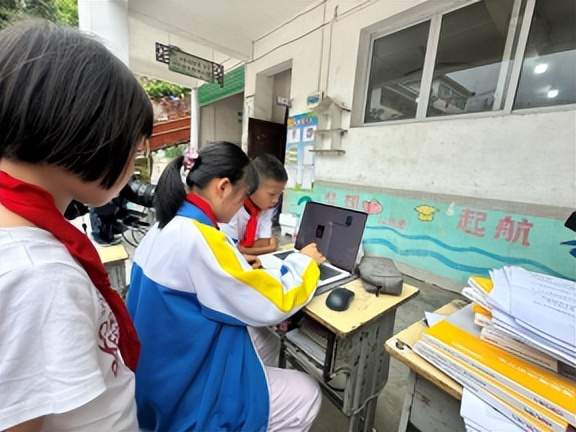
During a break at Qiaosang Primary School, a group of students gathered around a sixth-grade girl, eagerly awaiting AI-generated photos of their dream careers. Without teacher supervision, she input the prompts herself—a skill acquired since the school introduced AI classes.
After departing Leishan, I stumbled upon Hou Changju’s social media journey of self-learning AI. At one moment, she lamented, “AI is so challenging!” Yet, just fourteen minutes later, she exulted, “Feeling like flying!”—accompanied by a photo of herself, seemingly airborne, proudly displaying Miao embroidery—a testament to her success.
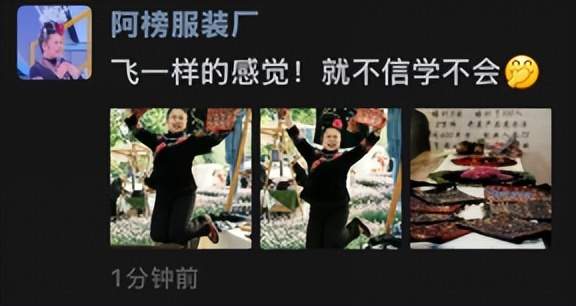
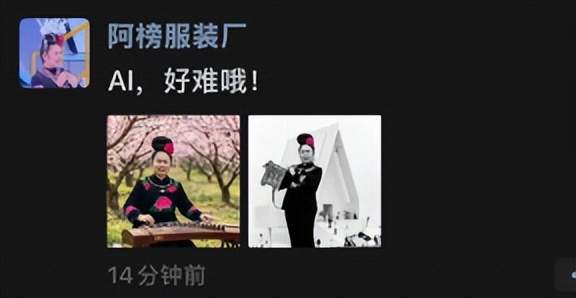
This is no刻意制造的 (deliberately contrived) technological spectacle—AI has simply become woven into the fabric of their daily routines. And this routine underscores a unique phenomenon: AI, a cutting-edge technology accessible to a mere 0.3% of the population, has penetrated deep into these mist-shrouded mountains.
You may be unfamiliar with Leishan, Guizhou. A young teacher assigned there recounted her arduous journey: a train to Rongjiang, followed by a three-hour bus ride to the foothills, and then a 90-minute winding ascent up the mountain road. Only when the mountain peaks vanished from sight did she finally arrive at her school.
Yet, it is these mountain dwellers who find themselves at the vanguard of the intelligent era.
What purposes do they employ AI for? And who has bridged the gap, connecting them to the mainstream of this era?
With these questions in mind, I delved into the AI-infused daily lives of Leishan’s residents, attempting to piece together a fragment of the puzzle that is intelligent China.

Upon arriving at Qiaosang Primary School in Yongle Town, Leishan County, I found the children had just completed their first AI class of the semester, learning to generate their dream careers through prompts.
AI holds no direct bearing on these children’s academic progress. Without the pressure of assessments, why does the school offer such a course? The answer lies in the unique challenges of mountain education.
Most students here are left-behind children, with parents working far from home. Lacking access to new technologies outside school, their digital literacy and AI awareness hinge almost entirely on the educational institution. Regular AI classes provide their sole window into the world of AI.
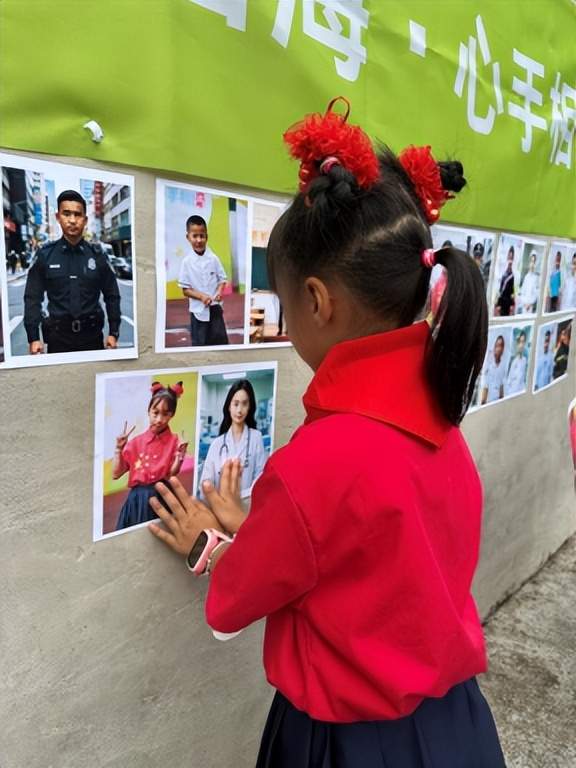
Teacher Wang Qinghai encountered unexpected hurdles when the class commenced. He had not realized that rural students rarely used computers—even basic typing proved difficult. The prompt-inputting step alone left a dozen students across grades stumped.
Ultimately, Wang resorted to screen-sharing to guide them step-by-step: which software to open, how to translate ideas into prompts. Thus, the first AI class unfolded.
What significance did typing a single prompt hold for these children? Wang remarked that it opened their eyes, revealing countless future possibilities through AI.
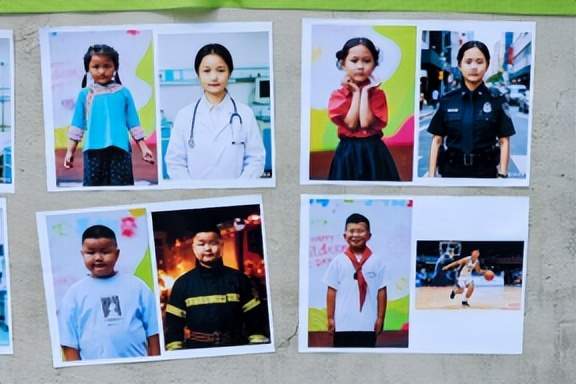
From having no awareness of AI to finally experiencing it firsthand, the students at Qiaosang Primary School achieved a breakthrough from zero to one. However, progressing further encounters real-world barriers.
Limited faculty means only one or two AI classes per semester—sufficient for basic awareness but insufficient for mastery akin to that achieved by urban children, let alone AI programming.
Hardware shortages are also glaring. Most computers in the IT lab are broken; only five function. With 17 students in the largest class, several must share a single computer during IT lessons, reducing hands-on opportunities.
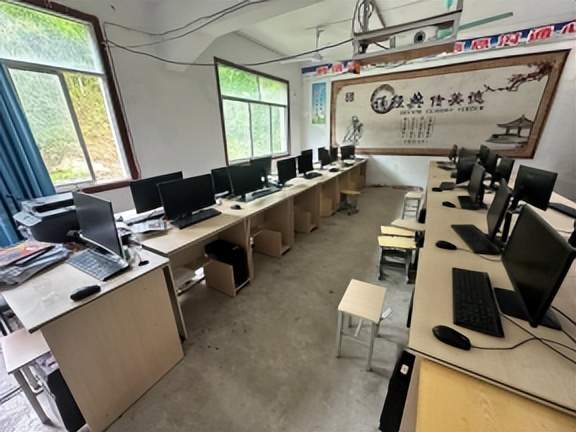
As more students utilize AI, the school’s account quotas quickly deplete. They love generating AI images and videos, but without teacher subscriptions, the quotas expire swiftly, forcing them to wait until the next day.
Through AI, these children glimpse both the future and its limitations. Yet, without this glimpse, they would remain oblivious to the era’s changes until thrust into society.

To teach AI effectively, Qiaosang’s Wang Qinghai first had to master it himself—understanding what AI is and how to wield it effectively. Otherwise, the class could not proceed.
In his three years at the school, Wang has taught science, ethics and law, physical education, and even managed cafeteria nutrition. Now, AI adds to his workload—a new challenge, but one he knows cannot be avoided.
Digital literacy in the AI era encompasses discerning AI-related misinformation in short videos, understanding AI ethics—skills that students can only learn from teachers, as parents and grandparents lack this knowledge. Waiting until they enter society would be too late. Teachers must learn first to teach effectively.
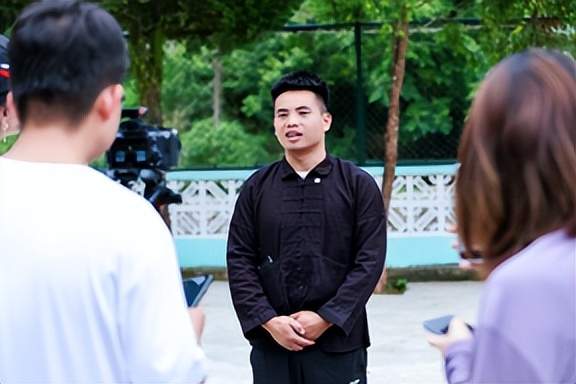
Thus, the multi-tasking Wang decided to resume his studies in the “Green Pepper Plan” to learn how teachers can utilize and teach AI.
Launched in 2017, the Green Pepper Plan (Rural Youth Teacher Social Support Public Welfare Program) operates under the guidance of the Ministry of Education’s Teacher Work Department, initiated by the Youcheng Entrepreneurs Rural Development Foundation, and supported by Huawei’s TECH4ALL digital inclusion project. It provides a one-year online, mentor-supported systematic empowerment program for newly hired rural youth teachers and special-post teachers. Three teachers from Qiaosang Primary School, including Wang, participate—Wang being one of them.
The AI curriculum he resumed studying is an upgraded version of the Green Pepper Plan’s basic IT empowerment. In 2021, amid the AI boom, the plan swiftly iterated its courses, incorporating AI specializations into its core teaching system.
Unlike urban AI education, rural AI courses must consider several factors:
First, teaching professionalism. The market abounds with diverse AI tools, many education-specific ones (like Meta AI) rarely known to the general public, let alone rural teachers. Thus, curating AI tools suited for grassroots teaching—better than general AI assistants for creating courseware or PPTs—is essential.
Second, frontline teacher involvement. University research teams alone cannot grasp rural teachers’ real constraints—such as insufficient school computers or limited student IT skills. Courses must, therefore, be highly detailed.
Online classes alone are insufficient. The AI specialization comprises only five sessions—five hours to build basic awareness. But in practice, rural teachers newly encountering AI face countless unexpected issues when integrating it into office work and teaching, requiring timely discussion and mentor guidance. Wang often seeks help in WeLink’s subject discussion groups rather than struggling alone.
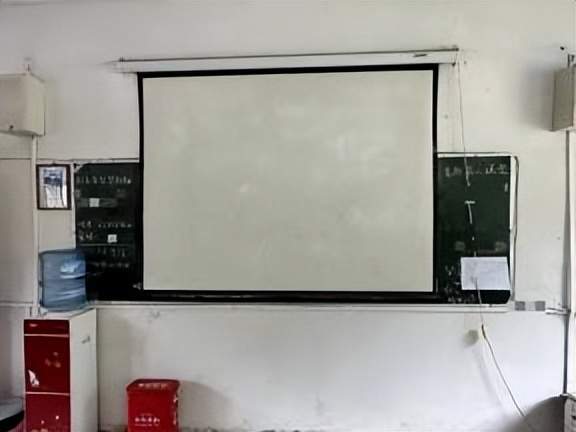
Today, Wang integrates AI into daily lesson preparation, teaching, and office work.
When crafting lesson plans, he first uses AI to generate outlines based on textbooks, then adjusts the content according to specific course needs and difficulty levels, significantly reducing his workload.
After finalizing the plan, AI instantly generates matching teaching PPTs, sparing him late-night formatting—a huge time-saver for the multi-tasking Wang.
For teaching videos, especially for physics, chemistry, and biology experiments lacking equipment or involving dangerous demonstrations, or abstract concepts hard to visualize, he uses AI to generate them. Appropriate prompts quickly produce videos and images for classroom use, addressing a core rural teaching challenge: low student motivation.
Many students lack interest in class. While manageable in lower grades, by fifth or sixth grade, academic pressure mounts, causing anxiety for teachers. AI makes classes more engaging and compensates for rural schools’ resource shortages, improving teaching outcomes.
A Green Pepper Plan staff member told me that some rural teachers feel overwhelmed on their first day, lacking teaching confidence—it takes 3–5 years for new teachers to stabilize. Yet Wang has worked at Qiaosang for three to four years. As long as teachers stay, there’s hope for knowledge inheritance.

Li Xiaoming, a local industry leader in Leishan, is among the earliest mountain residents to embrace AI as a tech enthusiast.
Motivated by his grandmother, Li returned home to start a business, guiding villagers in specialty farming and breeding—first beekeeping, then sheep farming, and now morel mushroom cultivation. His modest base integrates various high-quality local agricultural products, covering the full chain from breeding to processing and sales.
His fascination with AI began due to work overload—constant trivial matters left him exhausted. When he saw short videos claiming AI could handle various tasks, he instantly became hooked, buying useful AI textbooks and tools and learning daily.
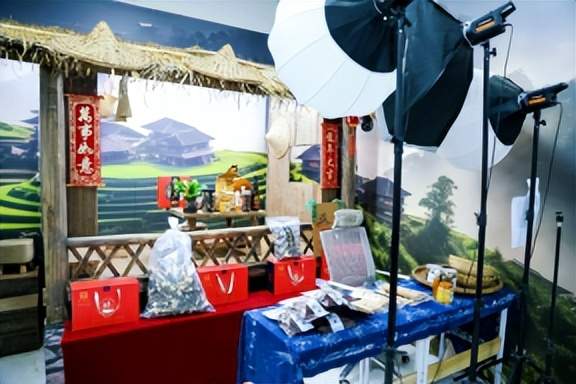
In 2023, as large AI models emerged, he bought an AI mouse for voice-input copywriting. But technology quickly iterated; better large models appeared, and the AI mouse, unupgradeable, was forgotten.
Now, he converses with AI fluently. During our visit, he was asking AI about cultivating a wild mushroom species.
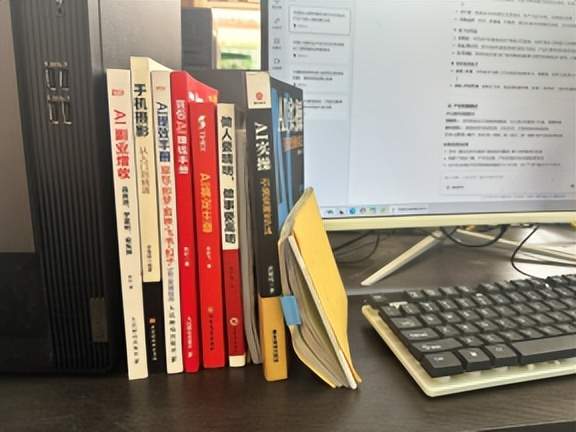
With limited education, he sometimes struggles with writing contracts, reception speeches, or livestream scripts. AI now handles these tasks, referencing content from his past interviews—news about his return home, Party membership, education, and company/cooperative info—with high accuracy, rarely needing revisions.
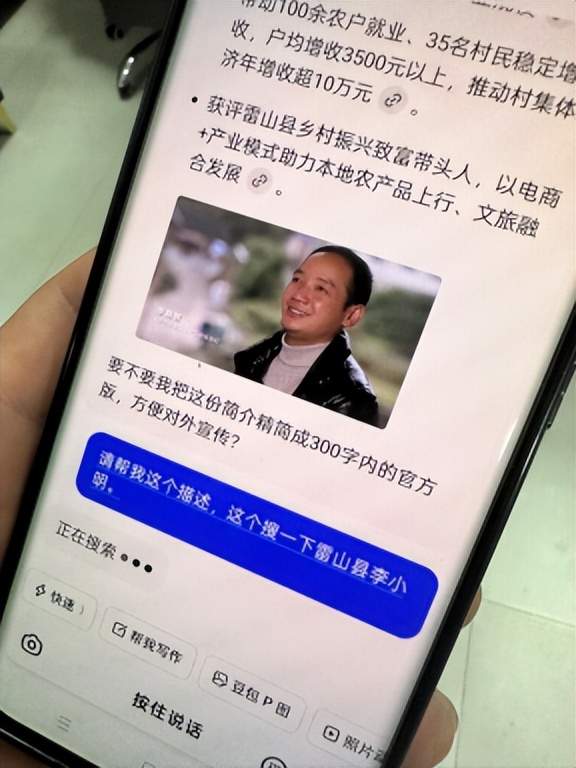
He’s also learning to use “Ji Meng” to generate videos in seconds. Besides personal use, he encourages his team to adopt AI. For a marketing video, he suggested consulting AI. After trying pure AIGC-generated content (with poor traffic), they now combine real footage (e.g., mountain beehives) with AI-generated visuals to promote agricultural products.
In the future, he hopes AI can “replace” him entirely, managing the company without his involvement. “Actually, I’m just brainwashed,” Li laughed.
In reality, they’re slowly accumulating AI experience. Currently, AI aids only in basic Q&A, office support, and light content generation. What rural industries need most is opening sales channels for local products—the deep waters of farm management, customer acquisition, and monetization, where AI rarely participates.

Compared to Li Xiaoming, who actively embraced AI, Hou Changju, an intangible cultural heritage artisan, faced a much more challenging journey in learning AI.
As a stay-at-home mother who relocated from the mountains to a town, Hou Changju had no formal educational background, and AI classes felt like deciphering a foreign language to her. Her Mandarin was far from standard, so AI often failed to understand her commands, frustrating her to no end. She would declare she was giving up, only to stubbornly return to the AI software moments later, determined to master it through repeated attempts.
This tenacity wasn’t limited to AI; it defined her entrepreneurial spirit throughout her life.
In her youth, like countless other stay-at-home women in the mountains, Hou Changju moved to a new residence and, no longer farming, found herself with no other job opportunities. She had to rely on her husband, who worked away from home, for financial support. Feeling stifled, she began to entertain the idea of starting her own business. Miao women are traditionally skilled with needles and threads, so she opened a clothing factory, balancing orders from foreign trade factories with traditional Miao embroidery intangible cultural heritage crafts.
How did Hou Changju, a clothing factory owner, become one of the first Miao intangible cultural heritage artisans to force herself to learn AI? Her introduction to AI came through the Orange Mom program, an economic empowerment initiative for rural women. Hou Changju participated in four phases of Orange Mom’s empowerment activities, starting from knowing nothing and gradually acquiring skills in e-commerce, financial management, and marketing. Later, when AI empowerment activities were introduced, Hou Changju signed up again.

Her Mandarin was poor. Once, at a conference, she had to share her entrepreneurial story with a group of foreigners. Struggling to find the words, she spontaneously sang a folk song, which turned out to be a hit. However, for daily business operations requiring the submission of materials and product descriptions, singing wasn’t an option. She had to rely on others for help. The arrival of AI broke Hou Changju’s dilemma, automatically generating materials, product introductions, and promotional content about intangible cultural heritage stories.

When delving into the transformative impact of AI on the intangible cultural heritage of Miao embroidery, it's essential to highlight the Orange Mom · Heritage Preservation Project. This initiative has provided robust support to numerous local Miao embroidery inheritors in Leishan, empowering them with e-commerce and online operation skills. The primary obstacle they encountered was their limited ability to articulate themselves effectively.
Many inheritors lacked proficiency in standard Mandarin and had minimal copywriting skills, which impeded their online operations. Despite their exceptional craftsmanship, they faced difficulties in selling their products, prompting many to abandon online sales altogether. AI emerged as a pivotal tool to bridge this communication gap.
Moreover, for Miao embroidery products to gain market acceptance, they must seamlessly integrate with modern lifestyles and aesthetics. Traditionally, this integration relied heavily on supported designers, leading to prolonged product development cycles. Now, Hou Changju can leverage AI to create sketches independently. She inputs traditional Miao embroidery patterns into AI systems to generate initial designs, which she then presents to designers, thereby expediting the creative process.
Hou Changju likened the experience of using AI to "feeling like flying."

Wang Qinghai, Li Xiaoming, Hou Changju, and others are pioneers in embracing AI in the mountainous regions. Some may argue that they are exceptional cases, receiving support and serving as exemplary models, which is why they stand out. However, upon closer examination, they are not unique.
Beyond the limelight, they are ordinary individuals from the mountains who incorporate AI into their daily lives, just like anyone else. There are likely many more individuals like them who are beginning to explore and learn about AI.
Our journey through Guizhou revealed aspects that are often overlooked at high-profile tech conferences in major cities like Beijing, Shanghai, and Guangzhou.
Our first revelation was the practical application of AI in mountainous regions. Teacher Wang Qinghai's "AI trifecta"—Doubao, Jimeng, and Xiaoyunque—were his most frequently utilized AI tools. Li Xiaoming and Hou Changju also made extensive use of Doubao's text-to-text and text-to-image functionalities. Industry experts might argue that Doubao's free version pales in comparison to premium AIs like Gemini or GPT. Nevertheless, for ordinary people, its user-friendliness, cost-effectiveness, and lack of complex operational requirements make it the mainstream choice in mountainous villages.
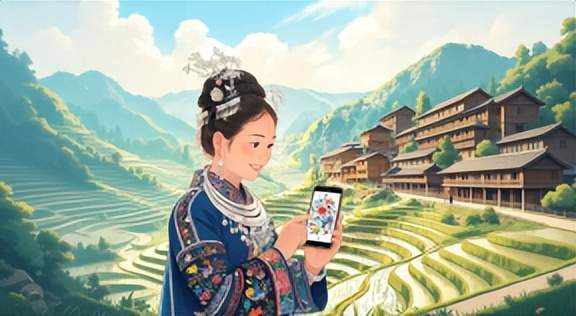
Our second finding was the immense potential of specialized AI. Teacher Wang Qinghai's Secret Tower AI for PPT creation and Li Xiaoming's Nano AI for conversations were tailored to their specific needs. Perhaps in the future, Hou Changju will discover a design AI specifically tailored to Miao embroidery intangible cultural heritage, and Li Xiaoming will find an agricultural AI that better understands wild mushroom cultivation. The vastness of China and its diverse user base provide fertile ground for numerous vertical AIs. We can speculate that the AI industry has yet to fully tap into niche scenarios.
We also observed that the token dilemma is just beginning to emerge. Qiao Sang's primary school classmate wanted to use AI for creative purposes but lacked the quota, posing a challenge for instructors. This issue may soon become a bottleneck hindering rural development.
Currently, due to the exorbitant costs of computational power operations, market-driven AI models cannot offer large-scale, long-term free services. They typically manage costs by reducing intelligence in free versions, delaying new model upgrades, or limiting usage frequencies. Reducing intelligence and delaying upgrades undoubtedly affect the user experience of rural users, exacerbating the technological gap between urban and rural areas. Limiting usage quotas has become the least detrimental choice for AI companies.
Tokens are the traffic and phone bills of the AI era, but the AI industry currently lacks a universal mechanism akin to the telecommunications industry's efforts to increase speed and reduce costs. As AI application scenarios and users continue to grow in rural areas, it may be time to plan for model speed enhancements and cost reductions.
After discussing AI extensively, the most memorable aspect of our Guizhou trip was undoubtedly the people. It is the people who hold the greatest value for the mountains.

Li Xiaoming, Hou Changju, and others share a common trait: they are industry leaders. They not only learn and start businesses themselves but also have a strong desire to give back to their villages, promoting employment for local women and villagers and driving the development of the entire community. Each of them can influence at least 100 households.
In "The First to Awaken," there is a saying that a country's modernization is not solely about the modernization of material objects; the key lies in the modernization of its people. The first batch of Chinese students who studied abroad and opened their eyes to the world in modern times contributed ideas and strategies in various fields, including industry, mining, railways, telegraphy, the navy, education, and commerce, injecting vitality into China's modernization transformation. They themselves were more important than the technologies they brought back.
The first batch of people learning AI in the mountains bring not only AI to this land but also the ability for rural areas to develop self-sufficiently and actively integrate into the modern era.

-
![]()
Honda CEO Faces Vote of No Confidence Due to Alleged Neglect of China Market
-
![]()
The Flip Side of 618: New Arrivals Steal the Spotlight as Major Sales Event Hits Midpoint
-
![]()
Wang Chuanfu's Goal of Becoming the World's No.1 Relies on a 'Production Schedule'
-
![]()
Jensen Huang: The Embodiment of a Bull Market
-
![]()
Joint Interview with Five Major E-commerce Platforms: Ending Involution for a Healthier 618 Shopping Environment
-
![]()
Does It Become More User-Friendly Over Time? The Rising Product Prowess of Hunyuan Hy3 and Tencent Yuanbao's Quiet Resurgence
-
![]()
Gross Profit Margin, Supplier Payments, and Dividends Undergo 'Abrupt Shifts': Indicators of Tianbo Intelligence's IPO Performance Manipulation", "Tianbo Intelligence, gross profit margin, financial i
-
Top Ten in May Sales Rankings Feature No Fuel Vehicles: Has China’s Auto Market Undergone a Complete Transformation?