Alipay's AI Strategy: Flexible Access, Yet Firm on Payments
 06/17 2026
 503
503
Author | Haotian Ji
Following WeChat's official announcement of its AI agent beta testing, Alipay has also embarked on its AI transformation journey.
On June 14, 2026, according to Kuaichuangban Daily, Ant Group is discreetly testing an AI-enhanced version of Alipay, introducing an AI assistant named 'Abao'. This assistant is designed to assist users in hailing taxis, ordering food delivery, and even handling financial tasks like purchasing funds.
As AI technology advances, not only Ant Group but also numerous tech firms are intensifying their efforts in agent development. However, it's crucial to note that due to the strong entry-point nature of agent assistants, most companies concentrate on a single product to prevent resource dilution and positioning conflicts.
In contrast, Alibaba has developed AI assistants like QianWen, LingGuang, and Kuake, and is now vigorously promoting Alipay's integration with agents, which is quite unusual.
This approach is partly due to Alibaba's extensive business portfolio, catering to diverse user needs and application scenarios. On the other hand, it's also directly linked to Alipay's unique product characteristics. As a payment tool, Alipay seamlessly aligns with the transactional demands driven by agent implementation, necessitating a targeted strategic布局 (layout).
01 Lacking a Social Network, Alipay Seeks Breakthroughs Through New Technologies
Given Alibaba's e-commerce proximity to the payment process, Alipay enjoyed a significant first-mover advantage and swiftly became China's leading third-party payment platform during the early mobile internet boom. According to iResearch Consulting data, in 2014, Alipay held an 82.8% market share in China's internet third-party payment market, ranking first.
Following this trend, Alipay seemed poised to dominate China's mobile payment sector. However, during the 2015 Spring Festival, WeChat Pay executed a 'sneak attack on Pearl Harbor' by distributing 500 million yuan in cash red envelopes through its 'Shake' feature, significantly eroding Alipay's market influence.
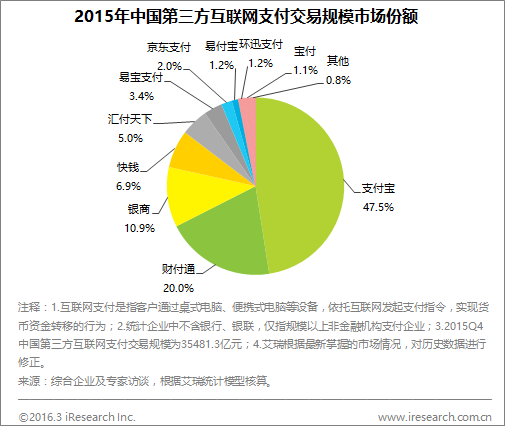
Image Source: iResearch Consulting
According to iResearch Consulting, in 2015, Alipay's market share in China's internet third-party payment market dropped to 47.5%, while Tencent's Tenpay saw its share rise to 20%.
To counter WeChat Pay, Alipay has launched differentiated services such as the Five Blessings campaign, Ant Forest, and 'Touch-to-Pay' in recent years, accompanied by frequent large-scale marketing activities. While these initiatives have somewhat enhanced user stickiness, they haven't altered the competitive landscape of China's internet third-party payment market.
Data from the China Payments and Clearing Association revealed that in 2024, Alipay held a 45.7% market share, while WeChat Pay accounted for 41.8%, placing both in the same tier.

Image Source: Alipay
It's noteworthy that since the advent of WeChat red envelopes, WeChat hasn't introduced any novel payment formats for years and still primarily relies on QR code payments, which offer a far inferior experience compared to Alipay's 'Touch-to-Pay'.
The vitality of WeChat Pay stems mainly from its integration with WeChat's vast social network, enabling deep binding with users' daily communication scenarios and naturally possessing higher usage frequency and user stickiness.
In contrast, Alipay is merely positioned as a 'wallet' with relatively limited usage scenarios, making it challenging to compete directly with WeChat Pay in terms of user activity and usage frequency.
However, precisely because it lacks a social network like WeChat Pay, Alipay has maintained a strong sense of crisis and innovation. With the gradual maturation of AI technology, Alipay has finally found a new focal point.
02 Alipay and WeChat Reunite in the AI Era
As Jensen Huang, founder and CEO of NVIDIA, stated, 'Agentic AI has arrived. Computers no longer run applications; they run AI agents.' To create greater user value, since 2025, tech companies have been upgrading their AI assistants from 'chat-capable' chatbots to 'task-capable' agents.
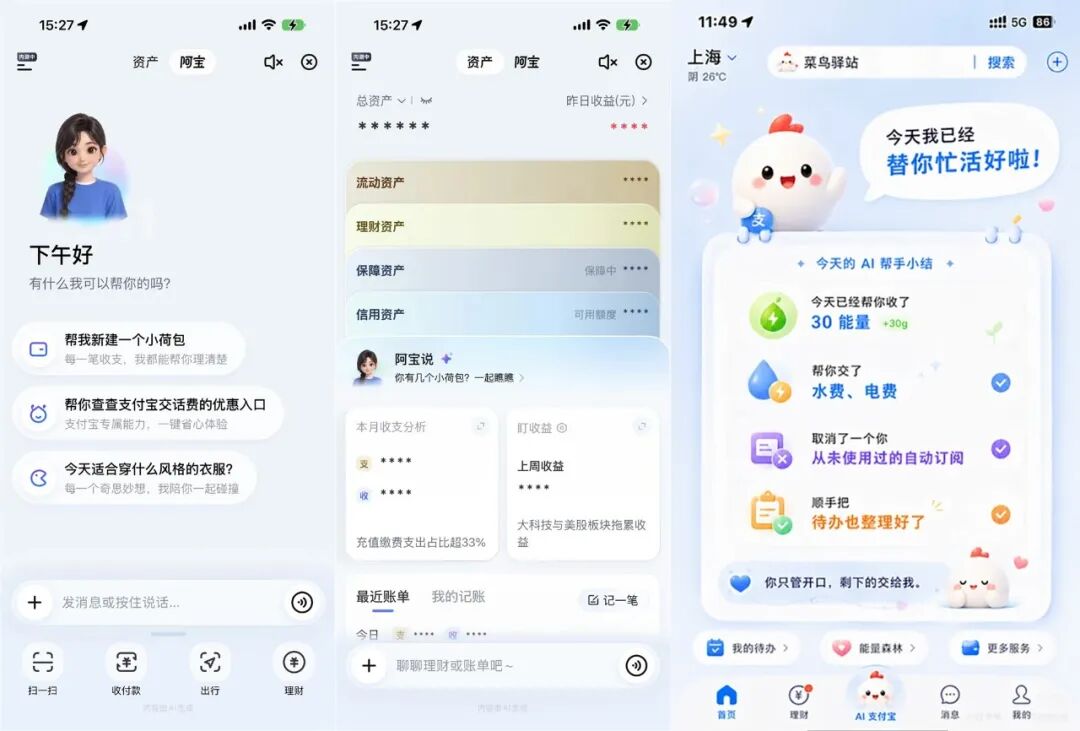
Image Source: Xiaohongshu
According to Kuaichuangban Daily, the AI-powered version of Alipay will overhaul its existing interaction system, allowing users to switch to a native AI interface with a single click and rely on the 'Abao' agent assistant for intelligent service and financial management.
During use, users can engage in natural language conversations with 'Abao' to issue instructions like hailing taxis, ordering coffee, or placing food delivery orders. With user authorization, 'Abao' can even complete financial tasks such as selecting funds and managing investment accounts.
It's worth noting that due to the immense commercial value of agents, not only Alipay is undergoing an AI transformation; WeChat is also actively investing in AI agents.
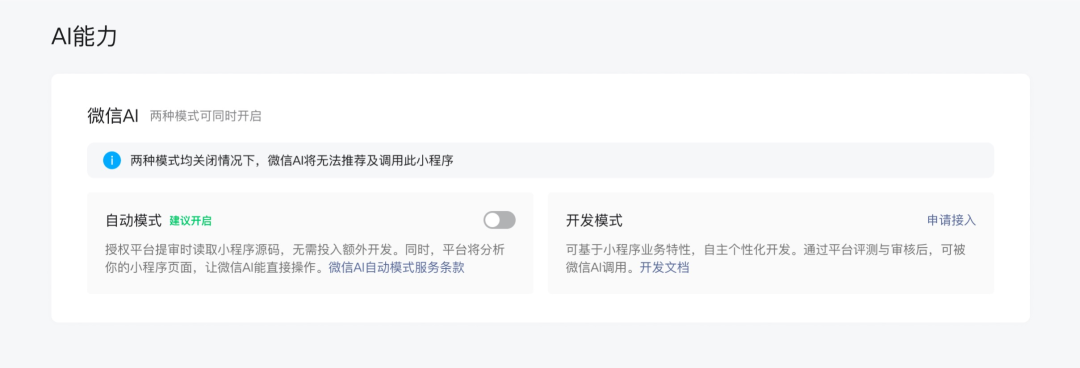
Image Source: WeChat Developer
On June 8, 2026, the official WeChat Developer WeChat account published the 'Guidelines for Developers to Integrate with WeChat's AI Ecosystem,' confirming that WeChat AI has entered beta testing.
The Financial Times, citing insiders, reported that the WeChat agent would be hidden on the left side of the main WeChat chat interface and accessible by swiping right. After users issue specific instructions through natural language, the agent can invoke WeChat Mini Programs to perform corresponding tasks.
Although the product forms are highly similar, there's a significant gap in ecological resources between Alipay and WeChat. Data from the Aladdin Research Institute revealed that as of Q1 2026, there were approximately 12 million Mini Programs across China's internet, with WeChat Mini Programs accounting for about 8.4 million (70%) and Alipay Mini Programs for only about 1.8 million (15%).
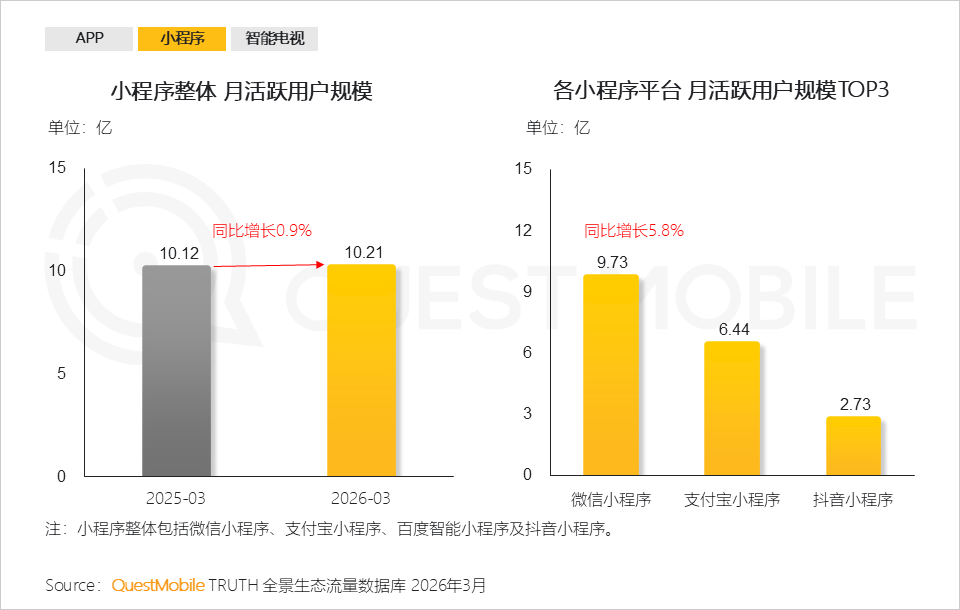
Image Source: QuestMobile
In an interview with LatePost, a WeChat insider stated that the natural advantage of WeChat's agent lies in the highly prosperous Mini Program ecosystem, as 'these developers are unlikely to have the incentive to move to a new platform, sign a new agreement, and build a new system.'
It's evident that, despite entering a new AI era, because the capabilities of agents are closely tied to mobile internet ecosystem resources, Alipay still faces systemic shortcomings.
Considering that users' core demand for agents is not merely to obtain information but to efficiently complete specific tasks, Alipay's insufficient ecological capabilities suggest that its agent will struggle to compete directly with WeChat in the short term.
03 Beyond Entry Points, AI 'Infrastructure' Holds Greater Strategic Value
Due to its strong 'wallet' attributes, Alipay hasn't placed all its bets on the competition for agent entry points. Instead, as a service provider, it's actively launching AI payment solutions such as AI Pay, AI Receive, and Token Pay.
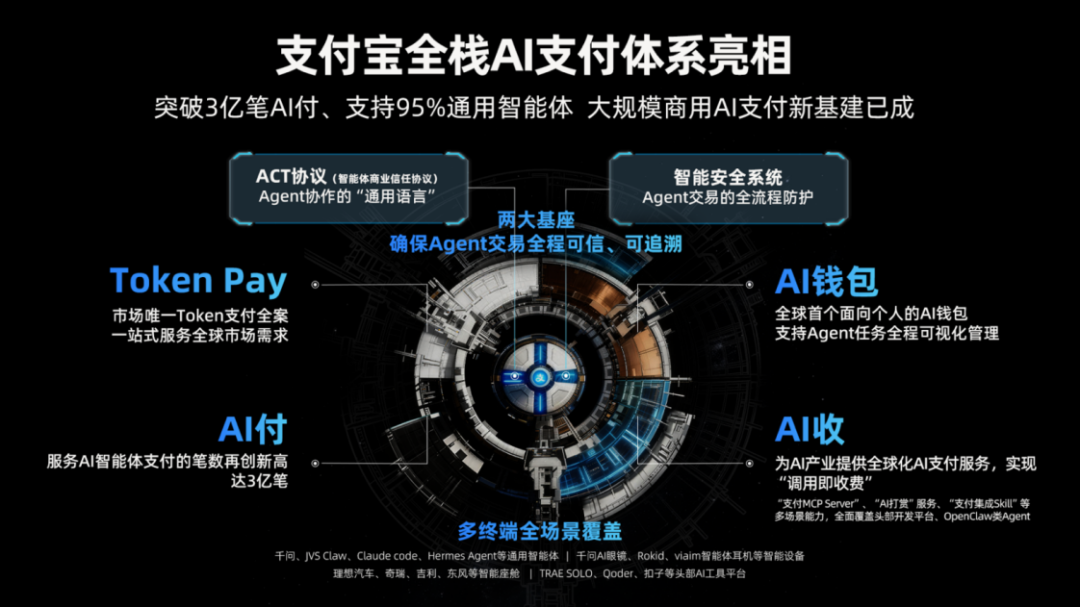
Image Source: Alipay
At the AI Payment Ecosystem Conference held in late May 2026, Han Xinyi, CEO of Ant Group, stated, 'The essence of commerce remains unchanged in the AI era, but the new role of agents is refactoring (reconstructing) everything. Alipay leverages its 22 years of technological accumulation and commercial know-how to build a new AI payment service and accelerate the development of the new commercial ecosystem.'
In short, Alipay aims not only to become a core entry point in the AI era by focusing on agents but also to become the payment 'infrastructure' in the AI era by meeting the transactional demands of agents.
For example, Alipay AI Payment currently supports 95% of general-purpose agent frameworks, covering AI assistants, smart devices, smart cockpits, and other products. As of May 2026, Alipay had completed 300 million AI payments.
From the perspective of AI technology evolution, Alipay's choice is insightful. At this stage, the product forms, interaction methods, and ecological landscapes of agents are still taking shape, and the competition for AI entry points remains full of uncertainties. In contrast, payment, as one of the most fundamental services in the digital economy, possesses stronger certainty and irreplaceability.
As agents mature, users may not actively choose a specific payment tool but instead directly issue tasks to agents, which will automatically complete processes such as selection, ordering, and payment.
In this context, the platform that first becomes the underlying payment infrastructure for agents is more likely to secure a place in the AI era. From this perspective, Alipay's proactive positioning as a payment 'infrastructure' provider demonstrates strong foresight.
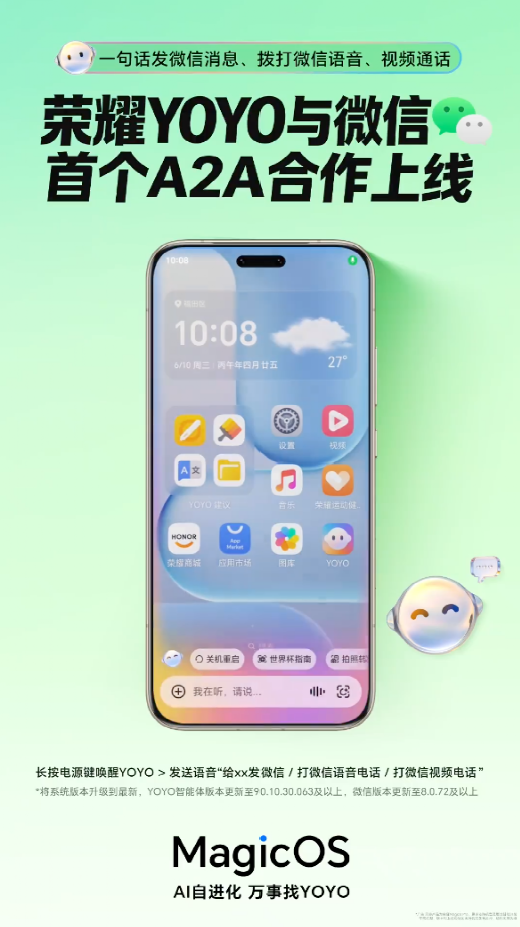
Image Source: Honor
In fact, not only Alipay but also WeChat has recognized the strategic value of AI 'infrastructure.' Recently, WeChat has not only been testing agents within its platform but has also collaborated with smartphone manufacturers such as Huawei, Honor, and Xiaomi to support A2A (Agent-to-Agent) interoperability, allowing AI assistants in phone systems to directly invoke WeChat for messaging.
It's worth noting that to protect its core asset—the social network—WeChat has not only rarely opened up key capabilities to external platforms in the past but has even repeatedly blocked products that 'overstepped boundaries.'
A typical example is the Doubao phone, which was 'blacklisted' by WeChat just days after its launch due to its ability to manipulate software through GUI simulation and clicking technology.
Facing the agent era, WeChat's proactive support for A2A interoperability indicates that it not only aims to be an entry point but also hopes to embed its decade-old social network into the agent collaboration framework. This way, regardless of which agent tool users employ to perform tasks, WeChat can continue to serve as the core hub connecting people and services.

Image Source: WeChat
After recognizing the strategic value of AI 'infrastructure,' WeChat's A2A interoperability has not been limited to social interactions but is also extending to payments. In April 2026, WeChat Pay released the 'AI Access Toolkit,' which includes three core modules: Skill packages, AI-friendly documentation, and AI-friendly APIs, to facilitate developers in integrating AI products with WeChat Pay.
From this perspective, as both Alipay and WeChat Pay invest in AI payment 'infrastructure,' they have once again become competitors. However, due to its first-mover advantage and strong payment attributes, Alipay holds a relatively proactive position in the competition for payment 'infrastructure.'
In the future, it remains to be seen which of Alipay or WeChat Pay will become the payment infrastructure in the AI era. However, one thing is certain: as agents take over more transactional and service processes, platforms that control the underlying payment tools will possess stronger long-term competitiveness than those that merely occupy traffic entry points.
Interactive Topic
Have you used AI payments? What was your experience like?
This article is original content from Farsight and is prohibited from being reproduced without authorization.
-
![]()
Afu’s ‘Bridge’ and the Doctor’s ‘Seal’: The Story Behind China’s Pioneering ‘AI + Doctor’ Collaborative Model
-
![]()
Domestic GPU Company with Heavy Tencent Ties Clears Regulatory Hurdle, Shanghai State-Owned Assets Reap Bountiful Returns Once Again
-
![]()
Geely Auto's Li Shufu: Automotive Safety Is Paramount; Ignorance Leads to Incessant Problems
-
![]()
BYD, FAW, and Chery Act Swiftly: Chinese Automakers Accelerate Acquisition of European Factories
-
![]()
MLCC: Igniting a Multi-Billion Supply Chain Battle | Golden Eye
-
![]()
Robots Spring into Action in Huizhou, Guangdong: Thousands of Robots on Production Lines, Autonomous Vehicles Delivering Goods—This Coastal City is Stealthily Rising Again
-
![]()
National Intelligence Restructuring: The Underpinning of AI Competition
-
![]()
Alipay's AI Strategy: Flexible Access, Yet Firm on Payments