The Unstoppable Rise of 'Optical Progress and Copper Decline': Sunny Optical’s Strategic Vision for the Next Decade
 06/29 2026
 656
656
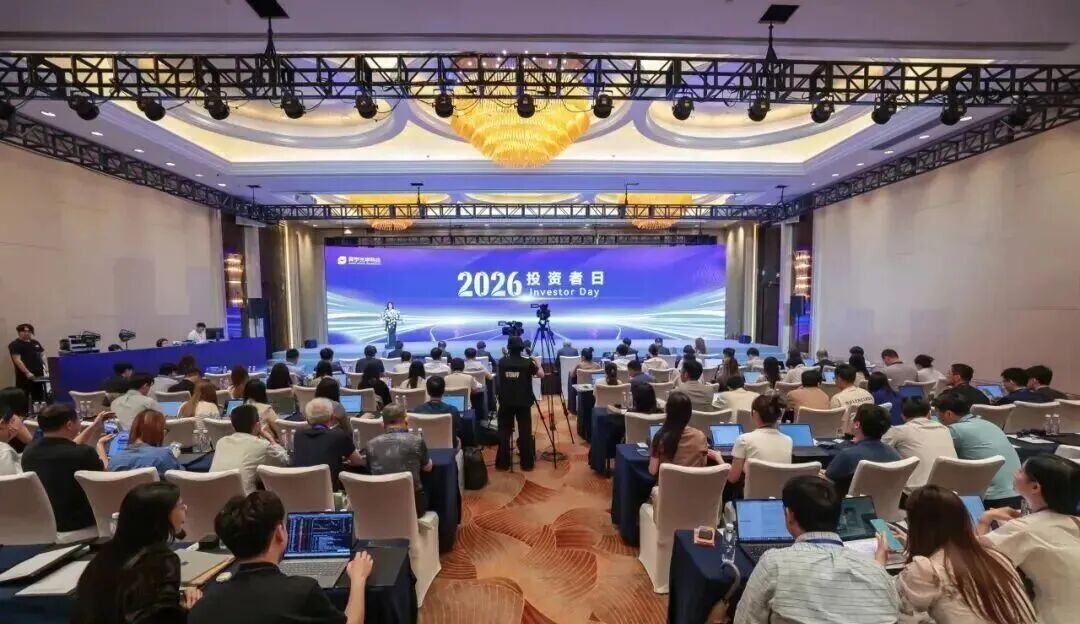
On June 24, Sunny Optical held its 2026 Investor Day event in Hong Kong. The most significant highlight of this year’s Investor Day was the official introduction of Gu Bo, a Fellow of the Canadian Academy of Engineering, as the Group’s Chief Technology Officer (CTO).
Public records show that Gu Bo brings nearly four decades of expertise in research, development, and industrialization within the optics and laser sectors. He also serves as Deputy Secretary-General of the Chinese Optical Society, Vice Chair of the International Commission for Optics under UNESCO, Vice President of the Laser Institute of America, and holds professorships at prestigious institutions such as Zhejiang University. His accolades include the Maiman Laser Award and Prism Award from the International Society for Optics and Photonics, as well as the Arthur L. Schawlow Award from the Laser Institute of America. His appointment signals a significant acceleration in Sunny Optical’s technological strategy, particularly in the two critical AI computing domains of optical interconnects and optical sensing.
In Gu Bo’s perspective, the driving force behind the current industry transformation is evident: the relentless expansion of AI computing clusters and the massive data exchange demands of GPUs have created transmission bottlenecks. Traditional copper wiring, constrained by bandwidth and power consumption limitations, struggles to keep pace with the escalating demands for high-speed computing. In medium- to long-distance interconnect scenarios, such as inter-cabinet and cross-cabinet connections, the shift towards optical solutions and away from copper has become inevitable. However, in extremely short-distance interconnects, copper cables continue to offer cost and power efficiency advantages and are expected to coexist with optical communication for the foreseeable future.
During the Investor Day, Gu Bo outlined a long-term technological roadmap for the optical communication industry: 2026 will see the commercial launch of 1.6T optical module prototypes; by 2028, co-packaged optics (CPO) are projected to become standard in computing clusters; by 2030, 6.4T and 12.8T high-speed optical modules will be widely adopted, with copper cables gradually losing their dominance in short-distance interconnects like inter-cabinet links; and by 2034, optical engines will be deeply integrated into computing chips, ultimately achieving a seamless fusion of computing, storage, and photonic interconnects.
This outlook is corroborated by data from third-party research institutions. In the short term, LightCounting forecasts that following 93% growth in 2024 and 82% growth in 2025, the Ethernet optical module market will expand by 65% in 2026. With 1.6T products gradually entering mass production, the markets for 800G and 1.6T coherent optical modules will grow concurrently. LightCounting also anticipates that sales of 1.6T chipsets will surpass $2 billion in 2026.
In the medium term, focusing on technological advancements, TrendForce estimates that CPO penetration in AI data center optical communication modules will be around 0.5% in 2026. As silicon photonics and CPO packaging technologies mature, penetration is expected to reach approximately 35% by 2030.
In the long term, considering market potential, Goldman Sachs paints an even more ambitious picture: the addressable market for optical communication networks will be approximately $15 billion in 2026 and is projected to soar to $154 billion by 2028, reflecting the explosive demand for optical communication driven by AI computing infrastructure.

Facing this rapidly expanding market, Sunny Optical Technology has adopted a phased R&D model: mass-producing one generation, developing the next, and pre-researching the one after that. The company’s optical interconnect-related products have entered the verification phase with both domestic and international clients, with small-scale supply anticipated by 2027. This timeline maintains a reasonable gap with the commercialization progress of leading optical module manufacturers, reflecting Sunny’s initial focus on differentiated entry through core optical components and transceiver subsystems.
Gu Bo emphasized that CPO optical path coupling demands extremely high nanometer-level precision, noting that “even a slight deviation of a few nanometers can result in product failure.” Sunny’s end-to-end ultra-precision machining capabilities, nanometer-level mold control, and high-volume production yield systems, honed in the consumer and automotive lens sectors, can be directly applied to the R&D and manufacturing of core components such as optical interconnect transceivers, coupling prisms, and microlenses. Unlike competitors who focus solely on components or modules, Sunny is advancing dual-line R&D for both optical core components and integrated optical module products, catering to diverse scenarios such as cloud computing and data centers.
In terms of solidifying its core business, mobile phone and automotive optics remain Sunny’s cornerstone, collectively contributing 80% of the company’s revenue. Regarding future-oriented investments in emerging technologies, the company invested 500 million yuan each in Goertek Optics through Ningbo Aolai and Goertek Inc. in early June.
Following the capital injection, Ningbo Aolai’s stake increased from 31.12% to 33.27%, maintaining its position as the second-largest shareholder, while Goertek Inc.’s stake rose to 39.67%, strengthening its foothold in the AR/VR waveguide device sector.
Sunny Optical Technology President Wang Wenjie stated at the Investor Day that the company is pursuing a synergistic approach across three business lines: strengthening its core mobile phone and automotive businesses, industrializing optical interconnect capabilities, and empowering emerging wearable and AIoT devices with optics. All three business lines share a common technological foundation—extending from optical components and lens modules to complete device and system solutions.
Sunny’s transformation from an imaging manufacturer to a full-chain optical solutions provider is not only a response to the value reconfiguration of the optics industry in the AI era but also a reevaluation of its four decades of precision optics manufacturing expertise. The future looks promising.
-
![]()
Doubao Work Unveiled! Domestic AI Leaders Fully Commit to the 'Work' Sector
-
![]()
Who’s Sounding the Alarm on ‘Rushed Vehicles’?
-
![]()
Over 5.3 Billion Yuan in Losses Over Three and a Half Years! Can Yonyou Reverse Its Fortunes Through Streamlining and AI Transformation?
-
![]()
Baidu AI Adopts Free Model: A Strategic Maneuver in Traffic and Monetization
-
![]()
Silicon-Based OLED Pioneer Unveils Financial Results: H1 Shipments Outpace Entire 2025 Volume
-
![]()
AI's First "Lost Summer"
-
![]()
Zeiss Makes Another €2.2 Million Bet: Will Eye Tracking Be the Next Big Thing in the Smart Glasses Industry?
-
![]()
RUNTO Ranking | Global Top TV ODM Factories' Shipment Figures for July 2026