Lingguang Shifts Leadership, Ant’s Afu Takes a Step Back
 07/02 2026
 538
538
Late last year, Alibaba overhauled Qianwen and announced its entry into the general AI assistant market.
Around the same time, Ant Group also unveiled Lingguang, with a focus on productivity and comprehensive modality capabilities.
With Doubao leading the pack, DeepSeek maintaining its distance, and Yuanbao struggling to keep up or form alliances, the launches of Qianwen and Lingguang were seen as Alibaba’s two main strategies for privately opening up the consumer-end battleground.
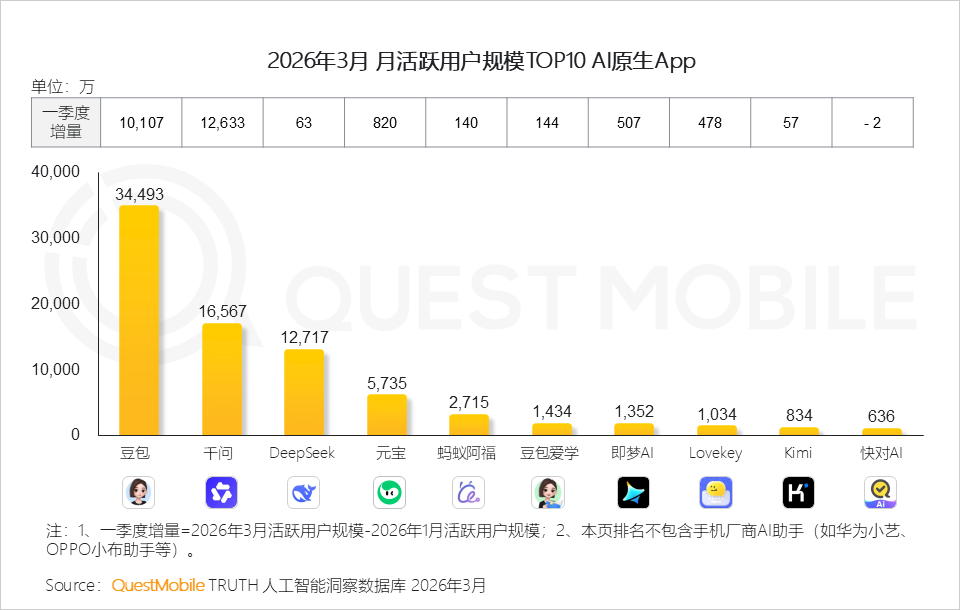
Over the past six months, Qianwen, bolstered by strong group resources, a unique positioning in AI-powered productivity, and aggressive marketing subsidies that far outstripped competitors, quickly overtook DeepSeek in monthly active users in the first quarter of this year. It became the second most popular AI-native application, trailing only Doubao.
In the same ranking from the same data source, Afu ranked after Yuanbao but successfully broke into the Top 5. Lingguang, however, failed to crack the top ten, with monthly active users falling below Kimi and even trailing educational apps like Kuaidui AI.
Frankly, this outcome is not surprising.
The general AI assistant market is already fiercely competitive, and features like comprehensive modality offer little incentive for users to switch. When business fundamentals falter, organizational and personnel changes become predictable.
Recently, media reports indicated that Lingguang’s leader (Hanluo) will be reassigned to oversee some of Afu’s operations. Meanwhile, some members of the Lingguang team will also support certain functions of Afu in the future.
This adjustment clearly isn’t a pursuit of victory following notable achievements in previous ventures but rather signals Ant Group’s strategic retreat from the same AI assistant market.
Lingguang Fails to Make Waves, But Costs Remain Controllable
In the general AI assistant market, the lofty visions presented by tech giants at product launches often translate into staggering operational and user acquisition costs in financial reports.
Over the past two years, major companies have viewed general large model applications as the absolute next-generation super gateway, with none daring to risk missing out.
Large models may represent today’s most critical technological frontier, but to draw users into their ecosystems, tech giants have engaged in a resource-intensive battle devoid of technical sophistication.
Take Doubao and Qianwen, currently leading in daily active users, as examples. Their impressive DAU figures, often reaching hundreds of millions, are underpinned by extreme fragility. In this market, every new user comes at an exorbitant cost.
LatePost revealed that Doubao incurs tens of millions in computational costs daily, generating less than one million yuan in revenue from e-commerce commissions. Qianwen is in an even worse position, with no need to discuss cost-benefit analysis at this stage—its financial metrics are clearly dire.
If even top players like ByteDance and Alibaba are struggling and bleeding in the general large model space, then second- and third-tier players face even more pressing existential questions.
This precisely explains Ant Group’s current predicament with Lingguang.
While it may be premature to definitively judge Lingguang at this stage, it has indeed failed to make significant waves in the highly competitive general AI assistant market.
Fortunately, amid the frenzy of the hundred-model war, Ant Group, though participating, has maintained restraint. Lingguang has not been deeply entangled in exorbitant promotional spending, making sunk costs easier to absorb. Consequently, management can pivot strategically with fewer historical burdens and greater decisiveness.
Looking beyond Ant Group’s individual business lines and examining Alibaba’s broader AI strategy, the adjustment of Hanluo and Lingguang’s technical team becomes even more logical.
Within Alibaba’s AI ecosystem at the time, Tongyi Qianwen was the favored project, backed by the entire group’s resources. In this layout, Qianwen was tasked with the “main assault” on the frontlines, attempting to overtake competitors with absolute advantages.
Lingguang, on the other hand, resembled an “ant guerrilla force,” trying to explore possibilities for a general-purpose entry point from the flanks.
Now that the battle lines have initially stabilized, and Qianwen has withstood pressure and gained a foothold in its main offensive direction, the strategic necessity of maintaining another overlapping, uncertain general AI assistant within the Alibaba and Ant ecosystems as a backup to Qianwen has diminished.
Since the main front no longer requires complex flanking maneuvers, withdrawing elite technical forces to attack truly monetizable vertical strongholds becomes a logical deployment.
Big tech’s strategic patience has strict boundaries. When top leadership recognizes that general AI assistants are likely just a costly battle for attention, halting unnecessary internal consumption and redirecting resources toward vertical business lines closer to commercialization is undoubtedly a rational, realist choice.
Vertical AIs Face an Ultimate Existential Question
The leadership and part of the team from Lingguang, withdrawn from the general battlefield, have been swiftly redeployed to Afu’s domain. From a business logic perspective, healthcare indeed offers management a temporary respite, providing a rare sense of certainty in the current AI winter.
The healthcare field enjoys natural advantages unmatched by other verticals: extreme frequency and absolute necessity.
Modern health anxieties are nearly constant, ranging from incomprehensible medical test reports to sudden gastrointestinal discomfort late at night, to chronic disease indicators requiring long-term tracking for parents and elders. These scenarios create a high-density demand for interaction.
When users turn to Afu with these pressing health concerns, their intentions are extremely clear. This goal-oriented traffic holds far greater value than aimless chatting.
Of course, Ant Group’s ambitions extend beyond mere health management.
Finance is Ant Group’s core foundation, and Afu theoretically can also establish a commercial closed loop of “health + insurance.” Afu will serve as the most sensitive touchpoint in Ant’s ecosystem, leveraging to expand into a broader financial landscape.
Imagine this scenario: Afu not only helps users interpret medical test indicators but also, based on these dynamic health data, customizes health intervention plans for them. As this “companion-style” health management deeply integrates into users’ daily lives, Afu effectively gains access to the most precise, dynamic health profiles of users across the web.
However, this model always faces an ultimate existential question: Can independent vertical AI applications sustain their survival in the shadow of super general AI assistants?
The scaling law implies that as long as computational power and data continue to accumulate, general large models, leveraging their vast world knowledge to generalize and solve complex problems, are destined to reach and eventually surpass so-called “vertical industry models.”
Attempting to establish technical barriers in vertical fields like healthcare or law can easily be crushed by the next major update of general large models through dimensionality reduction.
Users exhibit deep-rooted inertia in tool usage, meaning an all-in-one solution is the most human-centric product endpoint, especially true in the domestic market.
Once a user becomes accustomed to opening Doubao or Qianwen daily for work, life, and learning, their first instinct when faced with an incomprehensible medical report is generally to toss it into the most familiar general dialog box.
Users accustomed to general AI assistants require no education to use them for healthcare issues.
The reverse, however, is not true.
To counteract the siphoning effect of super assistants, vertical applications like Afu must exert greater effort to reshape user habits, attempting to implant the subconscious notion that “for health matters, ask Afu” into users’ minds.
Will Becoming a Qianwen Plugin Be Afu's Destiny?
The solution to this question lies in providing differentiated, value-added products beyond model intelligence. For instance, health records and renowned doctor avatars are features Afu offers but general products lack.
However, their absence now does not guarantee their absence in the future. Adding such features would be very easy for Doubao or Qianwen, given their critical importance. ChatGPT launched a health assistant this year, serving over 230 million weekly user demands related to health consultations.
Will Doubao follow suit in the future? I believe the likelihood is high.
Of course, specific features will differ. Health records and health assistants would likely have high priority, while emotional value features like renowned doctor avatars might have lower priority.
Looking at the current AI landscape, the trend toward platformization and systematization is already clear.
Just last week, news broke of Doubao integrating with Feishu and map services. Qianwen has also been aggressively promoting the integration of full ecosystem capabilities, initially focusing on Alibaba's internal businesses and recently expanding to more external ones.
They do not reject vertical industry expertise but prefer to absorb it as an underlying Agent (intelligent agent) or functional plugin within their ecosystems.
In this grand architectural reorganization, computational power and entry points within big tech companies are undergoing unprecedented centralization.
Looking back at Alibaba’s recent establishment of the ATH (Alibaba Token Hub) business group and its highly centralized scheduling of scattered AI resources, the strategic intent to break down departmental silos and unify underlying computational power with front-end businesses is already very clear.
Under Alibaba’s comprehensive AI resource collaboration strategy, if Ant Group’s Afu continues to operate independently externally, it would not be conducive to maximizing strategic synergy with Alibaba.
In the final analysis, Afu’s most dignified and commercially valuable destination may not be to compete with general large models for downloads in app stores but to ride the “All in one” trend and become the core “healthcare plugin” within Qianwen’s ecosystem.
Ant Group could modularly package the healthcare capabilities already accumulated by Alipay and Afu, seamlessly integrating them into general AI assistants.
Given the natural bloodline and ecosystem synergy between Ant Group and Alibaba, the scenario where Alipay’s homepage perennially reserves core exposure slots for Taobao flash sales and Gaode group buys could easily be replicated in the AI era.
In the future, Qianwen would serve as the super entry point for general conversations. Once it identifies a user’s healthcare intent, it would directly invoke Afu’s service modules at the underlying level to handle the request.
This ecosystem integration approach directly resolves the vertical application’s existential anxiety of being replaced by general large models and eliminates unnecessary internal friction between sibling teams over traffic acquisition.
Abandoning the futile obsession with independent apps and front-end entry points, Afu could comfortably retreat behind the scenes and become the most profitable vertical service provider within a super ecosystem with never-drying traffic.
Perhaps this is the survival rule for vertical AI businesses in the next brutal decade.
-
![]()
MathWorks: Generative AI Holds Great Potential, Yet a Trusted Toolchain is Essential for Flawless Operation
-
![]()
Small Earphones, Big Business
-
![]()
Volkswagen Slashes 100,000 Jobs, Mercedes-Benz Axes Year-End Bonuses: What’s Ailing German Auto Titans?
-
![]()
Doubao Can No Longer Offer Free Services to 345 Million Users: China's Era of Free AI Is Drawing to a Close
-
![]()
How Can Chinese Small Home Appliances Conquer Southeast Asia Through 'Dimensional Competition'?
-
![]()
Why are top intelligent driving players betting on reinforcement learning?
-
![]()
June 2026 Automobile Complaint Index Rankings: Persistent Problems Ignite Grievances Among Long-term Vehicle Owners
-
![]()
Avita Takes Another Stab at HKEX Listing: Facing the Urgency of Sustaining Operations Amid 11.2 Billion Yuan Loss Over Three Years