Tencent's "Embodied AI": Does the Connector Story Still Hold in the Era of Physical AI? | WAIC Observations
 07/20 2026
 487
487
 © Chaoyong AI Editorial Team
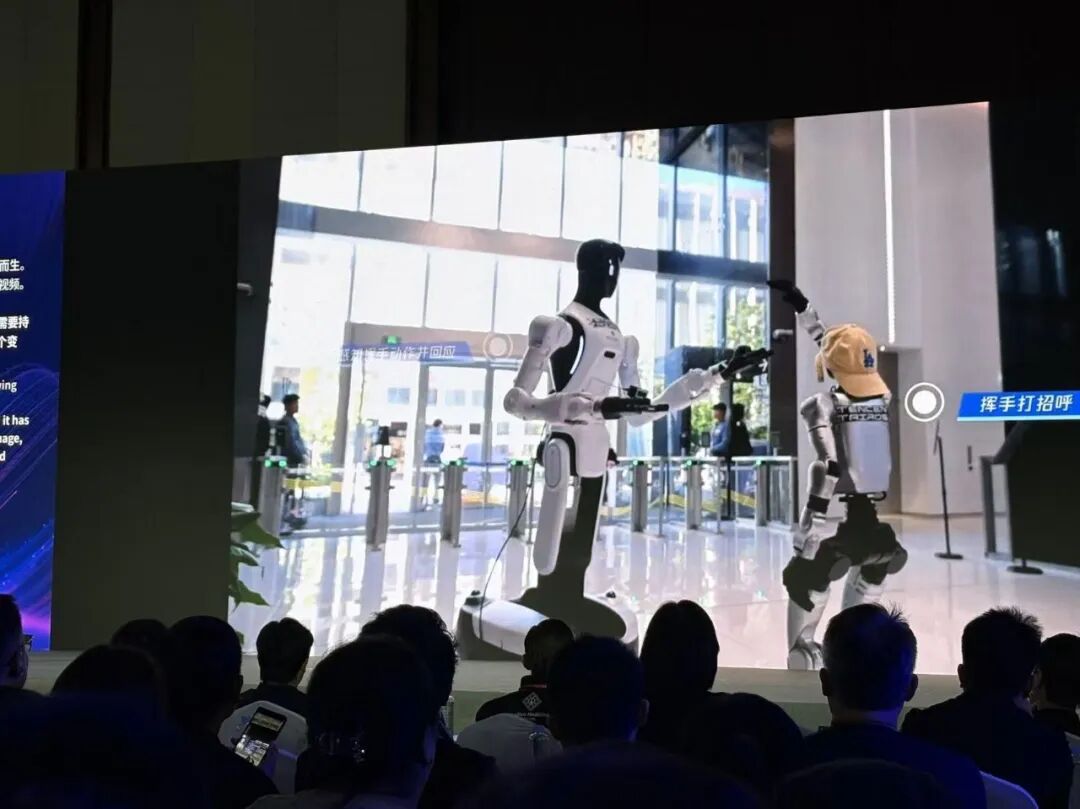
At WAIC 2026, Tencent unveiled its "Full-Stack Solution for Embodied AI."
From the model layer—Hy-Embodied-VLA-0.5, Hy-Embodied-VLM-1.0, and Hy-Embodied-RxBrain-1.0—to the platform layer—TairosAgent and Apexio—and then to the cloud infrastructure and application layer—EaaS—the four-tier architecture forms a complete closed loop. Tencent's Chief Scientist Zhang Zhengyou summarized it as "breaking the brain in a jar," enabling AI to be validated within a closed loop of "perception, body, and action."
This marks another upgrade for Tencent in the embodied AI track (race track). A year ago, RoboticsX Lab's "Three Nos Principle" (no hardware, no mass production, no commercialization) sparked industry discussion.
A year later, Tencent has upgraded from a "modular external brain" to a "full-stack closed-loop solution," but its core positioning remains unchanged: to be a partner for all robotics manufacturers, not to replace them by making hardware.
Tencent Cloud's strategy is clear.
Hardware involves heavy assets, low margins, and complex supply chain management, ultimately risking a price war. While the brain and platform layers require significant upfront investment, once an ecosystem is formed, marginal costs decrease, and continuous revenue can be generated through cloud services.
This logic was unbeatable in the mobile internet era, but embodied AI is not mobile internet.
Industry Reality: No Leading Player Wants to Outsource Their "Brain"
2025 has been dubbed the "era of leading humanoid robot startups developing their own brains." By 2026, this trend has become irreversible.
Zhiyuan Robotics (a company Tencent led in Series B funding) self-developed the Qiyuan large model GO-1 and the interactive large model WITA Omni, with cumulative production exceeding 10,000 units by March 2026. Zhiyuan's partner Yao Maoqing stated bluntly in an interview: "Robot companies have no future if they don't develop large models."
Zhipingfang completed nearly 5 billion yuan in financing in June 2026, valuing it at over 20 billion yuan, with its self-developed AlphaBrain embodied large model. According to the company, AlphaBrain has completed three generations of evolution—"end-to-end VLA → enhanced VLA → brain-like VLA"—with NeuroVLA being the world's only brain-like system capable of active perception, fault self-recovery, and temporal memory.
Yinhe General Technology has disclosed cumulative financing exceeding 6.9 billion yuan, with its self-developed AstraBrain, and has built a 10-billion-scale synthetic data infrastructure system called Yinhe Xingfang.
Xinghaitu has open-sourced its G0 series foundation model, constructed a Real2Sim2Real data flywheel, and serves over 150 research institutes and major companies.
Unitree Technology shipped over 5,500 humanoid robots in 2025, achieving profitability for two consecutive years, and announced the open-sourcing of UnifoLM-VLA-0 in January 2026.
Even Tashi Zhihang, which set a record for China's largest single-round financing in embodied AI in April 2026 (USD 455 million in Pre-A funding), owes its core assets to the universal embodied large model AWE 3.0 and a real-world multimodal dataset.
An industry report from mid-2025 has been validated: Early robot startups relied on tech giants' large models for empowerment, but as competition intensifies, companies with strong AI capabilities and involvement in hardware have become darlings of the capital markets. Players without self-developed brains are falling behind.
The "Impossible Trinity" of Data: Why Platform Models Falter Here
The biggest difference between embodied AI and the internet is that data is not a byproduct but a core production resource.
Large language models can be trained on publicly available internet text, but robot training data must be generated in the real physical world. Every frame of data—whether from a robot grasping a cup, moving materials in a factory, or walking up stairs—comes from expensive real-world operations or high-cost simulated synthesis.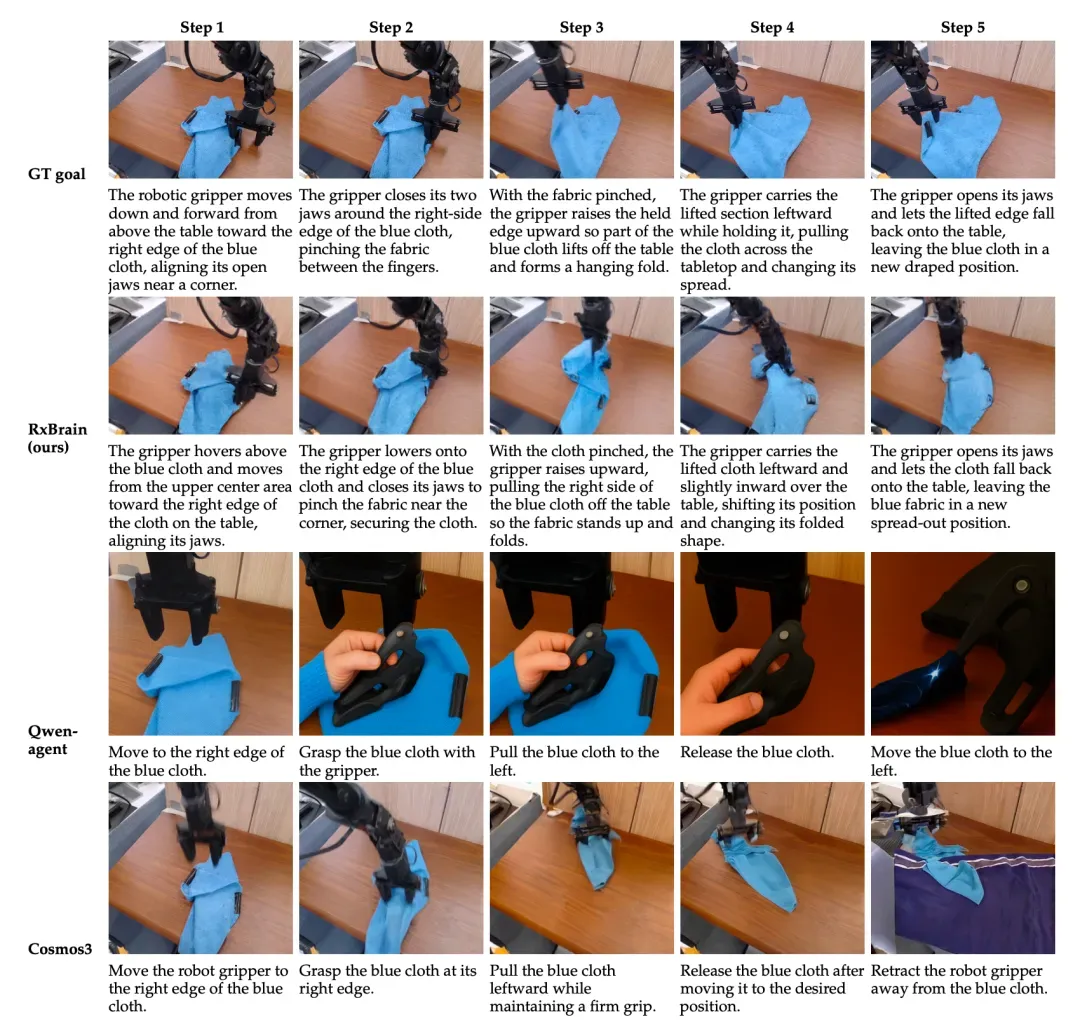
Tencent RxBrain Testing
The π0 large model by U.S. robotics company Physical Intelligence collected only 10,000 hours of training data in a year, while the large language model Qwen-2.5 was trained on data equivalent to 1.2 billion hours of human collection. One researcher calculated: At current data collection speeds, embodied AI models would need 120,000 years to reach the intelligence level of large language models.
What does this mean?
Data is scarce, and therefore data is a barrier.
Zhiyuan's Genie Studio development platform covers data collection to one-click deployment, with its self-built AGIBOT WORLD dataset; Zhipingfang's collision reflection response data (20-millisecond-level, according to the company) from real factory operations is a core asset of its NeuroVLA; Yinhe General Technology's 10-billion-scale synthetic data in Yinhe Xingfang determines its model's generalization ability in retail scenarios.
This data will not be shared with any third-party platform. Not because companies are "closed," but because data is competitiveness itself. Handing over physical world interaction data to Tencent Cloud for model training is equivalent to surrendering business secrets.
Tencent's Tairos platform's "modular external" logic assumes robotics manufacturers are willing to accept standardized solutions for perception, planning, execution, and other key links. But in an industry where data is scarcer than algorithms and more valuable than computing power, this premise is questionable.
The "Brain" and "Body" Cannot Be Separated
Tencent's strategy also faces a deeper technical challenge: The "brain" of embodied AI is not general-purpose software but is strongly tied to specific hardware forms.
At the Caijing Annual Conference held in late 2025, Tencent's Chief Scientist and RoboticsX Lab Director Zhang Zhengyou elaborated on his proposed SLAP paradigm (Sense-Action Tight Coupling), which already illustrates this point. The effectiveness of human cognitive hierarchy stems from the fact that the "brain" has always co-evolved with the "body."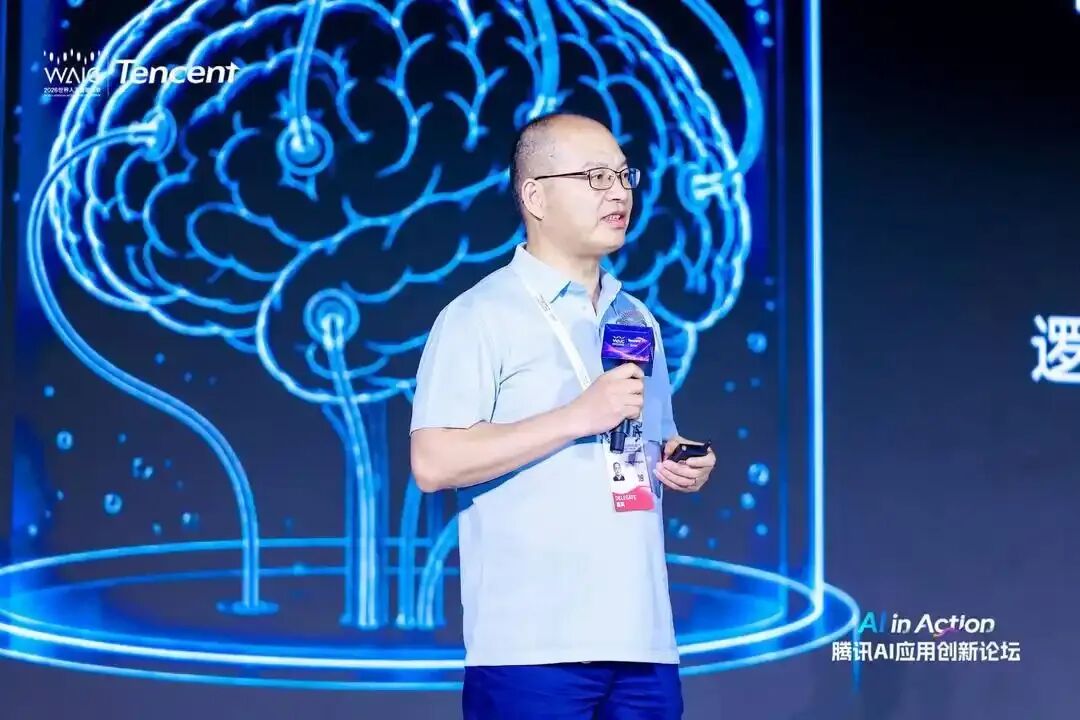
Tencent Chief Scientist, RoboticsX Lab Director Zhang Zhengyou
The same applies to robots.
Zhiyuan's ViLLA architecture MoE, Zhipingfang's three-layer brain-like system ("cortex-cerebellum-spinal cord"), and Xinghaitu's EFM-1 dual system—each iteration of these architectures involves deep adaptation to the kinematics and dynamics of specific bodies (wheeled, bipedal, quadrupedal).
An industry investor told Chaoyong AI: "A universal embodied model is a beautiful vision, but at this stage, whether the relationship between models and bodies is 'one-to-many' or 'many-to-many' is still not consensus in the industry. Tencent wants to create a universal platform adaptation (adapt) to all bodies, which is technically very difficult, and commercially, robotics manufacturers have no incentive to cooperate."
Where Is Tencent's Real Opportunity?
This doesn't mean Tencent has no opportunity in the embodied AI race. On the contrary, Tencent Cloud's capabilities in computing power, simulation, and data infrastructure are industry necessities.
Investments in infrastructure like 10,000-card cluster training and TokenHub inference scheduling are difficult for individual robotics companies to bear. Tencent can position itself as a "shovel-seller" rather than a "gold prospector."
But "shovel-seller" and "platform ruler" are two entirely different business models. Platform rulers (like WeChat and Alipay in the mobile internet era) profit through ecosystem control and passive revenue.
Shovel-sellers (like AWS and NVIDIA in the cloud computing era) earn service fees through infrastructure capabilities, requiring continuous heavy investment and facing intense competition.
Tencent wants the former, but the structure of the embodied AI industry may only leave room for the latter.
A source close to Tencent's RoboticsX revealed that internally, the lab recognizes the limitations of a "pure platform" strategy, and the "Three Nos Principle" was more a statement of strategic restraint than an immutable rule.
The launch of EaaS (Embodied-AI-as-a-Service) in the 2026 WAIC full-stack solution is, to some extent, an exploration of the "shovel-seller" revenue model.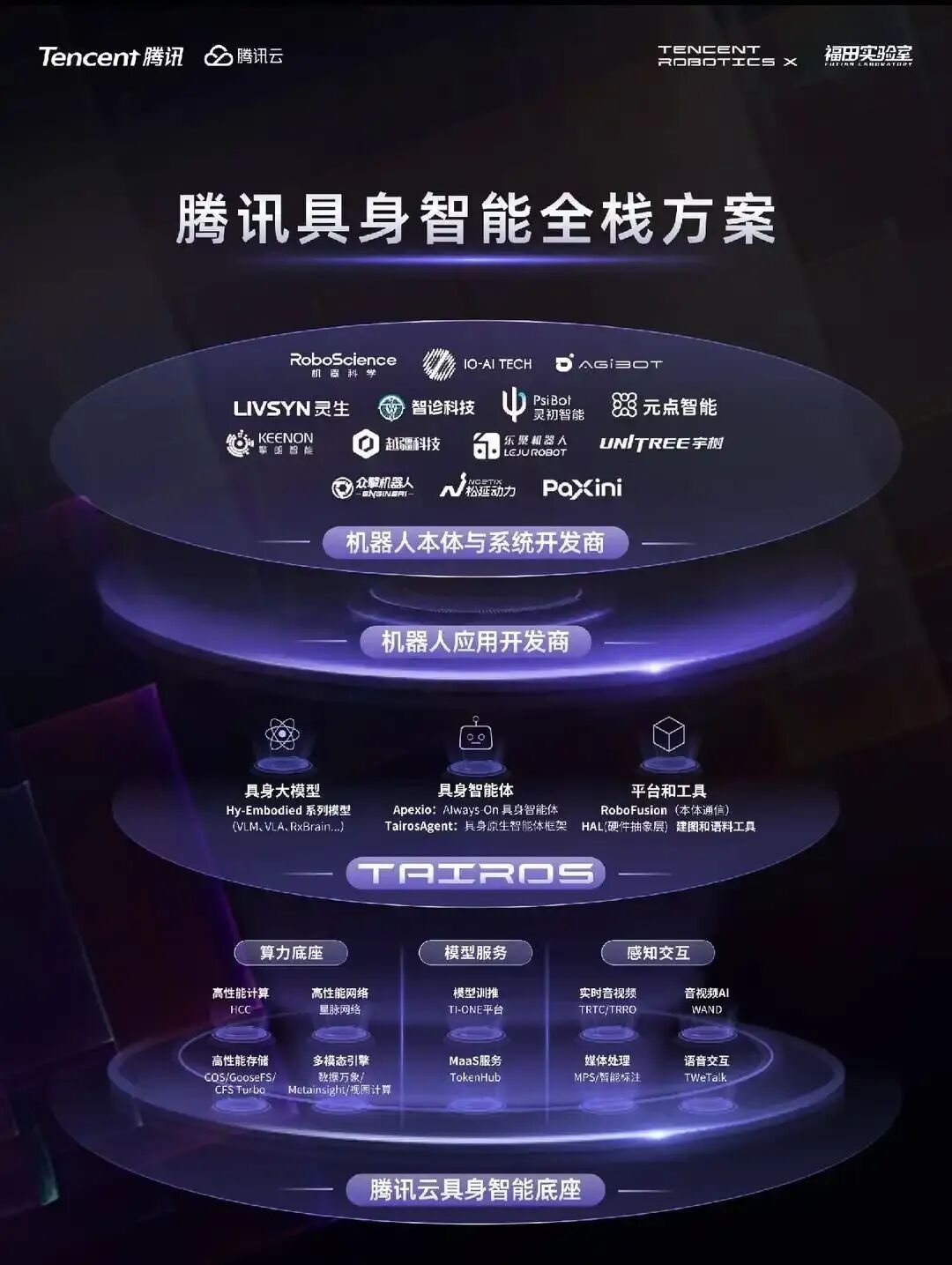

Conclusion
The success formulas of the internet era do not necessarily apply in the hard tech era.
Tencent once ranked among China's most valuable companies by "connecting everything." But embodied AI is not social media, e-commerce, or gaming. It is a physical industry requiring the "brain" and "body" to be welded together, with data as each company's core barrier. No company is willing to hand over its lifeblood to a platform.
Tencent's choice not to make hardware or engage in mass production is not wrong. But if the underlying assumption is "others do the hard work, I take a platform cut," a recalibration may be needed. In this race, the value of a platform may be inferior to a shovel, and the shovel business has never been about passive profits.
*Referenced Articles:
"2026 Embodied AI Robot Data Industry Layout Research Report" jointly released by Zo Siyuan (Zosi Auto Research) and Shuiqing Muhua Research Center
IT Home "2026 Embodied AI 'Brain' Power Rankings"
Zhidongxi "6 Months, 15 Embodied AI Startups, Valuations Exceed 10 Billion"
-
![]()
In the First Half of the Year, Car Companies’ Profit Margin Plummets to 3.8%! CPCA: Automakers Must Speed Up Battery Production Amid Upstream Pressures | MINGJING Pro
-
![]()
Tesla’s Q2 Revenue Rises, Yet Profitability Slips; Energy Storage Margins Take a Dive
-
Chinese Automakers Strike Gold Overseas: Prices Double?
-
![]()
Joint Ventures, Once Dismissed, Are Now Making a Comeback
-
![]()
Automotive Market News: Retail Penetration Rate of New Energy Vehicles Reaches 62.8%
-
![]()
Once a Sales Leader Among New Car Manufacturers, Now Selling Equipment at Bargain Prices
-
![]()
There are risks in going global, but we must rise to the challenge when facing 'competitors'!
-
![]()
Is Selling Cars in China Primarily a One-Time Transaction?