In the First Half of the Year, Car Companies’ Profit Margin Plummets to 3.8%! CPCA: Automakers Must Speed Up Battery Production Amid Upstream Pressures | MINGJING Pro
 07/28 2026
 476
476
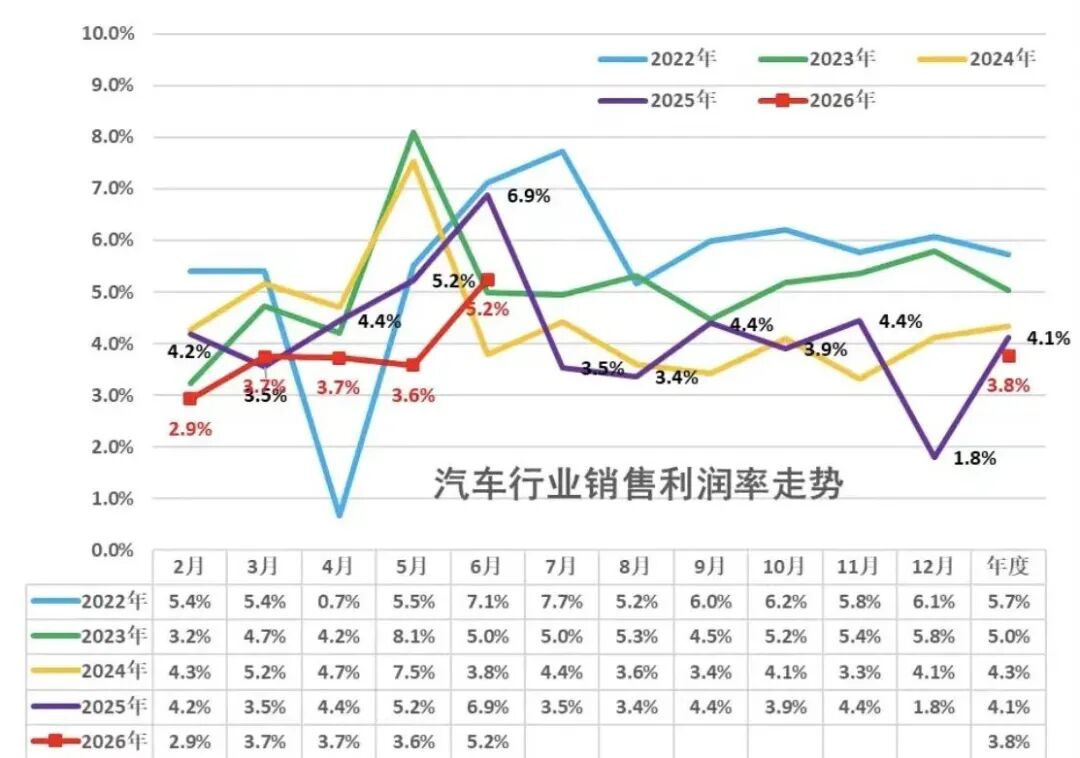
New car models are launching in quick succession, creating a bustling scene, yet the automotive industry is facing dwindling profitability. According to data from the China Passenger Car Association (CPCA), from January to June this year, 15.1 million vehicles rolled off the production lines, marking a 4% year-on-year decrease. In contrast, 7.4 million new energy vehicles were produced, a 6% increase over the same period. During this time, the domestic automotive industry reported total operating revenue of RMB 5,189.3 billion, a modest 1.8% year-on-year increase. However, total profits plummeted by 20% year-on-year to RMB 195.4 billion, resulting in an industry-wide scenario of "rising revenue but shrinking profits."
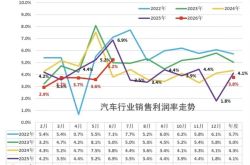
When it comes to the automotive industry's profit margin—a key indicator of profitability—it dropped to a mere 3.8% in the first half of this year, the lowest level in nearly a decade. Looking at the long-term trend, the profit margin has been on a downward trajectory for years. In 2014, the profit margin from automobile sales stood at a relatively high 9%. Since then, it has steadily declined, dropping to 4.3% in 2024 and further to 4.1% in 2025. In the first half of this year, it fell below the 4% threshold. This is not only lower than the historical average of the past decade but also nearly 2.7 percentage points behind the 6.5% average profit margin of downstream enterprises during the same period.
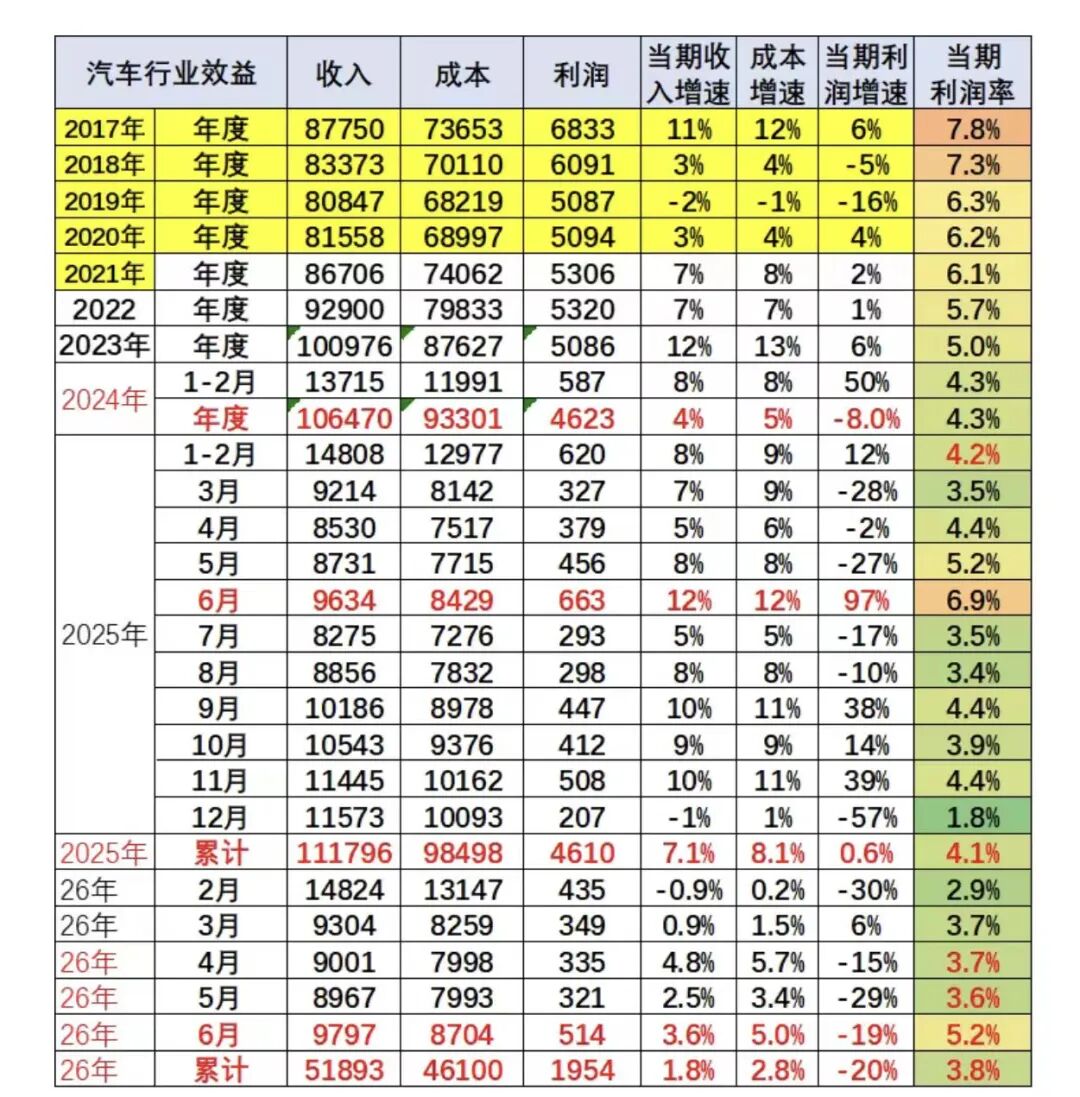
On a monthly basis, the profit margin dipped to as low as 2.9% in February this year, due to the combined impact of the Spring Festival holiday and the seasonal market lull. It rebounded to 3.7% in March-April and surged to 5.2% in June. Cui Dongshu, Secretary-General of the CPCA, noted that June traditionally sees relatively high profit margins throughout the year, but this year's level was abnormally high. This was attributed to an exceptionally strong push by high-end vehicles and a surge in export demand, which highlighted the profit-pulling effect. Nevertheless, the overall trend of declining profitability in the first half of the year remained unchanged.
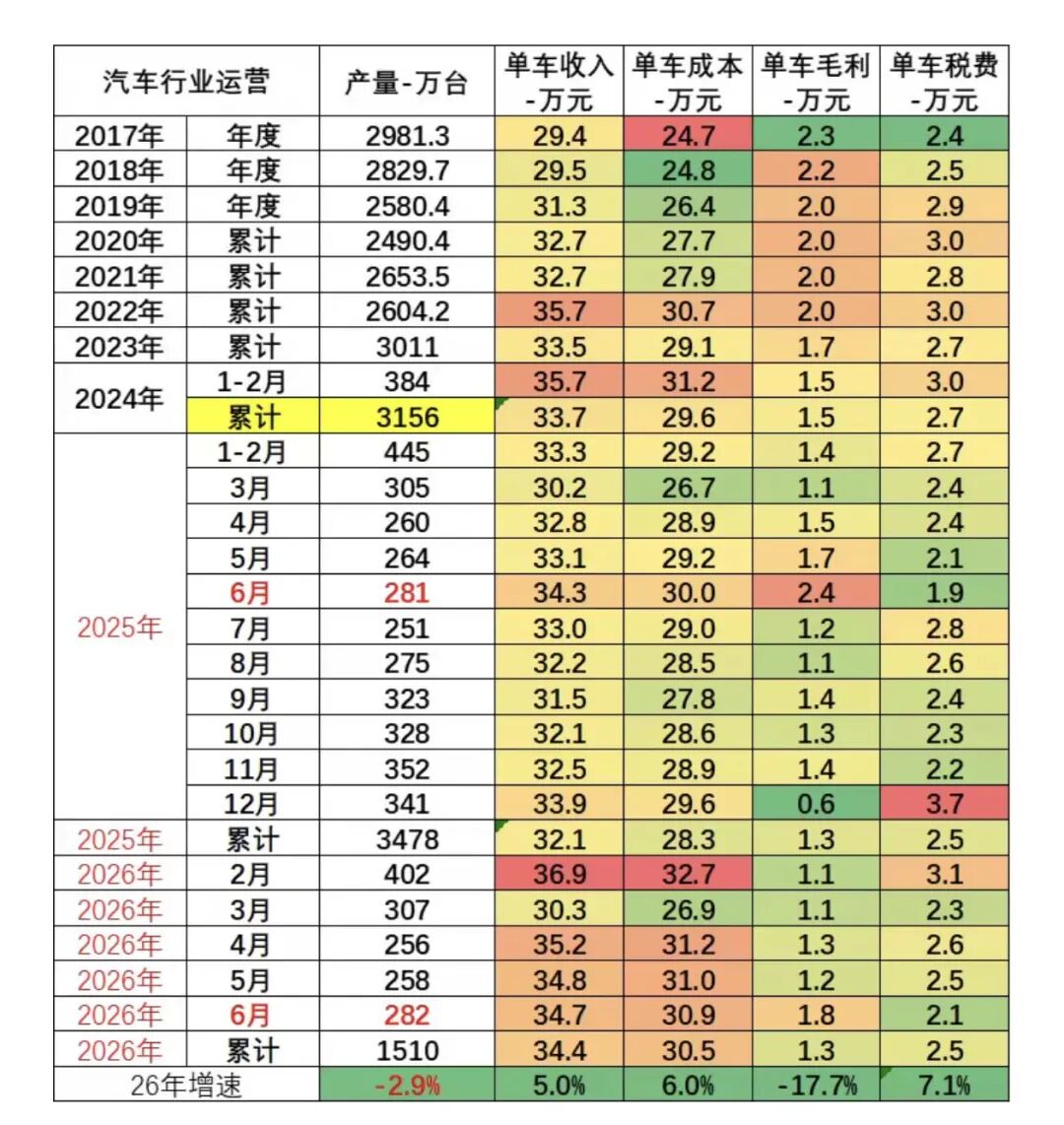
Behind this trend lies the continuous rise in costs. Data shows that in the first half of this year, the revenue per vehicle in the automotive industry chain was approximately RMB 344,000 (including double-counted parts of the industry chain), a 5% year-on-year increase. However, the cost per vehicle reached RMB 305,000, a 6% year-on-year increase. Meanwhile, the gross profit per vehicle in the industry chain was only RMB 13,000, a significant 17.7% year-on-year decrease. This means that for every vehicle sold, the overall earnings of the industry chain were nearly 20% less than last year. It's important to note that the gross profit per vehicle in the industry chain does not include subsequent expenses such as advertising and sales by automakers.
One of the core reasons for the decline in profits and the increase in costs is the pressure exerted by rising upstream raw material prices on the middle and downstream sectors. "As the country continues its efforts to combat excessive internal competition, the automotive industry is severely squeezed by upstream pressures, with prominent price issues. Oil prices have surged, and profits in sectors such as non-ferrous metals and semiconductors have skyrocketed. Terminal users are adopting a strong wait-and-see attitude towards vehicle purchases, and the operational pressure on automakers continues to mount, with high-quality development facing significant impacts from upstream factors," Cui Dongshu explained.
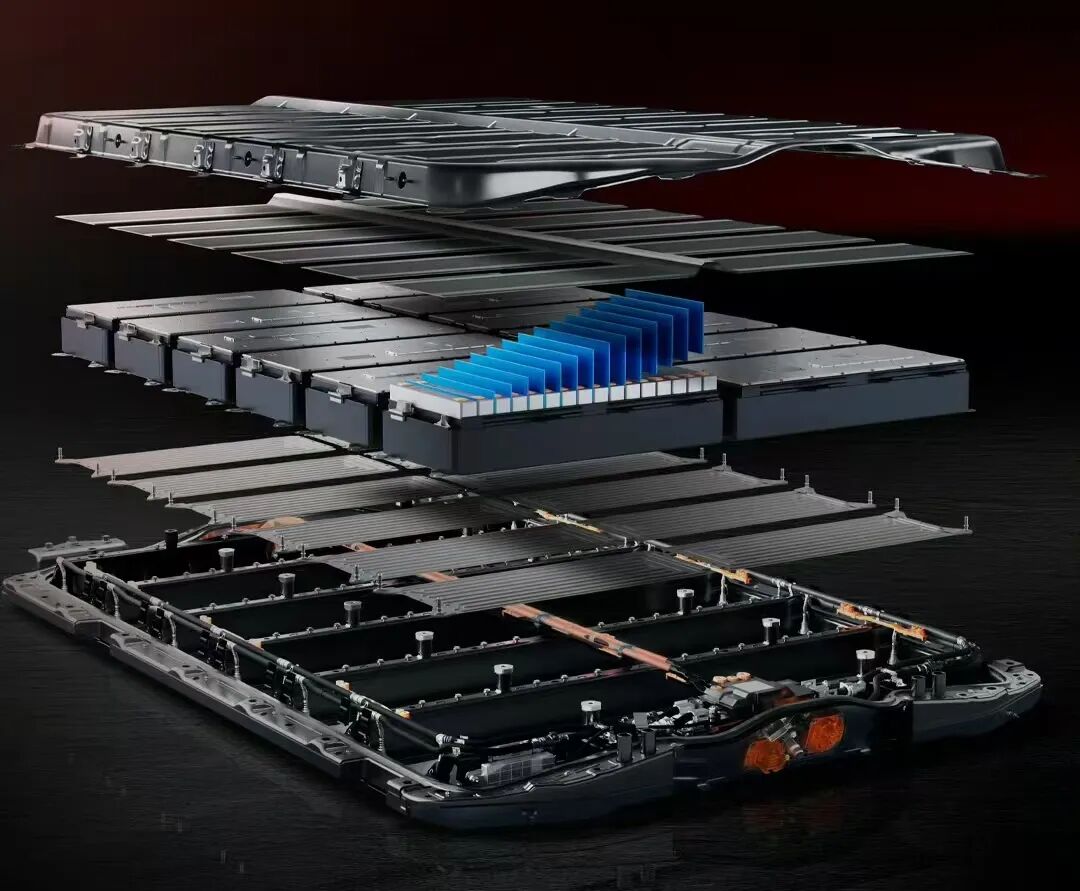
Cui Dongshu also highlighted the impact of the battery sector on the profitability of vehicle companies. "Since most vehicle companies do not produce batteries and lack bargaining power, the profit pressure on mainstream automakers will continue to escalate sharply," he said. He pointed out that in the first half of 2026, the export price of lithium batteries was RMB 104,800 per ton, a 12% year-on-year decrease. However, domestic battery prices remained firm. At the same time, the payment terms for listed lithium battery companies were as long as 200 days, while automakers were only required to pay within 60 days.
Within the industry, there has been a growing sentiment that automakers are essentially working for leading battery manufacturers like CATL. A comparison of the financial reports of CATL and vehicle manufacturers reveals a stark contrast. In the first quarter of this year, CATL's net profit attributable to shareholders was as high as RMB 20.74 billion, while the combined net profit of seven vehicle companies—Chery, Geely, BYD, SAIC, Great Wall, Seres, and Changan—was only RMB 17.5 billion, less than that of CATL alone. In the first half of this year, CATL achieved operating revenue of RMB 276.9 billion, a 54.8% year-on-year increase, and net profit attributable to shareholders of RMB 43.28 billion, a 42% year-on-year increase.
During the same period, the profits of vehicle companies almost all declined, with some even turning from profit to loss. Great Wall Motor expected its net profit attributable to shareholders in the first half of the year to be between RMB 2.35 billion and RMB 2.6 billion, a 58.97% to 62.92% year-on-year decrease. Changan Automobile expected its net profit attributable to shareholders to be between RMB 740 million and RMB 970 million, a 57.66% to 67.70% year-on-year decrease. Seres would turn from profit to loss, expecting a net loss attributable to shareholders in the first half of the year of between RMB 1.5 billion and RMB 1.8 billion, compared to a profit of RMB 2.941 billion in the same period of 2025. GAC Group expected its net loss attributable to shareholders in the first half of this year to be between RMB 4.06 billion and RMB 4.57 billion, further expanding from the net loss of RMB 2.538 billion in the same period of 2025.
Additionally, among the passenger vehicle companies that have released their performance forecasts for the first half of 2026, only BAIC BluePark and JAC Motors have seen a reduction in losses. BAIC BluePark expected its net loss attributable to shareholders in the first half of this year to be between RMB 1.77 billion and RMB 1.97 billion, narrowing from the loss of RMB 2.171 billion in the same period of 2025. JAC Motors expected its net loss attributable to shareholders to be around RMB 740 million, a year-on-year reduction in loss of approximately RMB 32.81 million.
"As the country continues its efforts to combat excessive internal competition, more vehicle companies will aim to become international giants in the future, and the production of batteries by automakers will inevitably accelerate. In the future, the vehicle will be king, and the profitability of automakers will gradually improve," Cui Dongshu predicted.
Faced with the continuous decline in profits across the entire industry, some automakers have already begun to adjust their strategic directions. This adjustment primarily focuses on two aspects: first, "slowing down" to prioritize quality. In addition to Great Wall Motor, which has always emphasized high-quality development, recent automakers such as Changan and Chery have also stated that they will bid farewell to the "scale theory" of simply pursuing sales volume and irrational competition, and instead pursue higher-quality growth and sustainable profitability.
Second, they are targeting overseas markets as a crucial breakthrough. In addition to Chery, the "export leader," independent automakers such as BYD and Geely have seen rapid growth in overseas sales in recent years. Among them, the export volumes of Great Wall Motor and Changan Automobile have already accounted for more than 50% of their overall sales volume, transforming from a supplementary sales channel to a significant part of their business. The significance of targeting overseas markets lies not only in opening up new channels for sales growth but also in bringing higher product premiums and profits, which will further optimize the profitability of automakers.

-
![]()
Is Design the Root of the Problem? The Lexus ES Dilemma: Despite New and Old Models Coexisting Post-Redesign, Sales Plummet by 40%
-
![]()
Are Japanese Automakers Now Taking Cues from China? A Perspective on Japan's Reversal in Learning
-
![]()
In the First Half of the Year, Car Companies’ Profit Margin Plummets to 3.8%! CPCA: Automakers Must Speed Up Battery Production Amid Upstream Pressures | MINGJING Pro
-
![]()
Tesla’s Q2 Revenue Rises, Yet Profitability Slips; Energy Storage Margins Take a Dive
-
Chinese Automakers Strike Gold Overseas: Prices Double?
-
![]()
Joint Ventures, Once Dismissed, Are Now Making a Comeback
-
![]()
Automotive Market News: Retail Penetration Rate of New Energy Vehicles Reaches 62.8%
-
![]()
Once a Sales Leader Among New Car Manufacturers, Now Selling Equipment at Bargain Prices