GPT-5.6 Announces Price Reductions! Save Up to 80%!
 07/31 2026
 443
443
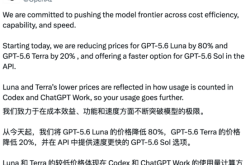
On the final day of July, OpenAI surprised GPT-5.6 series users with a host of benefits by substantially adjusting the pricing of three models. The base model, Luna, saw its input price slashed to $0.2 and output to $1.2, marking an 80% reduction. Terra, tailored for everyday tasks, now costs $2 for input and $12 for output, reflecting a 20% decrease.
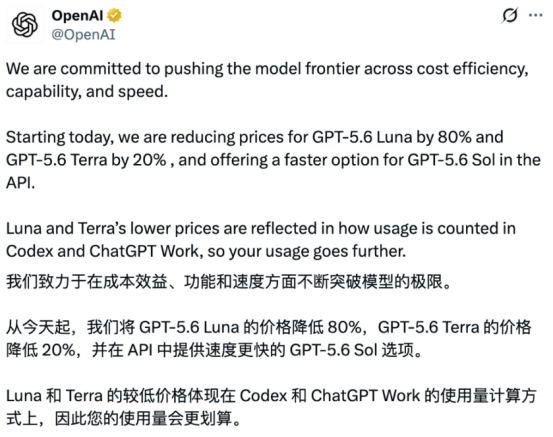
The flagship model, Sol, retains its original pricing at $5 for input and $30 for output. However, it introduces a Fast mode, accelerating processing speeds up to 2.5 times that of the standard mode, effectively offering a speed-based price advantage.
The price reductions are largely attributed to GPT-5.6 Sol's role in optimizing the production system. GPT-5.6 Sol has rewritten and fine-tuned certain GPU Kernels within the production environment, designed and executed hundreds of token generation experiments, and actively participated in training monitoring, intervening promptly when issues arose.
Following self-optimization, the end-to-end service cost of GPT-5.6 has dropped by 20%. Enhanced speculative decoding has boosted token generation efficiency by over 15%.
Model involvement has not only enhanced operational efficiency but also reduced costs. Lower prices enable models to be integrated into more high-frequency workflows. Increased usage, in turn, drives further efficiency improvements.
With heightened efficiency, OpenAI is confident in implementing these price reductions.
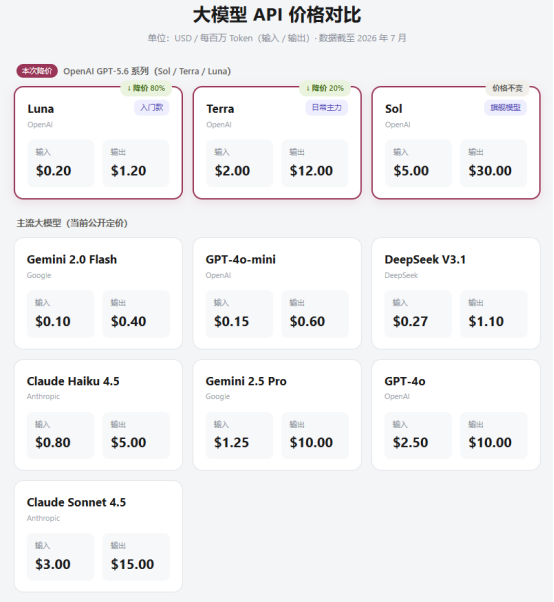
For comparison, Luna's input price of $0.2 now rivals that of GPT-4o-mini ($0.15) and Gemini 2.0 Flash ($0.1). In essence, OpenAI has lowered the entry barrier to a level comparable to Google's offerings and its own mini series.
A small team developing customer service bots, summaries, or classifications, previously deterred by GPT-4o's high costs and hesitant to opt for smaller models, now finds Luna to be an ideal choice—offering sufficient capabilities at an affordable price.
However, Sol's output price of $30 remains the highest in the market. It surpasses Claude Opus 4.5 ($25), is three times that of Gemini 2.5 Pro ($10), and twenty-seven times that of DeepSeek V3.1 ($1.1).
OpenAI's stance is unequivocal: no price reductions for the flagship model. It posits that customers operating core businesses and prioritizing performance over price are less cost-sensitive.
Terra's 20% price reduction strikes a balanced middle ground. Priced at $2/$12, it sits between GPT-4o ($2.5/$10) and the domestic DeepSeek V3.1 ($0.27/$1.1). It is marginally more expensive for output and slightly cheaper for input compared to the older GPT-4o, signaling a minor adjustment without undermining Sol's premium position.
Examining the timeline, API price reductions for large models have been significant. When GPT-4 was initially launched in 2023, its input price stood at $30 and output at $60, positioning it as a luxury option for finance and law firms.
Over the past two years, OpenAI has implemented several price cuts, bringing GPT-4o's prices down to $2.5/$10.
From $60 to today's Luna output price of $1.2, prices have dramatically decreased over three years.
Horizontally, Google's Gemini has maintained its Flash series pricing around $0.1 from the outset, adhering to a "low-margin, high-volume, ecosystem-driven" strategy. DeepSeek has priced V3.1 at $0.27/$1.1, leveraging its cost structure to compel European and American vendors to follow suit.
Anthropic adopts a contrasting approach. Claude Haiku 4.5 caters to the lightweight segment, Sonnet 4.5 to the mainstream, and Opus 4.5 to the high-end, with substantial price gaps between tiers, preventing customers from accessing premium intelligence at discounted rates.
OpenAI's current pricing strategy aligns with Anthropic's tiered approach but cuts the low end more aggressively. One strategy utilizes the high end as a flagship, while the other employs the low end as a funnel to attract a broader user base.
-
![]()
Mobile Phone Manufacturers Bet on AI: A New Game of 'Who Controls the Users'
-
![]()
US Space Force Shells Out $1.6 Billion: SpaceX Clinches 18 Falcon 9 Launch Contracts Once Again
-
![]()
Five to six hundred new car models flood into a shrinking market every half year, leaving many automakers crying out amidst fierce internal competition.
-
![]()
German Media: Will Volkswagen Be Taken Over by Chinese Automakers?
-
![]()
"High Installation Costs" and "Rising Mobile Phone Prices": Do Huaqiangbei's Counters Hold the Answers?
-
![]()
From Luna Ultra to See Insta360's Gimbal Strategy: Profit or Growth?
-
![]()
GPT-5.6 Announces Price Reductions! Save Up to 80%!
-
![]()
Memory Price Surge Fuels Apple’s 27% Profit Jump, With Chinese Consumers Propelling 22% Revenue Growth