"High Installation Costs" and "Rising Mobile Phone Prices": Do Huaqiangbei's Counters Hold the Answers?
 07/31 2026
 446
446
Author | Jiang Xu
For more financial information | BT Finance Data Pass
The full text is 2,489 words, with an estimated reading time of 9 minutes
Who ultimately foots the bill for the production capacity lost to AI? The answer has emerged in the counters of Huaqiangbei and the price adjustment announcements from smartphone manufacturers.
A 32GB DDR5 memory kit now sells for nearly 4,000 yuan, up three to four times from the same period last year; a 1TB consumer-grade SSD, long a mainstream bestseller, has broken the 900-yuan mark at retail. This is no short-term fluctuation but a supercycle now entering its third quarter, which institutions predict "may not ease until the second half of 2027 at the earliest."
In this chain of transmission, Apple, Xiaomi, OPPO, vivo, Honor, ZTE, and others have made starkly different choices—choices largely constrained by their respective gross margin buffers.
1. Distribution Channel: Rapid Changes, Merchants Dissuade Buyers

Shenzhen's Huaqiangbei, the nation's most representative electronics component hub, serves as the most intuitive observation window for this price surge.
A gamer planning to upgrade a desktop computer found, after comparing prices, that a 32GB DDR5 memory kit now costs nearly 4,000 yuan. Weighing the options, they opted to purchase a 24GB configuration as a temporary solution, planning to expand capacity once prices stabilize. The distribution market has seen "two daily price changes, rejected orders, and merchants discouraging buyers," with dealers generally advising non-urgent purchases to be postponed.
Graphics card prices have also climbed, with the RTX 5080 The quotation once soared to about 12000 yuan reaching around 12,000 yuan at one point, cementing the consensus of the "most expensive PC-building season" in the industry.
2. Cost Structure: Memory's Share in Smartphone BOMs Surges from 10%–15% to Over 30%
Beyond prices, the restructuring of cost structures warrants closer attention.
Industry statistics show that DRAM contract prices have surged by over 340% year-to-date, while NAND flash memory has risen by more than 320%. Breaking it down to specific components: the cost of 12GB LPDDR5X memory for a flagship smartphone has jumped from $77 to $146 per unit; 1TB flash memory chip costs have soared from just over 200 yuan to nearly 600 yuan.
Consequently, memory chips' share of smartphone material costs has exploded from 10%–15% in the past to over 30%, nearing 50% for some high-end models. Institutional reports indicate that for low-end models, memory costs have risen nearly 300% year-on-year, now accounting for over 65% of total bill-of-materials (BOM) costs—directly determining the varying survival thresholds for different manufacturers.
Counterpoint Research previously calculated that for a $200 low-end phone (typically configured with 6GB LPDDR4X + 128GB eMMC), memory could account for up to 43% of the total BOM, with entry-level products hit hardest.
3. Corporate Responses: Three Approaches, Three Fates
OPPO: First Major Player to Announce Price Hikes
On March 10, OPPO stated in an official announcement that, faced with rising costs for key smartphone components, including high-speed storage hardware, the company had carefully assessed the situation and decided to adjust prices for certain released products starting at 0:00 on March 16, 2026, affecting the OPPO A series, K series, and OnePlus. vivo, Xiaomi, Honor, and Samsung soon followed, leading to industry-wide price increases: mid-range models rose by 300 to 800 yuan, while flagship models saw hikes exceeding 1,000 yuan.
Xiaomi: "Holding Firm" with a 10.1% Gross Margin
Xiaomi was among the last to follow suit and implemented smaller price increases, a decision made against the backdrop of an extremely thin profit margin—its Q1 2026 earnings report showed a smartphone business gross margin of just 10.1%, far below Apple's 40%+.
Lei Jun publicly stated during the March 2026 Two Sessions that the soaring cost of memory chips had placed significant pressure on Xiaomi's smartphone business, but the company would explore various measures to minimize the impact on consumers. In practice: the Xiaomi 17 Ultra started at 6,999 yuan, up just 500 yuan from its predecessor; the Redmi K90 Ultimate Edition 12GB+256GB version debuted at 2,799 yuan; the May-released Xiaomi 17 Max was priced only 300 yuan more than the standard edition, starting at 4,299 yuan after subsidies.
Xiaomi Group President Lu Weibing, speaking at MWC 2026, judged this memory price surge as an "unprecedented" long-cycle trend, expected to last until the end of 2027—spanning nearly three years from Q2 2025. He noted that Q1 2026 memory quotes had reached nearly four times those of the previous year, emphasizing that the price hikes were impacting not just smartphones but also tablets, TVs, automotive electronics, and nearly all consumer electronics categories, "leaving no player unscathed."
Apple: Leveraging Bargaining Power and Stockpiling to Pass on Costs Later
Apple's cost defense rests on two pillars: its massive purchasing volume enabling price pressure and its strategy of early, low-cost stockpiling. Leveraging these, Apple not only avoided following the price hikes in late 2025 to early 2026 but instead captured market share through promotional discounts—the M4 Mac mini dropped to just over 2,000 yuan with incentives, while the iPhone 16 series saw channel-wide price reductions to clear inventory. Only after exhausting its inventory advantages did Apple shift to cost pass-throughs, a classic high-margin player tactic.
ZTE and Others: Forced to Innovate
The memory price surge has exacerbated the divide between high-end and low-end markets. In Q2 2026, brands like Samsung and Apple gained market share against the trend, while manufacturers reliant on low-end products struggled to survive. ZTE chose to partner with ByteDance to launch the "Second-Generation Doubao" phone (the world's first AI agent-enabled smartphone, with a specific release date pending MIIT network access approval), seen by the industry as a strategic pivot amid the pricing cycle. Some insiders commented that other mainstream smartphone brands "would never cede control" to partner with ByteDance—a statement that underscores the predicament of tail (tail-end) manufacturers.
Additionally, multiple smartphone companies intensified their overseas market expansion during this cycle to offset shrinking domestic demand.
4. Demand-Side Consequences: Shipments Hit 13-Year Q2 Low
Passing on costs comes with consequences.
Counterpoint Research data shows that with memory shortages becoming a major industry headwind, global smartphone shipments in Q2 2026 fell 11% year-on-year, marking the lowest Q2 level since 2013. Some estimates indicate a roughly 15% year-on-year decline in smartphone SoC shipments in H1 2026.
Omdia expects the most pronounced shipment declines in the next two quarters; IDC projects that China's smartphone market shipments could see year-on-year drops expand to around 20% in H2 2026. IDC's earlier annual forecast predicted a 12.9% decline in global smartphone shipments and a 0.5% revenue drop for 2026, with growth resuming at 1.9% in 2027 and rebounding to 5.2% in 2028.
The PC sector faces similar pressures. TrendForce notes that sustained high memory costs may drag down PC shipments for the rest of the year, prompting manufacturers to adopt cautious production plans; commercial procurement and government-backed IT markets have emerged as relatively stable outlets for PC vendors due to rigid demand.
5. When Will It End?
On the supply side, there is currently no visible impetus for proactive relief. Original manufacturers continue to shift capacity toward higher-margin server products and HBM, reducing allocations for consumer memory—even as PC and smartphone demand weakens, prices remain resilient, marking the biggest difference from previous cycles.
TrendForce forecasts that traditional DRAM contract prices will rise 13%–18% quarter-on-quarter in Q3 2026, with NAND Flash up 10%–15%, a significant slowdown from Q2's roughly 60% increases. However, institutions clarify that this slowdown stems not from improved supply but from consumer electronics manufacturers' unwillingness and inability to absorb further cost hikes. Multiple agencies expect memory prices to begin declining only in the second half of 2027 at the earliest.
In other words, this bill will keep arriving for over another year.
Quick Corporate Reference 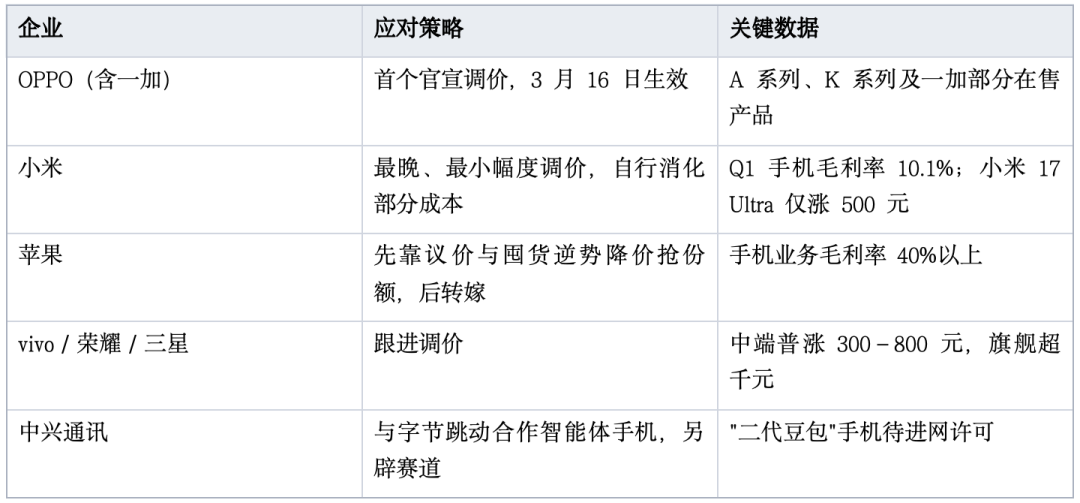
Data Timeliness Note: The memory prices, BOM cost structures, and institutional shipment forecasts cited in this article are primarily sourced from public reports and institutional analyses between March 2026 and mid-July 2026, representing cyclical background data rather than daily updates. Sources: ZOL, 21st Century Business Herald, The Paper, Beijing News Beike Finance , TrendForce, Counterpoint Research, IDC, Omdia, China Fund News, company public statements, and price adjustment announcements. This is an industry analysis and does not constitute investment or consumption advice.
This article is original content from BT Finance and may not be used, reproduced, disseminated, or adapted without permission. Infringement will be pursued legally.

The views expressed in this article are the author's own. For questions or feedback, please leave a comment directly in the comments section.
-
![]()
Mobile Phone Manufacturers Bet on AI: A New Game of 'Who Controls the Users'
-
![]()
US Space Force Shells Out $1.6 Billion: SpaceX Clinches 18 Falcon 9 Launch Contracts Once Again
-
![]()
Five to six hundred new car models flood into a shrinking market every half year, leaving many automakers crying out amidst fierce internal competition.
-
![]()
German Media: Will Volkswagen Be Taken Over by Chinese Automakers?
-
![]()
"High Installation Costs" and "Rising Mobile Phone Prices": Do Huaqiangbei's Counters Hold the Answers?
-
![]()
From Luna Ultra to See Insta360's Gimbal Strategy: Profit or Growth?
-
![]()
GPT-5.6 Announces Price Reductions! Save Up to 80%!
-
![]()
Memory Price Surge Fuels Apple’s 27% Profit Jump, With Chinese Consumers Propelling 22% Revenue Growth