2026 Decisive Game: Who Can Capture the Largest Increment in China's AI Cloud Market?
 01/29 2026
 696
696

Author | Chang Yuan
Editor | Key Focus
Evolutionary economist Carlota Perez discovered in her research on the history of technological revolutions that every major technological wave undergoes a transition from a frenzied 'installation period' to a rational 'deployment period.' Technology itself is merely the engine, while the matching infrastructure is the key to determining whether technology can create value.
Standing at the threshold of 2026, AI large models are transitioning from technological validation to deep integration and large-scale industrial deployment. The AI cloud infrastructure supporting model operations is the 'power grid' that must be built first. In this arena, competition among Chinese cloud providers has reached a fever pitch.
Behind the exceptionally lively performance in the cloud computing market, three clear industry trends emerge:
First, AI cloud is the main driver of cloud computing market expansion. Computing power demand is shifting dramatically from CPUs to GPUs, with B-end industrial adoption and C-end intelligent agent applications being the key drivers;
Second, full-stack capabilities have become the entry ticket for leading cloud providers. Only by achieving full-stack vertical integration from 'chips-cloud platforms-models-applications' can they support industrial adoption and handle application explosions;
Third, the importance of chips has further increased. Against the backdrop of supply chain uncertainties, whoever can provide large-scale stable computing power will hold the dominant position.
Against this backdrop, an aggressive signal has emerged from the market: Baidu Intelligent Cloud recently raised its 2026 AI-related business revenue growth target from the original 100% to 200% at an internal strategic meeting and explicitly stated its ambition to 'fully compete for the top spot in the AI cloud market.'
Meanwhile, market leaders such as Alibaba Cloud and Volcano Engine are also ramping up their efforts. The intense competition reflects a fundamental shift in the underlying logic of the AI cloud market: as AI begins to truly 'deliver results,' whoever can provide the fastest, most stable, and cheapest 'power grid' will capture the largest increment in China's AI cloud market.
The Market Logic Has Changed
In 2026, the global cloud market will no longer remain calm. The industry consensus is that this year will mark the beginning of accelerated industrial adoption of intelligent agents (Agents).
This trend poses two new challenges for cloud providers and constitutes a new market screening mechanism:
First, computing power demand is shifting from instantaneous bursts to continuous inference. With the widespread adoption of deep thinking models like DeepSeek R1, AI applications such as intelligent agents are transitioning from simple 'fast thinking' to complex 'slow thinking.' Before outputting results, models need to perform large-scale chain-of-thought reasoning. This means that enterprise demand for computing power is no longer just a 'flash in the pan' during training but has become a 24/7 'water and electricity' requirement for business operations. The exponential growth in inference-side computing power forces cloud providers to offer highly cost-effective GPU computing power bases rather than traditional CPU resources.
Second, enterprise procurement is shifting from one-off 'project-based' trials to 'systematic deployment.' Bidding data from 2025 shows that large model projects are highly concentrated in key industries such as finance, energy, and government affairs. Enterprise core demands have changed; they are no longer satisfied with simply calling APIs for Q&A but require AI to truly solve business pain points. This necessitates a series of complex system engineering efforts, including computing power supply, model fine-tuning, tool orchestration, knowledge base integration, and security control.
Simply put, customers in 2026 will be more pragmatic. This explains why Baidu Intelligent Cloud dares to set a 200% growth target—while the industry is still discussing model capabilities, market pain points have shifted to engineering implementation.
Industry Barriers Have Risen
In the new competitive cycle, the competition dimension for cloud providers has shifted from single computing power leasing to full-stack capability competition.
In the past, cloud providers acted like 'sublandlords,' profiting by subleasing computing power. However, in the face of large-scale model training and complex intelligent agent applications, enterprises have found that without underlying chip-level interconnection optimization, the efficiency of 10,000-card clusters will be severely compromised, leaving expensive computing power idle. Without upper-layer model and framework collaboration, application inference costs will remain high.
This leads to the core logic of the 2026 cloud market: only by achieving full-stack vertical integration from chips, cloud platforms, models, to applications can cloud providers establish barriers in terms of cost and efficiency. This logic was validated by Google: in 2025, Google achieved a market comeback with its Gemini series models, self-developed TPU chips, and highly optimized cloud infrastructure. In the Chinese market, few players can align with this logic.
Observing the domestic market, Baidu is one of the few players in China capable of aligning with Google, possessing full-stack capabilities in 'chips, cloud platforms, models, and agents.'
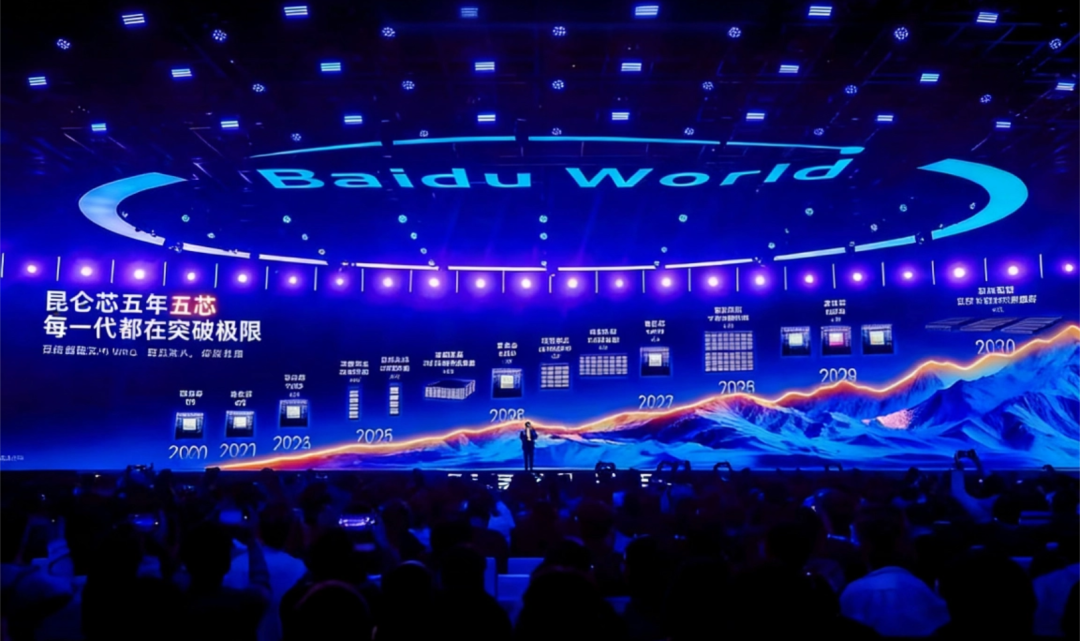
At the chip level, Baidu's Kunlun Core has iterated to its third generation. In 2025, Baidu successfully lit up China's first fully self-developed 30,000-card Kunlun Core cluster and unveiled its next-generation M100 and M300 chips.
At the cloud platform level, Baidu Intelligent Cloud has built a full-stack infrastructure of AI Infra + Agent Infra. The soft-hard collaboration between Kunlun Core and the Baige platform fully unleashes chip potential. Data shows that with the support of the Baige platform, the effective training duration of the Kunlun Core 10,000-card cluster can reach 98%, with fault recovery time shortened from hours to minutes. Baidu Qianfan Agent Infra provides capabilities across five layers: models, tools, agent development, data, and agent operating environments, helping enterprises and developers easily build usable agents.
At the model level, Baidu's recently released ERNIE Large Model 5.0 adopts native multimodal unified modeling technology with a parameter scale of 2.4 trillion. In a comprehensive evaluation of over 40 authoritative benchmarks, the official version of ERNIE 5.0 surpasses models like Gemini-2.5-Pro and GPT-5-High in language and multimodal understanding capabilities, firmly ranking in the international first tier.
At the application level, Baidu Intelligent Cloud's 'Miaoda' no-code intelligent platform enables users without coding knowledge to generate applications, having already created over 400,000 applications. Famu, the world's leading commercially viable self-evolving intelligent agent, breaks through the efficiency ceilings of traditional algorithms in core industrial scenarios such as logistics scheduling and industrial manufacturing through its self-evolving capabilities.
The Matthew effect brought about by this 'full-stack' approach is becoming evident. According to the '2025 H1 China AI Cloud Full-Stack Service Market Share Report' released by CCID Consulting, the Chinese AI cloud full-stack service market reached RMB 28.09 billion in the first half of 2025, a year-on-year increase of 195.7%. Baidu Intelligent Cloud ranked first with a 40.2% share. IDC data shows that Baidu Intelligent Cloud has remained the leader in the AI public cloud service market for six consecutive years.
The changes AI brings to the cloud computing industry are just beginning. Only all-round players with 'chips, cloud platforms, models, and agents' can truly capture the growth dividends of the AI era.
Where Does Baidu Intelligent Cloud's Growth Momentum Come From?
Why does Baidu Intelligent Cloud dare to set an internal target of doubling its 2026 AI-related revenue growth to 200%? In our view, its confidence comes from three aspects:
First, it offers an extremely cost-effective computing power base. Against the backdrop of intensifying supply chain uncertainties, autonomous controllability and high utilization of computing power are two sides of the same coin. Baidu's Kunlun Core not only achieves large-scale deployment of 10,000-card and 30,000-card clusters but also solves performance bottlenecks in practical applications of domestic chips through soft-hard collaboration with the Baige platform. This essentially provides customers with a form of 'computing power insurance.' For example, in a collaboration with a major bank, a computing power base based on Kunlun Core P800 completed full-scale training of a 100-billion-parameter model using only 32 servers. This domestically produced computing power solution, validated through large-scale practical applications, is highly scarce in the current market environment.
Second, it captures incremental dividends brought by intelligent agents. If computing power represents stock competition (stock competition), then intelligent agents (Agents) represent the largest increment in 2026. Qianfan Agent Infra solves the engineering challenges of enterprise agent development; 'Miaoda' lowers the threshold for application development through its no-code platform, directly driving consumption of underlying cloud resources; Famu, as a commercially viable agent, enhances efficiency in industrial scenarios such as retail, energy, and manufacturing through its self-evolving algorithm capabilities.
The explosion of these toolchain products essentially 'nourishes' the cloud business. Customers are not just buying servers but purchasing a complete 'operating system' that enables rapid business intelligence.
Finally, it boasts market-validated industrial adoption practices. This aspect is often overlooked by outsiders. Baidu Intelligent Cloud's technology stack is not a laboratory product but has undergone 'internal training' in high-concurrency, high-complexity scenarios such as large-scale search requests and autonomous driving data processing. The stability and engineering experience accumulated in these scenarios constitute extremely high competitive barriers when addressing complex external enterprise demands.
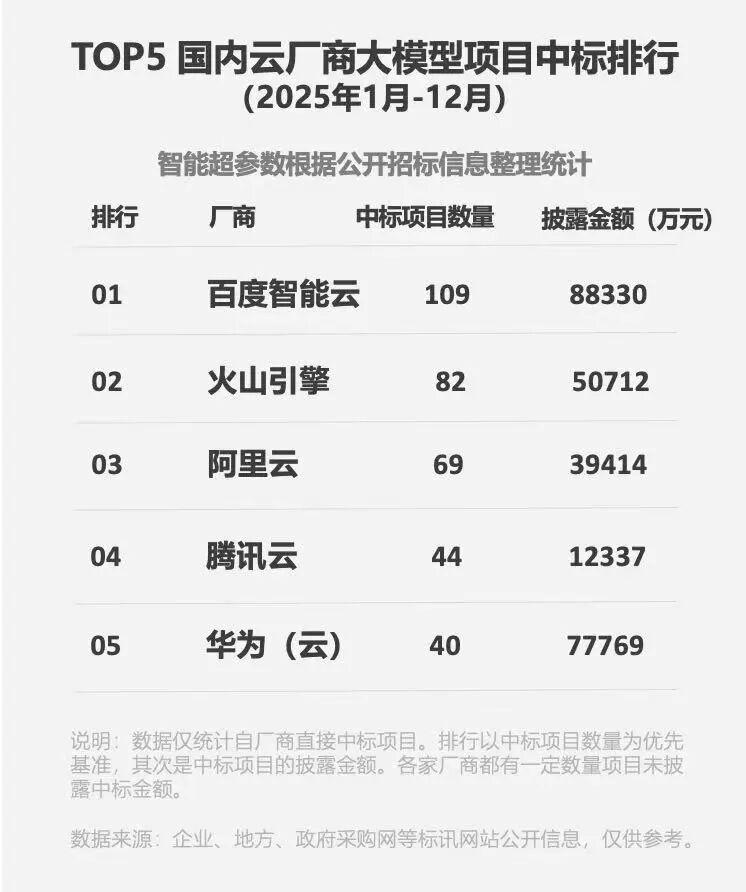
In the 2025 bidding market, Baidu Intelligent Cloud ranked first in both project count (109) and bid amount (RMB 900 million) for two consecutive years. Volcano Engine and Alibaba Cloud ranked second and third, respectively. More persuasively, Baidu Intelligent Cloud also ranked first in the number of winning bid (bid-winning projects) in energy, finance, and automotive sectors. This high penetration in key industries means that Baidu Intelligent Cloud has crossed the trust threshold in the most discerning B-end market.
Conclusion
The so-called 'long-termism' essentially involves enduring long periods of silence to achieve explosive growth during technological paradigm shifts.
Looking back over the past decade, Baidu has often been scrutinized and questioned by the outside world. However, in the AI era, its long-term technological investments are beginning to show their value.
Baidu began laying out Kunlun Core as early as 2011, with over a decade of high-intensity R&D investment. These 'secret deep dives,' once scrutinized by outsiders, now form the underlying support for its full-stack AI capabilities.
In 2026, competition in China's AI cloud market will become even fiercer, a battle of technological depth and implementation breadth.
For enterprise customers, choosing a cloud service provider is essentially selecting a technological partner for the next five years.
Baidu Intelligent Cloud's decision to raise its 2026 AI business growth target to 200% is not merely aggressive expansion but a strategic confidence based on a decade of technological accumulation, demonstrating readiness for the industrial harvest period.
In this decisive game, the winners will be all-round players who understand chips, clouds, and can master model applications. And at the current table, Baidu Intelligent Cloud clearly holds the largest chip (chips).
-
![]()
Li Shufu's Lesson in 'Abstract' Thinking: With Speed Dividends Peaking, What Will Drive China's Auto Industry Through the Next Two Decades?
-
![]()
World’s Pioneering! Automated Production Line for Million-Scale Volume Holographic Waveguides Launched in Tianjin
-
![]()
Cars Can't Be Made with the 'Quick Buck' Mentality: Li Shufu's Candid yet Impactful Remarks
-
![]()
Can You Snag a Complete Trio of Digital Gadgets for 10,000 Yuan? AI Recommendation Showdown: How Trustworthy Are Doubao, DS, Qianwen, Kimi, and Yuanbao?
-
![]()
DingTalk Undergoes Leadership Overhaul Amid Alibaba’s AI Strategy Unveiling
-
![]()
Revealing the Myth of the '10 Billion Subsidy': Pinduoduo Faces Heightened Scrutiny with Its '100 Billion Initiative'
-
![]()
Yousu's '70,000-Character Long Essay' Resonates with Alibaba Executives' 'Cultural Awareness'
-
Analysis | SpaceX is about to land on Nasdaq. Where is the breakthrough point for China's commercial aerospace?