Chinese Games Make a Strong Comeback: Money Alone Can't Secure AAA Titles
 03/27 2026
 681
681
Author/Proton
Editor/Jiajia
Recently, ByteDance announced its decision to sell its mobile game company, Moonton Technology, to Savvy Games Group, a subsidiary of Saudi Arabia's Public Investment Fund (PIF), for a staggering sum exceeding $6 billion.
In fact, this is not the first instance of a Chinese company offloading an overseas game company or studio. In March, NetEase revealed that it would cease investing in Nagoshi Toshihiro's Tokyo studio from May onwards, allowing it to continue operating independently. Additionally, industry giants like Tencent and miHoYo have been progressively shutting down their overseas R&D studios.
It's evident that Chinese game developers have collectively shifted their stance towards overseas game studios, transitioning from a phase of frenzied entry and heavy investment to one of disengagement and withdrawal.
This contrasting attitude stems from both domestic game developers' skepticism towards the lengthy development process of AAA games and their assessment of the overall gaming trend—who says China can't produce AAA games?
【1】Frenzied Expansion: Establishing Overseas Studios
"We aim to leverage these studios as a springboard to attract international R&D talent, enhance our technological prowess, and progress towards developing AAA-grade self-developed games," Tencent's TiMi Studio declared in August 2021 upon establishing its Montreal studio, emphasizing its commitment to AAA game development.
Indeed, Tencent is not alone in its pursuit of AAA games. Chinese game developers such as NetEase, miHoYo, Lilith Games, and FunPlus have all ventured overseas to regions like Montreal, Lisbon, and Los Angeles to set up game R&D centers.
The rationale behind Chinese game developers' overseas expansion is straightforward—the market is at a pivotal juncture. According to Gamma Data, in the third quarter of 2022, the actual sales revenue of the Chinese game market was 59.703 billion yuan, marking a year-on-year decrease of 19.13% and hitting a decade-low.
In stark contrast to the gaming industry's downturn, miHoYo's AAA game Genshin Impact emerged as a colossal success: within two months of its release in 2021, it topped the charts in 35 countries/regions, generating a total revenue of $1.8 billion; by 2022, its total revenue had soared to $3.7 billion, ranking third among global mobile games.
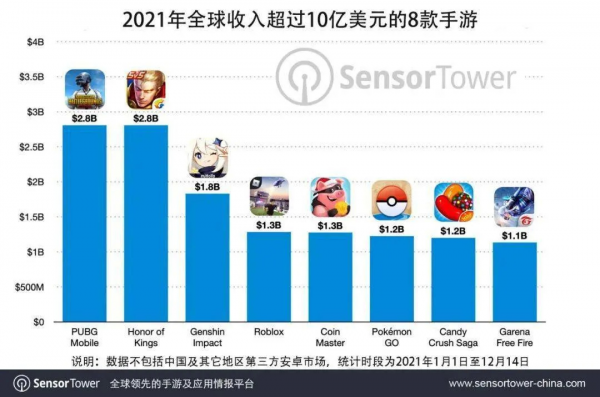 (Source: Sensor Tower)
Spurred on by Genshin Impact's success, nearly all game developers recognized that "skin-swapping games" were no longer viable, and only high-quality games benchmarked against AAA standards could retain users.
However, at that time, the Chinese game market lacked the necessary environment to nurture AAA games, such as industrial production capabilities, a focus on gameplay over art in game design, and a near-absence of AAA game products domestically...
"The vast majority of domestic developers are still makeshift teams when it comes to industrialization. Even the top, most profitable teams often fall short of our expectations," bluntly stated in The Battle for Game Industrialization in 2022, highlighting the dearth of R&D capabilities for AAA games among Chinese game companies.
"AAA is not merely a project but a system; it demands long-term management capabilities, industrialized processes, and global distribution experience," remarked Liu Xingliang, a renowned digital economy scholar, emphasizing that AAA games require a comprehensive system rather than a mere aggregation of project resources.
Given the colossal investment required for AAA game development, it seemed more pragmatic to transfer AAA game projects overseas rather than starting from scratch domestically. Chinese game companies like Tencent and NetEase would provide the funds, while overseas game producers would contribute the talent and experience, forming a symbiotic partnership.
It was under this dual pressure of the need for AAA game transformation and the reality of domestic capabilities that Chinese game companies embarked on their overseas journey:
Tencent collaborated with producers such as Scott Warner, former chief designer of Halo 4, and Paul Ehreth, former chief designer of Control, to establish self-developed studios in five or six overseas regions.
NetEase lured talent from game companies like Sony, Rockstar, and Ubisoft with lucrative salaries. At its peak, NetEase operated over 13 studios overseas simultaneously.
From 2020 to 2024, Chinese game developers collectively established R&D centers for AAA games overseas. However, could this collaborative approach of setting up studios overseas truly propel Chinese game companies from "skin-swapping" into the AAA era?
【2】Underwhelming Results: Zero Output from Overseas Studios
The idea of overseas R&D was enticing, but this cooperation model of domestic funding and foreign talent faced challenges, as exemplified by Black Myth: Wukong.
On August 20, 2024, Black Myth: Wukong was officially released, selling over 30 million copies worldwide to date, with total sales approaching 10 billion yuan, becoming a benchmark product for domestic AAA games.
More significantly, consider the development timeline of Black Myth: Wukong: the project was initiated in 2018, entered a stable development cycle in December of the same year, released its first real-time demo in August 2020, and was officially released in August 2024.
In other words, it took two years to release the real-time demo and six years for the official release of Black Myth: Wukong.
"The Chinese game industry already boasts the largest user base and market size globally. Game Science might just be the final ripple on this foundation," said Feng Ji, founder of Game Science, indicating that the environment for developing AAA games in China has matured, though many have yet to realize it.
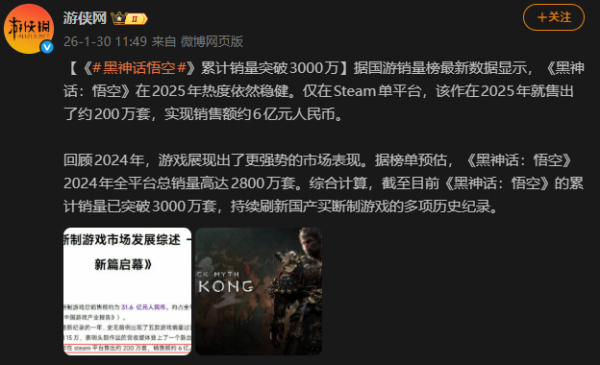 (Source: Youxia Network)
In contrast, consider the AAA game aspirations of Tencent, NetEase, and other game developers:
Since its establishment in 2021, Tencent's Montreal studio has been positioned internally as "focused on developing large-scale game products with AAA quality, open-world architecture, and cross-platform capabilities." However, after five years, the Montreal studio has yet to release any finished projects.
A similar situation exists with NetEase. Its Tokyo office, in collaboration with Nagoshi Toshihiro, is developing the AAA game Ryū-gumi. The game has been in development for over three years, but NetEase estimates that it would require an additional 350 million yuan to complete the game.
Among NetEase's four remaining overseas studios, only Ichimura Ryuutarou's studio has publicly released a product, while the other overseas studios have yet to release any related products.
It can be said that Tencent, NetEase, and other game companies have invested heavily in overseas studios but have yet to produce any AAA games over an extended period. Meanwhile, the domestic market, once considered lacking the environment for AAA game development, has produced a top-tier game like Black Myth: Wukong.
AAA games, characterized by high cost, high volume, and high quality, necessitate sustained high investment and lengthy development times. This is not inherently flawed, but the issue lies in the excessively long development time for Chinese game developers' overseas studios, resulting in no effective output in terms of production capacity.
Why can overseas star producers, with proven success, fail to deliver AAA game products when collaborating with giants like Tencent and NetEase, which are flush with funds?
In an interview with Sina Finance's BUG column in the article "5 Years, Zero Works! Tencent Shuts Down Another Overseas Studio, Who's Next?," industry analyst He Beihang stated, "Companies in North America's AAA sector that truly have stable output often have over a decade of accumulation. TiMi Montreal recruiting hundreds of people cannot replicate that."
"High investment and low output, many studios have not released successful works after years of establishment and continue to consume funds," Li Chengdong, founder of Haitun She, told Siku Finance, indicating that from an ROI perspective, it was inevitable for game companies like Tencent and NetEase to shut down overseas studios.
Liu Xingliang shared a similar viewpoint: "The input-output imbalance is severe. Many overseas studios 'burn money quickly and produce slowly,' failing to release products in two or three years and even becoming black holes of 'only input, no output.'" He believes that Chinese game R&D overseas has shifted from "expansion" to "cost-calculation," and "once mistaken, it results in huge sunk costs."
Whether it's giants like Tencent and NetEase or rising stars like miHoYo and Lilith Games, the success of Black Myth: Wukong compared to the work outcomes of overseas studios underscores one point.
【3】Strategic Contraction: R&D Returns to the Homeland
From the current vantage point, both Genshin Impact and Black Myth: Wukong have not only become massive hits domestically but have also garnered a global fanbase. This has provided NetEase, Tencent, and other game developers with a fresh perspective on AAA games and globalization—the domestic gaming environment can indeed support the development of AAA games.
Genshin Impact has demonstrated to Chinese game developers the value of high-quality games, prompting these developers to invest in AAA game development. Black Myth: Wukong has proven that China can also produce high-quality AAA games.
"Twenty years ago, if you asked Chinese car manufacturers to develop products that could compete with top overseas brands, no one would know where to start. Today, developing an AAA game is not that daunting anymore. At least, there is a very clear systematic understanding of how to do it," said Huang Zhuo, general manager of marketing and sales at NetEase's LeiHuo studio, indicating that the environment for developing AAA games in China has fully matured.
 (Source: Baidu Baike)
It is precisely due to this transformation that Chinese game developers have begun to collectively shift their focus, shutting down and disbanding numerous overseas self-developed game studios.
Tencent has successively shut down/sold multiple overseas projects, including TiMi Montreal Studio, Team Kaiju Studio, The Outsiders, and Funcom Stockholm Studio, and has conducted massive layoffs at studios such as Sumo Digital and 10 Chambers.
NetEase has closed/divested at least 10 studios, including Sakura Studio, Fantastic Pixel Castle, Bad Brain Game Studios, and Jackalyptic Games.
Perfect Game has disbanded its Seattle-based development team for the Neverwinter Nights IP, and its Montreal studio has shifted from game development to AI R&D support.
Lilith Games has paused the AAA console project at its Los Angeles studio, concentrating its European and American resources on the Southeast Asian Farlight division.
miHoYo has downgraded its Montreal R&D center, shifting from a previous AAA shooting game project to engine toolchain development.
"This round of contraction is not a failure but a shift from 'storytelling' to 'profit-calculation,'" Liu Xingliang said, indicating that Black Myth: Wukong has proven that Chinese teams can produce works close to AAA standards, and future domestic AAA games will follow a "differentiated AAA" route.
In contrast, domestic game developers are ramping up their R&D efforts in the domestic AAA game market:
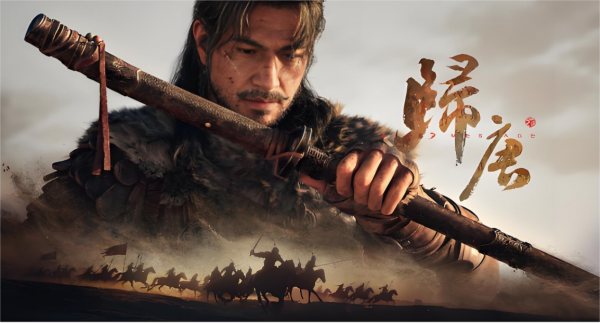
During its 2026 campus recruitment, Tencent's Lightspeed & Quantum Studios revealed two AAA titles in development: Sword of the Young Master and Sword Comes. NetEase's LeiHuo studio also released the first trailer for its AAA game Return to Tang in June 2025...
"Chinese game industry technology has advanced rapidly in recent years, fully capable of undertaking AAA game development," Li Chengdong said, indicating that the shutdown of overseas R&D studios by giants like Tencent and NetEase presents a significant opportunity for the domestic game industry.
Looking back at the five years of overseas R&D by Chinese game companies, it can be described as a phase of frenzied entry and disengagement. The past five years and the expenses incurred during this period can be seen as tuition fees paid by Chinese game developers.
However, the failure of the overseas studio model has also made Tencent, NetEase, and other game companies realize that China now possesses the R&D and production capabilities for AAA games. The true environment for AAA games is not built on capital-stacked overseas studios but on localized storytelling and persistence.
END
-
![]()
AI Giants Start Borrowing to Fuel Computing Power Race
-
ByteDance Initiates Largest B2B Structural Adjustment, This Time It's Truly Different
-
![]()
Let's Talk About Kingsoft Office's Mid-Year Outlook and the True Strength of Its AI-Powered Office Solutions
-
Despite 150 Million Users, Struggles Persist: AIShige Faces Tough Competition from Seedance and Kling in AI Video Monetization
-
![]()
Ensuring Safe Gear Shifting in the Automotive Industry: Transitioning from 'Product Oversight' to 'Full-Chain Governance'
-
![]()
Net Profit Soars to $133.7 Billion! Azure Revenue Tops $100 Billion, with AI Fueling Microsoft's Growth
-
![]()
Before 6G Hits the Market, the U.S. Forges a 'Rules Alliance': What Challenges Await Chinese IoT Enterprises?
-
![]()
Intelligent Driving's 'Little Blue Light' Faces Ban: Night Glare and Cut-in Risks Prompt Official Action