AI Can Write Code, But Who Launches the Product? The 'Middle Layer' Battle Among Netlify, Vercel, and Cloudflare
 05/14 2026
 674
674
In the 2010s, we said 'everyone can be a product manager'; by 2026, the industry's new proposition is 'everyone can build AI-powered products themselves.'
From ChatGPT and Cursor to various no-code and vibe coding tools, the barrier to building an application has been reduced to nearly zero. Writing code is being replaced by 'generating code.'
However, a vast gap remains between 'generating an idea' and 'launching an accessible product.' Complexities like environment setup, deployment, databases, permissions, and feedback loops stop most creators at the prototype stage.
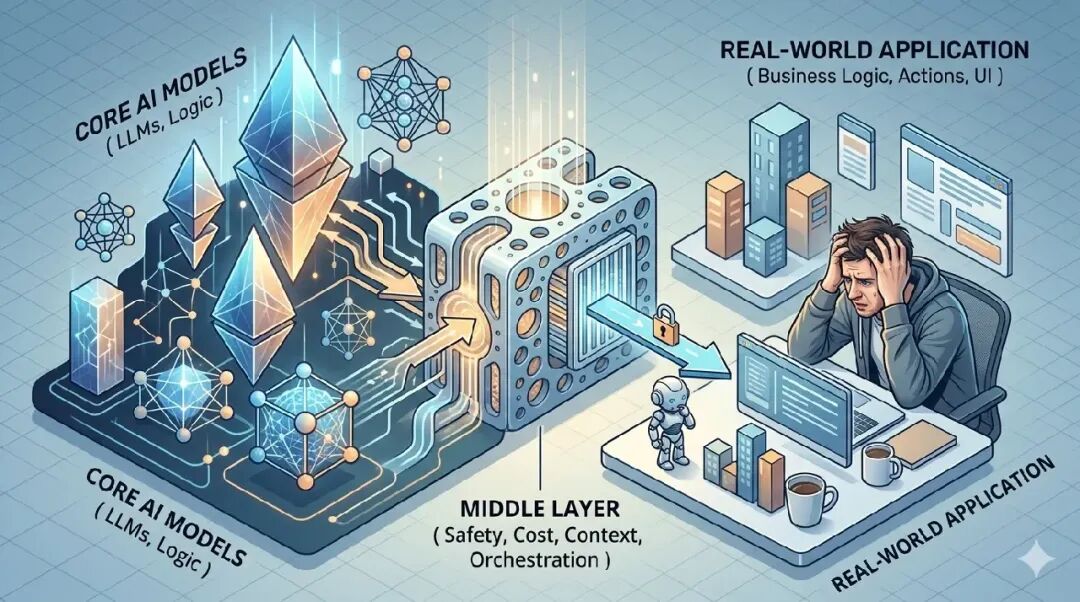
On the other side of this gap, platforms like Netlify, Vercel, and Cloudflare are competing over the 'middle layer between AI and deployment.' Their goal is not just to make AI-generated code look better but to turn that code into user-accessible services.
In the AI era, these developer platforms and tools symbolize the ability to 'take ideas live instantly.'
I. Three Major Pain Points in the AI Application Era
Developers and startups commonly face three systemic challenges in current AI development:
1. Deployment complexity: AI-generated code still requires manual integration with databases, APIs, and front-end frameworks, leading to lengthy development cycles.
2. Low collaboration and preview efficiency: Teams cannot quickly preview, test, and adjust model outputs, slowing product feedback loops.
3. High costs and maintainability: AI projects often rely heavily on upstream and downstream components (model APIs, inference engines, front-end frameworks), making unified management difficult.
In other words, AI solves 'creative expression,' but the 'middle layer' that makes this creativity viable is still determined by platforms and tools. In this sense, the platform competition is essentially a debate over 'who handles deployment.'

II. Platform and Tool Integration: Taking AI Applications from Idea to Launch in Minutes
A clear trend in the current AI application boom is that platform competition is no longer just about 'speed' but about 'efficiency'—reducing configuration, switching, and repetitive tasks. For developers, the ideal state is to handle code, databases, AI models, and deployment within a single workflow, rather than jumping between multiple systems.
Netlify leads in this direction:
It does not aim to replace IDEs or traditional DevOps tools but integrates building, deployment, databases, AI orchestration, and edge delivery into a unified platform, acting as developers' 'AI application console.'
Current core capabilities include:
AI Gateway: Centralized management of model orchestration, deployment, and routing, supporting multiple model providers.
Netlify DB: A database designed for AI applications, supporting natural language queries and structured storage.
Edge Functions: Run inference interfaces with CDN-level performance for zero cold-start latency.
Preview Deploys: Generate visual previews for every change, drastically shortening team feedback cycles.
This system transforms the linear 'write → test → deploy' workflow into an instant 'idea → launch' loop.
III. Developer Platforms: Different Approaches from Netlify, Vercel, and Cloudflare
The AI-driven development wave is redefining what 'platforms' mean. Vercel, Cloudflare, and Netlify all belong to the new generation of developer infrastructure but have taken three distinct paths.
Vercel focuses heavily on 'front-end experience.' Its tight integration with Next.js makes development and deployment seamless for Next.js users, delighting front-end engineers. However, this ecosystem bias limits its reach when AI applications move beyond specific front-end frameworks.
Cloudflare takes a different route. Starting as a network infrastructure provider, it leverages globally distributed edge nodes and Workers ('run code closest to users') to attract enterprise developers. While performance and stability are strong, the learning curve is steep: complex configurations, detailed billing rules, and traditional ops-like deployment logic make it less accessible for small-to-medium teams seeking rapid iteration.
Netlify chooses a third path: not competing on 'speed' but prioritizing 'ease of mind.' It focuses on integrating development, testing, deployment, databases, AI orchestration, and team collaboration into a single, smooth workflow. This allows many users, even those without strong engineering backgrounds, to go from 'an idea' to 'a live online version' with minimal toolchain and configuration interruptions.
Key Dimension Comparison: Netlify / Vercel / Cloudflare
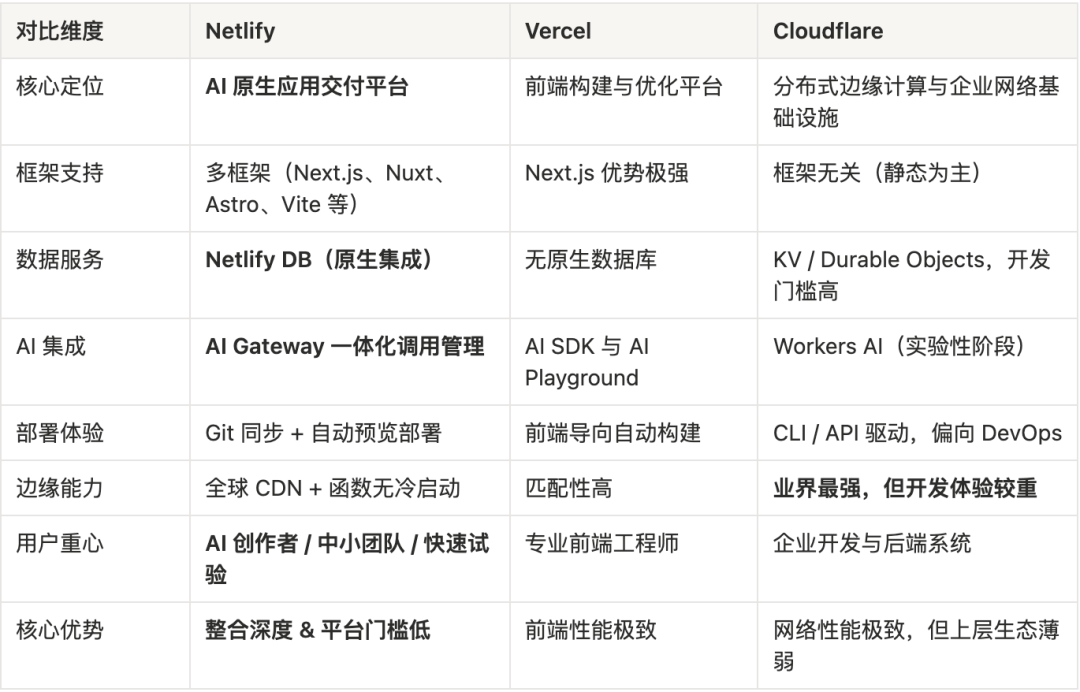
If Vercel is seen as a tool for accelerating engineering efficiency and Cloudflare as an amplifier for underlying networks, Netlify functions more like a 'central nervous system for application creation.'
No single platform wins outright, but on the critical metric of 'how quickly AI products can launch,' Netlify's path is more grounded and universally applicable.
IV. Business Models and Ecosystem Inertia: From Feature Use to System Dependency
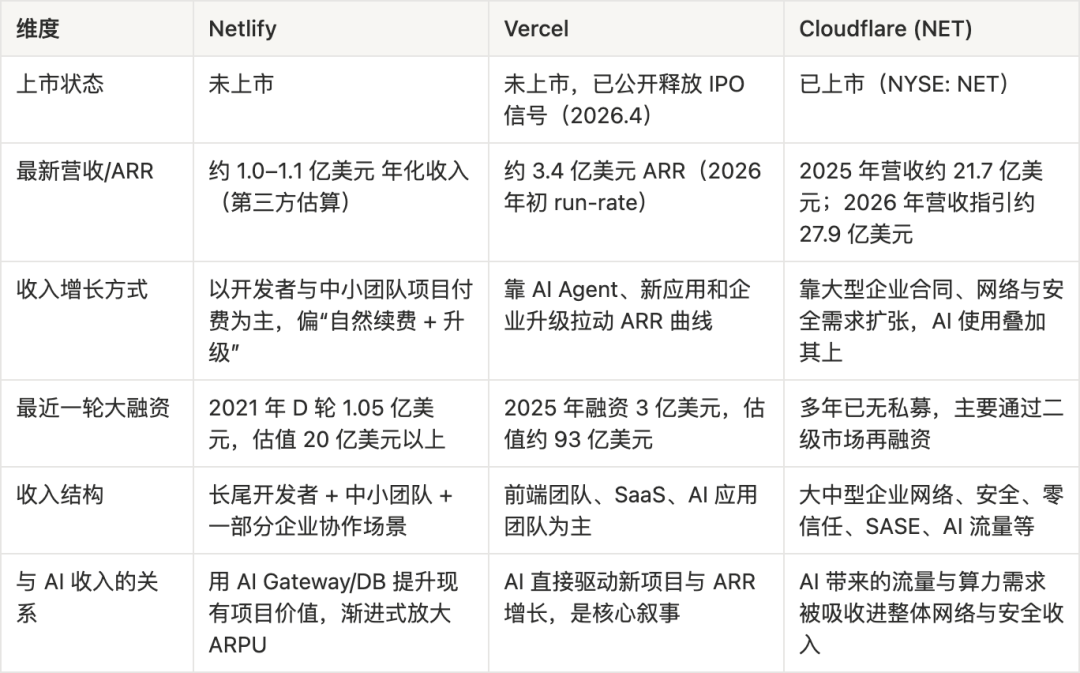
On the surface, Netlify, Vercel, and Cloudflare all sell similar offerings: a monthly subscription base plan with pay-as-you-go pricing for bandwidth, requests, and compute. The real difference lies in their chosen commercial directions—whether to trade Valuation Story (valuation narratives) for capital, infrastructure for long-term enterprise contracts, or daily habits for stable cash flow.
Key Metrics at a Glance
Three Distinct Commercial Paths
Vercel positions itself as a 'high-growth SaaS' company: built around front-end teams and AI-generated applications, it fuels growth to provide a solid foundation for IPO expectations. Growth comes from new applications, enterprise upgrades, and AI agents, making it highly imaginative in capital stories but also heavily dependent on the front-end ecosystem's continued prosperity.
Cloudflare continues as an infrastructure blue-chip: rooted in network, security, and zero-trust budgets of large-to-medium enterprises, it overlays AI traffic and edge computing demands onto existing contracts. With $2+ billion to nearly $3 billion in revenue in 2025–2026 and ~30% growth, it supports a 28–32x price-to-sales ratio, resembling a 'cloud infrastructure large-cap stock' with both growth and defensive attributes.
Netlify bets on a 'fragmented but real' path: its revenue comes primarily from project-based payments by thousands of developers and small-to-medium teams, driven by natural renewals and feature upgrades. Rather than chasing higher ARPU per customer, it amplifies usage inertia by eliminating seat-based pricing and simplifying price structures, encouraging more people, projects, and daily operations to run long-term on the same platform. Over time, these fragmented uses accumulate into a stable mid-market cash flow curve.
Conclusion: The Endgame of Platform Competition Is Making Creation Faster
The rise of AI is redefining software development boundaries. Code generation is no longer a rare skill; what truly differentiates productivity is the speed from idea to execution. In this sense, Netlify, Vercel, and Cloudflare each represent distinct technical philosophies and constitute three directions in today's development ecosystem.
Cloudflare focuses on accelerating website speed and network performance, pushing infrastructure to its limits.
Vercel optimizes front-end development, accelerating engineering workflows through frameworks and tools.
Netlify simplifies the entire launch process, enabling developers to handle everything with minimal steps.
In an era where anyone can call models, generate applications, and validate instantly, the value of development platforms is shifting from 'enabling you to do it' to 'letting you not worry about it.' Netlify stands at this trend's intersection: it retains engineering certainty while absorbing AI's automation, transforming creative acts from technical tasks into product thinking.
Ultimately, platform competition will not end in absolute victory or defeat. It resembles a reorganization of ecological divisions—
Vercel continues to optimize depth for professional engineers, Cloudflare provides underlying stability for enterprise users, and Netlify connects the broadest middle path: naturally linking creativity, AI, and product delivery.
In the next AI-driven cycle, development will no longer mean 'writing code' but 'making ideas instantly usable.'
Any platform that accelerates, lightens, and democratizes creation will become long-term infrastructure for this revolution.
Author's Note: Personal views for reference only
-
![]()
AI Giants Start Borrowing to Fuel Computing Power Race
-
ByteDance Initiates Largest B2B Structural Adjustment, This Time It's Truly Different
-
![]()
Let's Talk About Kingsoft Office's Mid-Year Outlook and the True Strength of Its AI-Powered Office Solutions
-
Despite 150 Million Users, Struggles Persist: AIShige Faces Tough Competition from Seedance and Kling in AI Video Monetization
-
![]()
Ensuring Safe Gear Shifting in the Automotive Industry: Transitioning from 'Product Oversight' to 'Full-Chain Governance'
-
![]()
Net Profit Soars to $133.7 Billion! Azure Revenue Tops $100 Billion, with AI Fueling Microsoft's Growth
-
![]()
Before 6G Hits the Market, the U.S. Forges a 'Rules Alliance': What Challenges Await Chinese IoT Enterprises?
-
![]()
Intelligent Driving's 'Little Blue Light' Faces Ban: Night Glare and Cut-in Risks Prompt Official Action