Four Major Independent Brands: Divergence Deepens | April New Energy Vehicle Market Report
 05/14 2026
 436
436
Introduction
New Energy Vehicle Penetration Reaches New Heights, with Divergent Performances Among the Four Leading Independent Brands
In April, the domestic automotive market experienced a slight cooling-off, with conventional passenger vehicle retail sales witnessing a marginal month-on-month decline. Nevertheless, the new energy vehicle (NEV) sector continued to thrive, with penetration rates soaring past the 60% milestone. BYD, Geely, Chery, and Great Wall, the four major independent brands, maintained their dominance in the NEV market for independent brands, each progressing at its own pace while holding their ground.
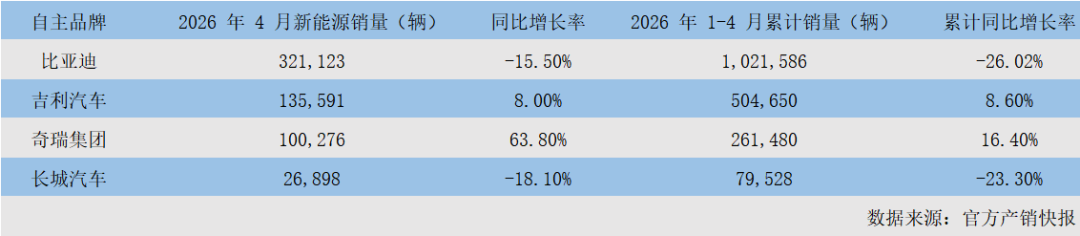
Among independent NEV brands, BYD stands out as a frontrunner, comfortably surpassing 320,000 NEV sales in April, leading by a substantial margin and leaving competitors trailing far behind. More notably, it continued its rapid overseas expansion, setting a new monthly export record and representing the face of Chinese automotive exports. However, its year-on-year decline was also noteworthy.
Close on its heels, Geely and Chery also delivered robust performances. Geely's monthly NEV sales approached 136,000 units, with penetration nearing 60%, demonstrating a steady transition supported by a comprehensive range of hybrid and pure electric compact cars for home use. Chery witnessed explosive growth, with NEV sales exceeding 100,000 units and a remarkable year-on-year increase, fueled by new product launches and expanded overseas distribution channels, showcasing strong momentum.
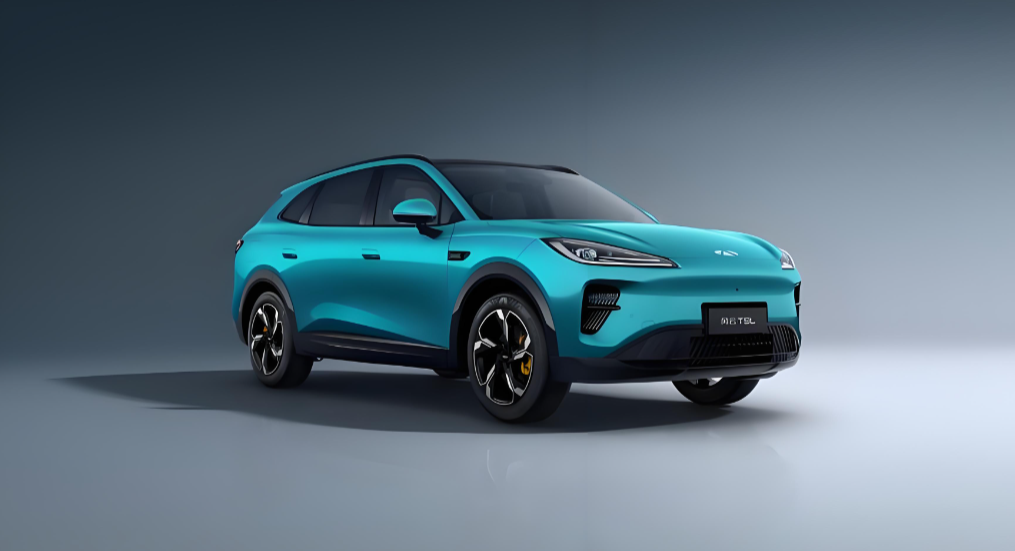
Great Wall, on the other hand, adopted a steady approach, shunning blind price competition and precisely targeting niche markets through its Ora, Haval, and Tank brands. It maintained its position in female-oriented pure electric commuting, home-use SUVs, and off-road vehicles. However, this "specialization" did not translate into steady growth in Great Wall's NEV sales.
Throughout April's NEV market, the most conspicuous trend was the increasing divergence. The industry's penetration rate has surpassed 60%, with NEVs becoming the primary growth driver in the automotive market, while the market share for fuel vehicles continues to dwindle.
These four major independent brands exemplify three distinct development paths for current domestic automakers: BYD pursues a comprehensive coverage + overseas expansion strategy, offering a wide range of vehicles from affordable family cars to high-end NEVs, firmly securing its market base through technological accumulation and an extensive product lineup. Geely and Chery are full-speed transitioners, stabilizing their fuel vehicle base while aggressively pursuing the NEV sector, with rapid product iteration and pricing that aligns with ordinary consumers' budgets, firmly grasping the mainstream home-use market in the 100,000-yuan range. Great Wall adheres to a differentiated approach, avoiding mindless price wars and focusing on niche segments, cultivating loyal user groups through distinctive models and taking a path of uniqueness over price competition.
The automotive market is no longer an era of solitary battles. The four major independent giants compete domestically while collectively expanding overseas, enhancing the influence of domestic NEVs. Every niche segment, from entry-level commuting to family transportation, long-distance travel, and off-road vehicles, is firmly controlled by these automakers, continuously squeezing the market share of joint-venture brands. It is evident that the industry's elimination race has accelerated, with resources and attention increasingly concentrated on leading independent manufacturers, leaving smaller brands with diminishing survival space.
Looking ahead, with continuous new product launches and technological upgrades, competition among these four major independent brands will intensify, with price competition, product upgrades, and market segmentation becoming the norm. However, this is positive for ordinary consumers, as automakers' rivalry leads to more generous model configurations and more affordable pricing. Whether for daily commuting or family use, consumers can find satisfactory domestic NEV models, with domestic independent brands truly supporting half of the domestic automotive market.
-
![]()
AI Can Write Code, But Who Launches the Product? The 'Middle Layer' Battle Among Netlify, Vercel, and Cloudflare
-
![]()
Four Major Independent Brands: Divergence Deepens | April New Energy Vehicle Market Report
-
![]()
Chinese-Style Reorganization: The Hierarchical Rivalry Between Foreign and Joint Ventures Amid the Auto Show Excitement | Cover Story: In China, for the Global – 2026 Beijing Auto Show Special Report
-
![]()
With Its New CEO at the Helm, Can Volvo Surpass Audi in the Coming Years?
-
![]()
Emulating Kazuo Inamori: The Overlooked Commercial Revolution Driving Dreame Technology’s Influencer Campaign
-
![]()
Who Deploys Products When AI Can Write Code? The 'Middle Layer' Battle Among Netlify, Vercel, and Cloudflare
-
![]()
Q1: AI Has Seamlessly Integrated into Every Aspect of Tencent's Operations
-
![]()
Overcapacity Weighs on Europe, China’s White Knight Rides to the Rescue