Emulating Kazuo Inamori: The Overlooked Commercial Revolution Driving Dreame Technology’s Influencer Campaign
 05/14 2026
 571
571
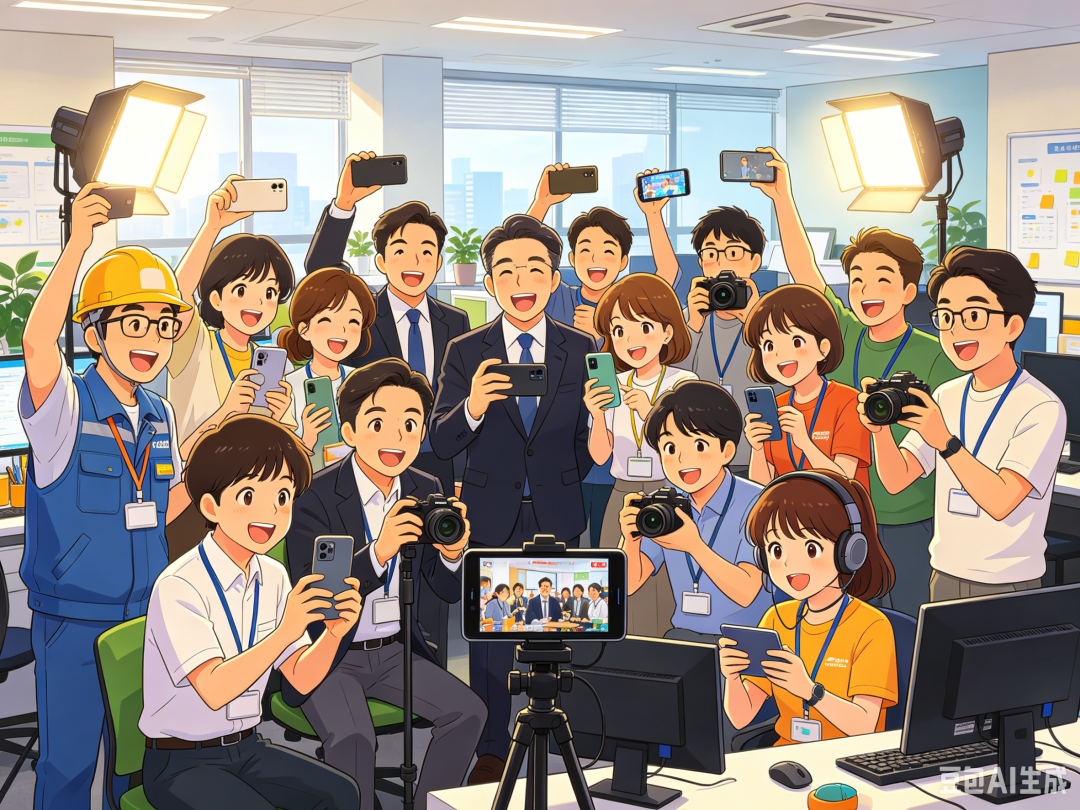
Infusing Technology with Human Touch / AI Generated Image
Manual Labor / Wage Worker
Manual Editing / Uncle Jiao
Produced by / Unicorn Observer
“This video is a call to action for all Dreame employees—I’m even showing up in my pajamas, yet some of you are still hiding behind filters and special effects. Step up and show your faces!” Dreame founder Yu Hao, dressed in a casual half-length pajama top, spoke to the camera with an air of relaxed confidence.
Since late April, when Dreame Technology launched its comprehensive staff IP incubation program, Yu Hao has posted up to 117 short videos in a single day, setting a precedent for Dreame’s 'Influencer Initiative'.
Dreame’s 'Influencer Initiative' is underpinned by clear cash incentive policies. On the official announcement day, April 30, two employees who each amassed over 10,000 followers were rewarded with RMB 10,000 in cash, sparking enthusiastic participation among the staff. The initiative quickly gained traction within the industry and sparked widespread online discussion.
Proponents hail it as a brilliant low-cost customer acquisition strategy, with over 20,000 employees acting as individual traffic nodes, where authentic content holds more credibility than official advertisements. Skeptics, however, caution that a flood of low-quality content from all employees could tarnish the brand’s image and backfire.
As every employee transforms into a brand communicator and traffic partner, what exactly is Dreame aiming to achieve with its bold and innovative all-staff IP strategy?
01 A Company-Wide IP Incubation Movement
Harnessing the power of traffic.
Unlike sporadic attempts at employee IP creation by other companies, Dreame’s 'Influencer Initiative' is characterized by 'full participation, clear policies, and effective incentives,' showcasing strong execution and appeal from the outset.

As the driving force behind this program, Dreame Technology founder and CEO Yu Hao leads by example, posting up to 117 short videos in a single day. His high-frequency, down-to-earth content sets a benchmark for employees and underscores the company’s commitment to fostering an all-staff IP culture.
In response to external doubts, Yu Hao has not only refuted them but also done so with a touch of humor that leaves people amused.
For instance, a tech founder posted on WeChat Moments, implying, 'Why do I see that guy everywhere on video platforms? He’s not even a female CEO, so why is he flooding my feed?'
On May 12, Yu Hao responded with a short video, using AI to transform his avatar into a beautiful woman, with the caption, 'I heard a certain tech tycoon enjoys watching beautiful women. Here you go—I’m satisfying your craving.'
This lighthearted and humorous response once again drew a wave of attention.
According to Dreame’s plan, its 22,000 employees will create accounts across all platforms. If each posts three pieces of content daily, this could theoretically generate over 60,000 daily updates. Combined with natural platform traffic and matrix effects, industry estimates suggest overall exposure could reach tens of millions daily and billions monthly.
Clear and substantial cash incentives have fueled employee enthusiasm. Dreame has introduced a tiered fan reward policy: employees with 10,000 genuine followers receive RMB 10,000 in cash; those with 50,000 followers receive RMB 50,000; and those with 100,000 followers receive RMB 100,000.
These incentives are not mere promises—some employees have already reaped the benefits. On the evening of April 30, when the plan was announced, two employees won RMB 10,000 each for surpassing 10,000 followers, with immediate payouts further motivating widespread participation.
To date, Dreame’s 'Influencer Initiative' has produced a number of high-quality employee IPs. Some engineers demystify the core technologies of high-speed digital motors in layman’s terms, while product managers share behind-the-scenes stories of intelligent cleaning device development. Frontline employees showcase the daily work atmosphere within the company. This authentic and vivid content has somewhat broken the traditional image of tech companies as 'aloof and rigid,' making Dreame’s brand image warmer and more relatable.
02 Bidirectional Reconstruction of Brand Trust and Employee Value
Behind this seemingly 'everyone becomes an influencer' trend lies Dreame’s profound insights into traffic logic, user needs, and employee value. At its core, this is a strategic layout based on modern commercial logic, rather than a mere marketing gimmick.
While the market focuses on superficial details like 'RMB 10,000 cash rewards' and 'three daily updates,' it often overlooks the deeper essence of Dreame’s 'Influencer Initiative'. This plan is not simply a means of acquiring traffic but represents a dual breakthrough in reconstructing brand trust and elevating employee value through employee IPs. It embodies mature commercial logic and bold organizational management experiments.
From a brand communication perspective, the core of the 'Influencer Initiative' is to replace traditional hard advertising with 'authentic employee perspectives,' reconstructing the trust link between the brand and users.
In today’s era of information overload and homogeneous advertising, user trust in brand official promotions continues to decline. Authentic sharing from internal employees, however, serves as a crucial carrier for building brand trust due to its authenticity, professionalism, and relatability. Dreame’s employees, especially those in R&D, product development, and after-sales roles, are the designers, users, and promoters of the products. Their interpretations of product technologies and sharing of usage scenarios are more persuasive than commercial promotions by professional KOLs and better resonate with users.
Unlike traditional tech brands that prioritize technology over expression, Dreame brings ordinary engineers and product managers to the forefront, explaining complex technologies in everyday language and showcasing corporate strength through real work scenarios. This approach not only sheds the 'obscure and difficult to understand' label from Dreame’s core technologies—such as high-speed digital motors, intelligent algorithms, and bionic mechanical arms—but also allows users to see the people behind the technology and feel the organizational warmth of the tech company.
For example, an R&D employee shared the debugging process of a robot vacuum cleaner lidar system, helping users intuitively understand the core logic of precise navigation. An after-sales employee shared the process of handling user feedback, demonstrating Dreame’s 'user-centric' service philosophy. While these contents appear to be the growth of individual employee IPs, they subtly spread Dreame’s brand reputation, embedding the brand philosophy of 'technology with warmth' deep into users’ minds.
From an employee value perspective, the 'Influencer Initiative' establishes a bidirectional win-win model of 'corporate empowerment + personal growth,' challenging the traditional notion that 'employees and companies are merely in an employment relationship.'

In most companies, employees who build personal IPs often have to do so 'secretly' and may even face doubts about 'insufficient workload.' Dreame, however, takes the opposite approach by openly encouraging employees to build personal IPs and providing comprehensive support and incentives, enabling employees to realize personal value within the company.
An overseas BD manager at Dreame Technology shared in a short video, 'Many workers complain that Dreame is too intense, forcing you to shoot videos after work. I want to say something harsh: True internal competition is ineffective and draining. Having everyone create videos is about personal IP growth as well as company reputation growth—it’s a bidirectional process. I’ve been in high-end B2B exports for 13 years, and the more high-end the clients, the more they value genuine transparency within the company. There’s no hiding in front of the camera.'
As this employee suggests, Dreame is proving through action that companies and employees can achieve 'bidirectional success'—companies leverage employee IPs for brand communication, while employees use the corporate platform for personal growth. This value symbiosis model may well represent the core trend in modern enterprise organizational management.
03 The New Economics of 'Old Wine in New Bottles'
In the traditional business era, cases of all-staff IP (marketing) were not uncommon.
Kazuo Inamori, the father of Japanese management, faced the 1973 oil crisis during his tenure at Kyocera. He implemented an all-staff marketing strategy, breaking down the barrier that 'marketing belongs only to the sales department.' He required R&D, production, administration, and even logistics staff to step out of the office, visiting clients with products and professional knowledge, promoting solutions, and conveying value.
Similar to how Yu Hao leads by 'appearing in pajamas' and having all staff shoot short videos, Inamori also personally led the charge, embedding the philosophy of 'everyone is an operator, everyone is a brand spokesperson' into the system and culture.
The difference lies in their methods: Dreame relies on short video platforms + cash incentives to ignite mass communication, while Inamori used Amoeba independent accounting + profit-sharing to turn every department and employee into a profit unit, actively acquiring customers and reducing costs while improving efficiency.
However, their essences are entirely congruent: transforming the enterprise from 'a few people doing marketing' to 'everyone expressing value.' Dreame represents digital-era all-staff IP-ization, while Inamori’s Kyocera embodied industrial-era all-staff operationalization—both turning every employee into a traffic node and value outlet for the company.
It can be said that Dreame’s Influencer Initiative is the 'same tune played differently' from Inamori’s all-staff marketing.
'They laugh at me for being crazy, but I laugh at them for not seeing the truth.'
Behind Dreame’s 'Influencer Initiative' lies a brand new economic logic of commerce. In the new era of high traffic costs, brand trust reconstruction, and intense talent competition, a company’s core competitiveness no longer lies solely in technological or market advantages but in the value symbiosis among 'brand, employees, and users.'
Dreame’s 'Influencer Initiative,' while appearing to be an all-staff IP incubation movement, is actually a reconstruction of the relationships among the company, employees, and users. For the company, it gains traffic assets, brand assets, and organizational vitality. For employees, it offers personal growth, extra income, and career competitiveness. For users, it provides authentic product information, professional technical interpretations, and a warmer brand experience.
As a tech company with a compound annual growth rate exceeding 100% for seven consecutive years, every strategic move by Dreame reflects profound insights into industry trends.
The implementation of this 'Influencer Initiative' is not only a crucial step for Dreame to break out of its brand circle but also serves as a significant signal for marketing transformation in the tech industry—tech brand communication is entering the 'era of ordinary people.' Employees are no longer 'bystanders' of the company but 'participants' and 'communicators' of the brand. The link between brands and users is shifting from 'one-way communication' to 'bidirectional interaction,' with trust and warmth becoming the brand’s core assets.
Of course, it must be emphasized that Dreame’s 'Influencer Initiative' is still in its early stages and will require continuous optimization in content quality, compliance management, and long-term operations. However, this does not diminish its value as an industry model.
In the new era’s business environment, companies aiming for long-term development need to break traditional mindsets and build a value symbiosis system where 'the company empowers employees, employees elevate the brand, and the brand serves users.' Dreame’s 'Influencer Initiative' is a vivid practice of this value symbiosis system. Once proven successful, its underlying new-era economic logic will prompt deeper reflection and adoption by more business practitioners. (End)
-
![]()
Four Major Independent Brands: Divergence Deepens | April New Energy Vehicle Market Report
-
![]()
Chinese-Style Reorganization: The Hierarchical Rivalry Between Foreign and Joint Ventures Amid the Auto Show Excitement | Cover Story: In China, for the Global – 2026 Beijing Auto Show Special Report
-
![]()
With Its New CEO at the Helm, Can Volvo Surpass Audi in the Coming Years?
-
![]()
Emulating Kazuo Inamori: The Overlooked Commercial Revolution Driving Dreame Technology’s Influencer Campaign
-
![]()
Who Deploys Products When AI Can Write Code? The 'Middle Layer' Battle Among Netlify, Vercel, and Cloudflare
-
![]()
Q1: AI Has Seamlessly Integrated into Every Aspect of Tencent's Operations
-
![]()
Overcapacity Weighs on Europe, China’s White Knight Rides to the Rescue
-
![]()
Is XPENG Merely a Stopgap Solution? Volkswagen’s Secret Weapon in China’s Autonomous Driving Race: CARIZON’s Advanced R&D Strategy