Chinese-Style Reorganization: The Hierarchical Rivalry Between Foreign and Joint Ventures Amid the Auto Show Excitement | Cover Story: In China, for the Global – 2026 Beijing Auto Show Special Report
 05/14 2026
 504
504
Editor's Note
The 2026 Beijing Auto Show has captured the world's attention, vividly illustrating the high-quality development of China's automotive sector. The underlying "code" is systemic innovation. The exhibition showcases a variety of technological advancements, serving as a key window into the comprehensive transformation and upgrading of the automotive industry. Chinese automotive companies have entered a new phase of deep integration across the entire industrial chain and ecosystem, providing fresh impetus to the global automotive sector. Meanwhile, multinational companies are shifting their strategies in China from "In China, For China" to "In China, For the World," advancing in tandem with local companies.
Focusing on the 2026 Beijing Auto Show, Auto Review presents this special “Cover Story” series. This series consists of seven articles, with the fourth installment being released today. Stay tuned.
Amid the hustle and bustle of the 2026 Beijing Auto Show, the foreign and joint venture sectors are undergoing a “Chinese-style reorganization.” Under themes such as AI, localization, and made-in-China products for global sales, diverging paths are rapidly emerging.
No automaker is willing to sit out, but none can afford an easy victory.
The 2026 Beijing Auto Show appears vibrant on the surface, yet there are underlying currents. In the exhibition halls, nearly all foreign and joint venture brands in China are pulling out all the stops: debut models, AI roadmaps, localization strategies, export commitments... Various buzzwords are taking center stage. Judging by the atmosphere at the press conferences alone, it seems every company has found its direction and is brimming with confidence.
However, a closer look reveals that the underlying tone of this spectacle is not uniform. Some are showcasing their transformation results, others are proving they are still in the game, while some are biding their time amidst uncertainty. Through these complex signals, we aim to analyze, sort, organize, and streamline several structural themes that sufficiently outline the contours of the industry.
AI is No Longer Just a Concept, but an Engineering Capability
If previous auto shows were still debating “whether to go electric,” by 2026, the question has shifted to “whether AI can truly come to life.”
This transformation is most evident among the German Big Three, but their paths are clearly diverging and do not constitute the same type of competition.
Volkswagen presents a systemic commitment centered on architecture. At its Group Media Night, it unveiled the “Omnidirectional Intelligent Agent AI” roadmap, stating that starting from the second half of this year, all models based on the CEA architecture will deploy onboard AI agents, using locally trained large language models as interactive interfaces, emphasizing end-side capabilities where “data does not leave the vehicle.” By 2027, CEA 2.0 will further advance the collaborative operation of “AI-driven driving” and “AI in-cabin and cloud services.”
More noteworthy than the statements themselves is the sequence of implementation. Volkswagen’s Intelligent Driving Capability Center in China, CARIZON, completed the delivery of its first-generation L2 system by the end of 2025 and achieved highway pilot assist and memory parking on the Zhong 07, with plans to expand to urban areas in the second half of this year. This means Volkswagen’s AI path is not a direct leap from concept to scale but is built upon the extension of existing self-developed capabilities.
Mercedes-Benz takes a data- and results-driven approach. Based on 8 billion kilometers of real-world driving data and 100 million “golden samples,” combined with reinforcement learning and simulation training, its urban and highway pilot assist capabilities in complex scenarios have improved by 5 to 10 times. The all-new electric CLA 260L has achieved nationwide availability of urban pilot assist and plans to cover existing users via OTA in the second quarter of this year. This move carries more signaling significance than performance data, indicating that its software capabilities have begun to exhibit cross-cycle iterative attributes rather than being tied to a single model launch. Within the year, Mercedes-Benz also plans to introduce a world model, advancing toward “parking spot to parking spot” full-scenario capabilities.
BMW’s path is closer to ecological integration. Its AI engine, jointly developed with Alibaba and powered by DeepSeek, is embedded in the BMW Panoramic iDrive system, with approximately 70% of the code for the China-version new-generation operating system completed by local teams. Simultaneously, it integrates AutoNavi Maps and Huawei HarmonyOS ecosystem, constructing a local digital system covering core in-cabin scenarios. In terms of driving assistance, its point-to-point pilot system, developed in collaboration with Momenta, is planned to launch around 2027.
The core of this path lies not in breakthroughs in single-point technologies but in shortening the capability catch-up cycle through ecological integration. However, the trade-off is higher dependency on external cooperation systems, with system consistency and long-term dominance remaining to be observed.
South Korea’s Hyundai has also outlined a clear implementation path. The IONIQ V integrates capabilities from Baidu’s ERNIE Bot, Volcano Engine’s Doubao, and other large models, while collaborating with Momenta to advance L2+ assisted driving. Its local supply chain covers companies such as CATL, BYD, and Horizon Robotics.
Overall, the “stratification” of AI integration in vehicles is no longer stuck at the conceptual level but is beginning to differentiate based on engineering capabilities and delivery timelines: one path drives scale replication through architecture, another achieves capability breakthroughs through data, a third relies on ecological integration for accelerated implementation, and yet another remains at the narrative stage. Over the next 12 to 24 months, this stratification will shift from “visible” to “solidified,” with the window of opportunity narrowing.
Localization Begins to Touch Upon Definition Rights
The phrase “In China, For China” has been repeated for years, but this year’s auto show has seen more substantive actions beyond mere slogans, with companies shifting from headquarters-authorized moves to locally driven initiatives.
The most typical case is Toyota. It has clearly proposed a shift in product development from “adapting to China” to “being defined by China,” with the number of chief engineers in China under its “ONE R&D” system increased to seven. The chief engineer system corresponds to product definition rights rather than local adaptation at the execution level. This change is also reflected in its autonomous driving collaborations: on one hand, it is jointly developing systems with Momenta based on real-world road conditions; on the other, it is advancing an L4-level Robotaxi project with Pony.ai, which has entered testing and plans to launch commercial operations in first-tier cities. This means Toyota is transforming China from a single market into an important source of technological and product decisions.
Volkswagen’s path leans more toward internal restructuring. The CEA architecture has undergone forward development from concept to mass production entirely in China, rather than being a local extension of an overseas architecture. The simultaneous advancement of multi-brand, multi-tier models reflects an actual transfer of R&D dominance. From the JETTA X to the Zhong 09 and the Audi E7X, the development leads for different product lines are all centered on Chinese teams. Compared to “developing for China,” this stage is closer to “being driven by China for development,” with local teams beginning to set the pace rather than merely executing tasks.
Mercedes-Benz offers another path. It jointly developed an end-side VLM model with Tsinghua University and was the first to introduce it into the new-generation S-Class. Such collaborations are no longer about introducing supply chain-level solutions but directly participating in the co-creation of foundational technological capabilities.
In essence, this model upgrades localization from resource allocation to capability co-creation, with foreign brands beginning to participate in China’s technological ecosystem itself rather than merely using its outcomes. However, it should be noted that the transfer of “definition rights” is still in progress, currently more evident in directional and organizational structural terms and not yet fully reflected in large-scale mass-production outcomes. Nevertheless, once R&D dominance begins to shift downward, subsequent product rhythms and technological paths often follow suit, and localization will transform from a strategic choice into a structural reality.
Chinese Factories Are Becoming Global Variables
At this year’s auto show, “made-in-China for global sales” is no longer an isolated case but has gradually become a collective trend that cannot be ignored.
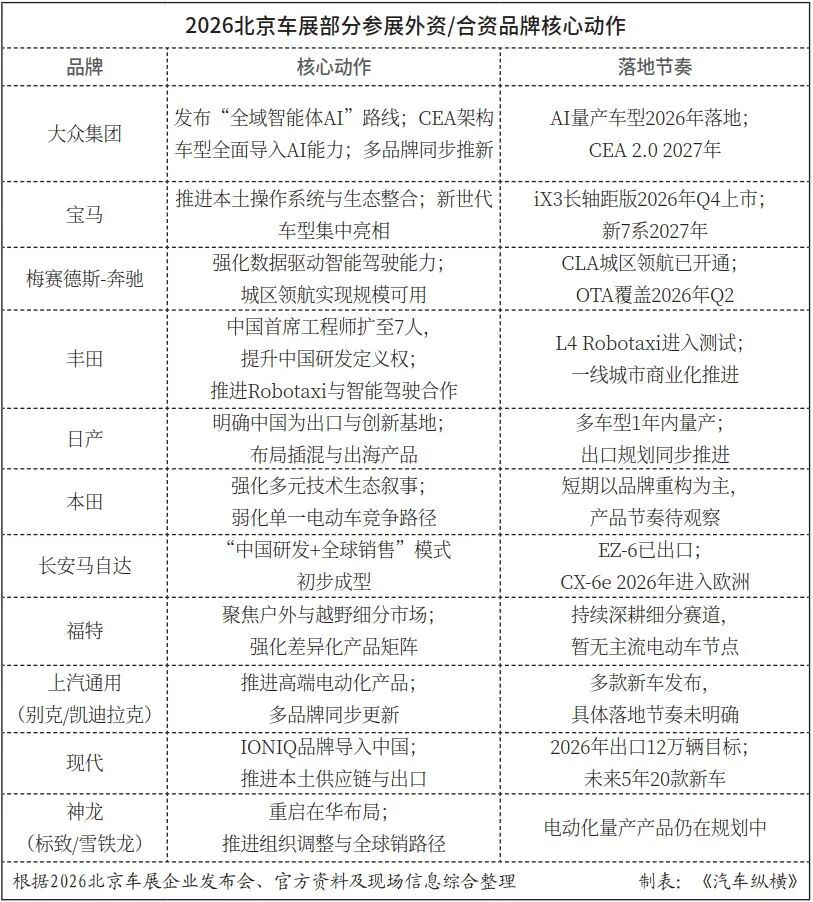
Nissan’s statement is relatively direct, explicitly defining the Chinese market as a “global innovation and export base” and providing specific product export plans: the N7 is planned for export to Latin America and Southeast Asia; the Frontier Pro to Latin America, Southeast Asia, and the Middle East; and the NX8 and other models also have export plans. CEO Ivan Espinosa particularly emphasized that Nissan is not only promoting product exports but will also simultaneously build overseas after-sales service systems to ensure spare parts supply and overseas user experience.
Changan Mazda is currently one of the most convincing joint venture brands in terms of export results. The EZ-6 (overseas version: Mazda 6e) has been exported to more than 20 countries and regions, securing over 7,000 orders in Europe within two months of its launch; the CX-6e, based on the EZ-60, will debut in Europe this summer and will also enter markets such as Australia and New Zealand within the year. The route of “Chinese R&D, joint venture manufacturing, global sales” has begun to take shape at Mazda—this is also a practical case of “reverse export” by foreign joint ventures.
Hyundai Motor has also incorporated export plans into its strategic commitments. It stated that it will rely on Beijing Hyundai’s two factories to export new energy vehicles, targeting 120,000 exports in 2026 and 200,000 by 2030. France’s Dongfeng Peugeot Citroën (DPCA) is also accelerating its “made-in-China for global sales” strategy after a new round of organizational adjustments and is collaborating with Dongfeng Import & Export and other partners on layout.
The logic behind this trend is not complicated: The combined advantages of China’s local supply chain in terms of cost and technology, coupled with the manufacturing standards of the joint venture system, make production in China capable of meeting both local demand and overseas market competitiveness. More importantly, this model is altering the global division of labor for foreign companies. China is no longer just the largest single market but is gradually becoming a critical pivot for capacity allocation and profit restoration. For joint ventures, this transformation is equally crucial. Exports not only boost capacity utilization but also extend their strategic value in the global system to a certain extent.
Some Compete Head-On, Others Choose to Bypass
Not all foreign brands are choosing to compete head-on in the most crowded main lanes. At this year’s auto show, some brands have adopted strategies closer to proactive lane-switching, driven by a reassessment of their own positions.
Ford did not introduce a pure electric product focused on urban commuting this time but instead built a “wild adventure” product matrix centered on the F-150 Raptor, including the Bronco, Ranger, Explorer, and Edge L, along with complementary route experience products, bringing outdoor scenarios entirely into the exhibition hall. This strategy is not merely a brand expression but is based on a pragmatic assessment of the competitive landscape. In the mainstream electric vehicle market, foreign brands no longer hold advantages in cost and iteration speed; however, in the hardcore off-road and outdoor segments, brand accumulation still presents barriers. Essentially, this is a proactive contraction of competition, trading certainty for survival space.
Honda has chosen another path. Its booth showcased not just automotive products but a complete technological spectrum ranging from motorcycles and general-purpose machinery to aviation power. Facing relative lag in electrification transition, Honda did not directly enter the same competitive coordinates but instead reconstructed its brand perception through technological breadth. This approach is unlikely to translate into sales advantages in the short term but carries self-contained logic in narrative terms. A deeper intention is to shift competition from a single product dimension to long-term technological capabilities, thereby delaying direct comparison in the new energy sector.
The return of French brands is closer to a relaunch after structural adjustments. Peugeot and Citroën brought multiple concept cars and motorsport technology displays, with their mass-production electrified lineup still on the way. However, at the organizational level, Dongfeng Peugeot Citroën has already begun adjusting, strengthening collaboration with multiple sectors within the Dongfeng system and mobility platforms. The significance of such changes lies more beyond the booth—whether they can reconstruct their business foundation. Without simultaneous organizational and systemic adjustments, catching up at the product level is difficult to sustain.
The Criteria for Success Shift from Buzz to Results
At the 2026 Beijing International Automotive Exhibition, foreign and joint - venture automotive brands are showcasing an intensity of investment that is unprecedented. Simultaneously, the distinctions between their strategic approaches are more distinct than ever before.
Several overarching themes have come to the fore. However, the more pivotal changes are unfolding beyond the confines of the exhibition booths. The Chinese automotive market is undergoing a transformation, transitioning from a phase of “providing opportunities” to one of “demanding tangible results.” In the past, brands could leverage systemic advantages, exploit product life - cycles, and tap into global resources to gain a temporary foothold in the market. Nowadays, the market places greater emphasis on the speed of product delivery and actual performance.
Against this evolving backdrop, the competitive logic of foreign automakers operating in China is also in the midst of a transformation. They are gradually shifting from “competing based on systemic advantages” to “competing on the basis of localized capabilities.” The focus is no longer on whether the overall system is at the forefront; instead, it hinges on whether specific capabilities can be effectively deployed at critical moments.
This shift implies that the significance of press - conference plans, strategic roadmaps, and technological declarations is being re - assessed. What truly determines a brand's market positioning are the rhythm of product delivery, the ability to fulfill technological promises, and the depth of understanding of local consumer needs. In essence, this competition has entered a new phase. A brand's continued presence in the market is no longer determined by what it promises but by what it actually achieves.
Note: This article was first published in the “Cover Story” column of the May 2026 issue of Auto Review magazine. Stay tuned for more.
Images: Sourced from the Internet
Article: Auto Review
Layout: Auto Review
-
![]()
AI Can Write Code, But Who Launches the Product? The 'Middle Layer' Battle Among Netlify, Vercel, and Cloudflare
-
![]()
Four Major Independent Brands: Divergence Deepens | April New Energy Vehicle Market Report
-
![]()
Chinese-Style Reorganization: The Hierarchical Rivalry Between Foreign and Joint Ventures Amid the Auto Show Excitement | Cover Story: In China, for the Global – 2026 Beijing Auto Show Special Report
-
![]()
With Its New CEO at the Helm, Can Volvo Surpass Audi in the Coming Years?
-
![]()
Emulating Kazuo Inamori: The Overlooked Commercial Revolution Driving Dreame Technology’s Influencer Campaign
-
![]()
Who Deploys Products When AI Can Write Code? The 'Middle Layer' Battle Among Netlify, Vercel, and Cloudflare
-
![]()
Q1: AI Has Seamlessly Integrated into Every Aspect of Tencent's Operations
-
![]()
Overcapacity Weighs on Europe, China’s White Knight Rides to the Rescue