Chip Unicorn Cloud Leopard Intelligence, Backed by Tencent, Sets Sights on IPO
 07/22 2026
 339
339
Recently, the Shenzhen Stock Exchange received Cloud Leopard Intelligence's IPO application for listing on the ChiNext board, capturing the attention of industry peers in the primary market. If successful, this company, founded just six years ago, will become the first A-share listed company in China's domestic DPU (Data Processing Unit) sector.
Before delving into Cloud Leopard Intelligence, let's take a moment to grasp a key concept: What exactly is a DPU?
We are all familiar with CPUs (Central Processing Units) and GPUs (Graphics Processing Units). The CPU serves as the "brain," handling thinking and decision-making tasks, while the GPU acts as the "muscle," specializing in heavy-duty tasks like AI computing. However, data centers also face numerous "miscellaneous tasks," such as network data transfer, storage management, security encryption, and virtualization scheduling. These tasks are inefficient for the CPU and not worth the GPU's effort.
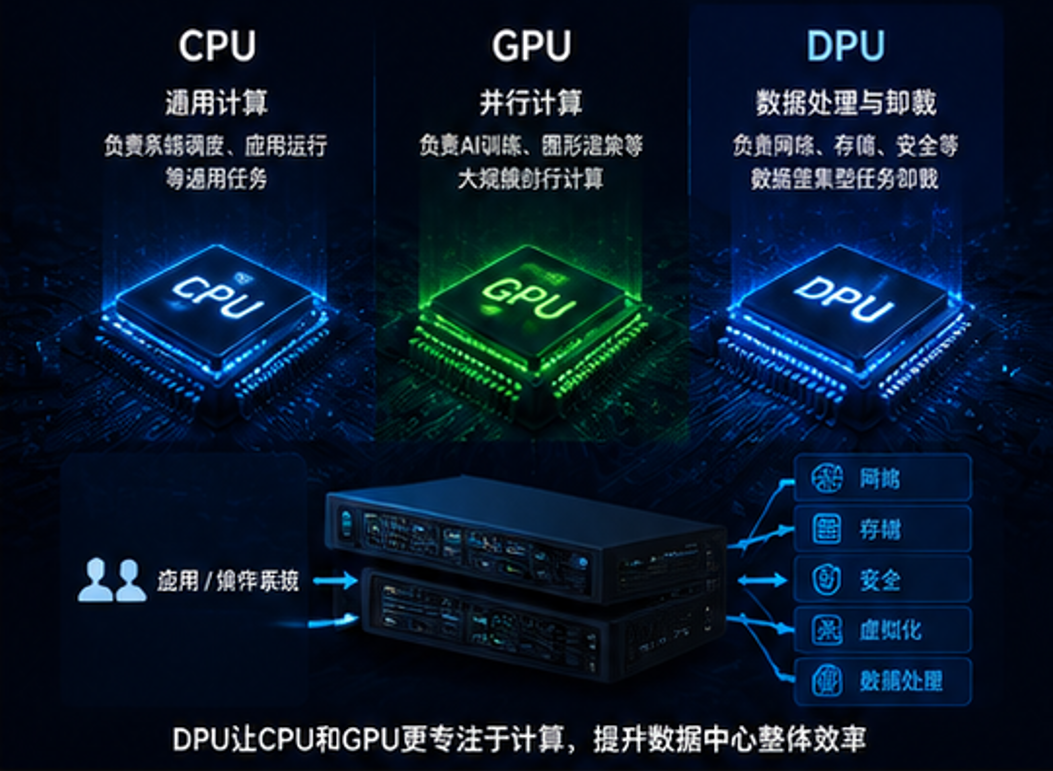
The DPU is a chip specifically designed for these "miscellaneous tasks." Think of the DPU as the "blood vessels and nervous system" of a data center, responsible for efficiently scheduling, diverting (Note: 'diverting' is used here for clarity, referring to the distribution of data flows), and securing all data flows. This ensures that the CPU and GPU can focus on their core tasks without distraction.
In 2020, NVIDIA CEO Jensen Huang officially proposed the "CPU + GPU + DPU" tri-chip strategy, referring to these three chips as the "engines" of computing power in the AI era. Since then, the DPU sector has rapidly emerged as one of the hottest segments in the semiconductor industry.

A Chip Company's "Shenzhen Speed"
Founded in Shenzhen in August 2020, Cloud Leopard Intelligence was established by Xiao Qiyang, a true academic entrepreneur.
At the age of 24, he earned a Ph.D. in Electrical Engineering from Stanford University, solving a theoretical problem in AI that had remained unsolved for over 30 years in his doctoral thesis. Marvin Minsky, known as the "Father of Artificial Intelligence," personally wrote the foreword for his work. Later, Xiao taught at MIT and co-founded the chip company RMI in Silicon Valley in 2002, which was subsequently acquired by Broadcom for $3.7 billion in cash.
In 2020, Xiao Qiyang, already financially independent, returned to Shenzhen to embark on another venture in the DPU sector.
Initially, he was the sole team member. "I dared to recruit the founding team only after securing the angel round," Xiao later recalled. However, the team he assembled was stellar, with top-tier institutions like Sequoia China, Shenzhen Capital Group, Tencent, and 5Y Capital quickly joining the fray.
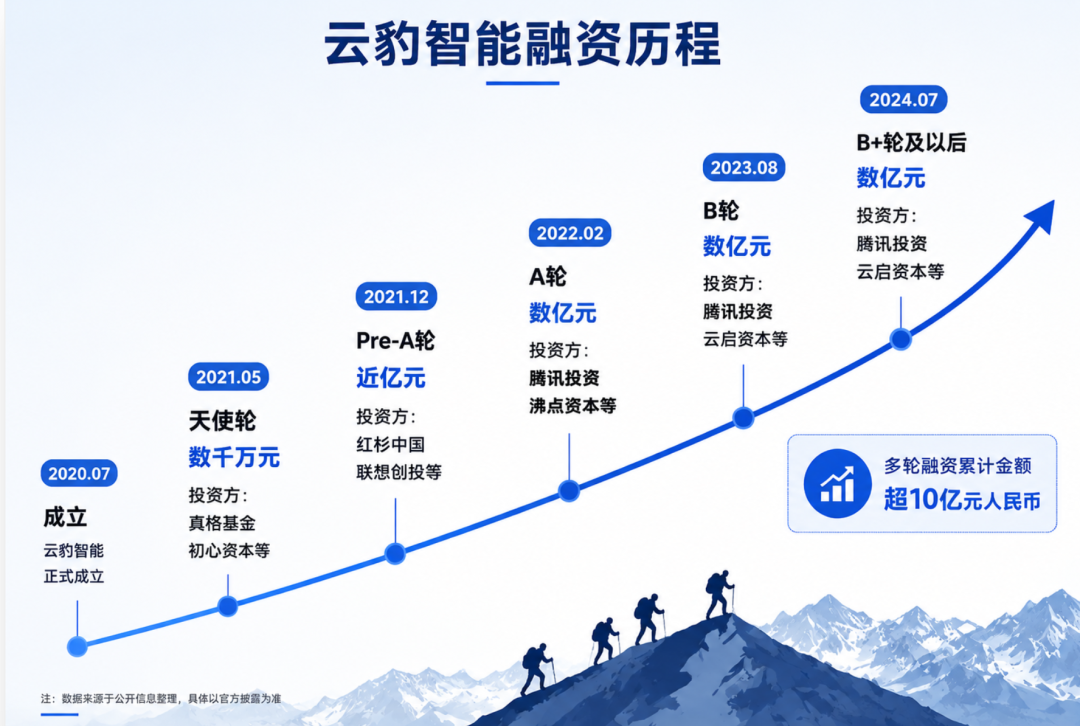
In just a few years, Cloud Leopard Intelligence completed multiple rounds of financing. By the last capital increase in December 2025, its post-investment valuation had reached RMB 14.273 billion. Tencent is the largest shareholder, holding a total of 19.78% of the shares.
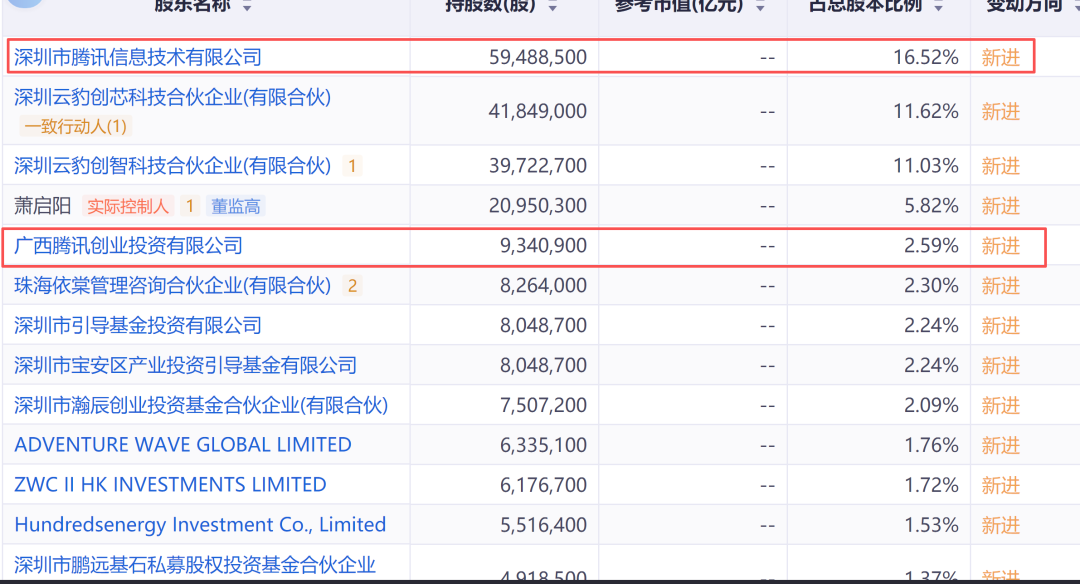
Data Source: Tonghuashun
Revenue Surges 900%, But Still in the Red
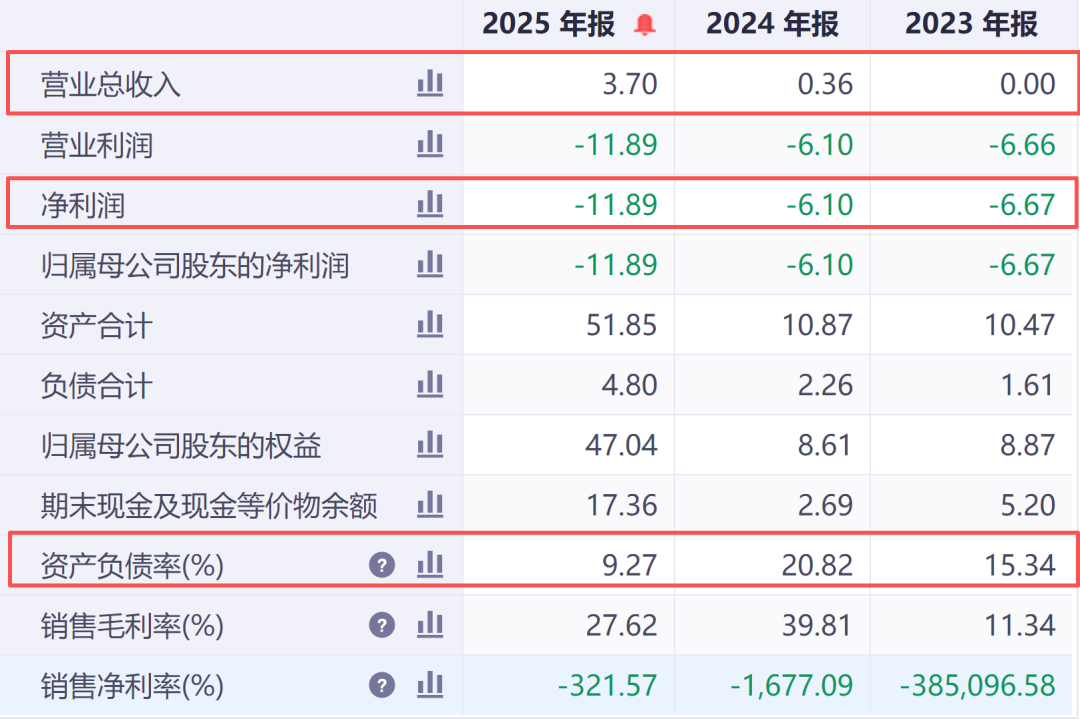
Data Source: Tonghuashun
Let's first examine the revenue trend:
2023: RMB 173,200 (products still in sampling and verification stage)
2024: RMB 36.3557 million (400G chips began mass shipping)
2025: RMB 370 million (year-on-year growth exceeding 900%)
From RMB 170,000 to RMB 370 million, a more than 2,000-fold increase in two years. This growth rate is remarkable in any industry.
However, the losses are equally significant:
Cumulative losses over three years amounted to RMB 2.466 billion. In 2025, the net loss attributable to the parent company expanded to nearly RMB 1.2 billion, primarily due to share-based compensation expenses from equity incentives. However, the loss after excluding non-recurring items narrowed from RMB 620 million to RMB 560 million, a positive signal worth noting.
Several key indicators warrant close attention regarding Cloud Leopard Intelligence's future performance in the capital markets.
First, assess the quality of revenue growth. For a chip company, revenue growth cannot be judged by scale alone. More importantly, whether customers continue to make purchases and whether scaled sales have been achieved. Second, evaluate R&D investment efficiency. The chip industry requires massive R&D investment. DPU companies need long-term investment in chip tape-outs, software development, and ecosystem building. R&D expense ratios may remain high for an extended period. Third, consider customer concentration. If revenue primarily comes from a few large customers, commercial stability needs to be monitored. Fourth, observe gross margin changes. Early-stage chip companies may face profitability pressures due to insufficient mass production scale, high R&D costs, and high supply chain costs.
The most striking figure is customer concentration: In 2025, Cloud Leopard Intelligence's direct and indirect sales to Tencent accounted for 95.22% of its annual revenue. In other words, this company has essentially been "nurtured" by Tencent.
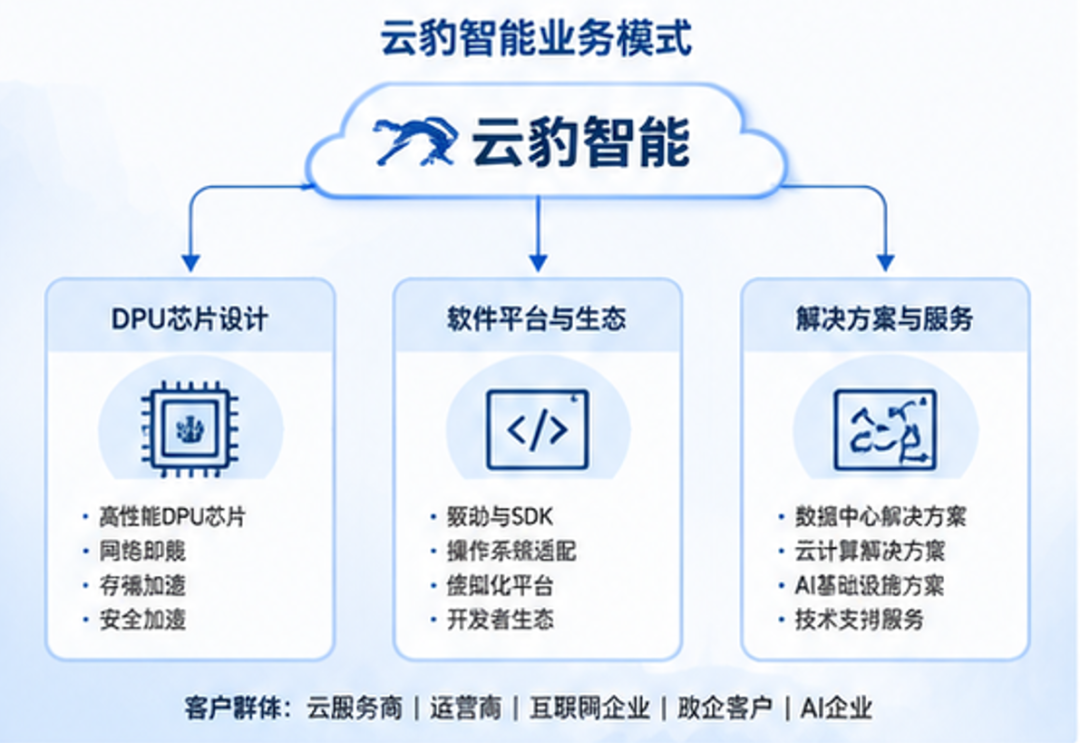
However, from another perspective, having a giant like Tencent willingly serve as a "seed customer" is itself a testament to the company's strength. Cloud Leopard Intelligence explains its "seed customer" strategy in its prospectus, refining product technology through deep cooperation with leading customers before accelerating market-wide promotion. This logic is not uncommon in high-tech entrepreneurship.
A Billion-Dollar Sector is Exploding
How high is the ceiling for the DPU market? According to Frost & Sullivan, China's DPU market size grew from RMB 15.044 billion in 2021 to RMB 49.758 billion in 2025 and is expected to exceed RMB 129 billion by 2030. The global market is also growing rapidly, with the data center DPU market valued at approximately $4.8 billion in 2025 and projected to reach $26.3 billion by 2034.
Cloud Leopard Intelligence ranks first among domestic independent manufacturers in China's full-function DPU market, with an overall market share of about 15.3%.
Cumulative chip shipments have exceeded 100,000 units. Its products have entered the supply chains of leading customers such as Tencent, China Mobile, China Unicom, China Southern Power Grid, and Industrial and Commercial Bank of China.
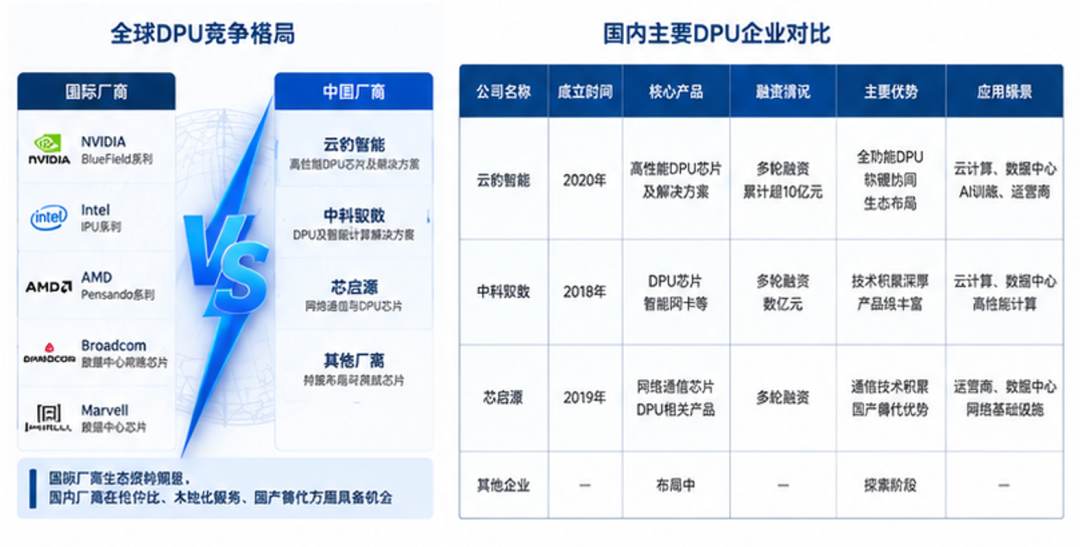
Internationally, NVIDIA dominates the global market with its BlueField series DPUs. NVIDIA acquired Mellanox for $6.9 billion in 2020, and the company has since become NVIDIA's second-largest revenue division, generating approximately $40 billion in annual revenue. Giants like Broadcom, Intel, and Marvell are also heavily investing in the DPU sector.
Domestically, Huawei holds about 31.4% of the market share with its Kunpeng DPU, primarily for internal ecosystem use. Enflame Technology, a DPU company incubated by the Institute of Computing Technology, Chinese Academy of Sciences, claims its K2-Pro chip as the "first domestically produced full-function DPU in mass production." Corigine is also continuously raising funds to advance its next-generation DPU R&D.
Cloud Leopard Intelligence's uniqueness lies in being the only independent DPU manufacturer to achieve large-scale commercialization. Other domestic DPU manufacturers are either smaller in scale or primarily serve their own ecosystems. This "independent third-party" positioning is both a differentiated advantage and a foundation for future customer expansion.
The Two Sides of Being the First DPU Listed Company
The commendable aspects:
Technical prowess stands up to scrutiny. Cloud Leopard Intelligence is the first domestic company to break the 400Gbps rate barrier for DPUs. Its chips adopt a 6nm advanced process, taking only four years from FPGA verification to SoC mass production. Its products were selected for the National Museum of China's "Made in China: Achievements of the 14th Five-Year Plan" exhibition, the only DPU chip on display. Behind this are 23 core technologies, 72 invention patents, and 22 integrated circuit layout design copyrights. The technical foundation is indeed solid.
The commercialization path has been proven. From RMB 170,000 to RMB 370 million, from 1 unit to 100,000 units, Cloud Leopard Intelligence completed the transition from technical verification to large-scale commercialization in just two years. Customers like Tencent, China Mobile, China Unicom, and China Southern Power Grid are all industry benchmarks.
Precise market positioning. DPU is the "third main chip" in AI computing infrastructure. Against the backdrop of explosive growth in demand for AI large model training and inference, the strategic value of DPUs will only continue to rise. Cloud Leopard Intelligence has secured the title of "first domestic DPU listed company," giving it significant branding and capital market advantages.
The noteworthy challenges:
Customer concentration is too high. 95% of revenue comes from Tencent. While the "seed customer" strategy has its rationale, over-reliance on a single large customer is always a sword of Damocles hanging over the company. A change in Tencent's procurement strategy could be devastating to the company's revenue. The good news is that Tencent's direct sales accounted for 71.31% in 2024, dropping to 5.04% in 2025, with more sales shifting to indirect models—indicating the company's efforts to diversify its customer base.
The profitability timeline remains uncertain. The company expects to achieve profitability as early as 2028. With cumulative losses of RMB 2.466 billion over three years and 2025 revenue at only RMB 370 million, there is still a long road ahead to transition from losses to profits. While the chip industry's model of "burning money for the future" is accepted by capital markets, sustained losses test cash flow and team morale.
International competitive pressures cannot be ignored. NVIDIA's BlueField-4 is scheduled for release in 2026, supporting 800G networks. Cloud Leopard Intelligence is currently benchmarking against NVIDIA's mainstay product, the BlueField-3. While the gap is narrowing, catching up with international giants is never a one-time achievement.
Conclusion
The significance of Cloud Leopard Intelligence's IPO lies more in the "signal" it sends than in the "numbers."
Numerically, the company has RMB 370 million in revenue, nearly RMB 1.2 billion in losses, and 95% of its income reliant on Tencent—none of these figures are particularly impressive on their own. However, the signal is clear: the first listed company in China's domestic DPU sector is about to emerge, marking a milestone event in the industry's journey from 0 to 1.
DPU is not as well-known a concept as CPU or GPU, but it is an indispensable part of AI computing infrastructure. Against the backdrop of global technology competition, the localization of DPUs is not just a commercial issue but also a supply chain security concern.
In less than six years, Cloud Leopard Intelligence has grown from a one-person operation to a unicorn valued at RMB 14.2 billion, with revenue soaring from RMB 170,000 to RMB 370 million. This speed itself demonstrates a fact: China's pursuit of high-end chips is moving from "can we make them" to "can we scale them."
Whether it can truly scale is another question. The IPO is just the beginning. Can its products expand beyond Tencent to more customers? Can its technology catch up from 400G to 800G or even 1.6T? Can losses narrow as projected by 2028? These are the true tests of the "first DPU listed company."
Regardless, the courage to strive for being the "first" deserves recognition. In the marathon of high-tech innovation, just standing at the starting line makes one a winner.
What's your take on this topic?
-
![]()
Realme Presses 'Pause': OPPO's Calculated Strategic Move
-
![]()
Gravity-1: The Glorious Journey of a Robust Solid Rocket and Its Pivotal Main Stage
-
![]()
Chip Unicorn Cloud Leopard Intelligence, Backed by Tencent, Sets Sights on IPO
-
![]()
Observation of German Auto Market: Electric Vehicle Market Maturity Ranks 12th in Europe, Chinese Brand Share Rises to 3.7%
-
![]()
He Xiaopeng Responds to a 'Critical Question'
-
![]()
Vivo's Strategic Retreat in India: From Market Dominance to Forced 'Partnership' in a No-Alternative Scenario
-
![]()
Following the Explosive Success of Kimi k3, Moonshot AI is Reportedly in Final IPO Financing Discussions
-
![]()
Baidu Dazi's Ambitious Overtaking with 'Product-Centric' Upgrades