He Xiaopeng Responds to a 'Critical Question'
 07/22 2026
 443
443

XPeng has recently taken center stage by launching the MONA L03 in Munich, a renowned automotive hub in Germany.
He Xiaopeng holds high expectations for this model, envisioning the L03 as XPeng's top-selling vehicle worldwide.
However, his remarks during a foreign media interview have stirred up controversy.
On July 16, following the launch event, a foreign journalist posed a standard yet 'critical question' to He Xiaopeng: 'What sets XPeng's and BYD's European strategies apart?'
He Xiaopeng replied as follows:
'I believe XPeng and BYD are fundamentally different companies with distinct strategic approaches. BYD follows its unique path, while XPeng aims to distinguish itself through advancements in software and hardware technology.','We aspire to build a mid-to-high-end brand in Europe and pursue distinctive endeavors. As you can see, I am deeply committed to high-quality, sustainable development rather than merely chasing sales volume.','I believe volume is not the ultimate goal in many cases. Therefore, our paths diverge, and we are each pursuing our own growth trajectory.'
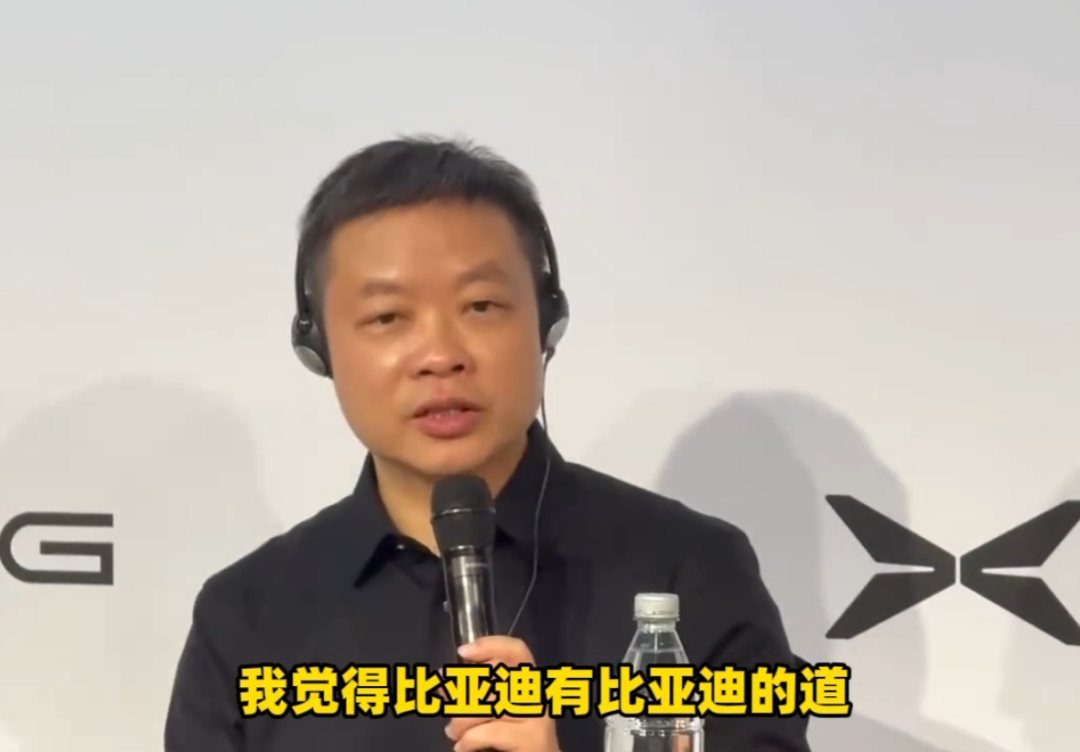
Image source: Screenshot from interview video
Once this statement spread online, it quickly sparked widespread debate, with some interpreting it as: 'Subtly mocking BYD for focusing solely on sales volume at the expense of quality.'
However, a thorough review of the entire interview reveals that He Xiaopeng's intention was not to belittle competitors. He only briefly referenced both companies at the beginning and end, choosing instead to focus on explicitly outlining XPeng's overseas market strategy and its approach to international expansion.
Unfortunately, his comments had flaws, being overly direct and simplistic, which made them susceptible to misinterpretation when taken out of context.
After selective editing, what was a routine strategic discussion turned into a contentious industry topic.
From a communication standpoint, the most appropriate response would have been to initially decline to directly evaluate competitors, then outline XPeng's strategy, and finally express good wishes for both automakers' success.
01 XPeng's Emphasis on Quality and Scale
He Xiaopeng has previously emphasized his strong commitment to high-quality, sustainable development.
Looking back at XPeng's journey, it is clear that the company places significant importance on exploring cutting-edge technologies.
Since its inception, XPeng has prioritized intelligent driving R&D. Its first model, the G3, launched in 2018, featured 12 ultrasonic radars, 5 high-definition cameras, and 3 millimeter-wave radars, supporting autonomous driving assistance and all-scenario automatic parking.
Subsequently, XPeng released models such as the P5, P7, G6, and G9, which incorporated lidar-based intelligent driving systems, later transitioning to a vision-based VLA (Vision-Led Autonomy) approach without lidar. By integrating cameras, millimeter-wave/ultrasonic radars, and its self-developed Turing AI chip, XPeng created a unique domestic intelligent driving solution.
Leveraging the second-generation VLA's understanding of the physical world, XPeng expanded into areas such as self-developed AI chips, Robotaxi, flying cars, humanoid robots, and even, as reported by Lei Feng Network, yachts currently under development.
Centered on physical AI derived from autonomous driving research, XPeng has diversified into numerous cutting-edge fields, justifying its rebranding from XPeng Motors to XPeng Group and earning playful comparisons to 'China's Tesla.'
Yet, sales volume—a key indicator of product popularity—remains crucial for XPeng.
Image source: AI
From its initial mass production in 2018, XPeng only surpassed 100,000 annual sales in 2022; sales rose to 190,000 in 2024 and doubled to 429,000 in 2025.
XPeng finally emerged from what He Xiaopeng described as the 'ICU,' achieving a record quarterly profit of RMB 380 million in Q4 2025.
This success owes much to the volume-driving MONA M03, which, since its August 2024 launch, dominated the 100,000-200,000 RMB pure electric sedan segment for 21 consecutive months. Building on this momentum, XPeng introduced volume-focused models like the GX and MONA L03.
In the first half of 2026, XPeng delivered 165,977 units, still falling short of its annual target of 550,000-600,000 units.
In Q1 2026, XPeng returned to losses, with revenue declining 17.56% year-on-year to RMB 13.034 billion and net profit attributable to shareholders widening 168.67% to RMB -1.784 billion, reflecting a 'dual decline' in both revenue and profit.
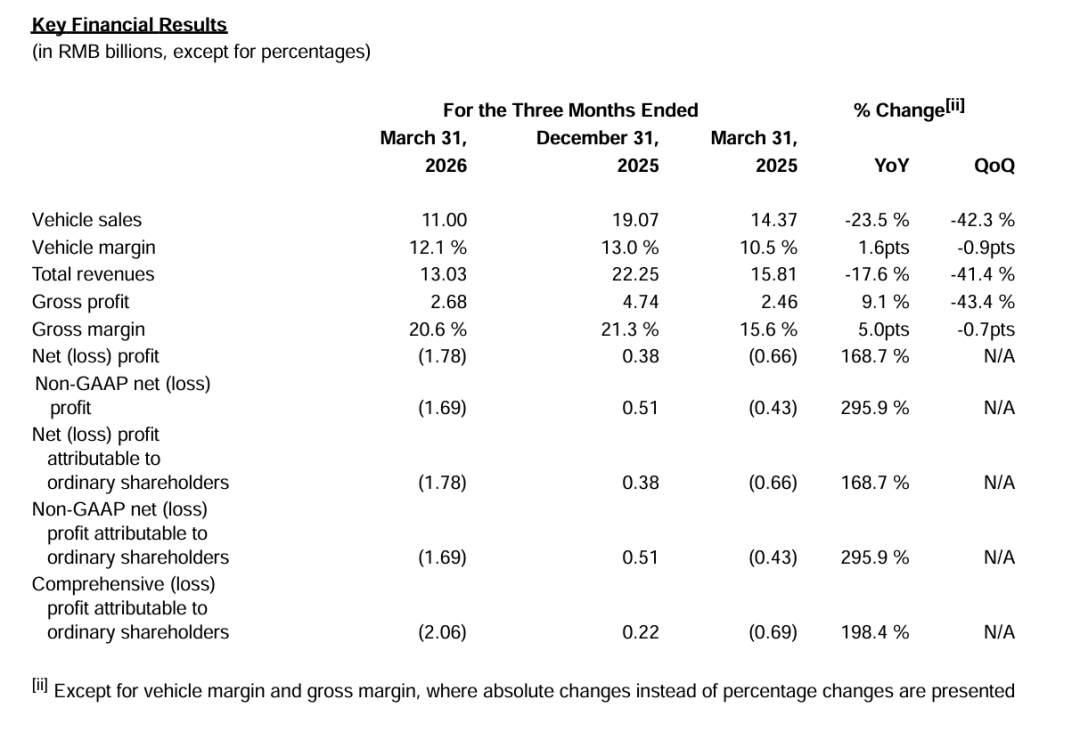
Image source: Financial report screenshot
Recently, while the XPeng GX gains traction and the MONA L03 drives H2 sales growth, the XPeng X9 encountered air spring failures in high temperatures, leading to widespread breakdowns. Though the company responded swiftly by extending air suspension warranties, this incident highlights the challenges new energy vehicle makers face in balancing quality and volume.
Establishing a premium brand while ensuring volume is a standard path in automotive development.
In XPeng's current context, He Xiaopeng's statement about 'not chasing volume' implies avoiding blind sacrifices to brand quality or overdrawing long-term value for short-term sales surges, rather than denying the importance of sales itself.
02 BYD's Focus on Quality and Scale
BYD is indeed unmatched in terms of 'volume.'
In 2025, its sales reached 4.6 million units, ranking sixth globally, with overseas sales surpassing 1 million for the first time.
In the first half of 2026, BYD's cumulative sales hit 1.8085 million units, including 789,400 overseas units, accounting for over 40% of total sales.
However, influenced by domestic market fluctuations, BYD's H1 domestic sales fell sharply by 39.2% year-on-year to 1.0191 million units.
Financial reports show BYD also experienced a 'dual decline' in Q1 2026, with revenue down 11.82% year-on-year to RMB 150.225 billion and net profit attributable to shareholders down 55.38% to RMB 4.085 billion.
Competition intensified, with XPeng, Leapmotor, Geely, and others vying in the sub-200,000 RMB segment.
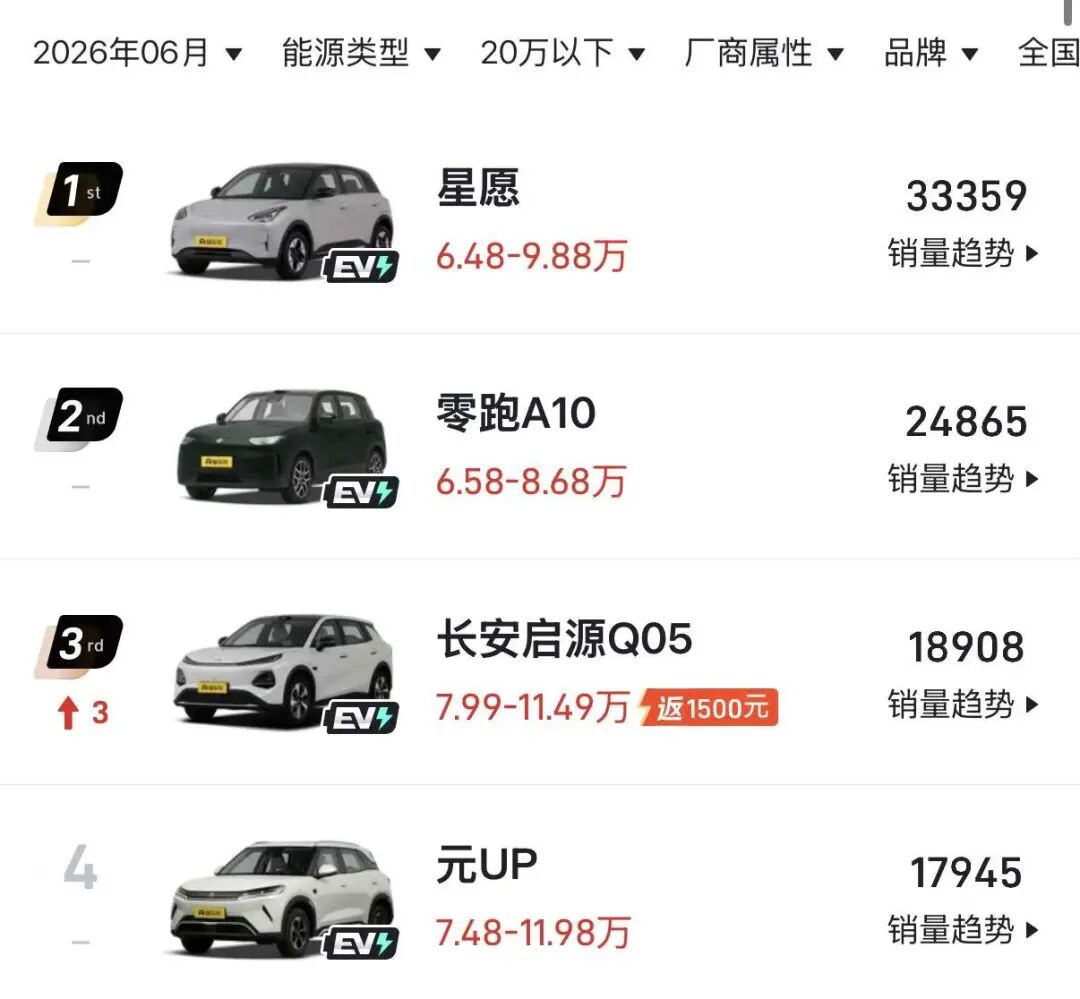
Image source: Screenshot from Dongchedi App
As a company with cumulative R&D investment exceeding RMB 250 billion, BYD continues to innovate technologically, introducing second-generation blade batteries with 9-minute full charging and flash-charging technology. Multiple new models became hits, though sales are now constrained by its FinDreams Battery production capacity.
Meanwhile, BYD's premium brands—Yangwang, Denza, and Fangchengbao—continuously launch new models.
Europe remains a key focus for BYD, with 162,400 registrations in H1 2026, up 136% year-on-year, though sales remain concentrated in mid-to-low-end PHEV models like the Seal U and Atto3.
BYD is investing EUR 4 billion to build a factory in Hungary, expected to commence operations this year.
With seven overseas vehicle factories and an 8-ship ro-ro fleet capable of transporting over 1 million units annually, BYD's global expansion is rapid.
This year, BYD's Denza brand made a high-profile European debut at the Paris Opera House and Britain's Goodwood Festival of Speed, pricing the Denza Z all-electric supercar between EUR 1.3 million and 1.58 million. Rumors also swirl about BYD entering F1.
From battery cells and IGBT chips to vehicle manufacturing and component supply, BYD achieves full vertical integration, minimizing production costs and ensuring supply chain stability.
Leveraging this robust industrial ecosystem, BYD pursues a cost-effective, full-coverage strategy overseas, rapidly capturing global mass markets through scale advantages. Its overseas sales consistently rank among China's top automakers, underpinning China's global influence in new energy vehicles with sheer market volume—a strategic value equally irreplaceable.
Clearly, neither company is right or wrong; they have simply chosen development paths best suited to their core strengths.
Whether He Xiaopeng's remarks constituted subtle mockery matters little now—far beyond the impact of a few words.
-
![]()
Realme Presses 'Pause': OPPO's Calculated Strategic Move
-
![]()
Gravity-1: The Glorious Journey of a Robust Solid Rocket and Its Pivotal Main Stage
-
![]()
Chip Unicorn Cloud Leopard Intelligence, Backed by Tencent, Sets Sights on IPO
-
![]()
Observation of German Auto Market: Electric Vehicle Market Maturity Ranks 12th in Europe, Chinese Brand Share Rises to 3.7%
-
![]()
He Xiaopeng Responds to a 'Critical Question'
-
![]()
Vivo's Strategic Retreat in India: From Market Dominance to Forced 'Partnership' in a No-Alternative Scenario
-
![]()
Following the Explosive Success of Kimi k3, Moonshot AI is Reportedly in Final IPO Financing Discussions
-
![]()
Baidu Dazi's Ambitious Overtaking with 'Product-Centric' Upgrades