Why has AI-powered office work become the new battleground for tech giants?
 07/30 2026
 353
353

AI-powered office work is emerging as a new battleground in the AI competition among tech giants.
Recently, major tech companies have been intensively adjusting their organizational structures and integrating products around AI-powered office work. Alibaba has launched Qianwen Office, integrating three Agent products—QoderWork, Wukong, and MuleRun—under the leadership of DingTalk's new CEO, Chen Yusen. Tencent continues to invest in its AI-powered office assistant, WorkBuddy, not only accelerating market promotion but also reportedly integrating the QClaw-related team into the WorkBuddy system. ByteDance is advancing multiple product lines, including Feishu, TRAE, and Doubao, with internal discussions about integration plans.
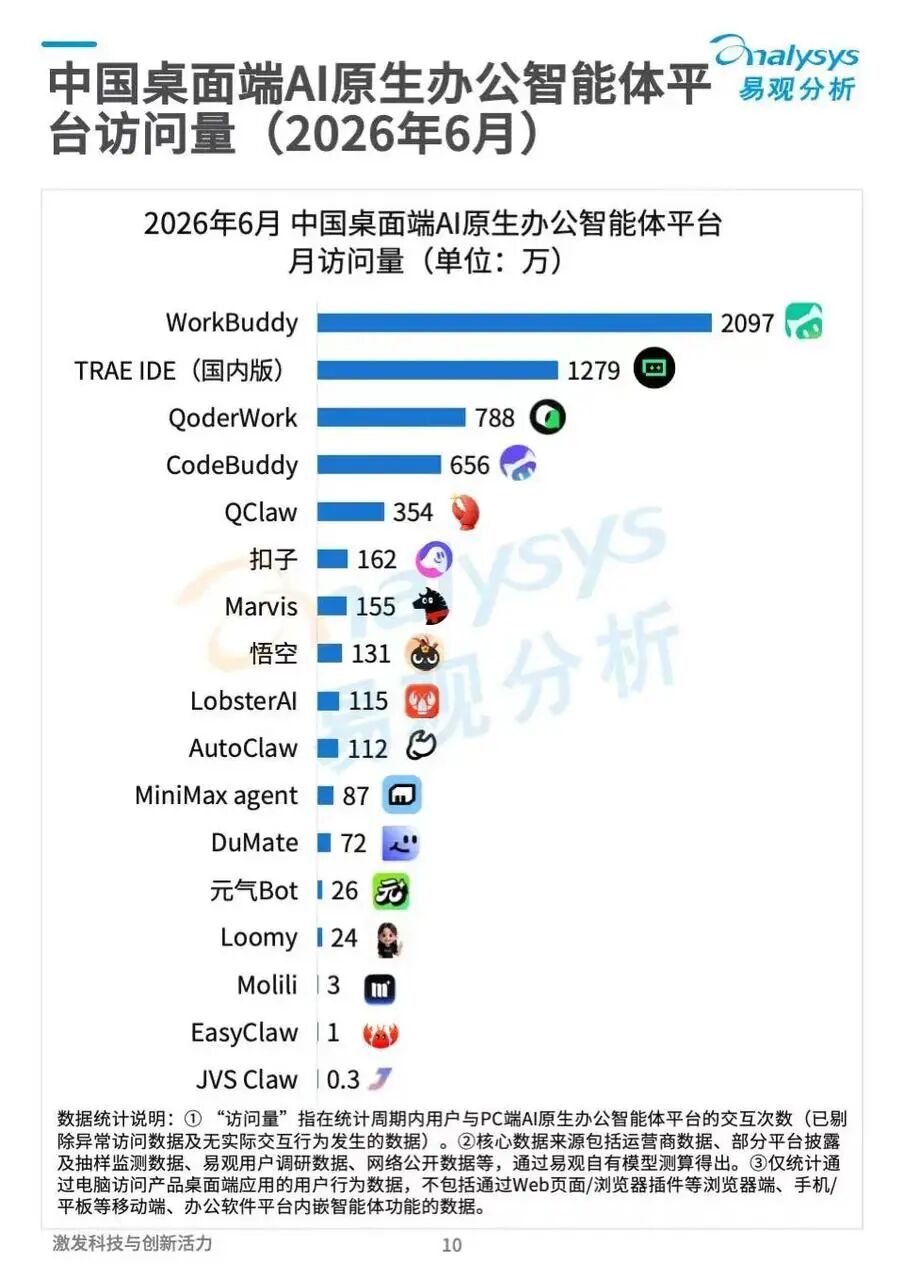
Meanwhile, a preliminary market landscape has emerged. According to Analysys'
According to sources, Tencent founder Pony Ma places great importance on the WorkBuddy project, rarely missing product meetings, and the project is being advanced internally as a "super project."
As AI technology evolves from "text dialogue" to the Agent form of "doing tasks for users," the once-stagnant office software sector has been pushed to the forefront of industrial transformation.
Unlike the previous phase of patching AI into traditional office software, the 2026 AI office war ignited by Alibaba, Tencent, and ByteDance has evolved into a battle for human-computer interaction portals.
Since the beginning of the year, Tencent has continued to invest in WorkBuddy.
From social platforms like Xiaohongshu and Douyin to elevator ads in office buildings and overseas social platform X, Tencent is increasing WorkBuddy's visibility. Elevator ads, in particular, have been launched on Focus Media, targeting office workers with the slogan, "For AI-powered office assistance, use Tencent's WorkBuddy," directly pointing to office scenarios.
Few know that this product originated from a small 10-member AI code assistant team within Tencent Cloud.
Three years ago, during the boom of large models, Wang Shengjie, the team leader of WorkBuddy, repeatedly sought opportunities to showcase Tencent's AI code assistant at events like the World Artificial Intelligence Conference, but was usually turned down.
It wasn't until 2026, when "Longxia" became popular, that WorkBuddy was forced to complete infrastructure reconstruction within a week, supporting remote control and integrating with the Longxia ecosystem, migrating from a standalone Web application to CodeBuddy's complete infrastructure, transitioning from beta to public testing. In January of this year, the initial version of WorkBuddy was launched, followed by the release of mini-program, overseas, and enterprise versions.
WorkBuddy can not only perform tasks such as data retrieval, document writing, and data analysis but also call on different tools to complete cross-application collaborations, gradually acquiring the ability to execute complete workflows.
By linking with WeChat, users can assign tasks to their computers via their phones, which then execute the tasks autonomously, automating cross-application file retrieval, data organization, and even software takeovers, and sending the results back to WeChat upon completion.
With strong product development and promotion, WorkBuddy has experienced rapid growth, helping Tencent gain an edge in the new round of AI portal competition.
In its Q1 2026 earnings report, Tencent stated that WorkBuddy had become China's most popular AI efficiency agent service in terms of daily active accounts. According to Analysys'
As user numbers grow rapidly, Tencent's emphasis on WorkBuddy continues to increase.
Recently, there have been reports that Tencent has adjusted the QClaw product center's related businesses and some teams to Cloud Product Division VI, placing them under the same management system as the AI-powered office assistant, WorkBuddy. Internally, WorkBuddy is considered a major business with the potential to become Tencent's third phenomenal product after QQ and WeChat.
Tencent founder, Chairman, and CEO Pony Ma places great importance on the WorkBuddy project, rarely missing product meetings, and the project is being advanced internally as a "super project."
If QQ defined the social portal for the PC era and WeChat defined the super portal for the mobile internet era, then WorkBuddy represents Tencent's latest bet on the portal for the AI era.
QQ connects people with people, WeChat connects people with services, and WorkBuddy aims to connect people with Agents. As more work is completed by Agents, the first window people open on their computers each day may no longer be a browser or Office but an intelligent agent capable of understanding needs, calling on tools, and delivering results.
Besides Tencent, ByteDance and Alibaba are also ramping up their efforts in AI-powered office work.
According to Analysys'
Breaking it down, Tencent's ecosystem (WorkBuddy, CodeBuddy, QClaw, and Marvis) accounted for 32.62 million visits, more than half of the total; ByteDance's ecosystem (TRAE IDE domestic version and Kouzi) accounted for approximately 14.41 million; and Alibaba's ecosystem (QoderWork and Wukong) accounted for approximately 9.19 million, the lowest among the three.
Although currently lagging behind Tencent, Alibaba and ByteDance have recently begun adjusting their organizational structures and integrating product resources to accelerate their layout (layout) in the AI-powered office market.
In June of this year, Chen Hang, the founder and former CEO of DingTalk, stepped down, and Chen Yusen officially took over as the new CEO of DingTalk. This marks the second leadership change within 15 months for DingTalk, and Chen Yusen, a post-90s geek, is seen as a signal of Alibaba's strategic adjustment in enterprise services.
Over the past few years, Alibaba has incubated multiple Agent products around AI. QoderWork targets AI programming, Wukong focuses on enterprise office work, and MuleRun handles Agent development and workflow capabilities. Although covering multiple directions such as R&D, office work, and Agent platforms, these products have long developed independently and have yet to form a unified enterprise AI portal.
Within a week of taking office, Chen Yusen began promoting the integration of Wukong and MuleRun. In early July, QoderWork was further incorporated into the unified sequence under Chen Yusen's leadership.
On July 27, Qianwen Office quietly launched its beta test. Currently, its desktop version is available, with web and DingTalk-embedded versions to follow. Qianwen Office integrates three agent products—QoderWork, Wukong, and MuleRun—and is defined as Alibaba Cloud and DingTalk's "only flagship SaaS product," becoming Alibaba's key product in the Agent office market.
For Alibaba, the internal competition among AI office products has ended. As Agents begin to enter the commercialization phase, it is better to unify the portal and concentrate resources on a single product rather than explore separately.
ByteDance's AI office work currently follows multiple paths.
The first is Feishu. In March of this year, Feishu held a product launch event, focusing on upgrades to Feishu Daily, Feishu Miaoda, and the Multi-Dimensional Table Agent, while introducing supporting tools such as the OpenClaw official plugin and Feishu CLI, forming a complete ecosystem of assistant Agents, development Agents, and data Agents.
The second is TRAE. Originally a programming tool, TRAE is an AI-native IDE launched by ByteDance, gaining traction among developers through Chinese-language optimization and a free strategy. However, in June of this year, ByteDance officially renamed TRAE SOLO to TRAE Work, shifting its positioning from developer-exclusive to an AI office platform for all employees, expanding its product boundaries from coding to broader workplace productivity scenarios.
Another is Doubao's office mode. In June of this year, ByteDance's Doubao officially launched Doubao Pro for productivity scenarios, with the core highlight being the new "Office Tasks" Agent mode powered by the flagship Doubao large model 2.1 Pro, aiming to provide localized and automated complex task processing capabilities for professionals, creators, and developers.
However, according to multiple media reports, ByteDance is already discussing relevant integration plans internally.
Despite their different approaches, Alibaba, Tencent, and ByteDance are doing the same thing: ending the era of parallel exploration of multiple products in the large model era and reintegrating scattered AI capabilities into a unified office portal.
Tencent is concentrating its resources on WorkBuddy, Alibaba is integrating to create Qianwen Office, and ByteDance is also expected to introduce an integration plan. Compared to the previous phase of competing on model parameters, the current focus has shifted to who can first establish a new office portal for the AI era.
From WorkBuddy's "super project" to Alibaba's "Qianwen Office" and ByteDance's multi-pronged layout (layout) with Feishu, TRAE, and Doubao, office software, once considered a mature sector, is once again becoming the fiercest battleground for tech giants.
On the surface, this is a competition among several AI office products; but at a deeper level, it is a battle for the next-generation enterprise portal. As AI begins to shift from answering questions to doing tasks for users, the role of office software is also changing.
Over the past two years, the mainstream form of AI office work has been Copilot. It functions more like a "co-pilot" for employees, handling single-point tasks such as writing documents, creating PPTs, and summarizing meetings. However, starting in 2026, more and more products are shifting toward the Agent form.
Unlike Copilot, which performs only a single action, an Agent is more like an employee. It can understand goals, autonomously break them down into steps, call on multiple tools such as search, documents, spreadsheets, browsers, and knowledge bases, and continue executing until delivering results.
Tasks that once required employees to switch back and forth between browsers, Office, enterprise WeChat, and knowledge bases can now be independently completed by AI.
Compared to the consumer market, enterprise office work has several natural advantages.
First is standardized scenarios.
Regardless of industry changes, most enterprises perform similar daily tasks, including researching information, writing proposals, making presentations, analyzing data, scheduling meetings, approving processes, and project collaboration. These tasks naturally follow fixed processes and are more easily learned and automated by AI.
Second is abundant data.
Enterprises generate vast amounts of documents, contracts, reports, emails, chat records, and meeting minutes daily. These accumulated knowledge assets are the foundation for Agents to understand the enterprise and complete tasks. Compared to open internet information, enterprise data is more precise and commercially valuable.
More importantly, enterprises are willing to pay for efficiency improvements.
For individual users, an AI product may only slightly improve work efficiency; but for enterprises, if Agents can replace some repetitive tasks, shorten business processes, and reduce communication costs, the value will be directly reflected in cost savings and productivity gains. Therefore, office work has become one of the AI application scenarios most likely to form a commercial closed loop .
Commercialization signals have already begun to emerge. Feishu has experienced rapid growth this year, with AI considered a key driver. According to
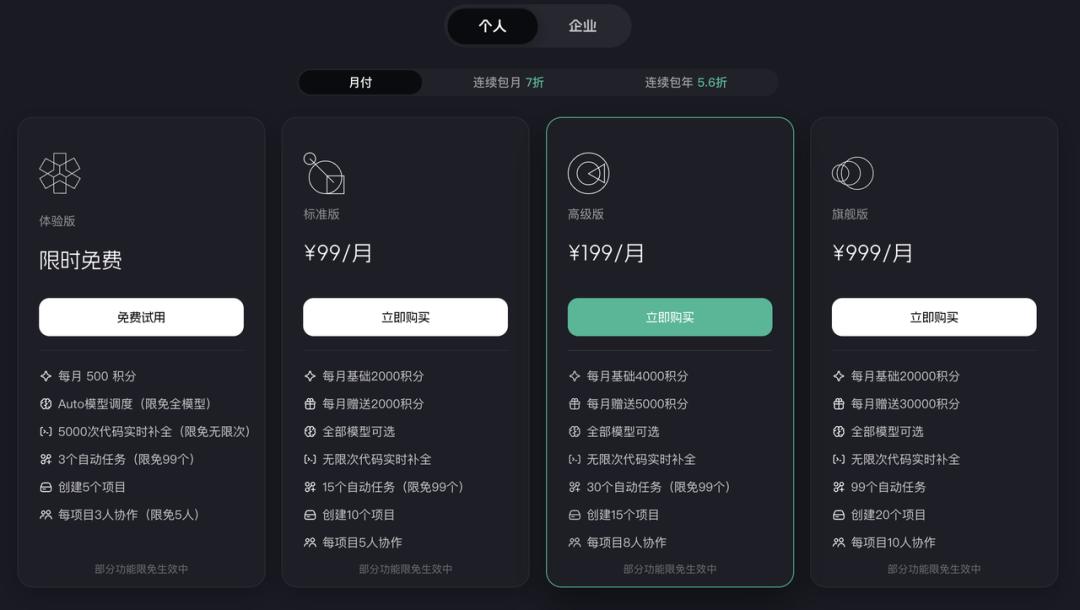
At the same time, unlike traditional internet products that often attract users with free offerings, WorkBuddy and Qianwen Office have established clear pricing systems since their launch.
For example, WorkBuddy's personal version offers four tiers: limited-time free, 99/month, 199/month, and 999/month, while its enterprise version offers two tiers: 198/person/month and 316/person/month. Qianwen Office's personal version offers three tiers: free, 98 yuan, and 198 yuan, with continuous subscription prices of 78 yuan and 158 yuan. Its enterprise standard version costs 198 yuan/month/seat, with the flagship version priced separately upon inquiry.
In fact, tech companies worldwide are evolving in the same direction.
Microsoft has deeply integrated Copilot into Word, Excel, PowerPoint, and Teams, aiming to make AI a default capability of the Office suite; Google continues to push Gemini into Workspace. The direction of competition in the international market is clear: future enterprise procurement will focus not just on office software but on AI capabilities that can participate in work.
Therefore, the domestic market is also entering the same development rhythm.
Unlike the previous round of large model competition, which focused on model parameters and reasoning capabilities, this round of AI office competition more heavily tests companies' existing software ecosystems and organizational capabilities. Model capabilities are gradually converging, while enterprise data, business processes, organizational relationships, and office portals have become key factors determining whether Agents can truly be implemented.
As a result, we see that major tech companies have recently begun adjusting their organizations, integrating products, and strengthening their office layout (layout) almost simultaneously. Whoever can first enable AI to truly integrate into enterprises' daily workflows will have the opportunity to become the next-generation digital infrastructure for enterprises. This is the fundamental reason why players like Alibaba, Tencent, and ByteDance are all betting on AI-powered office work.
-
![]()
Memory Prices Soar 300%, Disrupting the Smartphone Market! SoC Shipments Plummet 15% in the First Half of 2026
-
![]()
From Dominance to Decline: The Gradual Fading of Black Shark Phones and the Predicament of Devoted Fans
-
![]()
Honor's 'Alpha' Ambitions and the 'Phone Case' Quandary: Securing Legal Victory, Yet Risking Public Favor
-
![]()
Chinese Automakers Sweep Across Europe but Are Trapped by 'Electricity Price Shackles'
-
![]()
It’s Official: The Era of Intelligent Driving Blue Lights Ends with a Complete Ban on Installation
-
![]()
Dongfeng Nissan's 'Prized Asset' Struggles to Keep Composure
-
![]()
Why has AI-powered office work become the new battleground for tech giants?
-
The WEY V8X Hasn't Been Launched Yet, But Its Marketing Team Has Already Disbanded