The WEY V8X Hasn't Been Launched Yet, But Its Marketing Team Has Already Disbanded
 07/29 2026
 437
437


WEY is once again on the eve of a new product launch.
According to WanTongShe, on July 22nd, several marketing directors and public relations personnel from WEY's marketing company resigned. At the same time, the second model from Great Wall Motor's Guiyuan S platform, the V8X, entered the countdown to its launch, expected to hit the market directly in August without a separate pre-sale event.
This is no ordinary personnel fluctuation.
Zhao Yongpo took over as CEO of WEY just seven months ago, and the V9X has been on the market for only two months. The high-end flagship has yet to achieve stable growth, and the marketing team is already showing signs of instability. For a brand that has changed leaders multiple times in nine years and has consistently struggled to establish itself at the high end, the V8X is more than just a new car.
It's more like a make-up exam for WEY's current management system.


The most important car for WEY this year was originally the V9X.
On April 17th, the Guiyuan S platform was unveiled, and the V9X began pre-sales; on May 18th, the V9X was officially launched, with three models priced starting at 349,800 yuan. Its positioning is lofty: an "AI luxury six-seater flagship," the first mass-produced model on the Guiyuan S platform, featuring a 2.0T Super Hi4, 800V high voltage, 6C ultra-fast charging, dual-chamber air suspension, rear-wheel steering, and a native AI cockpit and driving intelligence system—essentially packing all of Great Wall's current technologies into one vehicle.
Wei Jianjun also got personally involved.
However, on the day of the launch event, what went viral was not the V9X's technology but Wei Jianjun's public criticism of Zhao Yongpo and Great Wall Motor's CGO, Li Ruifeng. He expressed his "extreme dissatisfaction" with the V9X's promotion, believing that the marketing team tried to say too much and ended up saying nothing clearly, failing to translate the product's advantages into understandable purchasing reasons for users.
This comment hit on WEY's long-standing issue. Great Wall Motor is not lacking in technical expression but in consumer-oriented communication.
The V9X's sales did not take off quickly after its launch. In May, the V9X sold approximately 1,018 units; in June, its sales in a complete sales month reached about 1,505 units. For a flagship model tasked with brand elevation, this start is not ideal.
Even more awkwardly, WEY's overall sales did not see a significant boost following the V9X's launch. In June, WEY sold 7,191 units, down 11.43% from May's 8,119 units and 29.48% year-on-year. In the first half of the year, WEY's cumulative sales reached 44,514 units, up 29.05% year-on-year, but the growth was mainly driven by the Gaoshan model.
The Gaoshan sold 5,318 units in June and 36,420 units in the first half of the year; the V9X sold a cumulative 2,523 units in the first half. WEY's current sales foundation still seems to be supported more by the Gaoshan rather than the V9X redefining the high-end SUV market.
This is why the pressure on the V8X is amplified.
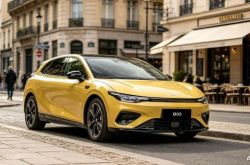
The V8X is positioned as a large five-seater mid-to-large SUV and will offer both plug-in hybrid and pure electric versions. The filing information for the plug-in hybrid model shows that the long-wheelbase version measures 5,125/2,025/1,821mm in length, width, and height, with a wheelbase of 3,050mm. It is equipped with a 1.5T Hi4 plug-in hybrid system and comes with two battery capacities: 42.8kWh and 64.7kWh, corresponding to WLTC pure electric ranges of 200km and 312km, respectively. The standard wheelbase version has a wheelbase of 2,968mm and offers 1.5T and 2.0T plug-in hybrid versions. The pure electric version has also been filed, featuring a five-seater layout, dual-motor all-wheel drive, with front and rear motor powers of 220kW and 320kW, respectively.
This means the V8X is not simply a scaled-down version of the V9X.
The V9X targets the six-seater flagship segment, while the V8X targets the more mainstream large five-seater family SUV market, which is larger but also more competitive.


Zhao Yongpo is not an outsider brought in as a marketing manager.
He has worked at Great Wall Motor for over 20 years, initially focusing on research and development for an extended period. He previously served as Vice President of Great Wall Motor's Technical Research Institute and Deputy General Manager of the Technical Center, overseeing vehicle platforms, lower body structures, overall vehicle performance, and chassis. In November 2023, he became the General Manager of the Haval brand before taking over WEY.
He is a typical Great Wall "technical expert."
Great Wall Motor's choice of Zhao Yongpo to lead WEY indicates a shift: WEY no longer wants to rely solely on external professional managers to tell new consumer stories but instead wants to return to the technical route that Great Wall Motor is most familiar with.
From the Mocha, Latte, and Blue Mountain to the Gaoshan, and now to the V9X and V8X, WEY has consistently tried to use hybrid, intelligent, safe, and comfortable features to prove that a "Chinese high-end" brand can succeed. However, the way consumers remember WEY has always been inconsistent.
The brand was established in 2016, named after Wei Jianjun's surname. The initial VV series helped WEY quickly gain traction, with annual sales reaching 139,500 units in 2018. Since then, WEY has undergone transformations from "affordable luxury" to "coffee intelligence," then to "zero-anxiety intelligent electric vehicles," and now to "AI luxury flagship."
The labels have changed many times, but the brand's identity has not solidified.
A more direct manifestation is the frequent turnover of personnel. In its approximately nine years of existence, WEY has seen multiple CEO changes. Yan Si, Liu Yan, Li Ruifeng, Hu Shujie, Yu Fei, Liu Yanzhao, Chen Siying, Feng Fuzhi, and now Zhao Yongpo—few have been able to hold the position steadily for two years.
For a high-end brand, this is fatal.
High-end status is not achieved with a single model but is built over years of consistent product, channel, service, and narrative efforts. WEY's problem lies precisely here: while cars can be replaced generation after generation and platforms can be re-launched, the organization and brand narrative are constantly being restarted.
WEY is Great Wall Motor's most direct brand for upward mobility. Tank has established itself in the off-road segment, Haval has its core market, Ora targets niche demographics, and the Gaoshan has found its rhythm in the MPV market. If WEY's SUV lineup cannot succeed, Great Wall Motor will lack a truly competitive brand in the mainstream high-end new energy SUV market priced between 200,000 and 400,000 yuan.
The V9X is tasked with establishing a flagship presence.
The V8X is tasked with driving volume.
The former tells the market that WEY can create luxury flagships, while the latter must prove that WEY can sell luxury technology in the larger family SUV market.
The market the V8X is entering is even more brutal than that of the V9X.
In June's SUV sales rankings, the Model Y sold 38,654 units, the Li Auto i6 sold 21,453 units, the Xiaomi YU7 sold 14,324 units, and the Aito M6 sold 10,624 units. In the mid-to-large SUV segment, the Li Auto i6, Titan 7, Xiaomi YU7, Aito M6, and Aito M7 are all vying for family users.
Some of these competitors excel in traffic, others in intelligence, some in price, and others in defining family scenarios. They are not waiting for WEY to slowly explain the Guiyuan S platform.
The V9X's failure to make an immediate impact cannot be blamed solely on the marketing team.
While marketing certainly bears responsibility, the deeper issue is that WEY needs to translate "great technology" into "why I must buy it." This difference is not just a slogan but requires a complete system of user understanding.


Great Wall Motor is not short on funds for this battle.
In 2025, Great Wall Motor's revenue reached 222.824 billion yuan, up 10.2% year-on-year, a record high; annual sales reached 1.3238 million units, up 7.23% year-on-year; overseas sales reached 506,800 units, and new energy vehicle sales reached 406,000 units, both setting new records.
However, profits have begun to feel the pressure.
In 2025, Great Wall Motor's net profit attributable to shareholders was 9.865 billion yuan, down 22.07% year-on-year. The company explained that this was mainly due to the construction of a new direct-to-consumer channel model, increased investment in promoting new models and technologies, and brand enhancement efforts.
By the first half of 2026, the pressure continued to manifest. Great Wall Motor expected its net profit attributable to shareholders for the first half of the year to be between 2.35 billion and 2.6 billion yuan, down 58.97% to 62.92% year-on-year; non-GAAP net profit was expected to be between 1.5 billion and 1.75 billion yuan, down 51.14% to 58.12% year-on-year. The company stated that while sales and revenue had grown year-on-year, and overseas and domestic high-value models had increased, profit declines were affected by delays in recovering overseas tax policy subsidies and exchange rate fluctuations.
In other words, Great Wall Motor can still grow overall, but its profit margins are no longer loose ( loose can be translated as "generous" or "lenient" in this context, meaning there is less room for error).
For WEY, this means the group can continue to invest but will not Unlimited tolerance ( Unlimited tolerance can be translated as "tolerate indefinitely") "having technology but no conversion."
The WEY V8X has its own opportunities.
A five-seater SUV is easier to reach mainstream family users than a six-seater flagship; offering both plug-in hybrid and pure electric versions can cover different energy replenishment needs; long-range plug-in hybrid, four-wheel-drive pure electric, and spacious interiors can all make it onto users' decision-making checklists.
The V9X has already proven that no matter how fully loaded the specifications are, if the promotional message is scattered, the market will not automatically buy in. Users are not there to listen to engineering presentations; they only want to know: For the same price of over 300,000 yuan, why should they buy a WEY instead of a Li Auto, Aito, Xiaomi, or Tesla?
Wei Jianjun's dissatisfaction with marketing, on the surface, is about promotional timing and content, but at its core, it is about "conversion efficiency." Great Wall Motor's engineering system has long excelled at building solid cars, but in the high-end new energy market, solid engineering is just the entry ticket.
Today's high-end new energy vehicles sell a complete experience: product definition, intelligence, service, community, dealerships, content dissemination, and founder expression. Any shortcoming in these areas can turn a good product into a niche vehicle.
What WEY lacks most now is not another launch event.
It lacks a brand expression that users can understand without Wei Jianjun having to explain it personally.
If the V8X can break into the large five-seater SUV market, Zhao Yongpo will have the opportunity to transition WEY from "Gaoshan driving sales" to "SUVs rebuilding brand identity."
If the V8X remains slow to gain traction, WEY's problems will not stop at the marketing team.
By then, the outside world will naturally ask again: Does WEY lack a single model, or does it lack a stable strategy?

-
The WEY V8X Hasn't Been Launched Yet, But Its Marketing Team Has Already Disbanded
-
![]()
Agent Smartphones Move Towards Mass Production, First Bow to Apps
-
![]()
2026 Semi-Annual Report | Electric Two-Wheelers: Domestic Sales Drop 12.6% in H1—Which Brands Are Defying the Downturn with Explosive Growth?
-
![]()
Exclusive Insight from Qualcomm! The 'Affordable VR Dream' Teeters on the Edge
-
![]()
McKinsey 2026 Mobility Report: Consumers Are Redefining What Makes a 'Good Car'
-
![]()
Duan Jianjun Spearheads Premium Project as Volvo Sets Sights on Rivaling Zunjie with New Flagship Model
-
![]()
Absent from New Energy Vehicle Rural Promotion, Leapmotor Turns Its Gaze Overseas
-
![]()
Reclaiming Global Dominance! Apple’s Market Cap Surges to $5 Trillion in Cook’s Epic Finale