Feishu Merges with Doubao, DingTalk Teams Up with Wukong: Are BAT Titans Attempting to 'Corner' AI Talent?
 07/31 2026
 464
464
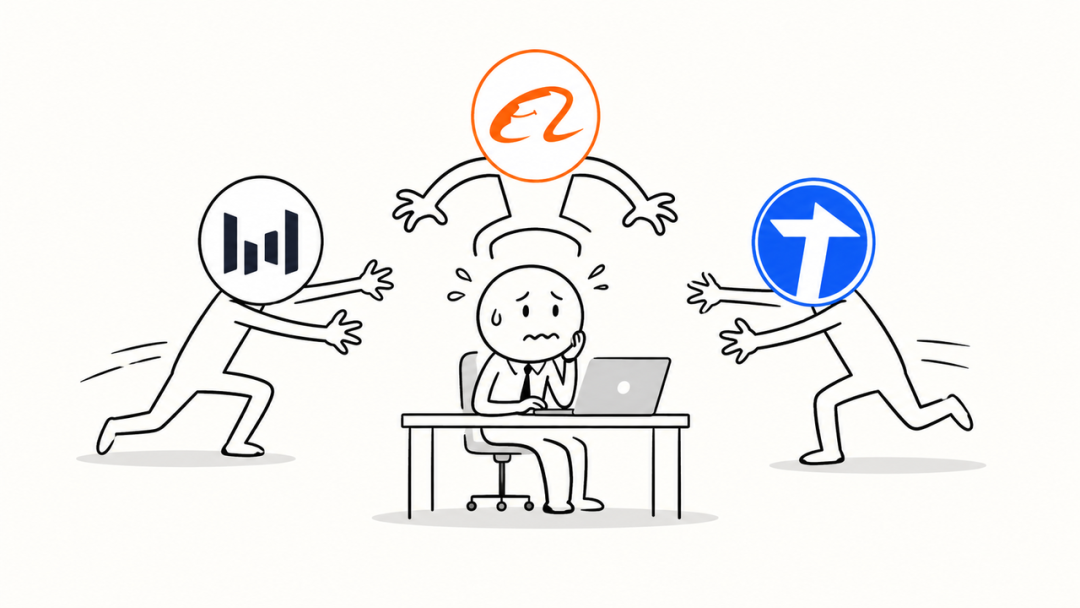
Dismantling Feishu to Bolster Doubao: ByteDance Aims to Elevate AI Office Solutions to the Next Cloud Service Echelon
On July 30, ByteDance underwent a significant organizational reshuffle within its AI and enterprise services divisions.
As part of this transformation, the Feishu product team merged with the Doubao product team, forming a new, unified Doubao product team. Concurrently, Feishu's existing sales, marketing, and customer service teams were integrated with corresponding teams from Volcano Engine.
In essence, Feishu's formerly integrated product and commercialization frameworks have now been fragmented and absorbed into Doubao and Volcano Engine: the former will manage products and user interfaces, while the latter will oversee enterprise clientele and commercialization efforts.
This industry-wide trend is not unexpected. Not long ago, Alibaba streamlined its three enterprise AI product lines—QoderWork, Wukong, and MuleRun. Similarly, Tencent integrated QClaw-related businesses and teams into the organizational structure of WorkBuddy.
This signifies that within a mere month, BAT (ByteDance, Alibaba, and Tencent) have all undertaken substantial realignments of their AI office products.
On the surface, this appears to be a strategic move by major corporations to eliminate internal rivalry and streamline operations. However, if cost efficiency were the sole objective, there would be no necessity for such coordinated reorganizations of decentralized agents, office software, and enterprise services in such rapid succession.
More significantly, what they are consolidating are precisely the entry points closest to enterprise clients.
01 Curbing Internal Rivalry: Major Players Tighten the Reins
ByteDance's restructuring extends beyond mere appearances.
Under the new organizational framework, the Feishu product team will merge with the Doubao product team, forming a new Doubao product team led by Doubao head Zhao Qi. Feishu head Xie Xin will now report directly to Zhao Qi.
Simultaneously, Feishu's existing sales, marketing, and customer service teams will merge with relevant Volcano Engine teams to create a new To B GTM organization known as the "Creativity Service Platform." This entity will be responsible for marketing, sales, and customer service for ByteDance's MaaS, SaaS, and other enterprise services.
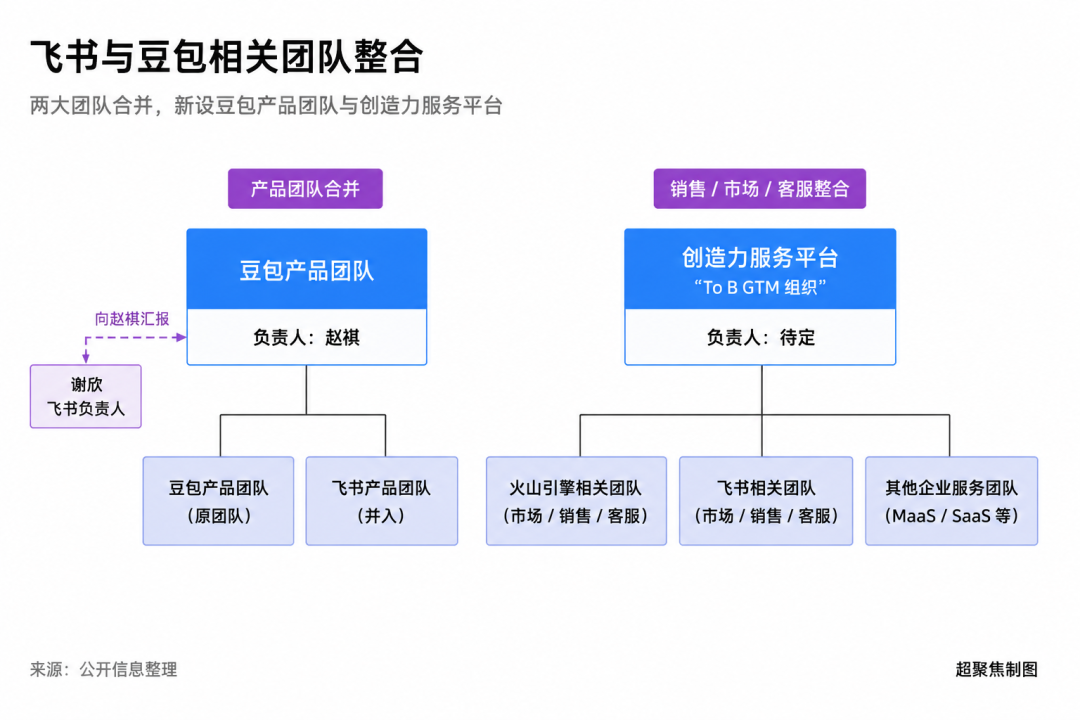
Feishu has not vanished, nor will its existing products and services cease. However, from an organizational standpoint, the once relatively autonomous Feishu—which handled product development, sales, marketing, and customer service internally—has now been effectively split into two distinct entities.
One entity will join Doubao, focusing on products and user experience within enterprise productivity scenarios. The other will join Volcano Engine, managing enterprise clients, market expansion, and commercialization.
This implies that ByteDance will no longer contemplate how to independently market Feishu, how to integrate Doubao into office settings, or how Volcano Engine should deliver model services to enterprises. Instead, all three will be positioned within a unified enterprise AI ecosystem: Doubao will provide AI capabilities and product access points, Feishu will offer work scenarios such as documents, meetings, spreadsheets, and knowledge bases, and Volcano Engine will handle cloud services and commercialization.
However, ByteDance did not hastily assemble these three teams. Previously, Doubao had already been integrated into Feishu's meeting minutes, smart spreadsheets, Q&A knowledge bases, and cloud documents. Thus, this adjustment appears more akin to an organizational realignment following product integration.
Similar consolidations have transpired at Alibaba and Tencent. Over the past six months, both giants operated multiple AI product lines concurrently but are now reining them in, concentrating teams, resources, and products on a select few key offerings.
In early July, Alibaba announced the integration of its three agent product lines—QoderWork, Wukong, and MuleRun. The new product will be based on QoderWork, incorporating capabilities from Wukong and MuleRun, and will continue to evolve for enterprise productivity scenarios under the leadership of DingTalk CEO Chen Yusen.
Alibaba stated that existing products and user benefits would remain intact. However, from a product strategy perspective, the three previously independent office agent pathways are now converging toward a unified entry point.
Tencent's move occurred on July 20, when it transferred QClaw product center-related businesses and some teams to Cloud Product Division VI, which houses another AI office agent, WorkBuddy.
As of now, QClaw will continue to operate, so this cannot be simply interpreted as its closure or complete merger into WorkBuddy. However, the two similarly positioned agents have now been placed under the same organizational and resource umbrella, making future resource sharing and strategic collaboration inevitable.
Compared to ByteDance, Alibaba and Tencent's adjustments are more product-centric: Alibaba consolidated three similarly positioned agent product lines, while Tencent placed two office agents in the same department. These moves primarily address product duplication, resource fragmentation, and internal competition.
ByteDance's changes are more radical. It did not simply merge two products but directly dismantled Feishu's existing organizational structure and incorporated it into Doubao and Volcano Engine. In other words, while Alibaba and Tencent are "reining in their horses," ByteDance has overhauled the stables, riders, and racecourses.
Nevertheless, whether consolidating products or restructuring entire organizations, all three companies are moving in the same direction: bringing dispersed AI capabilities under a unified entry point to embed themselves more deeply into enterprise clients' workflows.
02 From 'Cloud Adoption' to 'AI Adoption': Clients Are Harder to Let Go
Curbing internal competition can indeed reduce redundant investments. However, for today's BAT giants, saving on R&D and marketing expenses for a few product teams is likely a minor consideration. The more pressing reason for their rush to unify entry points is that AI-driven customer retention far surpasses that of past cloud computing services.
In fact, over the past decade, cloud providers have consistently attempted to "bind" clients—but their approach has been to use infrastructure as the anchor. Once enterprises deploy servers, databases, and business systems on a particular cloud, leaving requires data migration, system modifications, and assuming business risks during the transition. Theoretically, the longer and more deeply an enterprise uses a cloud provider's services, the stronger its dependency becomes.
However, reality is more nuanced. While cloud computing does raise the bar for enterprises to leave, it has not fundamentally altered their cost-calculation habits.
Xiaohongshu provides a classic example.
In its early stages, Xiaohongshu built nearly its entire technical infrastructure on public clouds and was among Tencent Cloud's earliest customers. For Xiaohongshu at the time, purchasing cloud servers eliminated the need for upfront data center construction or maintaining a large infrastructure team, while also allowing for easy scaling during rapid business growth. The elasticity of public clouds helped Xiaohongshu expand at a lower cost in its early stages.
However, as its business scale grew, Xiaohongshu did not become increasingly reliant on a single cloud provider. Instead, it began diversifying its dependencies.
On one hand, Xiaohongshu gradually adopted a multi-cloud architecture. In 2024, it migrated its data lake—containing 11 years of raw data totaling 500PB—to Alibaba Cloud. In other words, even if an enterprise heavily uses one cloud provider early on, it can still transfer core business operations to another cloud, creating mutual substitutability and checks among providers.
On the other hand, Xiaohongshu also began building its own infrastructure. As its computing resources reached millions of CPU cores, issues related to cost, scheduling, and operations from relying solely on public clouds became apparent. Consequently, Xiaohongshu adopted a resource-scheduling approach that prioritizes self-built infrastructure while using public clouds as a fallback: stable, predictable workloads are placed on self-built clusters, with public clouds used only when self-built resources are insufficient or during traffic spikes.
This incident underscores the upper limits of cloud computing's stickiness.
When enterprises are small, the elasticity and low barriers of public clouds are more cost-effective. However, once businesses reach a sufficient scale, they will recalculate costs and reduce reliance on single vendors through self-built infrastructure, hybrid clouds, and multi-cloud architectures. Cloud providers can raise the cost of client migration but cannot completely prevent it.
Among these factors, the accumulation of model engineering systems is most critical. Today, integrating large models into business operations involves far more than writing a few prompts or calling an API.
For a model to truly penetrate customer service, sales, finance, or R&D processes, enterprises must first establish their own business test sets to define accuracy rates, response speeds, call costs, and risk boundaries. They must then configure model routing, tool calls, output structures, manual reviews, and exception handling mechanisms around different tasks.
This means that what enterprises accumulate is not just a few prompts but a set of production standards built around specific models.
Which tasks should be assigned to large models and which to small models? Under what circumstances should the model execute directly, and when must it defer to humans? How much cost and latency can be tolerated per call? Will existing processes encounter new errors after model upgrades? All these questions require long-term testing and validation through real-world business operations.
If switching to another office application alters the large model being called, enterprises often need to rerun business evaluations to confirm that the new model can still operate stably across hundreds or even thousands of real-world scenarios. For B-end clients of a certain scale, this is nearly an unbearable consequence.
This explains why all three companies are now halting internal competition and consolidating their office products.
Previously, when products were fragmented, clients could choose among QoderWork, Wukong, and MuleRun or simultaneously trial WorkBuddy and QClaw. While such competition was beneficial for exploring product directions, it hindered the formation of genuine customer retention: with accounts, data, and resources scattered, clients would not trust any single product with uncertain prospects to handle their core businesses.
Only by establishing a long-term primary entry point can major players persuade enterprises to open up more systems and permissions to them.
ByteDance's restructuring is particularly telling: Doubao oversees models and AI products, Feishu handles enterprise office scenarios, and Volcano Engine manages cloud services and commercialization.
Once integrated into a unified system, ByteDance will no longer sell clients just Feishu seats, Doubao models, or Volcano Engine computing power but a complete enterprise AI service spanning work entry points to task execution.
Although Alibaba and Tencent have only consolidated their product lines for now, their direction is the same: first end internal product competition, then vie for enterprises' sole AI entry point. It is certain that future iterations of DingTalk and Enterprise WeChat will follow Feishu's path and become "subordinate products" under Qwen and hy.
Thus, this wave of intensive organizational adjustments may appear to reduce redundancy on the surface but is actually a more direct competition for clients—a race to become the default AI entry point for enterprise customers.
Once clients become accustomed to initiating tasks through these platforms, BAT giants will gain not just software revenue but an inseparable customer relationship. At that point, even if they make "excessive" demands, clients may have no choice but to comply.
In the cloud era, enterprises could still weigh the costs of migration. In the AI era, once entry points, permissions, and processes are entrusted to a single platform, enterprise clients will find it nearly impossible to leave. By then, major players will secure not just revenue but absolute pricing power.
- END -
-
![]()
Lei Jun Disrupts the Market: Xiaomi Unveils N70/N90 Dual Models, Zeroing in on Two Leading Extended-Range Rivals
-
![]()
Sales Champion Leapmotor's Quest for Scale
-
![]()
SAIC-GM and SAIC Passenger Vehicles Announce Leadership Shifts on the Same Day: 'Technical Talents' Step Forward to Steer the Course
-
![]()
BMW's Turnaround Starts with the Easy Part
-
Tesla's Q2 Operating Profit Plummets, 'Cash-Guzzling' Expansion Drains Free Cash Flow
-
![]()
Volkswagen's Strategic Shifts: Cutting Back and Expanding
-
![]()
Unraveling the Decline of the Imported Car Market
-
![]()
Interpretation of the European + UK Automobile Market in the First Half of 2026: Electrification Surpasses Critical Point, Chinese Brands Experience Collective Growth in Sales