Interpretation of the European + UK Automobile Market in the First Half of 2026: Electrification Surpasses Critical Point, Chinese Brands Experience Collective Growth in Sales
 07/31 2026
 557
557
Recently, the European Automobile Manufacturers Association (ACEA) released the latest data on new vehicle registrations across the 27 EU countries, EFTA (Norway/Switzerland/Iceland), and the UK market. The data indicates that the first half of 2026 in the European auto market represents a noteworthy milestone:
First, the market share of fuel vehicles in Europe fell below 30% for the first time, with electric vehicles (BEVs at 20.7% + PHEVs at 9.8%) collectively accounting for 30.5%, surpassing fuel vehicles.
Meanwhile, Chinese brands such as BYD, Chery, and Leapmotor collectively achieved triple-digit growth. 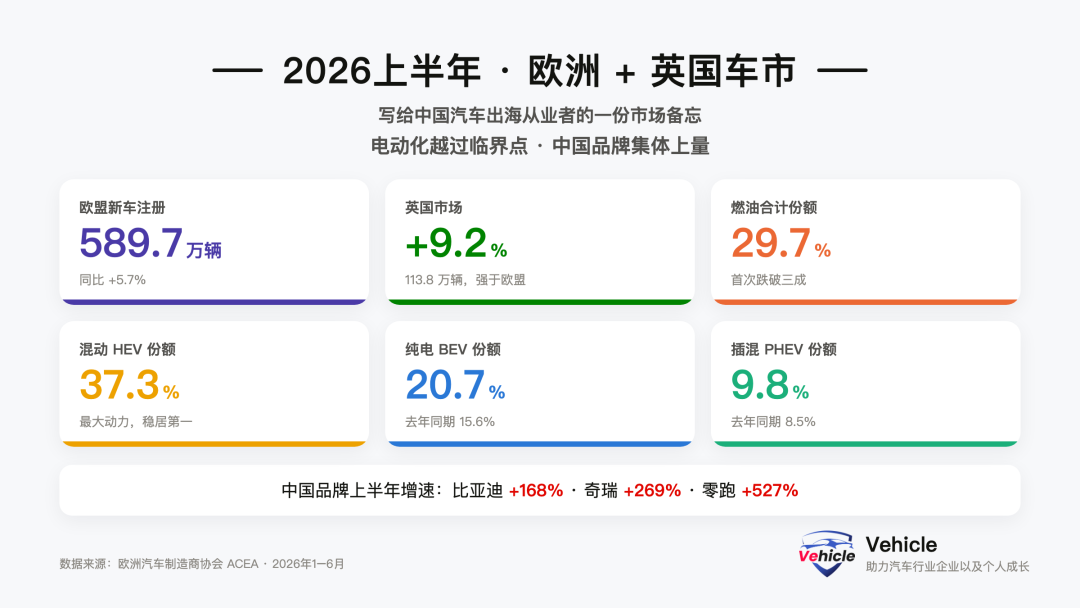
The data indicates that vehicle electrification in Europe has reached a tipping point, with the "door" to China's overseas markets structurally opening. However, a closer look at the ACEA data reveals that the manner in which each country is opening up varies, and even the classification of powertrain types differs from that in China.
Therefore, this article breaks down the sales and registration data for the first half of 2026 released by the European Automobile Manufacturers Association (ACEA), providing an in-depth analysis of electric vehicle sales and regional characteristics in Europe, with the aim of offering insights and inspiration for overseas expansion strategies and tactics.
Overall Market: Comprehensive Recovery in Europe + UK
In the EU, new vehicle registrations in the first half of the year reached 5.897 million units, up +5.7% year-on-year; June alone saw a significant increase of +18.4%, pulling the entire first half back to positive growth.
In the UK, sales in the first half of 2026 reached 1.138 million units, up +9.2% year-on-year, outperforming the EU overall and representing a significant single market that cannot be overlooked.
According to the latest ACEA data, approximately 15% of new vehicle sales in the UK in the first half of 2026 were imported from China. Across Europe, including the EU, EFTA, and the UK, total sales reached 7.23 million units, up +6.1% year-on-year. 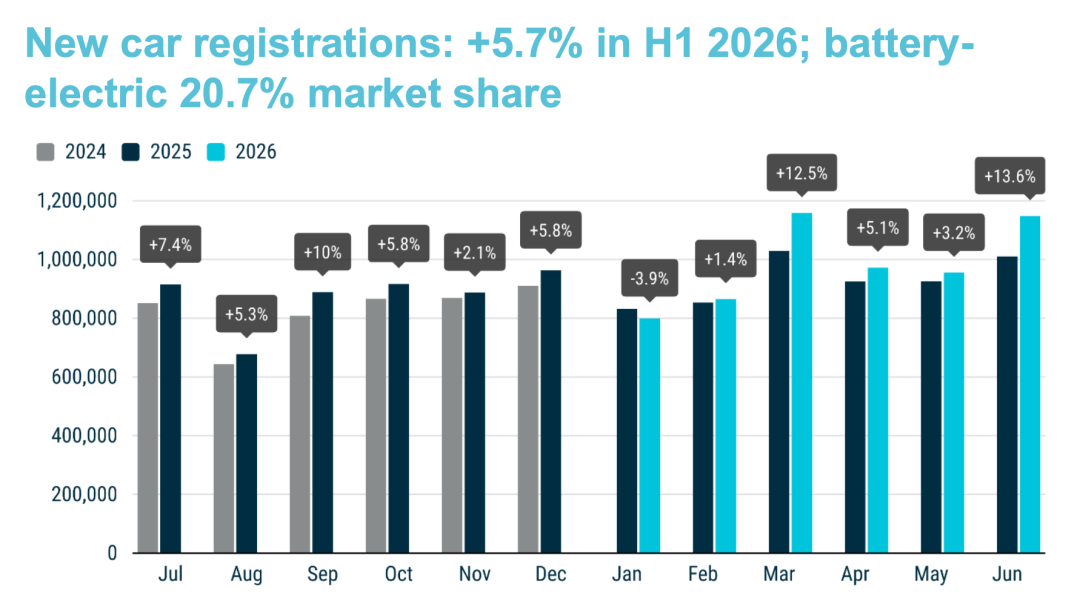
The growth in vehicle sales across Europe is estimated by Vehicle to be driven not by economic growth—given the ongoing geopolitical headwinds—but rather by demand for electrified models, primarily due to market support and subsidy policies in various countries. Additionally, the stimulation from competitively priced, high-configuration Chinese vehicles entering the market has played a role. In the first half of 2026, the top five Chinese automotive groups (BYD, SAIC, Chery, and Geely) registered a total of 791,958 vehicles in the European market (including the EU, EFTA, and the UK), not counting the tens of thousands of vehicles from Leapmotor.
Powertrain Mix: Fuel Vehicles Decline, Hybrids Dominate
The primary powertrain types in Europe are fuel (diesel and gasoline), hybrid (HEV), battery electric (BEV), and plug-in hybrid (PHEV). Among these:
Hybrid (HEV) vehicles are the absolute dominant force: Approximately 2.198 million units were registered in the first half, up 13.2% year-on-year, with a market share of 37.3%, firmly in first place.
Gasoline vehicles fell to second place, with sales of 1.309 million units, a significant decline of 17.2%, and their market share shrank from 28.4% in the same period last year to 22.2%.
Battery electric (BEV) vehicles experienced the fastest growth, with sales of 1.221 million units, a surge of 40.5%, and their market share jumped from 15.6% a year ago to 20.7%.
Plug-in hybrid (PHEV) vehicles saw 578,000 units registered, a growth of 22.5%, with their market share increasing from 8.5% to 9.8%.
Diesel vehicles continued to decline, with sales of 439,600 units, down 16.5%, and their market share fell from 9.4% to 7.5%. 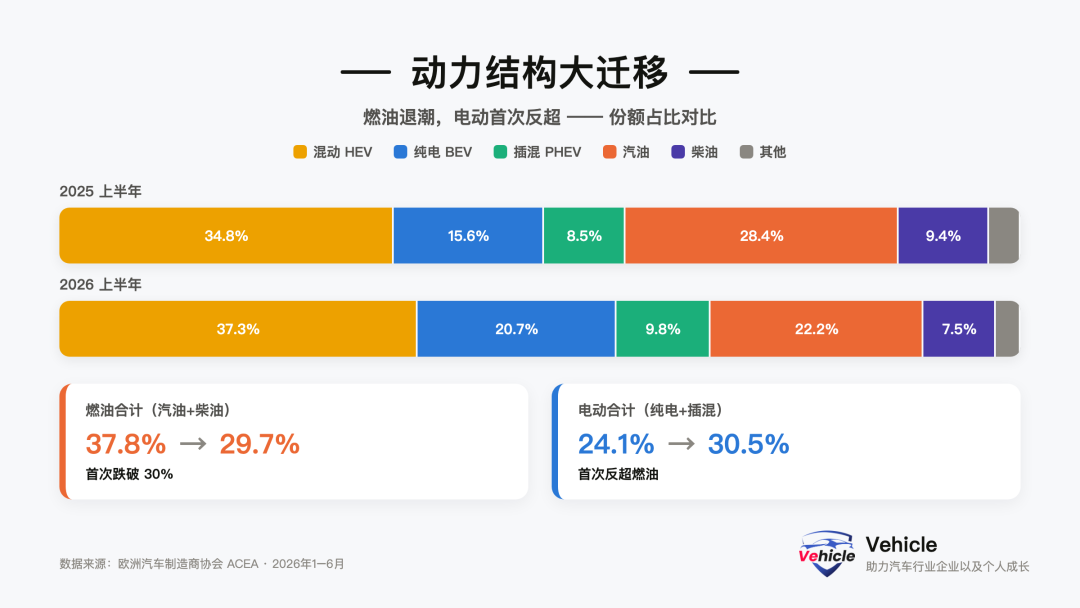
Based on these powertrain shifts, three key judgments can be made:
The inflection point has passed: The combined market share of gasoline and diesel vehicles fell from 37.8% to 29.7%, while the combined market share of BEVs and PHEVs reached 30.5%, officially surpassing fuel vehicles in electrification.
BEVs are the growth leaders (+40.5%), with their market share jumping from 15.6% to 20.7% in a year—this is the primary battleground for Chinese BEV products.
However, hybrids represent the largest market segment (37.3%). Most European consumers are still in a "transitional phase," with BEVs not yet the default choice. European hybrids may be displacing Japanese non-plug-in hybrids. For companies expanding overseas, focusing solely on BEVs would mean missing out on the largest market segment; HEV/PHEV product lines remain essential in Europe.
Regional Map: Customized Strategies for Each Country
When discussing Europe, many may think of it as a single market, but in reality, it is a mosaic of different markets shaped by "subsidy policies + consumer habits." Strategies for each core market vary significantly:
Germany (1,484,393 units, +5.8%)—BEV-centric, with 368,000 BEVs (+48%) and a BEV market share of about 25%. As Europe's largest and most "BEV-friendly" market, it is a top priority for Chinese BEV brands.
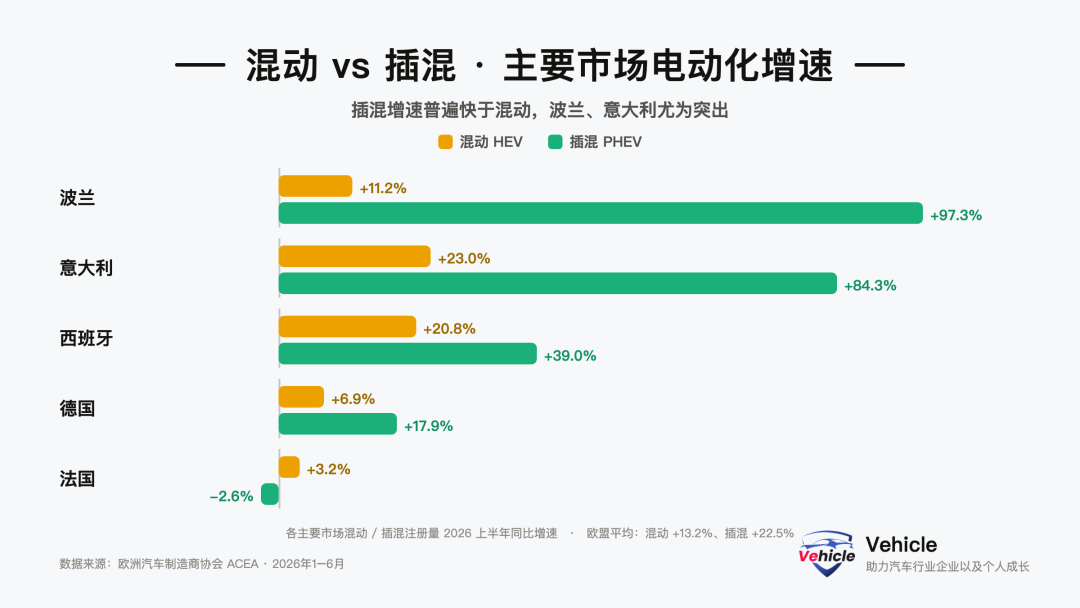
Italy (936,045 units, +9.5%)—A hybrid stronghold, with HEVs accounting for about 49% and PHEVs up +84.3%. Without hybrid products, breaking into the mainstream in Italy is nearly impossible.
France (857,165 units, +1.8%)—Fuel vehicles decline, EVs rise, with BEVs up +62.9% and gasoline vehicles down -34.2% (the largest decline in Europe). The market is undergoing the most dramatic shift, with BEV opportunities opening up, but overall market growth remains weak.
Spain (647,309 units, +6.1%)—Balanced growth, with PHEVs up +39% and HEVs up +20.8%, showing growth across all powertrains. It is a relatively accessible market.
The UK (+9.2%) operates independently of EU regulations and is experiencing strong growth, requiring separate product and compliance strategies. 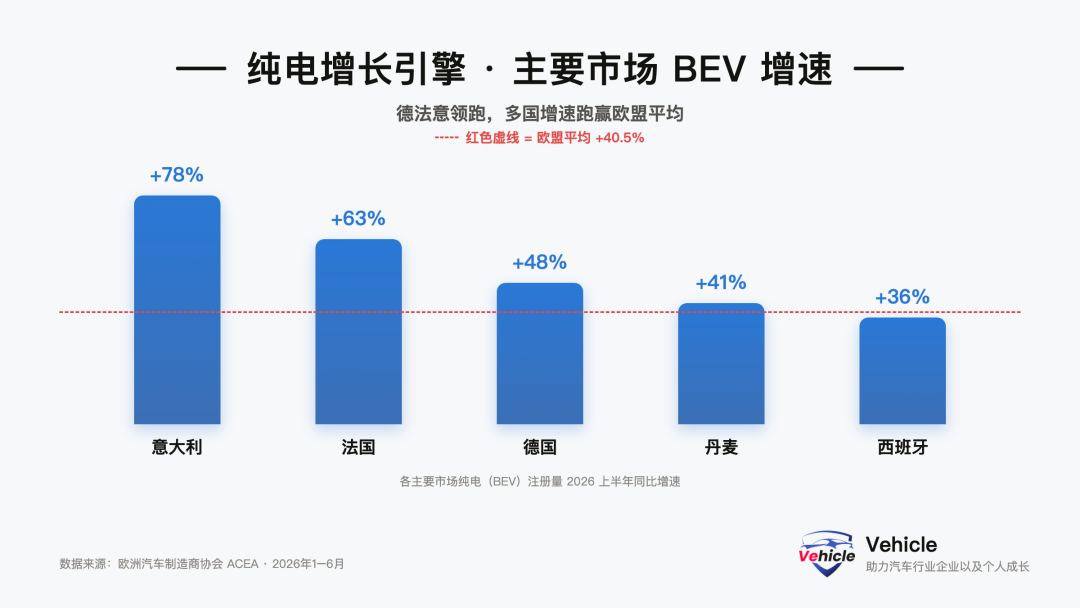
In addition to these well-known mainstream markets, there are also notable niche markets:
EV-first markets: Norway is nearly all-electric (BEV share ≈98%), and Denmark is up +12.9% (BEVs up +41.2%)—high penetration but intensely competitive.
Emerging Eastern European markets (low base, high growth): Romania +51.9%, Estonia +62.1%, Poland +9.4%, Czech Republic +5.8%—small in scale but growing rapidly, representing marginal growth pools relatively overlooked by major players. 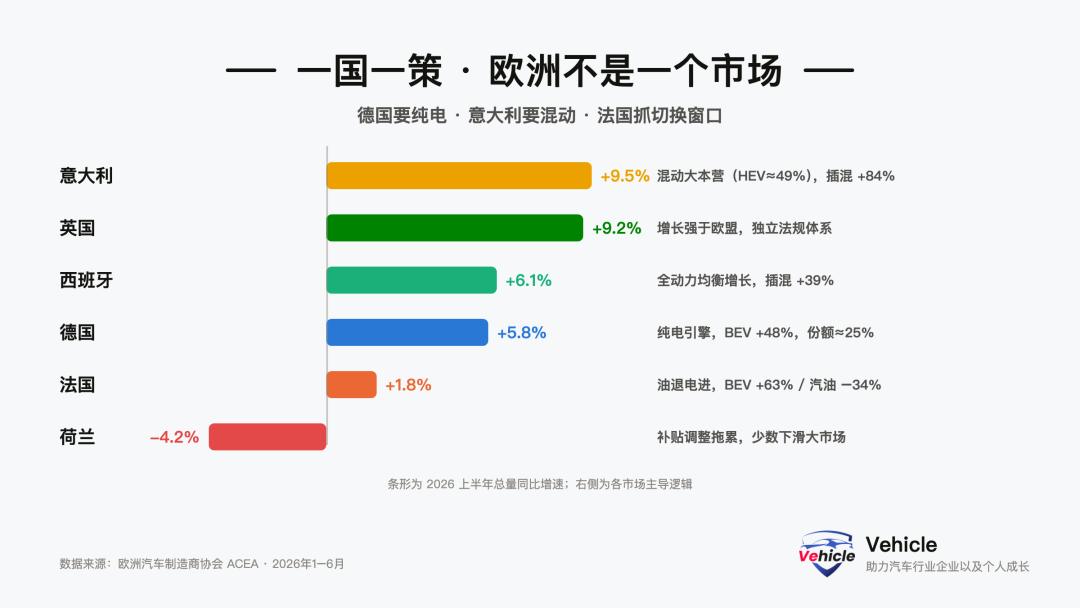
Overseas Expansion Insights: A "one-product-fits-all-Europe" approach will not work. Germany demands BEVs, Italy requires hybrids, France presents a window of opportunity for BEVs, and Eastern Europe offers incremental market positioning—product mixes and launch timings must be customized by country.
Vehicle Segment: Fuel-Powered Small Cars Dominate Sales
At the vehicle segment level, fuel-powered small cars dominate the European market in terms of sales. According to JATO Dynamics, the best-selling model in Europe in the first half of 2026 was the Dacia Sandero (about 113,000 units, down -12.2% year-on-year), with the Tesla Model Y closely following at about 109,000 units, up +59.7%—the only model in the top ten with significant growth, trailing by just about 2,500 units. The Renault Clio (108,000 units) ranked third.
Rankings 4–10 were the Volkswagen Golf, Volkswagen T-Roc, Peugeot 208, Toyota Yaris Cross, Volkswagen Tiguan, Peugeot 2008, and Opel Corsa. By powertrain, seven of the top ten were fuel-powered (including mild hybrids and a few BEV versions), two were hybrids, and only one was all-electric (the Model Y). 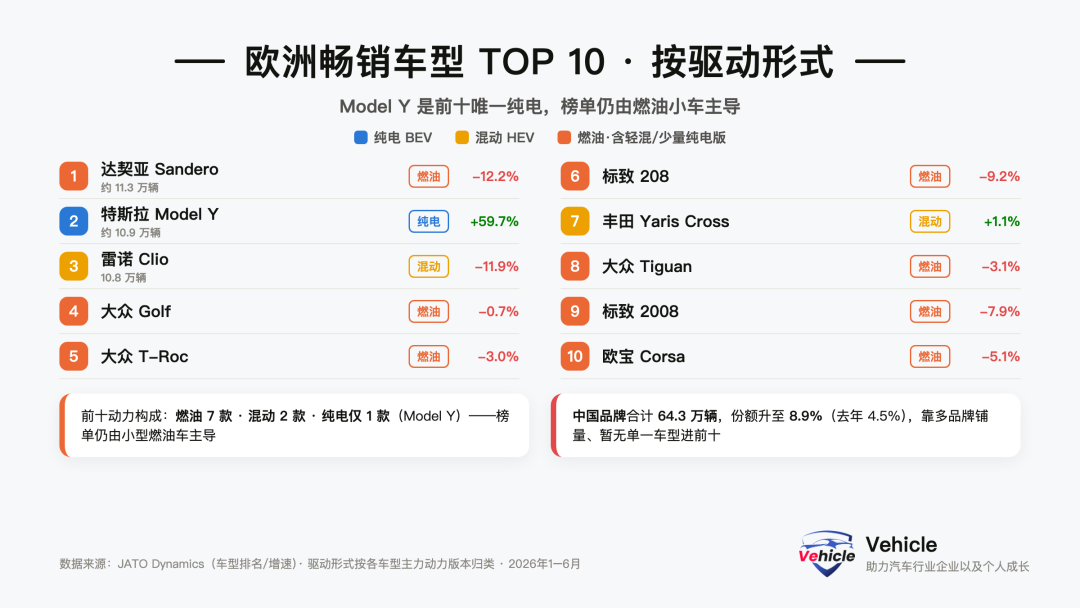
Meanwhile, Chinese brands (distinct from the automotive groups mentioned earlier, primarily brands originating from China) collectively sold about 643,000 units, doubling their market share from 4.5% to 8.9%, up +111.5% year-on-year. However, this growth relied on multiple brands collectively increasing volume, with no single Chinese model breaking into the top ten (the best-performing newcomer, Jaecoo J5, ranked only 118th).
Implications for Overseas Expansion: While Chinese brands have achieved a breakthrough in market share in Europe, a breakthrough with a single blockbuster model has not yet occurred. Creating a volume model that can crack Europe's top 20 is the next battleground for Chinese brands, and such a model would likely need to cover mainstream price segments for fuel and hybrid vehicles, rather than focusing solely on BEVs.
Competitive Landscape: Traditional Giants Diverge, Chinese Brands Grow Collectively
Breaking down the brands further reveals:
The European duopoly remains strong: Volkswagen Group +2.6% (market share 25.6%, supported by Skoda +11.7% and Audi +7.8%, while the Volkswagen brand itself declined -2.6%); Stellantis +6.0% (Fiat +31.4% and Opel +13.4% leading growth). BMW +6.2% and Mercedes +3.5% remained stable.
But the real story is the growth of Chinese brands. By brand, the growth of Chinese automakers has been particularly remarkable:
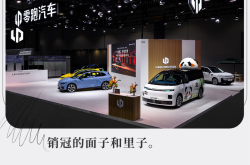
Leapmotor registered 48,261 units in the first half, up a staggering 526.7% year-on-year;
Chery sold 84,987 units, up 268.7%;
BYD sold 130,743 units, up 168.2%;
SAIC (including MG and others) sold 127,585 units, up 19.1%;
Geely Group (including Volvo, Zeekr, and others) sold 157,253 units. Geely, with a long-established presence in Europe, led in sales volume and achieved 4.1% growth.
BYD's first-half sales surpassed Ford's (Ford -20.2%), transforming BYD from a "new face" to a "substantial player." 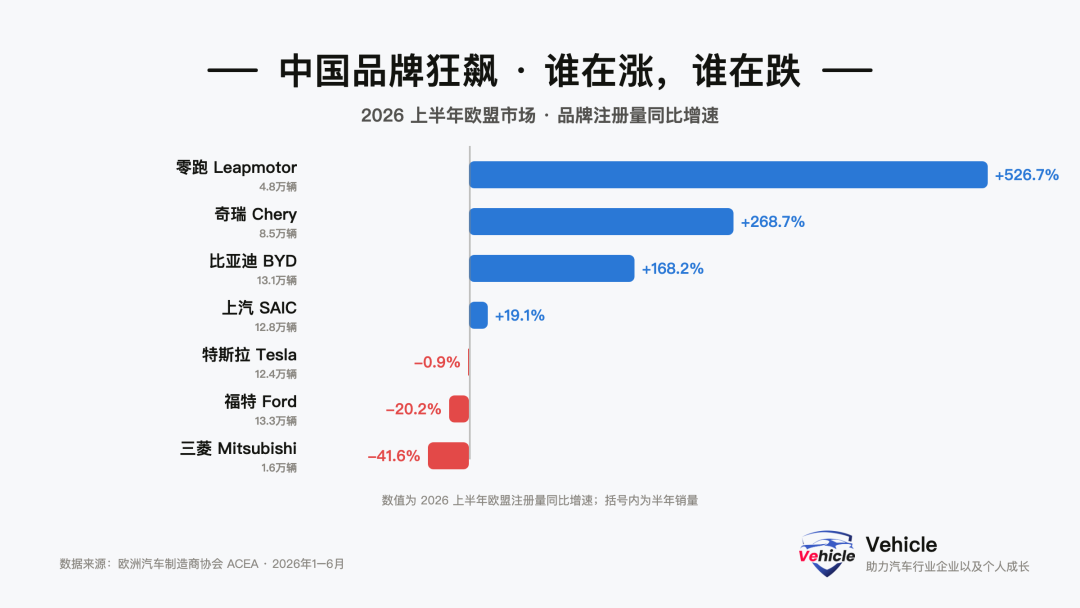
Leapmotor's strategy is worth studying: Distributed through a joint venture majority-owned by Stellantis, it leverages mature European channels, with the two companies' combined EU market share reaching 17.2%—a model for "riding on established channels" for overseas expansion.
Geely's large volume but moderate growth, due to dragging along several aging European brands, illustrates that "acquiring brands" and "capturing incremental growth" are two different strategies.
Who is retreating: Ford -20.2%, Mitsubishi -41.6%, Nissan -5.3%, Jaguar Land Rover -7.8%. Japanese and some U.S. brands are ceding market share—this is the space being filled by Chinese brands.
Tesla's signal is mixed: -0.9% in the first half (essentially flat), but +72.1% in June alone. Short-term rebound vs. annual stagnation reflects intense competition among BEV leaders, though Tesla's sales may have been affected by the U.S.-Iran conflict.
Final Thoughts
The sales data for Europe in the first half of 2026 reveals structural changes in the European auto market, presenting an excellent window of opportunity for Chinese automakers expanding overseas. Vehicle summarizes five key considerations:
Fuel vehicles decline, EVs advance: Japanese and U.S. brands will cede market share in Europe as in China, with clear windows of opportunity and structural market shifts.
Hybrids, at 37.3% of the European market, represent the largest segment. The mainstream electrification in Europe is still in transition, making HEV/PHEV product lines indispensable.
Germany is BEV-centric, Italy demands hybrids, France is shifting—Europe is fragmented, with significant differences across countries and regions.
Two overseas expansion models: Leapmotor's rapid growth through Stellantis and Geely's scale through brand acquisitions both demonstrate that local channels and joint ventures are key to rapid volume growth. BYD's purely self-built production and channels are slower, costlier, and carry political risks.
Growth is highly dependent on subsidies, compounded by trade variables such as EU tariffs on Chinese EVs. Buffer zones must be reserved for subsidy phase-outs and compliance costs.
In summary: In the first half of 2026, the European market has opened a "structural door" for Chinese brands—but behind it are seven or eight rooms with different rules. Success depends on the adaptability of product mixes and the speed of production and channel localization.
References and Images
EU + EFTA + UK H1 2026 Sales - Press_release_car_registrations_June_2026.pdf - ACEA
*Unauthorized reproduction or excerpting is strictly prohibited-
-
![]()
Lei Jun Disrupts the Market: Xiaomi Unveils N70/N90 Dual Models, Zeroing in on Two Leading Extended-Range Rivals
-
![]()
Sales Champion Leapmotor's Quest for Scale
-
![]()
SAIC-GM and SAIC Passenger Vehicles Announce Leadership Shifts on the Same Day: 'Technical Talents' Step Forward to Steer the Course
-
![]()
BMW's Turnaround Starts with the Easy Part
-
Tesla's Q2 Operating Profit Plummets, 'Cash-Guzzling' Expansion Drains Free Cash Flow
-
![]()
Volkswagen's Strategic Shifts: Cutting Back and Expanding
-
![]()
Unraveling the Decline of the Imported Car Market
-
![]()
Interpretation of the European + UK Automobile Market in the First Half of 2026: Electrification Surpasses Critical Point, Chinese Brands Experience Collective Growth in Sales