Microsoft: Has the Tide Turned in Favor of the Old Guard?
 08/03 2026
 534
534
On July 30th, after the U.S. stock market closed, Microsoft released its Q4 FY2026 financial results for the period ending in June this year. In short, the AI tide has finally turned in Microsoft's favor, allowing them to breathe a sigh of relief.
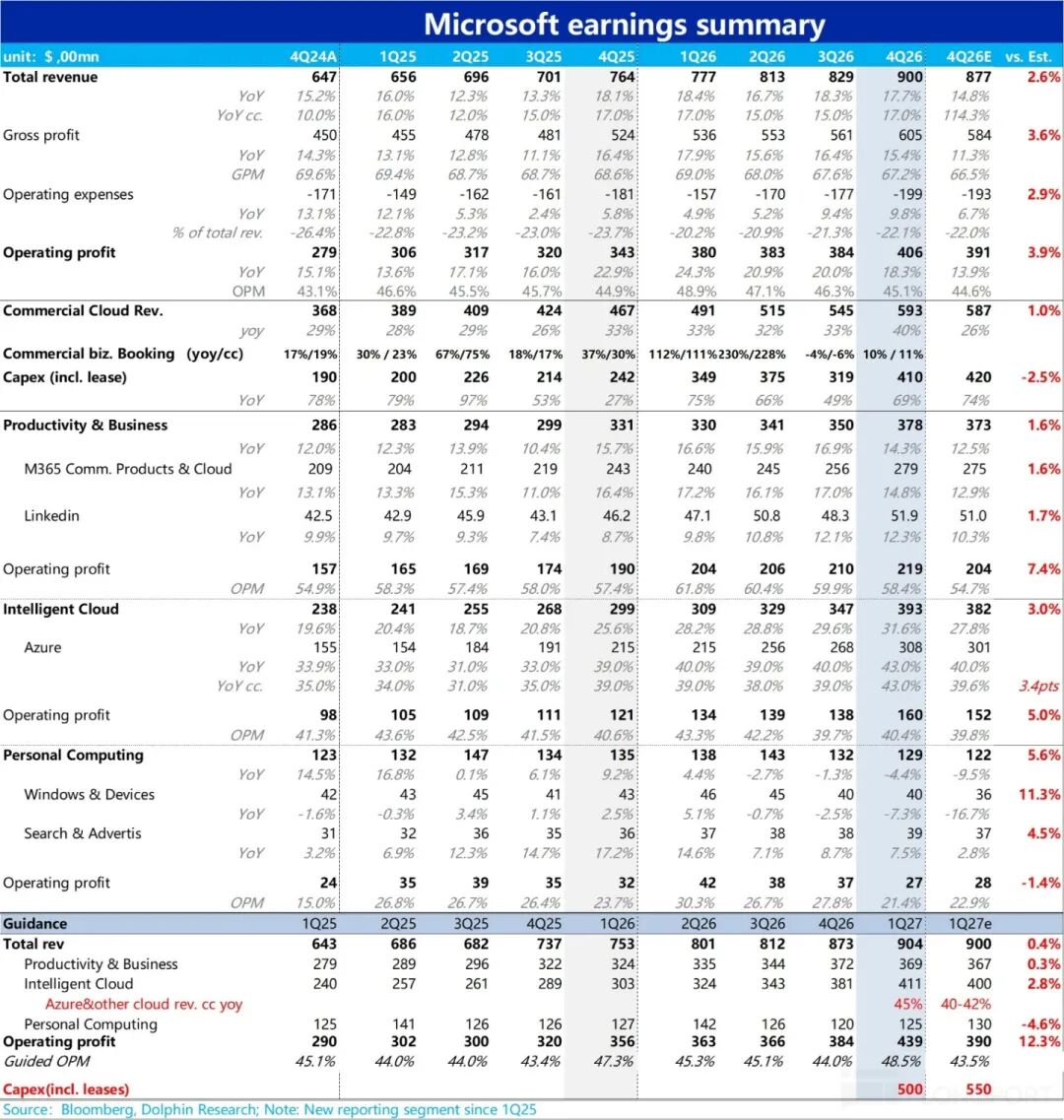
1. As the most critical focal point for recouping AI investments: Azure's growth accelerated to 43% YoY this quarter (same when excluding FX impacts), surpassing some optimistic forecasts that expected 40-42%. More importantly, guidance for next quarter's constant currency growth is set at 45%, indicating continued acceleration for Azure.
Following Codex's recent surge, OAI's ARR revenue in July exceeded that of the entire second quarter, providing a positive boost for Microsoft's cloud services.
2. Capex (including capital leases) stood at $41 billion this quarter, with $50 billion projected for next quarter—both in line with expectations. The reduction in FY2026 Capex from $190 billion to $175 billion is more of an accounting maneuver, with actual guidance remaining unchanged. Contrary to some market assumptions that Microsoft would increase capital expenditures, Dolphin Research never believed this would happen, primarily because Microsoft invested early. Google's increased capital spending is actually catching up on past underinvestment.
3. Microsoft stands out as a cloud giant with stable cash flow! The company generated $55 billion in operating cash inflow this quarter. Of its $41 billion in Capex, $5.6 billion was in the form of capital leases, resulting in actual cash capital expenditures of less than $36 billion. Consequently, the company had nearly $20 billion in free cash flow this quarter.
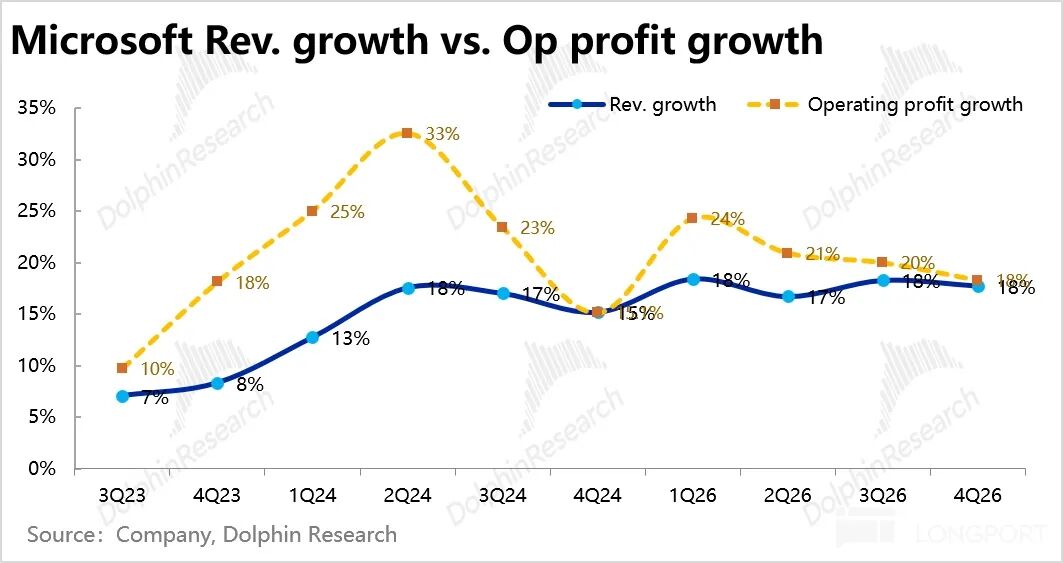
4. Surprisingly stable profits? Contrary to fears that AI-related Capex entering the amortization phase would significantly suppress gross margins, and despite operational cost-cutting measures (including layoffs) throughout FY2026 to make way for AI investments, Microsoft's operating profit margin did not decline—it even slightly increased. Operating profit reached $40.6 billion, up 18% YoY, slightly outpacing the 17.7% revenue growth.
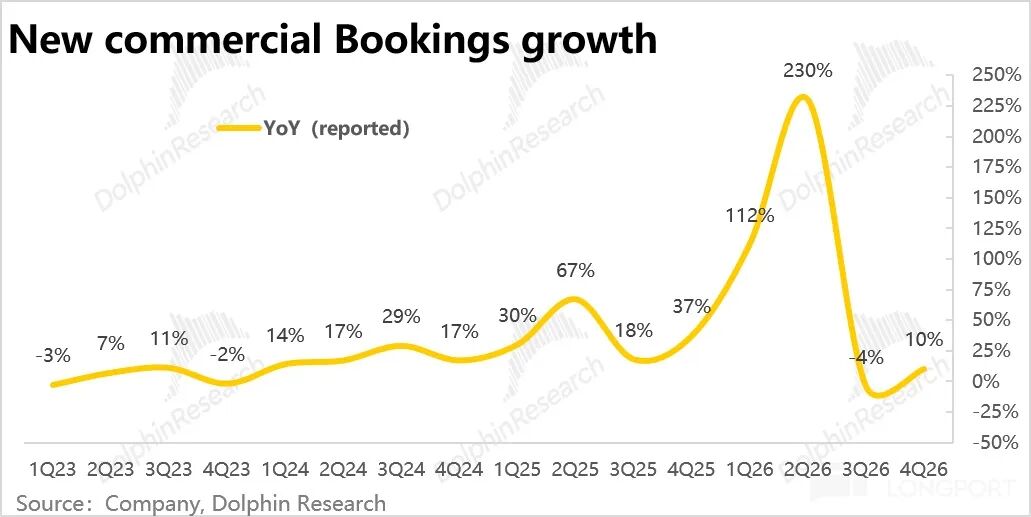
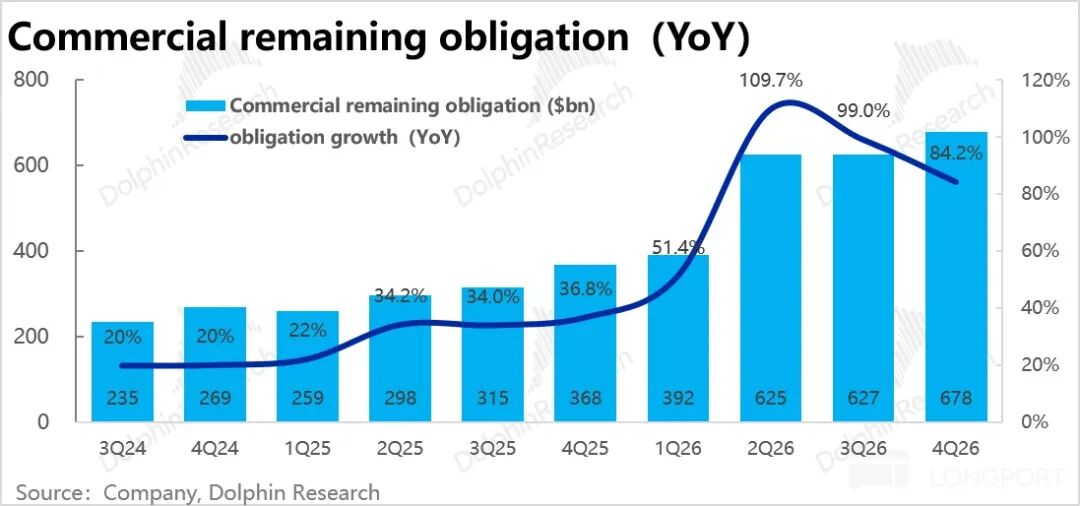
5. New contract signings were strong: New contracts totaled $77.4 billion. Without OAI as a major client, contract signings have begun to recover. The company confirmed $59.3 billion in to B cloud revenue for the quarter. With new contract values exceeding quarterly recognized revenue, the backlog of unfulfilled enterprise contracts (RPO) inevitably grew, increasing by $50 billion this quarter to a total of $678 billion.
Dolphin Research's Viewpoint
In 2023, Microsoft was the true beneficiary behind OAI's rise to fame, benefiting from OAI's cloud usage and the AI integration of Microsoft's productivity software like Office. Microsoft was riding high.
However, Microsoft and OAI began to drift apart, with Azure's growth slowing. Microsoft struggled to monetize AI in its office software, and after parting ways with OAI, its self-developed models and chips lagged, leading to capital market disfavor and suppressed valuations.
Following this earnings report, while Microsoft's self-developed models and chips have not improved, Azure's growth has accelerated, and new contract signings are rebounding. This indicates that in the post-OAI era, Microsoft's efforts to diversify its customer base are beginning to pay off.
On the financial front: a cloud company with restrained AI investment (no Capex surge), robust AI-driven growth (Azure accelerating beyond expectations + new contract values rebounding), stable profit margins, and solid cash flow now looks attractive relative to peers, offering a valuation discount.
Looking ahead, with OAI's GPT 5.6 model release in July driving increased cloud usage, GitHub Copilot's price hike in June (shifting from a flat monthly fee to usage-based billing), and a nearly $680 billion contract backlog, Microsoft may have already started to emerge from its 'post-divorce slump' with OAI.
Below is a detailed review of the financial results
I. Overview of Changes in Financial Reporting Disclosures
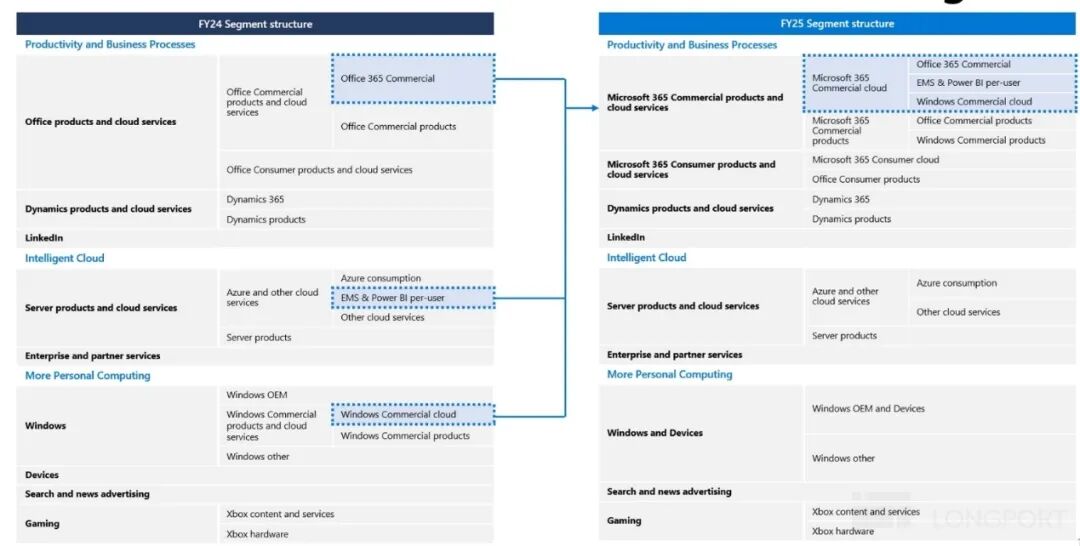
Starting in FY2025, Microsoft made significant adjustments to its financial reporting structure. The overall approach was to consolidate various enterprise-oriented 365 services, including Commercial Office 365, Windows 365, and Security 365, under the Productivity & Processes (PBP) segment from their original segments. For specific changes and Dolphin Research's insights, please refer to our Q1FY2025 review. The following is a brief summary:
II. Contract Signings Rebound
In cloud business, contract signing amounts and backlog are as important as recognized revenue. Previously, a direct decline in YoY new contract signings spooked the market. Fortunately, this quarter saw a rebound.
Dolphin Research estimates that this quarter's contract signing amount exceeded Microsoft's entire cloud business (SaaS and PaaS clouds), a pace that will inevitably lead to a growing contract backlog.
II. Stable Amortization Expenses and Strong Cash Flow
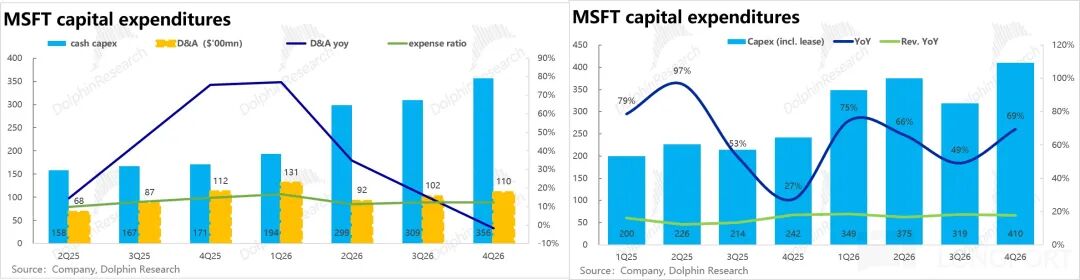
Microsoft's capital expenditures were $41 billion, but some of this was in the form of capital leases (with less mismatch between cash outflows and expenses), resulting in actual cash capital expenditures of $36.5 billion.
Dolphin Research notes that despite being a pioneer in AI capital spending, Microsoft has not seen a significant increase in amortization expenses, with nearly zero growth YoY this quarter—one reason for the modest decline in gross margins.
Additionally, over the past three quarters, the proportion of short-cycle assets (servers, etc.) in Microsoft's capital expenditures has gradually increased from 50% to over two-thirds. Dolphin Research believes the impact of increased amortization expenses has yet to materialize.
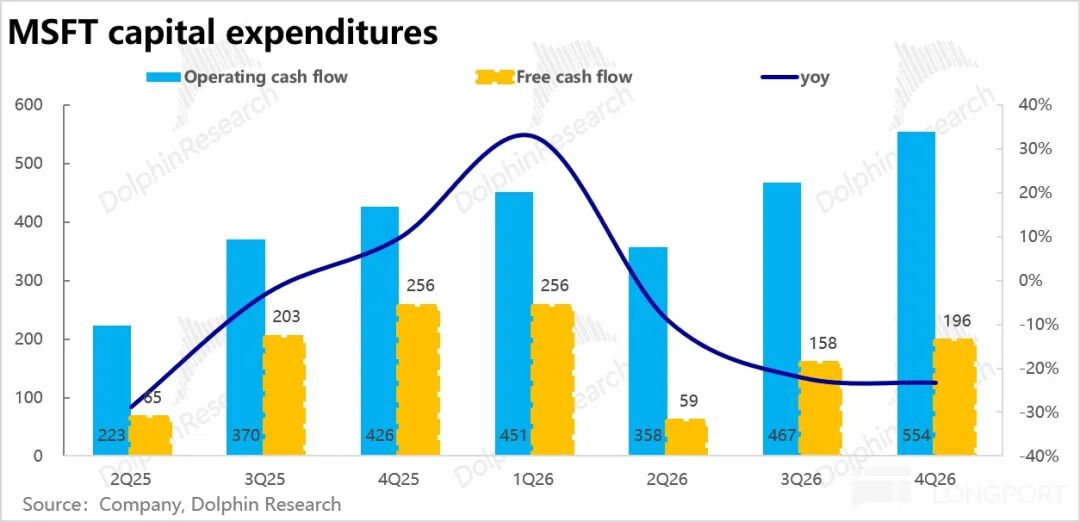
Microsoft's exceptional performance this quarter compared to other giants lies in its ability to generate substantial cash flow. With operating cash flow of $40-50 billion per quarter, $30-40 billion in Capex cash outflows have not overwhelmed Microsoft's cash generation.
While Microsoft's free cash flow declined 23% YoY this quarter, it still reached $19.6 billion.
Based on current capital expenditure guidance, Dolphin Research projects that with approximately 18% operating cash flow growth next year and around $210 billion in capital expenditures, Microsoft should barely maintain its free cash flow for FY2027.
III. Segment Performance: Cloud Drives Growth, Productivity Tools Provide Support, Personal Computing Struggles
1.1 Cloud: Azure Accelerates, Profitability Remains Intact
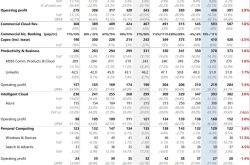
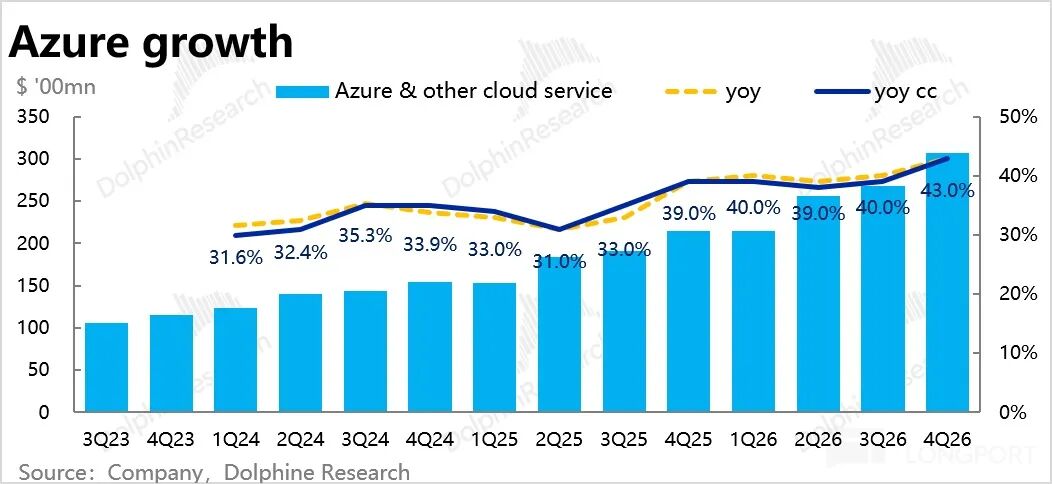
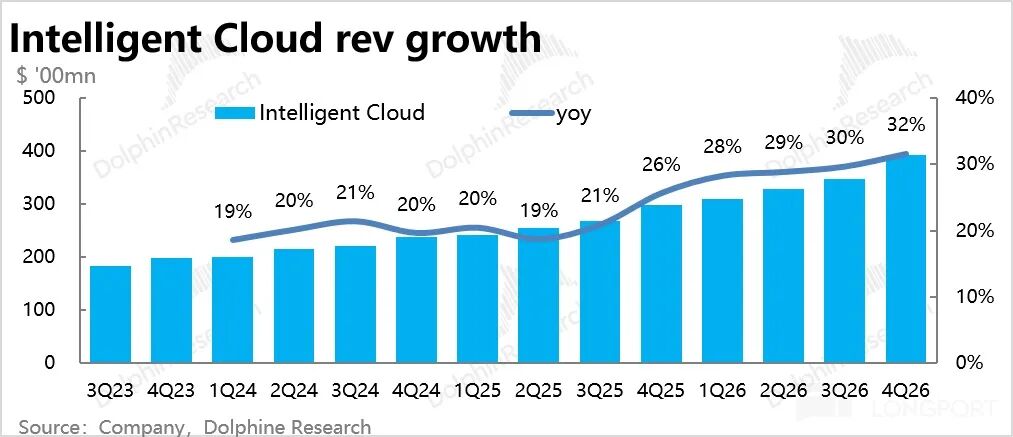
The focus of cloud investment returns—Azure's revenue grew 43% YoY this quarter (same when excluding FX impacts), surpassing optimistic market expectations of 42%. Next quarter's guidance is 45%, confirming acceleration. However, the market had expected around 42%.
Given the company's guidance of accelerated growth in the second half of the year, coupled with a growing contract backlog and server deployments from Capex, Dolphin Research believes Azure has decisively restarted its acceleration mode after the slump following Microsoft's split with OAI.
1.2 Productivity Segment: Steady as a Rock
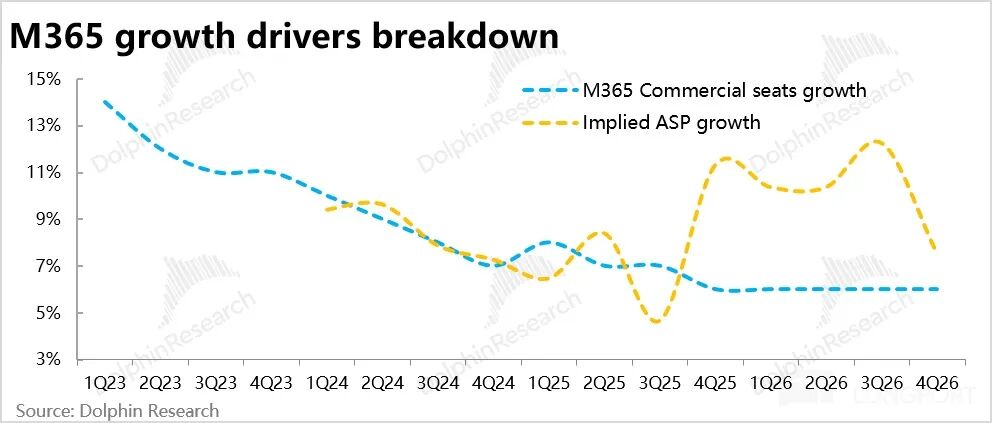
Microsoft 365 Commercial Cloud, the second most critical segment, saw revenue growth slow slightly to 14% this quarter.
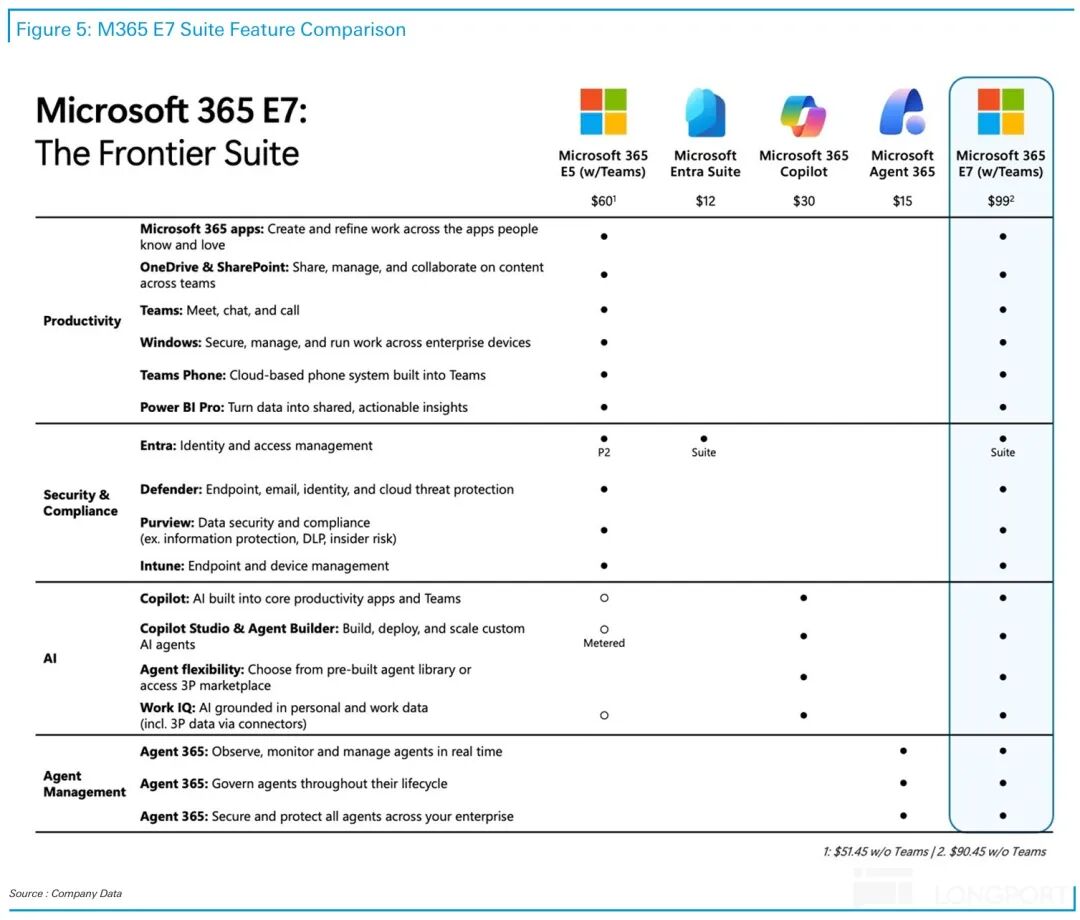
In product sales strategy, the shift from E3 to E5 and now E7 reflects a clear focus on increasing the penetration of high-value products to boost overall ASP, despite nominal price reductions.
The newly launched E7, for example, integrates the separately priced $30 M Copilot feature and Agent functionality, along with upgraded security features, which would cost $120 if sold separately. Microsoft offers E7 as a bundled monthly package for $99.
However, while Microsoft's SaaS has not shown signs of obsolescence, progress in getting users to pay for AI-driven value has been slow.
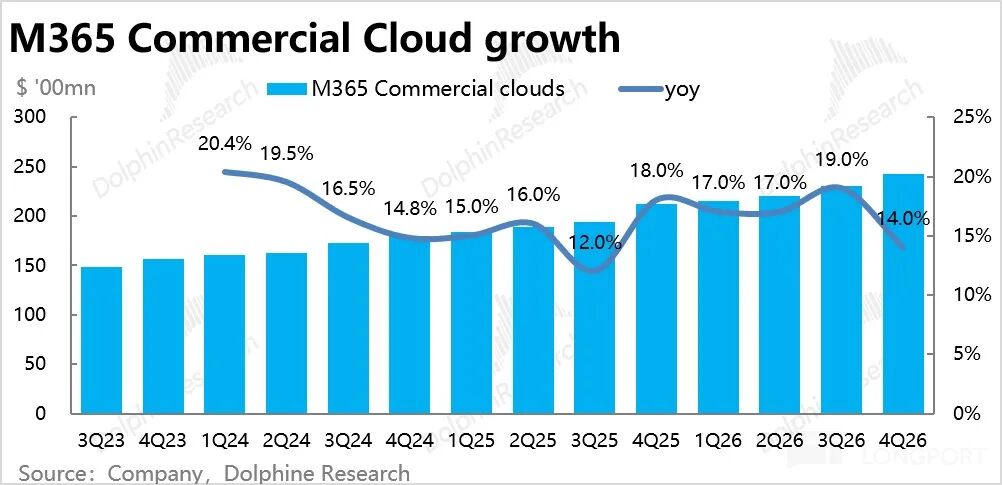
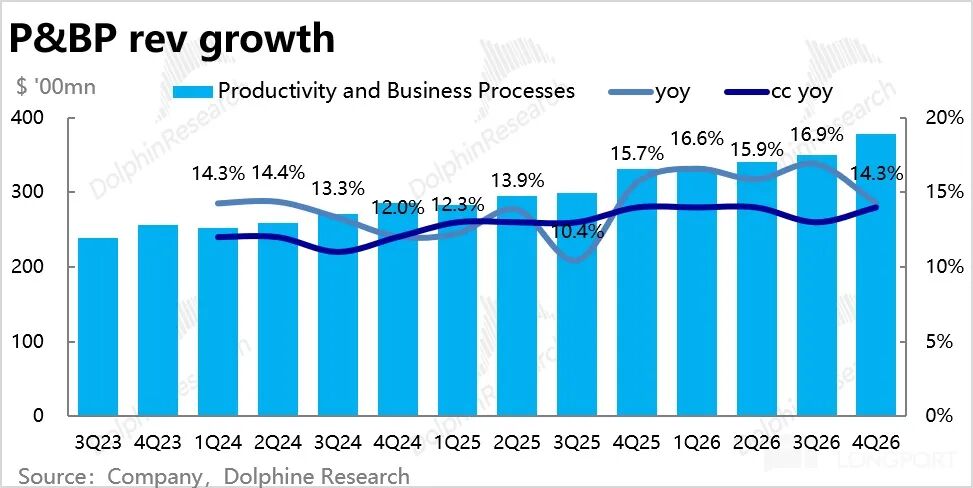
The Productivity Processes segment, which includes to B Microsoft 365 services, saw growth return slightly to 14% this quarter (excluding FX impacts), after 13% growth last quarter. Performance has been remarkably stable over several quarters.
1.3 Personal Computing: The Weakest Link
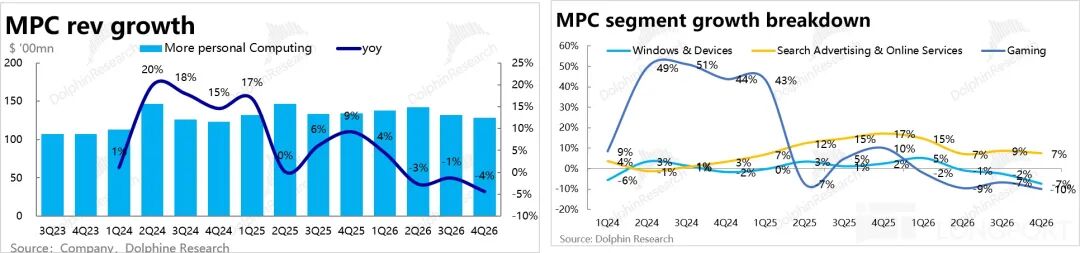
The Personal Computing segment saw a 5% decline this quarter, slightly better than the expected 10%. Difficulty selling PCs due to rising raw material costs was already anticipated, with market expectations of a >15% drop in Windows business. In reality, it declined 7% YoY.
The gaming business contracted the most, while Bing search and other advertising businesses (including Windows) grew just 7% YoY (10% excluding FX). Search has not seen an AI-driven turnaround, with Google remaining the dominant player.
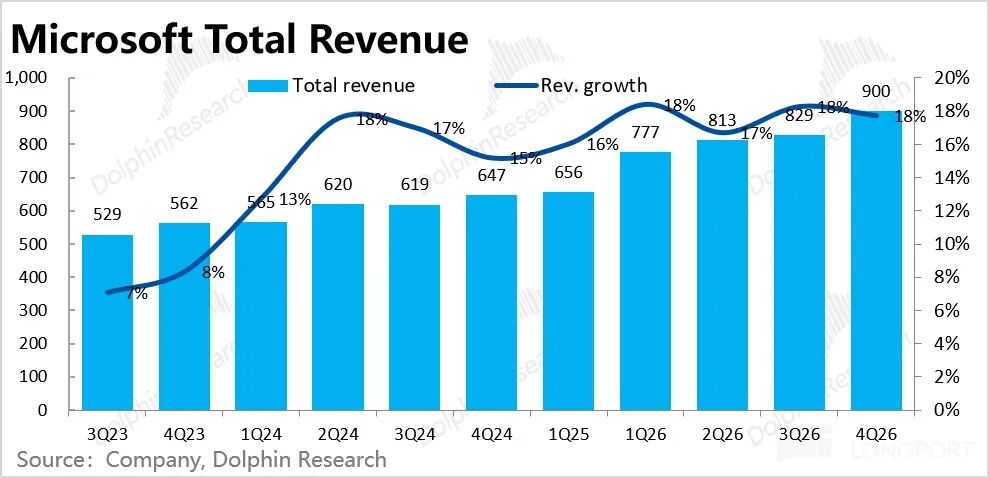
Microsoft's total revenue for the quarter was $90 billion, up 17.7% YoY, slightly exceeding sell-side consensus expectations of 15%. Excluding FX tailwinds, actual revenue growth was 17%, with all segments performing slightly better than expected.
IV. Structural Decline in Cloud Gross Margins, Profitability Maintained via Operating Leverage
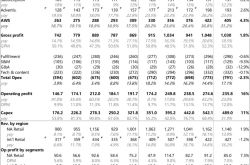
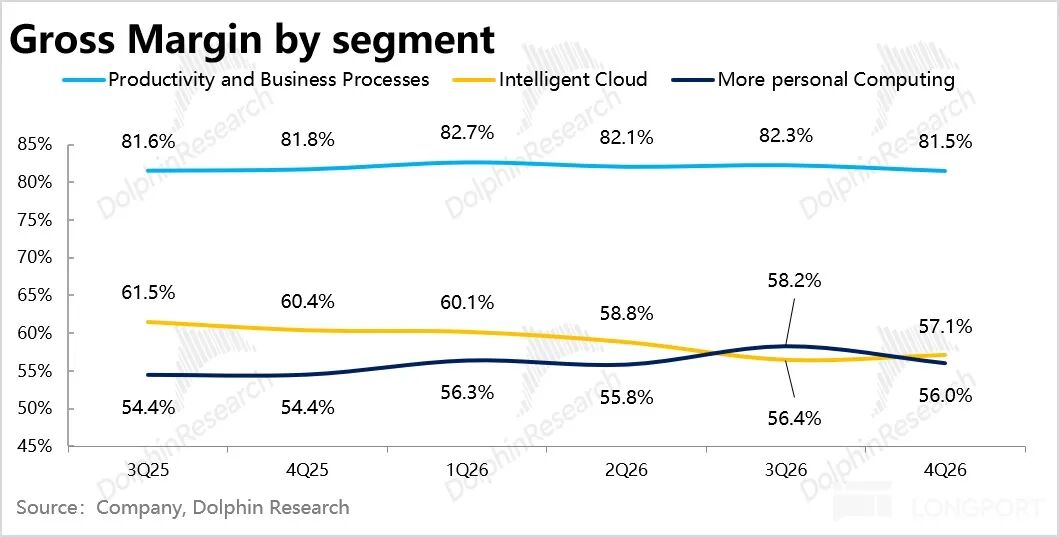
1) The trend in gross margin structure is clear: Cloud business, being the largest revenue contributor with the highest growth, continues to face downward pressure on margins due to the rising share of AI contributions.
Markets generally expect cloud gross margins to decline sequentially. However, this quarter saw an unexpected uptick, a key reason for the overall gross margin outperformance.
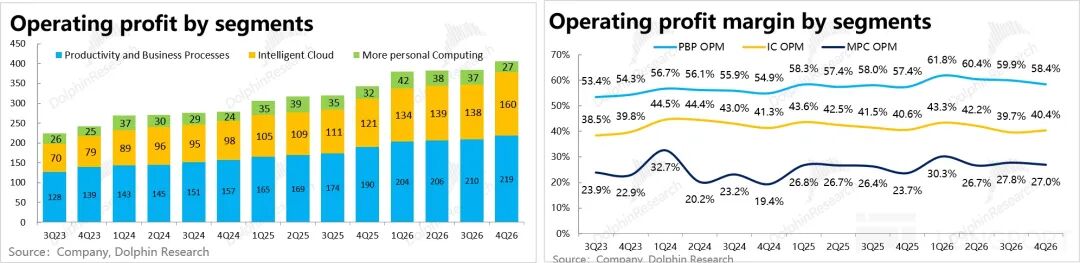
2) Operating profit for the quarter was $40.6 billion, up 18% YoY, roughly in line with revenue growth. Despite structural declines in gross margins, profit growth was driven by operating leverage.
High revenue growth diluted increases in R&D and sales expenses. In terms of headcount, Microsoft reduced its workforce by 5,000 this fiscal year to 123,000, a clear shift toward AI investment.
2) From a segment perspective, the profit contribution from More Personal Computing is essentially negligible, with Microsoft primarily relying on its Productivity SaaS + Cloud business.
While cloud is the main revenue driver, its profit generation capability still lags behind that of SaaS products like Office. Currently, the Office business is increasing ASP by bundling Copilot, though there is a trend of declining profit margins, as seen in this quarter.
The operating profit margin of the Intelligent Cloud segment, which bears the brunt of Capex and depreciation and garners the most attention, stood at 40.4%, remaining stable year-on-year and exceeding expectations.
- END -
// Reprint Authorization
This article is an original work by Dolphin Research. Reprinting is permitted only with authorization.
// Disclaimer and General Disclosure
This report is intended solely for general comprehensive data purposes, designed for general reading and data reference by users of Dolphin Research and its affiliated entities. It does not take into account the specific investment objectives, investment product preferences, risk tolerance, financial situation, or particular needs of any individual receiving this report. Investors must consult with independent professional advisors before making investment decisions based on this report. Any person making investment decisions using or referring to the content or information mentioned in this report assumes all risks. Dolphin Research shall not be liable for any direct or indirect responsibilities or losses that may arise from the use of the data contained in this report. The information and data in this report are based on publicly available sources and are for reference purposes only. Dolphin Research strives to ensure, but does not guarantee, the reliability, accuracy, and completeness of the relevant information and data.
The information mentioned or the views expressed in this report shall not, under any jurisdiction, be considered or construed as an offer to sell or a solicitation to buy securities, nor shall they constitute advice, inquiries, or recommendations regarding relevant securities or related financial instruments. The information, tools, and materials contained in this report are not intended for, nor are they intended to be distributed to, jurisdictions where the distribution, publication, provision, or use of such information, tools, and materials would conflict with applicable laws or regulations, or would result in Dolphin Research and/or its subsidiaries or affiliated companies being subject to any registration or licensing requirements in such jurisdictions, or to citizens or residents of such jurisdictions.
This report merely reflects the personal views, insights, and analytical methods of the relevant creators and does not represent the stance of Dolphin Research and/or its affiliated entities.
This report is produced by Dolphin Research, and the copyright is solely owned by Dolphin Research. Without the prior written consent of Dolphin Research, no institution or individual may (i) produce, copy, duplicate, reproduce, forward, or create copies or reproductions in any form by any means, and/or (ii) directly or indirectly redistribute or transfer them to other unauthorized persons. Dolphin Research reserves all related rights.
-
![]()
Microsoft: Has the Tide Turned in Favor of the Old Guard?
-
![]()
Amazon: AWS Soars, Catching Up with Competitors at Last!
-
![]()
Acknowledging Task Incompletion: Neither Shameful Nor Daunting
-
![]()
How to Efficiently Manage and Control Street Lights in Industrial Parks? The Smart Street Light Control System Solution for Parks Offers Insights
-
![]()
Only One of Its Kind in the Country! Shenzhen's 'Five-Party Collaborative Operation' Pilot for Unmanned Delivery Takes Off, Steering Autonomous Driving Away from 'Money-Burning Competition' into the E
-
![]()
Qwen Still Sees Value in Open Source Initiatives
-
![]()
Qwen Still Sees the Merits of Open Source
-
![]()
A Complete Retrospective of the Thailand Campaign: A Detailed Review of the First 'Complete Model' for Chinese Automobiles Going Global