Acknowledging Task Incompletion: Neither Shameful Nor Daunting
 08/03 2026
 437
437

Introduction
Don't let temporary setbacks disrupt your overall pace.
Half a year has elapsed, and the auto market's performance this year has been less than stellar compared to previous years. In the first half of the year, cumulative retail sales of narrowly defined passenger vehicles reached 8.701 million units, marking a year-on-year decrease of 20.2%. Including commercial vehicles, total domestic auto sales stood at 9.921 million units, down 21.1% from the previous year. This downturn is palpable for industry participants.
The sudden market slump, which began to manifest at the end of last year, can be attributed to several factors. For instance, concentrated purchases before the policy window closed at the end of last year overdrew (anticipated demand for) the market in 2026. The preferential policy for purchasing tax exemptions on new energy vehicles was adjusted from full exemption to half exemption starting January 2026. Additionally, the U.S.-Iran conflict pushed up oil prices, leading to a significant contraction in demand for fuel-powered vehicles.
Many argue that under the combined impact of these factors, terminal consumer willingness has been severely curtailed. Nevertheless, automakers persist in their struggles, engaging in price wars to boost sales. Consequently, the financial data for each company is lackluster, bringing the profit margins of the entire auto industry to a near-standstill.
Despite these efforts, the half-year sales of over a dozen mainstream automakers, when statistically analyzed, were almost universally below expectations. Overall, the average completion rate for sales targets among domestic mainstream automakers in the first half of the year was only around 35%, significantly lower than the annual halfway mark. Faced with these results, task incompletion has become an unavoidable reality for most automakers.
01 Effort and Strategic Choice: Both Are Crucial
From the end of last year to the beginning of this year, many automakers set ambitious sales targets for 2026. For example, Dongfeng Motor Corporation aimed for 3.25 million units, a ~30% increase; Great Wall Motor targeted 1.8 million units, a 36% increase; Leapmotor challenged 1 million units from 596,600; and HiMo Smart Travel aimed for 1 to 1.3 million units...
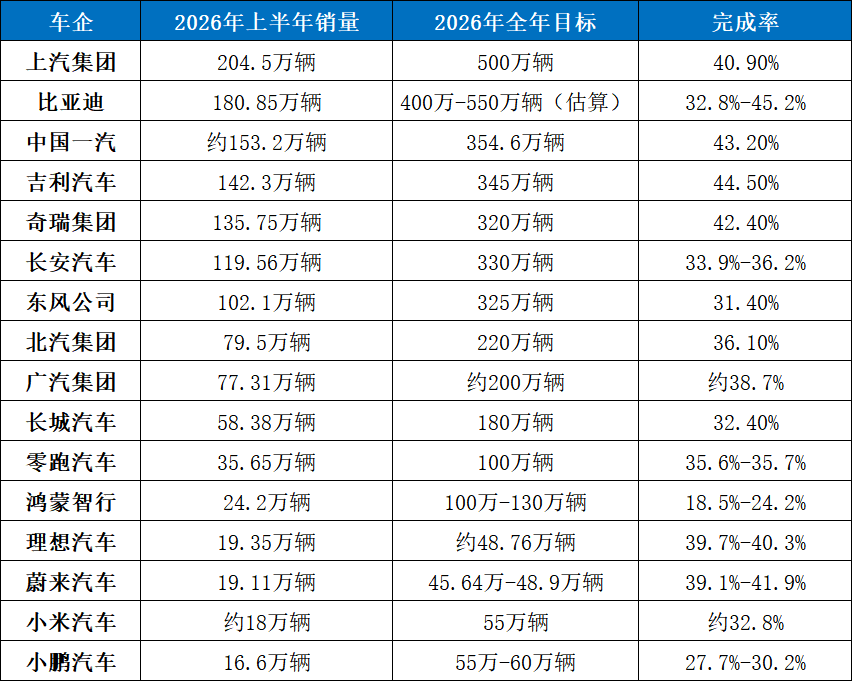
However, the market environment in the first half of this year surpassed the predictions of most. As an industry analyst noted, "The primary reason for the difficulty in meeting targets is that ideal goals are detached from realistic demand. Automakers are aware of the challenges and difficulties this year, but when setting sales targets, they are influenced by core competitors, believing that sales targets should not fall behind, rather than basing them on market demand."
In other words, the sales targets set by many automakers at the beginning of the year were not derived from backward calculation based on market demand but were rather natural outcomes of commercial competition. Expecting companies to maintain the same pace of KPI completion as in growth years, when the industry as a whole is declining by 20%, is unrealistic.
Of course, every company aspires for year-on-year sales growth, hence the incremental targets set by automakers. However, from another perspective, a market's capacity is finite and can reach a saturation point. There will come a time when this number stabilizes within a certain range, meaning that not everyone can continue to grow.
It is believed that automakers are cognizant of this situation. So why do they still set high growth targets? This reflects an unspoken attitude: while the overall market may experience slight growth or decline, individual automakers can achieve incremental growth by capturing market share from competitors. This explains the prevalence of price wars.
However, reality does not always conform to preconceived plans, and this year's auto market performance serves as the best evidence. After all the competition, automakers find that not only are they unable to meet annual sales targets, but they are also sacrificing significant profits, dragging the entire industry into a precarious state of unhealthy and unsustainable development.
This approach, where losses outweigh gains, warrants reflection from all automakers. What is particularly worth contemplating is that failing to complete tasks is not daunting, nor is it daunting to be unable to account to investors. What is truly daunting is losing composure and failing to solidify foundations or seek new growth avenues while experiencing negative growth or failing to meet targets.
Therefore, practices that maintain strategic investment and structural adjustments in extremely unfavorable market environments are more commendable. This is especially true for automakers with obvious weaknesses, such as those previously reliant on joint ventures, those with weak overseas markets, or those slow in transitioning to new energy.
For example, Dongfeng Motor Corporation has excelled with its independent brands and new energy vehicles in the past two years. Chang'an Automobile saw a 35.1% year-on-year increase in overseas deliveries in the first half of the year, reaching 402,000 units, accounting for about 33.6% of total sales. Chery Group has made significant strides in new sectors.
Compared to the loud rhetoric but small actions of new energy or new force automakers, these traditional automakers may not generate as much buzz or discussion in the market, but they have a solid foundation of millions of units in sales. Comparing a new energy automaker with annual sales of 500,000 units to an automotive group with annual sales of 2.5 million units, if both experience a 20% decline, the former only loses 100,000 units, while the latter loses the entire volume of the former.
Thus, new energy or new force automakers in the early stages of development still have room for trial and error, but large traditional automakers cannot afford to make mistakes. This is why rhythm and composure are more important for them than completing sales targets. In this regard, product structure adjustments, overseas market expansion, and new energy transitions are the dimensions that determine long-term competitiveness.
Even if the completion rate is not ideal, their efforts are evident, and these efforts are more meaningful than sales volumes. Looking back, when external environmental changes occur, requiring companies to complete tasks on a predetermined track is neither commercially logical nor economically sound.
Failing to meet targets is not daunting; what is daunting is abandoning what should be done in adversity. During this period of deep industry adjustment, companies that can maintain market share, optimize product structures, and expand overseas growth space are actually accumulating advantages for the next cycle.
02 Maintaining Composure and Adhering to Market Laws
As many say, when the market declines, the first things to be sacrificed are often the things that should not be sacrificed, such as rhythm and composure.
In the first half of 2026, price wars have shown signs of being unsustainable. From January to June 2026, the average price reduction for passenger vehicles nationwide was 12.6%, corresponding to an average price of about 30,000 yuan; for fuel-powered vehicles, it was 14.1%, about 32,000 yuan; and for new energy vehicles, it was 12%, about 30,000 yuan. In this context, retail sales have declined.
This indicates that once the price system is disrupted, the game between buyers and sellers falls into a deadlock. Consumers have become almost numb to price reductions and have begun to solidify their mindset of waiting for further reductions. From another perspective, automakers relying solely on price reductions to boost sales can no longer stimulate automotive consumption or drive market growth.
At the same time, the prices of core raw materials upstream continue to rise. The price of lithium carbonate has increased by more than 130%, and automotive-grade memory chip prices have risen by 180%... These factors continue to compress automakers' profit margins. The average profit margin in the vehicle manufacturing sector has fallen to 1.5%, a ten-year low. Some calculate that, based on an average vehicle price of 202,000 yuan, automakers earn only about 3,000 yuan per vehicle on average.
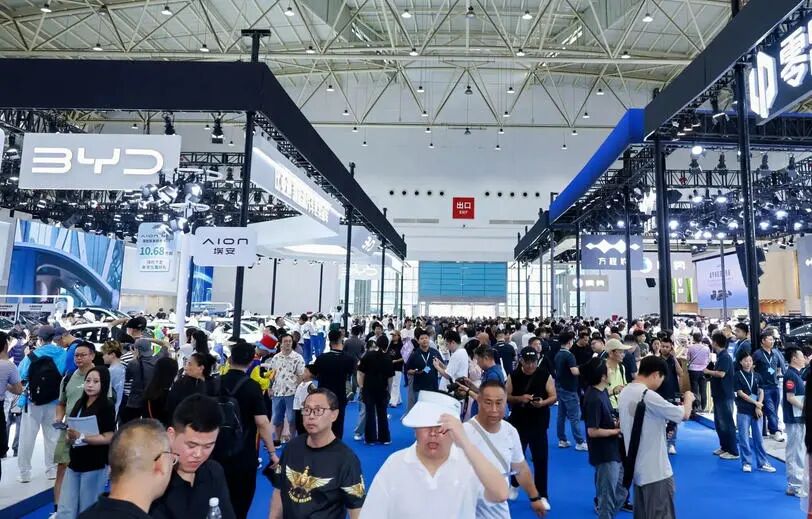
What does this indicate? It shows that the logic of trading price for volume, which has been widely believed in the industry over the past few years, has reached its limits. Continuing to engage in this logic will only trap the entire industry in a cycle of selling more but losing more. Moreover, consumer trust in automakers continues to decline, and the greatest loss for automakers is brand value.
Therefore, some relatively strong automakers have begun to attempt to reverse this trend. In early 2026, at least 15 automakers, including Tesla, Xiaomi, BYD, and Chang'an, began raising prices for their models. Although this approach may not seem sophisticated and may not necessarily be recognized by the market, it essentially provides a possibility for breaking free.
This represents the pursuit of the automotive industry from top to bottom over the past two years: transitioning from price wars to value wars and from scale orientation to profit priority. Automakers must not be led by short-term sales pressure, following competitors' rhythms to engage in price wars, pressuring inventory, or anticipating future demand, as this will only exacerbate problems.
At this point, maintaining composure becomes crucial. As many statistics show, more than 600 new models were launched in the first half of this year, including boxy designs, MPVs, large six-seaters, and large five-seaters, with every market segment being fiercely contested. However, in the end, many new models fail to maintain sales beyond a month and quickly become casualties.
New models that fail to drive sales have far-reaching negative effects, causing deep harm to companies across multiple dimensions, including R&D, finance, channels, branding, supply chains, and strategy. Moreover, if new models do not sell, the first consideration is product strength, and if product strength is not the issue, then it is a people problem.
A typical example is when a company's own capabilities are insufficient, leading to poor sales of new models. Many automakers, on the one hand, wanted to showcase their R&D capabilities and, on the other hand, wanted to catch the wind of market segments, treating the launch of one new model per year as an achievement to show off. However, looking at automakers established more than five years ago with more than five product lines, many still sell less than 200,000 units annually.
This is actually a result of insufficient capabilities, which manifest in two ways: inadequate headquarters operational capabilities and inadequate channel capabilities. The ultimate result of insufficient capabilities is that even with numerous new models, no blockbuster models can be created. This not only wastes R&D resources but also puts pressure on dealers.
Reports indicate that in the first half of 2026, automotive dealers, as a whole, fell into a deep loss and survival crisis, with seven out of eight listed groups experiencing losses, totaling approximately 4.2-5 billion yuan in losses. Fuel vehicle channels have seen large-scale closures, with core contradictions being price inversions, high inventory, collapse of after-sales profits, and manufacturers shifting risks through pressure on inventory.
Therefore, in an increasingly competitive environment, it is essential to face one's own capabilities squarely and follow market laws more closely. After all, the Chinese automotive industry has fully entered a mature growth phase driven by the market rather than policies. For automakers, rather than anxiously focusing on completion rates, it is better to direct energy toward building composure and adopting a pragmatic mindset.
Thus, the auto market in 2026 serves as a mirror. Companies that can maintain composure, respect laws, and not lose their rhythm over temporary gains and losses are more likely to recover first when the next cycle arrives. Failing to complete a year's tasks is merely a brief adjustment in a long race. Losing composure and rhythm, however, is a truly irreparable loss.
Editor-in-Chief: Yang Jing Editor: He Zengrong

THE END
-
![]()
Microsoft: Has the Tide Turned in Favor of the Old Guard?
-
![]()
Amazon: AWS Soars, Catching Up with Competitors at Last!
-
![]()
Acknowledging Task Incompletion: Neither Shameful Nor Daunting
-
![]()
How to Efficiently Manage and Control Street Lights in Industrial Parks? The Smart Street Light Control System Solution for Parks Offers Insights
-
![]()
Only One of Its Kind in the Country! Shenzhen's 'Five-Party Collaborative Operation' Pilot for Unmanned Delivery Takes Off, Steering Autonomous Driving Away from 'Money-Burning Competition' into the E
-
![]()
Qwen Still Sees Value in Open Source Initiatives
-
![]()
Qwen Still Sees the Merits of Open Source
-
![]()
A Complete Retrospective of the Thailand Campaign: A Detailed Review of the First 'Complete Model' for Chinese Automobiles Going Global