Amazon: AWS Soars, Catching Up with Competitors at Last!
 08/03 2026
 496
496
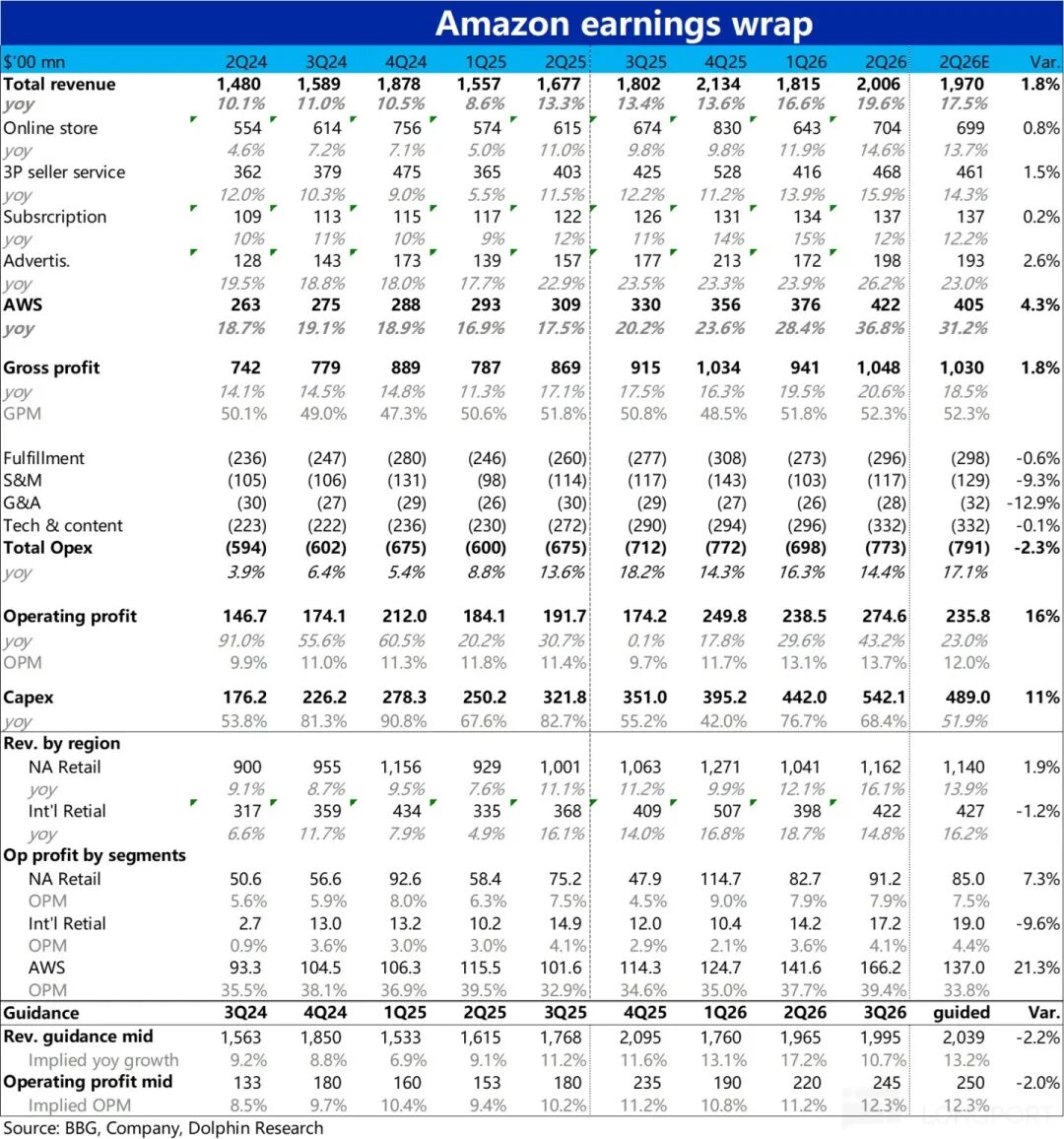
As major tech behemoths rolled out their earnings reports in succession, Amazon, following the close of the U.S. stock market on July 31 (Beijing Time), disclosed its Q2 2026 earnings. The outcomes validated what Dolphin Research had projected last quarter—it's now Amazon's moment to bask in the spotlight!
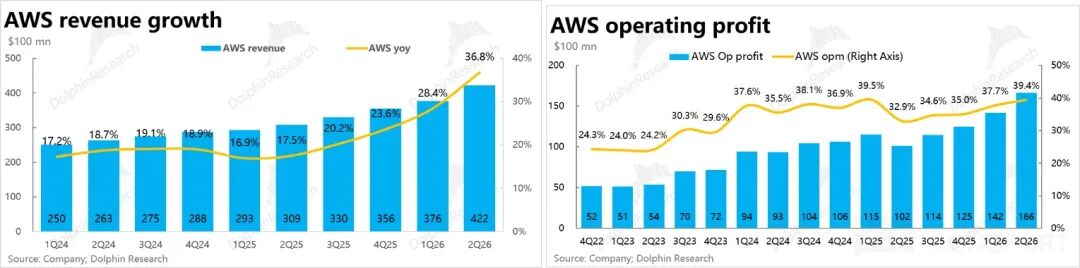
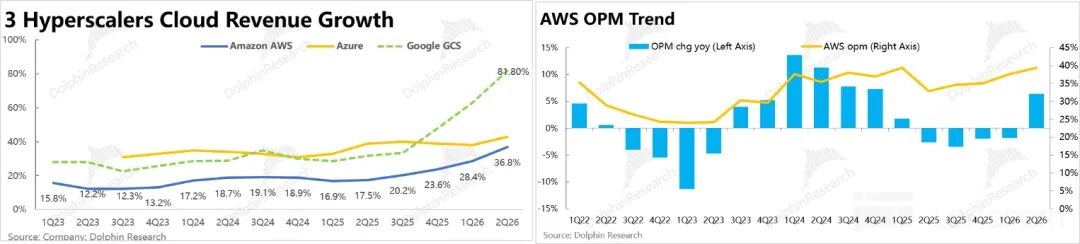
1. Is AWS on the verge of a meteoric rise? Its year-over-year growth surged from 28% to 37%, hitting $42.2 billion. Anthropic, a spin-off from AWS, witnessed its Annual Recurring Revenue (ARR) soar, delivering tangible perks to AWS.
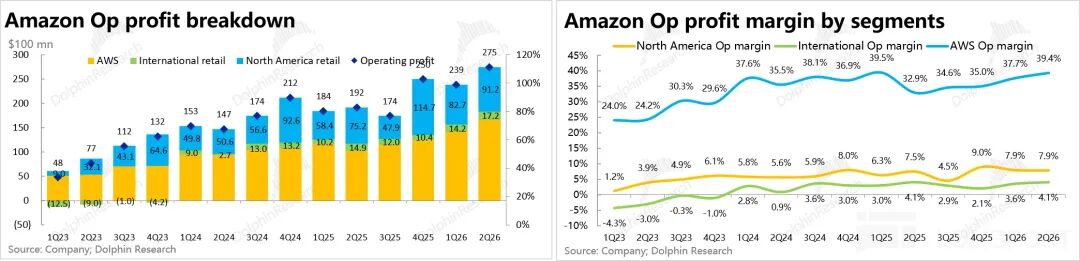
More crucially, in contrast to most cloud firms, AWS is experiencing an upswing in both revenue and profit margins: on a quarter-over-quarter basis, profit margins climbed by 1.7 percentage points to 39.4%, nearing an all-time peak.
2. Contract balances: They reached $469 billion, with a quarterly uptick of $100 billion. Dolphin Research estimates new orders at $150 billion, significantly outstripping Microsoft. The burgeoning contract balances, with new orders far outpacing recognized revenue, signal that AWS's revenue growth will gather pace as capacity is freed up.
3. Capital expenditures (Capex) soar: The quarterly sequential increase approached $10 billion, positioning Amazon as the clear frontrunner among tech giants. Nevertheless, since Amazon's retail operations are also capital-intensive, the actual cloud investment is on par with Google's, at around $45 billion.
The annual target was raised from $200 billion to $220 billion due to storage price hikes, implying capital expenditures of $60 billion per quarter for the upcoming two quarters. Such spending levels suggest that AI infrastructure investment will keep climbing after a correction.
4. Cash flow plummets: With a quarterly operating cash inflow of merely $45 billion and capital expenditures of $53 billion, followed by $60 billion in the following quarters, free cash flow will remain deeply in the red.
Given the cash flow debacle, the company methodically elucidated its current Return on Investment (ROI) measurement rationale, aligning with Dolphin Research's prior analysis of Google in 'Judging Google: Is Market Volatility or Aggressive Investment to Blame?':
a. The company computes ROI based on 'confirmed' orders, converting contract value to recognized revenue once capacity becomes available.
b. Long-cycle assets, such as factories included in capital expenditures, drive upfront costs but remain operational due to lengthy depreciation cycles; short-cycle assets, like servers and network equipment, can be procured in advance based on demand, with current large-scale purchases spurred by high order volumes.
c. Short-cycle assets, such as servers, have a payback period of roughly 3 years and a useful life of 5-6 years, after which free cash flow will materialize.
However, in Dolphin Research's opinion, this involves penalty mechanisms for order cancellations, breaches of upstream procurement contracts, and maturity mismatches between upstream procurement orders and downstream contract balances. While the explanations are well-reasoned and enhance understanding, they don't entirely allay doubts.
Essentially, the market remains apprehensive about the payment capacity of AWS's customers' customers. This can't rely solely on AI-driven cost savings and efficiency enhancements to reallocate budgets; it must stem from AI genuinely generating incremental revenue. Presently, the answer regarding generating incremental revenue for customers' customers remains elusive.
5. Will capital expenditures peak? For Amazon's predominantly self-operated retail business, Dolphin Research estimates capital expenditure intensity at 50% of gross profit. Many wonder if this signals a peak, as further increases would imply investing most revenue directly rather than just consuming profits.
However, following Amazon's explanation, Dolphin Research believes capital expenditure forecasts should hinge on cloud giants' order backlogs. As long as order balances keep accumulating significantly, there's hope for the Capex investment rationale, but order balances ultimately hinge on model advancements.
6. Will depreciation eat into profits? Possibly. This quarter's depreciation expense was $20 billion, accounting for 10% of revenue, and stabilized at high levels for two quarters. While still well below the $50 billion+ Capex cash outflow, considering the high proportion of short-cycle assets, like servers, in current capital expenditures, subsequent depreciation pressure will mount, primarily offset by accelerating revenue growth.
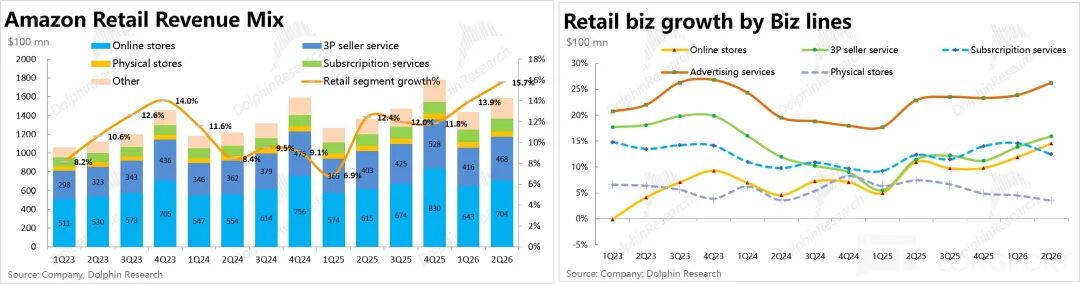
7. Retail shines: Owing to an early Prime Day, Amazon's retail performance surpassed Dolphin Research's expectations, with year-over-year growth accelerating to 16%. Meanwhile, North American retail profit margins held steady at 7.9%, and international retail at 4.1%, performing averagely. Cost hikes didn't significantly erode Amazon's retail business. Structurally, the growing share of high-margin advertising continues to positively influence retail profit margins.
8. Strong quarter, but conservative guidance: Next quarter's revenue guidance suggests a maximum year-over-year growth of 12%, which the company attributes to Prime Day shifting to Q2 affecting Q3 data. Profit guidance of $22.5-26.5 billion also didn't exceed market expectations.
Based on Dolphin Research's estimates, under this guidance, the cloud business's revenue and profit acceleration may not be substantial. However, considering Amazon's track record of surpassing guidance, with only variations in the degree of the beat, Dolphin Research regards this guidance as merely a reference point.
Dolphin Research's Overall Perspective
The gist is straightforward: Retail is robust, cloud is surging, and guidance is conservative. However, given expectations of cloud growth and Amazon's traditionally cautious guidance, the market isn't perturbed by this guidance.
The core concern remains over cloud ROI and cash flow strain. The company's systematic explanation not only clarifies its stance but also speaks for the entire Cloud Service Provider (CSP) sector, effectively reassuring the market.
The company directly furnished two key metrics: AI revenue and chip sales revenue have each annualized at $25 billion, with AI revenue growing at a triple-digit rate year-over-year; last quarter, chip sales revenue annualized at $20 billion.
Dolphin Research roughly estimates that among AWS's 37% year-over-year growth this quarter, AI's contribution to growth and traditional business are roughly on par.
Regarding self-developed chips, as Dolphin Research noted last quarter, in the era of inference, Amazon aims to narrate a tale of internal cost savings and external revenue generation through self-developed hardware. Currently, despite model limitations, the hardware line is performing admirably.
In summary, stepping into the inference era with Agent+Coding implementation, Amazon's 2026 cloud strategy (investing in Anthropic to bind cloud usage + self-developed hardware) has begun to yield results. AWS is entering a relatively certain upward cycle, with growth acceleration contingent on order accumulation and capacity release speeds. The retail business just needs to maintain stability.
Subsequent tracking will zero in on Anthropic's rising ARR as a side indicator.
Relevant charts below:
1. AWS: Impressive Revenue and Profit Growth Trajectories
2. Surging Capital Expenditure vs. Gradual Depreciation
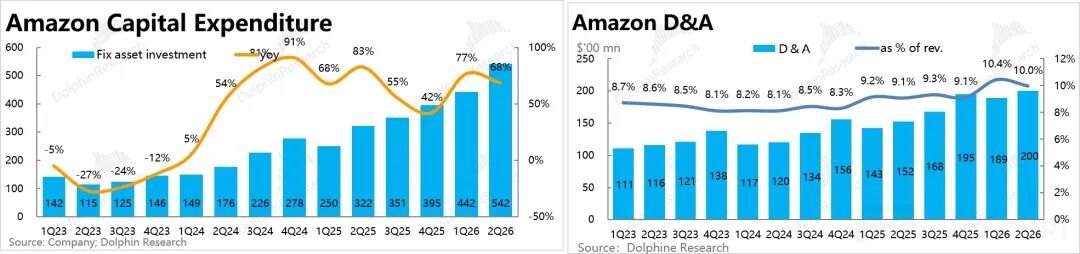
(Note: Capital expenditures exclude proceeds from asset sales)
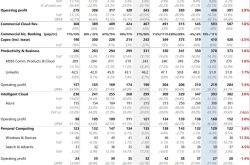
3. Retail Facade, Cloud Essence: Profits Hinge Entirely on Cloud
4. Retail: Early Prime Day; Advertising Shines, Self-Operated Performs Well, 3P and Advertising Go Online
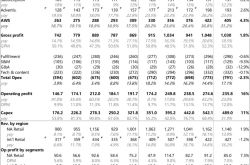
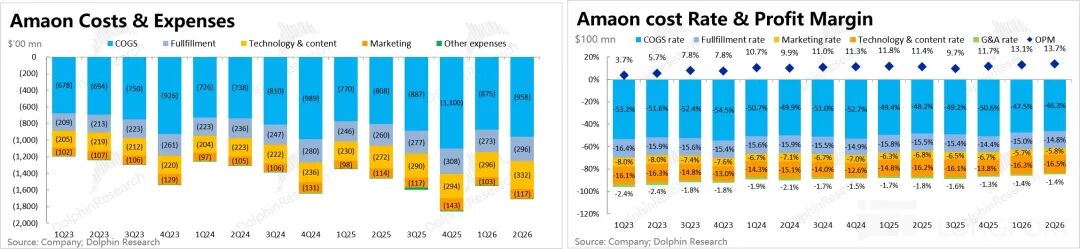
5. Expenses: All Restrained Except R&D
- END -
// Reprint Authorization
This article is an original work by Dolphin Research. Reproduction requires authorization.
// Disclaimer and General Disclosure
This report is solely for general comprehensive data purposes, intended for general reading and data reference by users of Dolphin Research and its affiliates, without taking into account the specific investment objectives, investment product preferences, risk tolerance, financial status, or special needs of any recipient. Investors must consult independent professional advisors before making investment decisions based on this report. Any investment decisions made using or referring to the content or information in this report are at the investor's own risk. Dolphin Research shall not be held liable for any direct or indirect responsibilities or losses arising from the use of the data in this report. The information and data in this report are based on publicly available sources and are for reference only. Dolphin Research strives to ensure but does not guarantee the reliability, accuracy, and completeness of the information and data.
The information or views mentioned in this report shall not be considered or construed as an offer to sell or an invitation to buy securities in any jurisdiction, nor as a recommendation, quotation, or endorsement of securities or related financial instruments. The information, tools, and materials in this report are not intended for distribution to or use by individuals or residents in jurisdictions where such distribution, publication, provision, or use contradicts applicable laws or regulations or requires Dolphin Research and/or its affiliates or subsidiaries to comply with any registration or licensing requirements in such jurisdictions.
This report reflects only the personal views, insights, and analytical methods of the relevant authors and does not represent the stance of Dolphin Research and/or its affiliates.
This report is produced by Dolphin Research, with copyright solely owned by Dolphin Research. No institution or individual may, without prior written consent from Dolphin Research, (i) reproduce, copy, duplicate, reprint, forward, or create any form of copies or replicas in any way, and/or (ii) directly or indirectly redistribute or transfer to other unauthorized persons. Dolphin Research reserves all relevant rights.
-
![]()
Microsoft: Has the Tide Turned in Favor of the Old Guard?
-
![]()
Amazon: AWS Soars, Catching Up with Competitors at Last!
-
![]()
Acknowledging Task Incompletion: Neither Shameful Nor Daunting
-
![]()
How to Efficiently Manage and Control Street Lights in Industrial Parks? The Smart Street Light Control System Solution for Parks Offers Insights
-
![]()
Only One of Its Kind in the Country! Shenzhen's 'Five-Party Collaborative Operation' Pilot for Unmanned Delivery Takes Off, Steering Autonomous Driving Away from 'Money-Burning Competition' into the E
-
![]()
Qwen Still Sees Value in Open Source Initiatives
-
![]()
Qwen Still Sees the Merits of Open Source
-
![]()
A Complete Retrospective of the Thailand Campaign: A Detailed Review of the First 'Complete Model' for Chinese Automobiles Going Global