Only One of Its Kind in the Country! Shenzhen's 'Five-Party Collaborative Operation' Pilot for Unmanned Delivery Takes Off, Steering Autonomous Driving Away from 'Money-Burning Competition' into the E
 08/03 2026
 497
497
Introduction
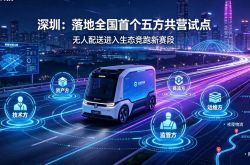
On July 30th, in Longgang, Shenzhen, the country's first 'Five-Party Collaborative Operation' innovative service system, jointly built by technology, asset, operation and maintenance, business flow, and regulatory parties, was officially launched, with its first pilot project in nighttime logistics in Longgang District.
This is not just an ordinary policy announcement; it marks a crucial leap for Shenzhen in advancing autonomous driving from 'technical testing' to 'ecosystem operation.'
When Neolix, DST, Huolala, East Bus, and SUTPC gather around the same table, the game of unmanned delivery changes completely: The future competition is not about who has more vehicles but whose ecosystem enables small and medium-sized businesses to afford and enjoy the service.
Unmanned Vehicle Insights (WeChat Official Account: Unmanned Vehicle Insights) is here to discuss this with everyone!
(For further reading, please click: 'Three Districts in One Month! Shenzhen's Unmanned Delivery Completes the Final Piece and Begins 'Cross-City Replication' to the Shenzhen-Shanwei Special Cooperation Zone')
I. Why Can't Small and Medium-Sized Businesses Access Unmanned Delivery After All This Time?
In 2024, Shenzhen took the lead in introducing a city-wide unified pilot program for autonomous driving, laying a solid foundation for subsequent work through top-level design and planning.
In 2025, Shenzhen became the first in China to propose the '4123' system.
By the end of 2025, the total number of functional unmanned vehicles in operation in Shenzhen reached 1,122, an 185.5% increase from the beginning of the year, surpassing 1,000 for the first time. The number of open routes expanded from 442 to 1,940, with the total mileage extending from 774 kilometers to 7,191 kilometers.
In 2025, there were 8.66 million orders throughout the year, with monthly orders surging from 900,000 in August to 1.87 million in December. Unmanned vehicles have penetrated various scenarios, including express delivery, instant fresh food retail, and food delivery.
The numbers look impressive, but there's a harsh reality:
These unmanned delivery services primarily serve major clients like China Post, SF Express, JD.com, and YTO Express. However, small and medium-sized businesses are fragmented and lack the capacity to connect, maintain, and manage new technologies.
This is not speculation but a lesson learned from industry setbacks.
When some cities attempted to provide unmanned delivery services to small and medium-sized businesses, the results were disastrous: Vehicles broke down with no one to repair them, accidents went unresponsive, and complaints surged, making the model difficult to promotion (promote).
The problem lies not in the technology but in the service ecosystem.
Small and medium-sized businesses don't just need an unmanned delivery vehicle; they need a complete collaborative operation service system.
II. 'Five-Party Collaborative Operation': Clear Roles and Responsibilities
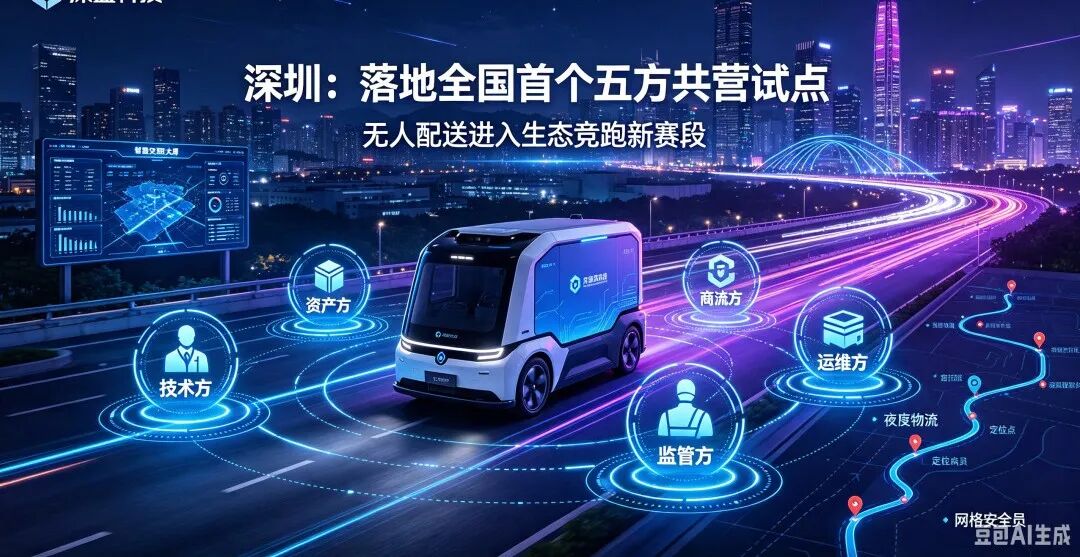
Shenzhen's solution is to break down the scattered capabilities into five distinct roles, each with clear responsibilities.
Technology Party (Neolix): Provides autonomous driving vehicles and algorithms, taking primary responsibility for system safety.
Asset Party (DST): Holds vehicle assets and provides stable operational capacity.
Business Flow Party (Huolala): Provides access to real logistics orders.
Operation and Maintenance Party (East Bus): Handles safety control and full-chain operation and maintenance services, including parking, charging, repairs, and emergency rescue.
Regulatory Party (SUTPC): Responsible for data security monitoring and regulatory early warning.
These five roles each have distinct responsibilities while supporting one another.
The technology party focuses on building better vehicles and optimizing algorithms;
The asset party focuses on leasing vehicles and improving asset efficiency;
The business flow party focuses on bringing in orders;
The operation and maintenance party focuses on managing, repairing, and charging the vehicles;
The regulatory party focuses on monitoring data and Warning (warning) risks.
Each party does what it does best, without trying to do everything alone.
Through the collaboration of the five parties, the operational support and safety control capabilities that were previously only available to major clients are now extended to small and medium-sized businesses, enabling them to have the same service capabilities as leading express delivery companies.
III. Bus Companies Stop Running Buses and Start Managing Unmanned Vehicles
The most brilliant stroke of the 'Five-Party Collaborative Operation' is transforming East Bus from a traditional bus company into an operation and maintenance service provider.
As early as 2025, East Bus began exploring the integration of 'buses + logistics,' transforming over 100 bus depots into recharging stations, regional transit hubs, and emergency support centers for unmanned vehicles.
Charging piles, maintenance teams, and dispatch systems were reused, revitalizing existing assets.
More importantly, East Bus employees found new career paths:
The maintenance team took on unmanned vehicle maintenance, the operations team handled dispatch and command, and some employees smoothly transitioned into roles in unmanned vehicle industry operations, maintenance, and control.
By the end of 2025, the collaboration project between Neolix, East Bus, and SF Express had deployed 15 L4-level unmanned delivery vehicles in regular operation, with daily mileage nearing 2,000 kilometers, monthly transport of 25,000 express parcels, a reduction in single-parcel delivery cost by 1.32 yuan (a 23% decrease), and a 30% increase in delivery efficiency.
Bus drivers no longer fear unemployment; they can manage unmanned vehicles instead.
East Bus also established a 'remote safety officer—near-field grid safety officer—ground crew' system, transforming safety assurance from 'reacting after an incident' to 'real-time monitoring and immediate response.'
IV. Nighttime Logistics: Turning Shenzhen's Nights into 'Prime Time'
The choice to start with nighttime logistics in the 'Five-Party Collaborative Operation' is no accident.
On March 26, 2026, Shenzhen took the lead in granting nighttime road access to functional unmanned vehicles in Pingshan and Longgang districts: From 10 PM to 6 AM, unmanned vehicles could operate on specified routes.
JD Logistics' 'Lone Wolf' intelligent delivery vehicle was the first to launch two cross-district nighttime routes, totaling over 50 kilometers.
The results were immediate.
In just three months, the number of nighttime delivery routes in the city surged from 2 to 331, with over 100 vehicles in use. In June alone, nighttime mileage exceeded 40,000 kilometers.
Longgang, the district with the densest unmanned vehicle routes and the most vehicles in Shenzhen, had a cumulative total of 846 open routes, 255 regularly operating unmanned vehicles, and total operational mileage exceeding 340,000 kilometers, including 201 nighttime routes with 76 vehicles deployed.
For delivery couriers, the changes are tangible.
The daily operating hours of unmanned vehicles extended from 12 to 24 hours, with the number of daily trips per vehicle increasing from 3 to 5, a 66% increase in capacity utilization, and a roughly 20% reduction in single-vehicle operating costs.
Nighttime pickup and delivery volumes now account for 40% of the daily total.
Compared to traditional freight vehicles, the comprehensive operating costs of nighttime unmanned vehicles have decreased by about 20%.
Unmanned vehicles cede daytime road resources to citizen travel and transform nighttime idle roads into transport capacity: This 'off-peak operation' not only enhances urban governance efficiency but also reduces costs for logistics companies.
V. From 'Regulating Enterprises' to 'Regulating Platforms': Shenzhen Fires the First Shot in the New Race
The most intriguing aspect of the 'Five-Party Collaborative Operation' is the fundamental shift in governance logic.
In traditional models, the government maintains a 'one-on-one' regulatory relationship with enterprises, resulting in high administrative costs and low efficiency.
The 'Five-Party Collaborative Operation' constructs a new governance structure: The government sets the rules and acts as the 'referee,' the operation and maintenance party serves as the unified 'general manager,' and the technology, capacity, and business flow parties compete on technology, safety, and service under unified rules.
Safety responsibilities are also clearly defined: The technology party is the primary responsible entity, forming a 'who manufactures, who takes responsibility, traceable' responsibility chain. The regulatory party monitors vehicle abnormalities in real-time, simultaneously pushing alerts to competent authorities and on-ground grid workers, establishing a '5-minute online response, 15-minute on-site arrival' disposal mechanism.
Since 2026, complaints about unmanned delivery vehicles in Shenzhen have month-on-month decrease (decreased by) 32% month-on-month, and safety incidents have Year-on-year decrease 28%. This system is working.
The 'Five-Party Collaborative Operation' ensures that each party gets what it needs:
The technology party can focus on algorithm iteration;
The asset party can improve asset utilization;
The business flow party can secure stable operational capacity;
The operation and maintenance party can explore sustainable models;
The regulatory party can achieve a governance upgrade from regulating enterprises to regulating platforms.
The pilot explicitly prohibits price undercutting and ordered (orderly) guides some delivery demand to nighttime hours.
In any case, Unmanned Vehicle Insights (WeChat Official Account: Unmanned Vehicle Insights) believes:
From the '4123' system to the 'Five-Party Collaborative Operation,' Shenzhen has explored a new path of 'market competition for excellence, mechanism coordination, government oversight, and safety assurance.'
The race for unmanned delivery has shifted from competing on scale to competing on ecosystems.
Shenzhen has fired the first shot in this race. Will others follow?
What do you think, dear readers? References: Reports from media outlets such as the Shenzhen Autonomous Driving Safety Laboratory's official WeChat account, Shenzhen Evening News, Evresources, and Shenzhen Special Zone Daily.
#UnmannedVehicleInsights #AutonomousDriving #SelfDriving #UnmannedVehicles
-
![]()
Microsoft: Has the Tide Turned in Favor of the Old Guard?
-
![]()
Amazon: AWS Soars, Catching Up with Competitors at Last!
-
![]()
Acknowledging Task Incompletion: Neither Shameful Nor Daunting
-
![]()
How to Efficiently Manage and Control Street Lights in Industrial Parks? The Smart Street Light Control System Solution for Parks Offers Insights
-
![]()
Only One of Its Kind in the Country! Shenzhen's 'Five-Party Collaborative Operation' Pilot for Unmanned Delivery Takes Off, Steering Autonomous Driving Away from 'Money-Burning Competition' into the E
-
![]()
Qwen Still Sees Value in Open Source Initiatives
-
![]()
Qwen Still Sees the Merits of Open Source
-
![]()
A Complete Retrospective of the Thailand Campaign: A Detailed Review of the First 'Complete Model' for Chinese Automobiles Going Global