July Sees Record 65.1% Penetration Rate for New Energy Passenger Vehicles, Fueled by Robust Export Growth
 08/12 2026
 367
367
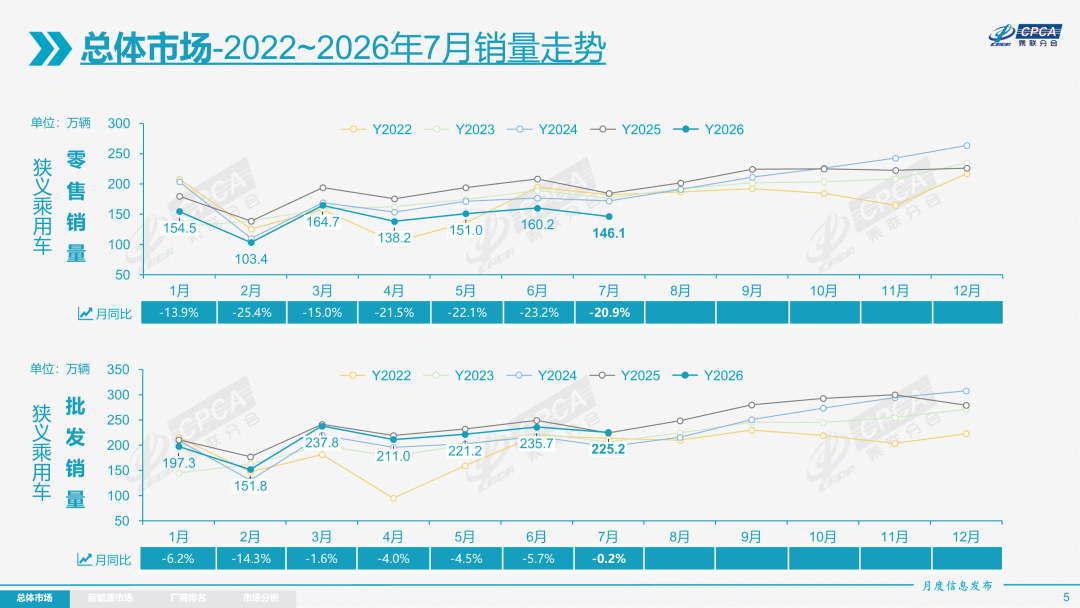
In July 2026, the new energy vehicle (NEV) sector demonstrated remarkable market resilience amid a confluence of factors, including the rebound in oil prices, cautious consumer sentiment, previous demand overdraft, and the implementation of new national standards for NEVs. Penetration rates continued to surge, with production and sales maintaining steady year-on-year growth. Explosive growth in overseas exports effectively counterbalanced domestic market pressures, cementing the industry's trajectory towards 'new energy dominance and fuel vehicle contraction'.
Resilience Shines in Terminal Retail
New Energy Penetration Rate Reaches New Heights
In July, retail sales of new energy passenger vehicles reached 951,000 units, experiencing only a 3.9% year-on-year decline and a 5.8% month-on-month decrease. These declines were significantly smaller than those in the overall passenger vehicle market, underscoring robust terminal purchasing power. From January to July, cumulative retail sales of new energy passenger vehicles amounted to 5.668 million units, down 12.5% year-on-year, with cumulative declines continuously narrowing and market recovery progressing steadily. 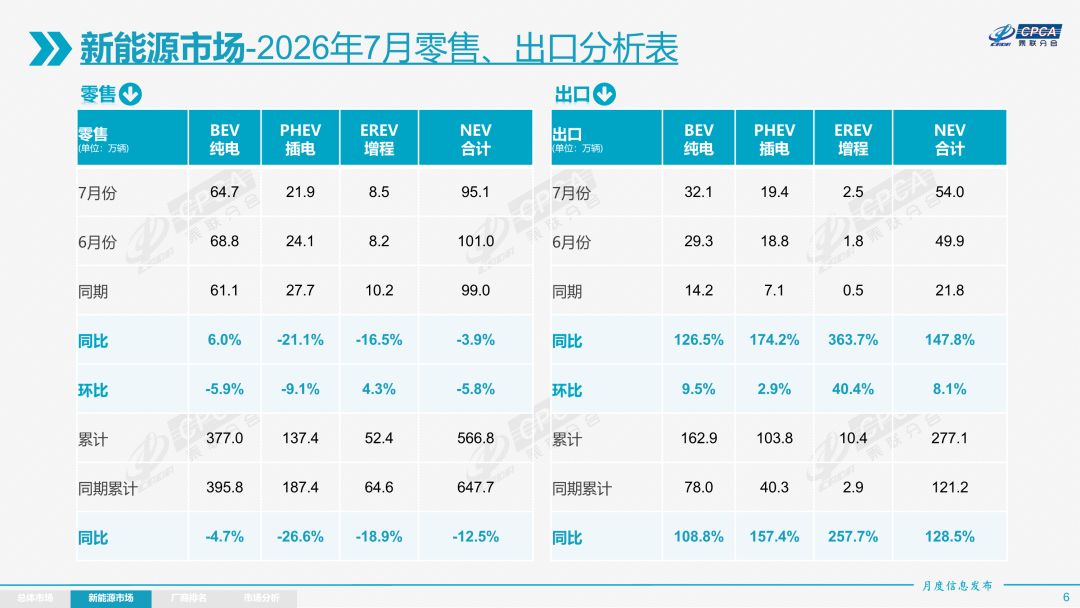
As the shift from oil to electric vehicles accelerates, the retail penetration rate of new energy vehicles has reached unprecedented levels. In July, the domestic retail penetration rate for new energy passenger vehicles hit 65.1%, up 2.1 percentage points month-on-month and 11.6 percentage points year-on-year, consistently breaking historical records. By brand segment, independent brands achieved an impressive new energy penetration rate of 83.8%, showcasing significant success in their electrification transformation. Luxury brands reached 30.9%, while mainstream joint-venture brands lagged at only 13.7%, highlighting a widening gap in transformation across segments.
Steady Growth in Production and Sales
Production Momentum Outpaces Terminal Performance
Compared to the slight pressure on terminal retail, the production and wholesale ends of new energy vehicles maintained robust growth, indicating strong vitality in the industry's supply side. In July, production of new energy passenger vehicles reached 1.449 million units, up 25.6% year-on-year and slightly increasing by 0.2% month-on-month, with accelerating capacity releases preparing for the subsequent 'Golden September and Silver October' market. From January to July, cumulative production reached 8.214 million units, up 7.9% year-on-year, with ongoing optimization of the industry's capacity layout. Wholesale data more accurately reflects automakers' actual production and sales trends, with July wholesale sales of new energy passenger vehicles reaching 1.446 million units, up 21.3% year-on-year and slightly decreasing by 2.8% month-on-month, achieving strong year-on-year growth. Cumulative wholesale sales from January to July reached 8.248 million units, up 7.6% year-on-year, with the production side leading the industry out of market sluggishness and achieving steady positive growth. The wholesale penetration rate of new energy passenger vehicles for the month reached 64.2%, up 11 percentage points year-on-year, with automakers fully shifting their production focus towards new energy. 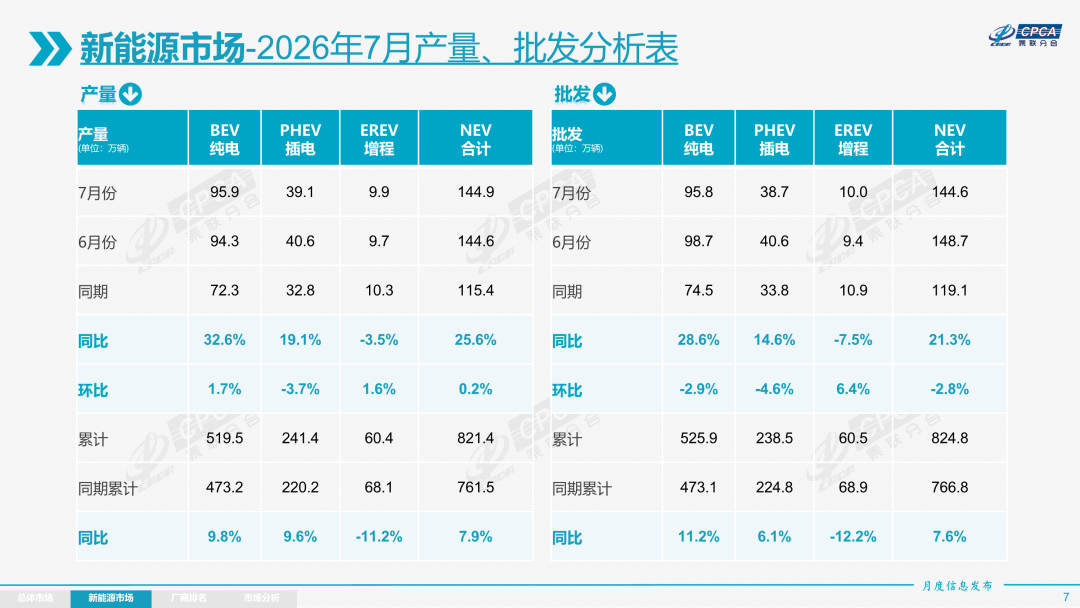
Continued Technological Differentiation
BEVs Lead, While EREVs Face Sustained Pressure
In July 2026, the divergence among the three major new energy technology routes intensified, with battery electric vehicles (BEVs) firmly dominating the market, plug-in hybrid electric vehicles (PHEVs) showing steady growth, and extended-range electric vehicles (EREVs) lacking growth momentum. BEVs remained the core growth engine, with July wholesale sales reaching 958,000 units, up 28.6% year-on-year and slightly decreasing by 2.9% month-on-month, accounting for 66.2% of total new energy wholesale sales, up 3.7 percentage points year-on-year, further consolidating their market dominance. By price segment, the BEV market exhibited a polarized pattern of strong high-end performance and weak low-end demand: high-end Grade B electric vehicles performed outstandingly, with 299,000 units wholesale in the month, up 35% year-on-year, accounting for 31% of total BEV sales and continuing to lead high-end market growth; entry-level Grade A00 electric vehicles faced sustained pressure, with wholesale sales plummeting 50% year-on-year and market share shrinking to 7%, accelerating the clearance of the low-end market. The PHEV market showed steady growth, suitable for family travel and long-distance commuting scenarios, with July wholesale sales reaching 387,000 units, up 14.6% year-on-year and decreasing by 4.6% month-on-month, accounting for 26.8% of total new energy sales and serving as a stable growth supplement to the new energy market. EREVs continued to weaken, becoming the only technology route lacking growth momentum. In July, EREV wholesale sales reached 100,000 units, down 7.5% year-on-year and slightly increasing by 6.4% month-on-month, with market share shrinking to 6.9%, down 2.2 percentage points year-on-year, indicating a clear trend of industry iteration and elimination.
Explosive Export Growth
New Energy Vehicles Become the Core Force in Automotive Overseas Expansion
Amid pressure in the domestic terminal market during the off-season, overseas exports became the core pillar for automakers to hedge risks and drive growth, with new energy vehicles continuing their strong overseas momentum. In July, new energy passenger vehicle exports performed exceptionally well, with export sales reaching 540,000 units, up a staggering 147.8% year-on-year and 8.1% month-on-month, far outpacing industry average growth. New energy vehicles accounted for 58.8% of total passenger vehicle exports, up 14 percentage points year-on-year, marking China's automotive exports officially entering a new energy-dominated era. The export structure continued to optimize, with BEVs remaining the mainstay of overseas expansion, accounting for 59.5% of new energy exports; PHEV models rapidly improved overseas competitiveness, with their share rising to 35.9% and becoming a new growth point for overseas expansion. Independent brands led the overseas expansion, with 775,000 units exported by independent automakers in July, up 87% year-on-year, led by top brands such as BYD, Chery, Geely, and Changan. Meanwhile, the CKD (Completely Knocked Down) local production model rapidly spread, helping Chinese new energy brands deepen their global market presence.
Industry Landscape Continues to Concentrate Toward Top Players
New Forces Gain Market Share
In July, the Matthew effect in the automotive market continued to stand out, with market resources accelerating their concentration toward top automakers. The market share of leading manufacturers with wholesale sales exceeding 100,000 units rose to 50.3%, with ongoing increases in industry concentration. Multiple automakers, including BYD, Chery, SAIC Passenger Vehicles, Leapmotor, and Tesla, achieved high wholesale sales growth of over 20% year-on-year, leading the industry. New force brands continued to perform well, with their retail share reaching 26.8% in July, up 5.4 percentage points year-on-year. The electrification rate of new force models continued to rise, with BEVs accounting for 77.6% of their sales, and the 100,000-150,000 yuan mid-end market becoming their core growth segment. Meanwhile, emerging new energy brands from independent automakers, such as Zeekr, Seres, and E-Pi, steadily rose, with their market share increasing by 5.4 percentage points year-on-year, continuously improving the industry's diversified competitive landscape. Policy support continued to release favorable conditions, providing strong support for the bottom-up recovery of the automotive market. The July Political Bureau meeting emphasized strengthening counter-cyclical adjustments and boosting domestic demand and consumption, with ongoing implementation of vehicle trade-in policies effectively offsetting off-season market pressures. From a product supply perspective, the trend toward larger and higher-end new energy vehicles became prominent, with over 50% of new mid-to-high-end models exceeding 5 meters in length, marking the industry's complete departure from low-end price competition and full entry into a new stage of value-based competition.
-
![]()
Behind Two Renewed Agreements: Joint Venture Automakers Choose Long-Term Presence in China's New Energy Sector
-
![]()
Will Zunjie’s Launch of Two L3-Ready MPVs Spell the End of the ‘Price Markup Era’ for Alphard and Its Peers?
-
![]()
17 Strategies, 1.8 Billion Parcels, 12.5 Billion Yuan: Huizhou, Guangdong, Paves the Way for Autonomous Vehicle and Drone Delivery
-
![]()
Manus to Regain Independence, Former Shareholders Including Tencent to Repurchase Shares from Meta for $2 Billion
-
![]()
Starting at 99,900 yuan, the Updated Seal 06 Hits the Market. How Should Family Buyers Decide?
-
![]()
In-Depth Analysis of Volkswagen CARIZON’s Proprietary Intelligent Driving Technology
-
![]()
Can a car priced at 80,000 yuan really have LiDAR? Features once exclusive to 300,000-yuan models now available at rock-bottom prices
-
![]()
He Shocked Silicon Valley, Yet Felt Every Day That the Company Was on the Brink