Tencent's Chess Game in WorkBuddy
 08/12 2026
 333
333

Editor|Sun Jing
WorkBuddy is undoubtedly Tencent's fastest-rising product this year.
In March, it was just a side project developed by a team of a dozen people within Tencent Cloud, built on the foundation of Tencent Cloud's code assistant, CodeBuddy.
A few months later, Pony Ma personally got involved, and the team expanded to a hundred members, with all six of Tencent's business groups giving the green light. Some Tencent employees even referred to it as the "new crown prince," sparking discussions about whether it could join the ranks of iconic Tencent products like QQ and WeChat Official Accounts in the company's Hall of Fame.
WorkBuddy is an AI-powered office agent designed for ordinary white-collar workers and knowledge workers. It rose to prominence during this year's "Lobster Craze," stepping over OpenClaw to gain traction. It helps users handle daily office tasks, code development, design creativity, and more through conversation.
Tencent has spared no expense in promoting WorkBuddy. Advertisements for the product can be seen everywhere from the subways and elevators that office workers use daily to the social media platforms they browse during breaks. According to media estimates, the offline advertising campaign in just four first-tier cities—Beijing, Shanghai, Guangzhou, and Shenzhen—cost nearly 100 million yuan.
Barring any surprises, WorkBuddy will feature prominently in Tencent's Q2 2026 earnings report. In the previous Q1 report, Tencent stated that WorkBuddy had become China's most widely used AI productivity service based on daily active accounts.
This level of attention has made Tencent's own Yuanbao seem increasingly neglected.
With WorkBuddy, Tencent seems poised for a second act in the AI space. However, the traffic generated by marketing only proves that the product is creating a buzz, not that users are willing to stay and pay.
WorkBuddy still needs to answer a more fundamental question: How can this excitement translate into revenue?
01 WorkBuddy Seizes the Moment
When it comes to AI office applications, the ultimate criterion boils down to four words: simple and useful.
When WorkBuddy first launched, it clearly fell short of this standard.
As
Under normal circumstances, such a product would likely have been relegated to a forgotten corner of users' desktops after the first error. But WorkBuddy arrived just as the era of AI agents was taking off.
At the time, the "Lobster Craze" sparked by OpenClaw had everyone excited. OpenClaw, Claude, and Codex made it clear to more and more people that AI could do more than just answer questions—it could also perform tasks.
The problem was that most "task-oriented" agents at the time were still designed for technical users. OpenClaw required deployment, coding agents relied on command-line interfaces, and overseas products involved complexities like account setup, payment, API integration, and usage environments. Just as ordinary white-collar workers were ready to put AI to work, AI handed them an entrance exam.
WorkBuddy filled this gap. Building on the existing technological foundation of CodeBuddy, Tencent quickly developed a desktop agent that required no deployment—just download and use. It might not have been the most powerful "lobster" at the time, but it was incredibly easy to use.
In just over four months after launch, WorkBuddy iterated through 52 versions, averaging nearly one update every two to three days. Xiaoming, a user who has been with WorkBuddy since its release, describes the experience similarly: the functionality didn't suddenly transform, but improvements were made where needed, and bugs were fixed one by one.
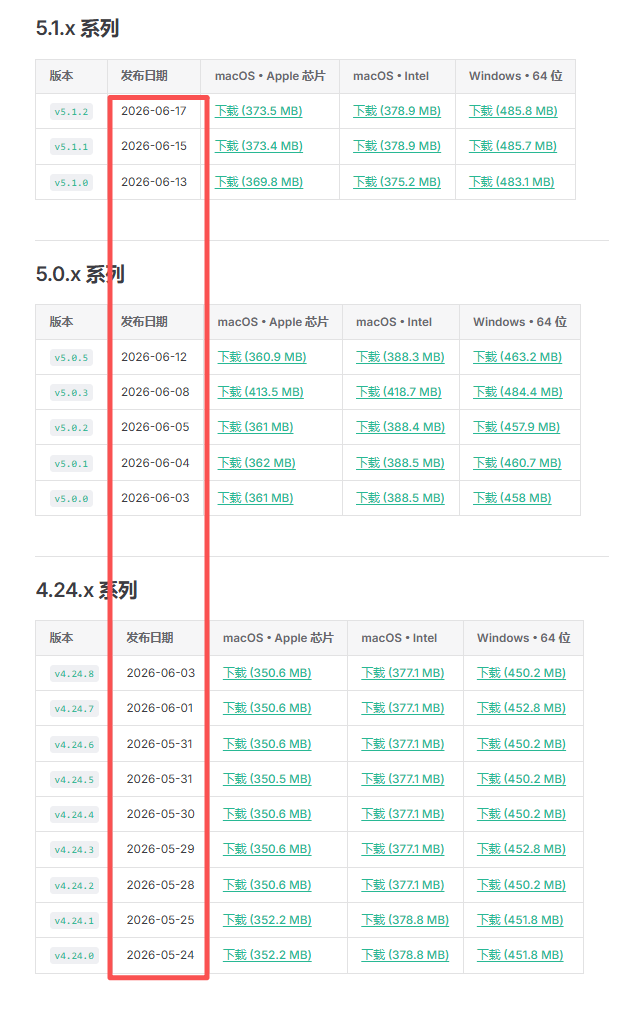
▲WorkBuddy's version iterations have been remarkably rapid
Sometimes, even two minor updates were released in a single day.
The earliest version of WorkBuddy featured only a general-purpose window, mixing document processing, development, and design tasks together. Expert functions had not yet been introduced. Later, it gradually split into separate sections for document processing, application development, and design creativity, while also adding individual experts, expert teams, and custom experts.
The most noticeable change was in its ability to get work done.
In the early days, when running long tasks, Xiaoming often idled away time only to return and find that WorkBuddy had also gone idle, with the task having failed and interrupted. Today, reviewing a complex contract may still take 40 minutes, but at least most of the time, WorkBuddy can see it through to completion.
This is where WorkBuddy began to pull ahead of its contemporaries in the "Lobster Craze": Tencent pushed the product onto the market first and then quickly addressed its shortcomings.
While filling in the basic capabilities, Tencent also added detailed office product features.
"Experts" solidify materials and processes, "Project Spaces" facilitate multi-person collaboration, and "Human-AI Co-Writing" addresses the issue of humans needing to modify files after AI completes them. Now, users can make changes directly within WorkBuddy or select specific sections for AI to adjust further.
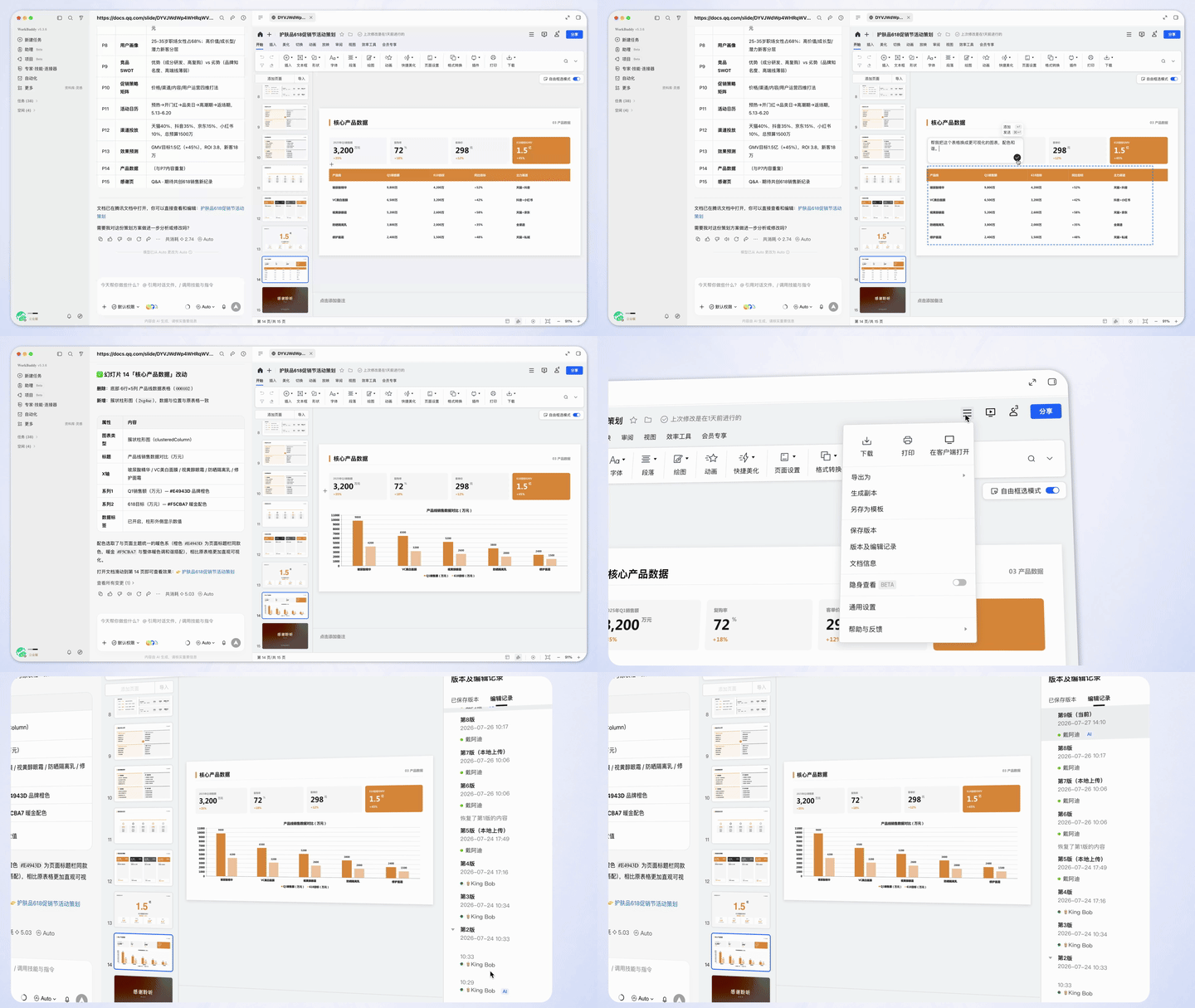
▲The "Human-AI Co-Writing" feature released on July 30th
This capability came from collaboration between WorkBuddy and Tencent Docs, exemplifying how Tencent's existing office ecosystem enhances product experience.
One Tencent employee believes that features like expert teams, project spaces, and human-AI co-writing put WorkBuddy one to two months ahead of some competitors in terms of product completeness.
A salesperson familiar with multiple AI office products also mentioned that while some competitors now match up in basic capabilities, what truly gives them headaches are the detailed features: it's not about having all the basics covered, but about offering more variety than others.
In terms of external compatibility, WorkBuddy supports multiple large models, including Hunyuan, GLM, MiniMax, Kimi, and DeepSeek, and even allows for custom model configuration. Qianwen Office and Doubao currently only support Alibaba's and ByteDance's proprietary large models. When it comes to application integration, WorkBuddy can connect with Feishu, DingTalk, and WeCom, while Alibaba's and ByteDance's products are limited to their own office applications for now.
At least in terms of product development speed, WorkBuddy has gained a slight lead.
Beyond the product itself, Tencent is using its most familiar internet growth tactics to subsidize this "AI subordinate" for office workers. The free version offers points, new users receive points, inviting friends earns more points, the Hy3 model is temporarily free, and features like code completion, auto-tasking, and some model calls are also free for a limited time.
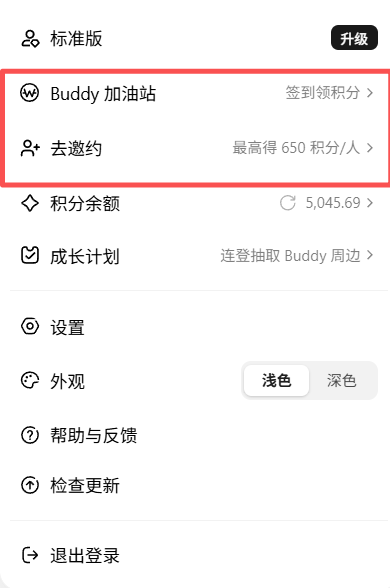
▲The client homepage features daily reminders to sign in for points and buttons to invite friends
As a result, WorkBuddy has managed to stand out among AI office software options.
However, for now, Tencent is still bearing many of the "onboarding costs" for this "AI subordinate." The next question is: Who will ultimately pay its salary?
02 Who Pays for AI Office Solutions?
WorkBuddy has proven that AI office tools can indeed improve efficiency in certain scenarios.
An airport engineer told
But employee efficiency gains don't automatically translate to corporate cost savings. Only when efficiency leads to hiring fewer people, taking on more business, or shortening delivery cycles does it become a measurable ROI for the finance department.
This is why China's office software market has never been particularly exciting.
Basic office tools have already been driven to low prices or even given away for free due to competition among major players; employees find them useful, but the ones actually paying are bosses and corporate IT departments; small and medium-sized enterprises have limited budgets, while large clients are willing to spend but demand security, permissions, privatization, and system integration...
Office software has never lacked value—the challenge lies in turning scattered efficiency gains into a bill that drives renewals.
WorkBuddy now faces this same hurdle.
Currently, a few individual users have started paying. The aforementioned engineer spends 70 yuan per month and believes that if efficiency truly improves by 20%-30%, a price range of 100-200 yuan would be acceptable.
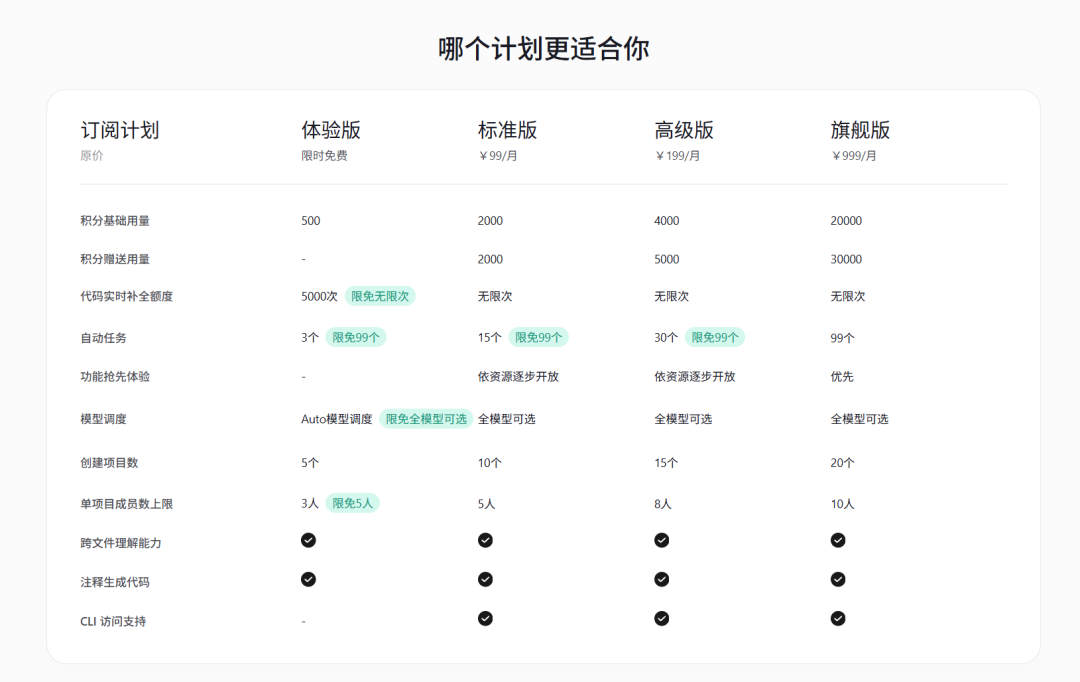
▲WorkBuddy's official website introduces personal version subscription plans
However, most of the people we spoke with are still using the free version. Some even praise WorkBuddy's thoughtful design while signing in daily to collect points and using third-party model APIs—claiming that WorkBuddy's points are too expensive.
While AI has generally raised people's willingness to pay, that doesn't mean personal subscriptions can become a scalable business.
Earning money from white-collar workers' idle time is difficult, and corporate spending is equally uncertain.
WorkBuddy's enterprise version currently follows the familiar SaaS model of charging per seat, with a flagship edition and a private cloud enterprise edition, both including 2,000 points per seat per month.
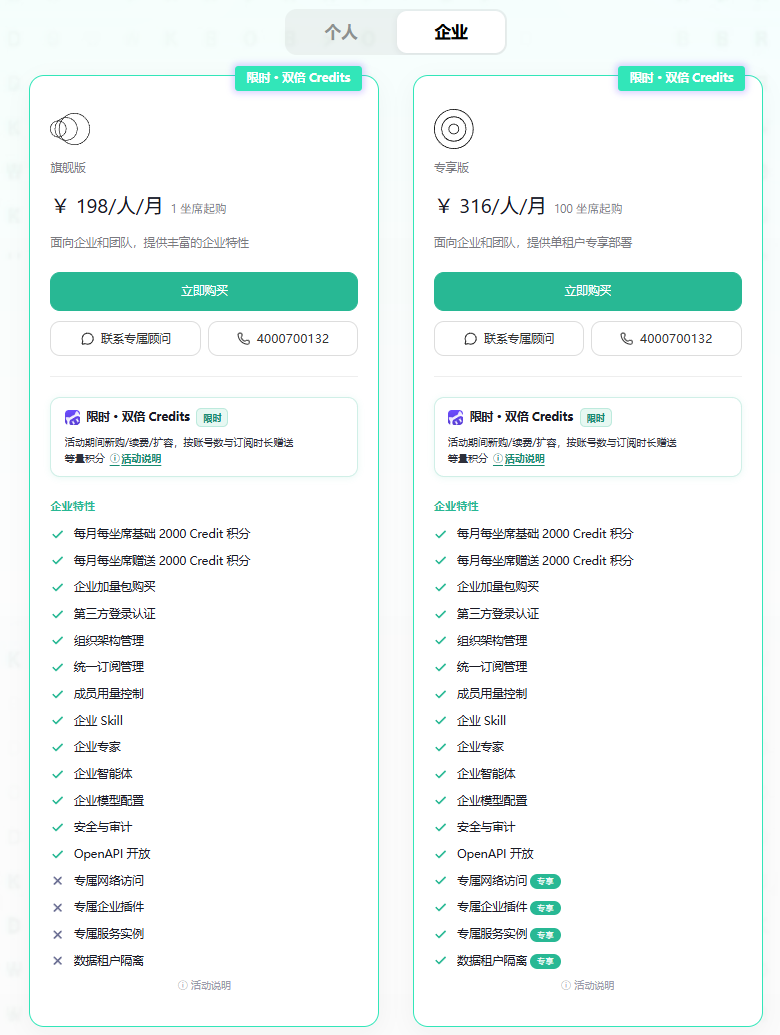
▲WorkBuddy Enterprise currently offers two pricing tiers
From what we understand, many companies are still in the trial phase. For example, a leading securities firm initially purchased 30 seats for testing, later increasing to 100. Another company first bought seats for its technical department to test before distributing a small number to other departments.
When it comes to commercializing AI office capabilities, Microsoft and Google in Silicon Valley offer two reference models: Microsoft sells Copilot as a high-priced AI seat separately, while Google integrates Gemini more heavily into its WorkSpace suite.
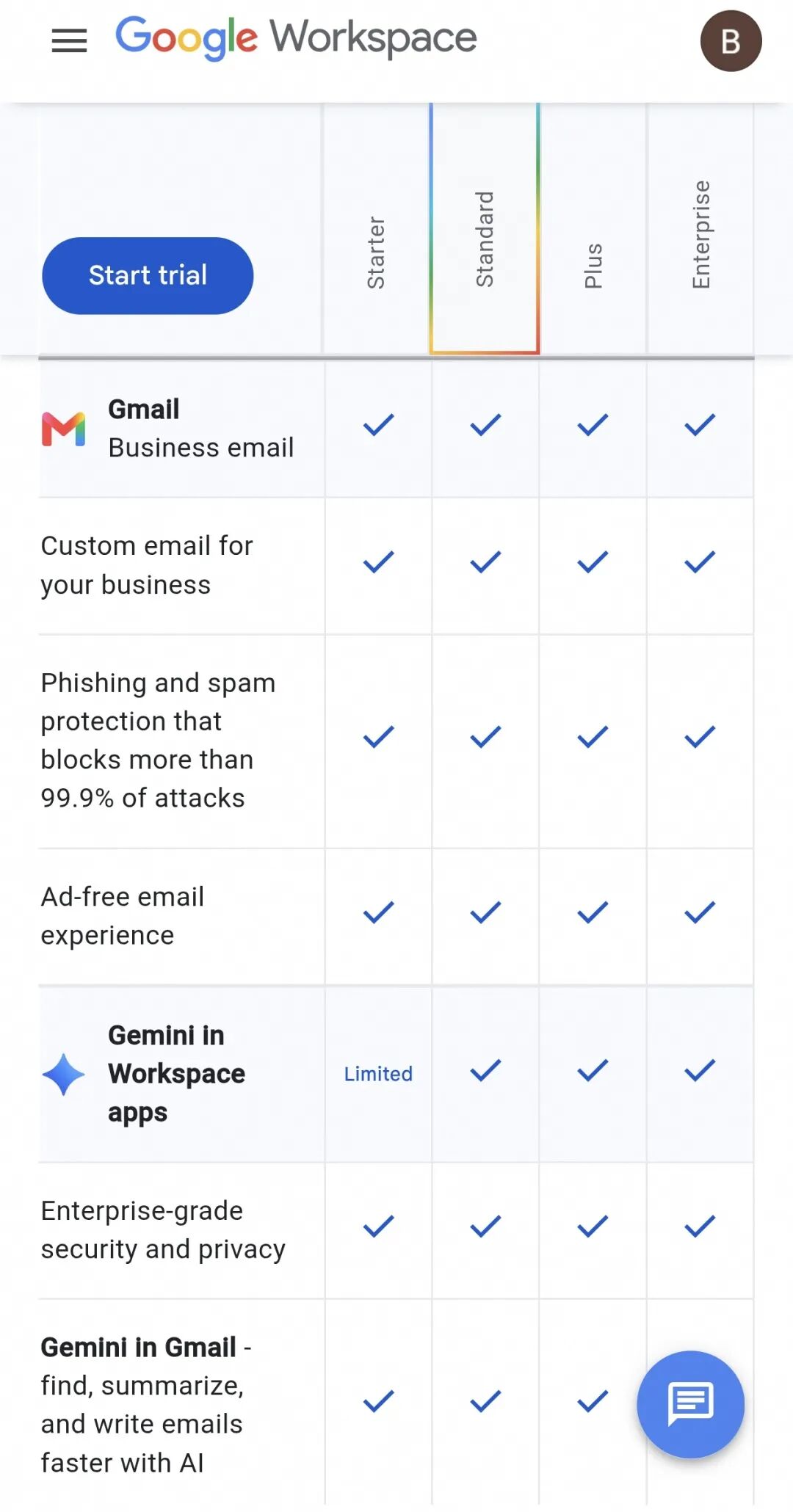
▲WorkSpace suite pricing highlights the Gemini AI suite as a key selling point
However, both companies already have mature office entry points and established enterprise payment relationships, which WorkBuddy lacks.
While Tencent has assets like WeCom, Tencent Docs, and Tencent Cloud, it still needs to persuade clients anew that this is a cost worth sustaining.
Of course, Tencent may not actually care about the AI office market alone.
If general-purpose AI assistants represent an entry point for C-end productivity, then office solutions are the entry point for the enterprise side. Currently, WorkBuddy Enterprise has added capabilities like model and quota management, security, auditing, permissions, and privatization. What companies are buying isn't just whether employees "can use AI," but also whether "the company can control AI."
Looking further ahead, if WorkBuddy becomes the gateway for enterprises to access AI and internal data, models, computing power, knowledge bases, security, and Tencent Cloud could all follow in.
This represents a more fundamental opportunity—one that other major players are also pursuing aggressively in the AI office space.
03 To Retain Office Users, Being Temporarily Ahead Isn't Enough
Right now, WorkBuddy has no shortage of buzz, but it's hard to say how much that translates into actual benefits.
This is evident from WorkBuddy's Schrödinger-like monthly and daily active user numbers.
Currently, market opinions on this matter are mixed. Tencent's internal sales teams often cite Analysys data when introducing WorkBuddy to enterprise clients, claiming that PC-side visits reached about 8.85 million in its launch month and 20.97 million in June, surpassing the combined total of the second and third-place products.
Note that these figures represent visits, not monthly or daily active users. Regarding daily active users, Yao Shunyu stated in an interview in July this year that WorkBuddy already had over a million DAU, which remains the most authoritative figure to date.
That same month, AI Product Rankings estimated that WorkBuddy's mobile app had about 2.17 million MAU. Other media reports suggested WorkBuddy had tens of millions in MAU and millions in DAU.
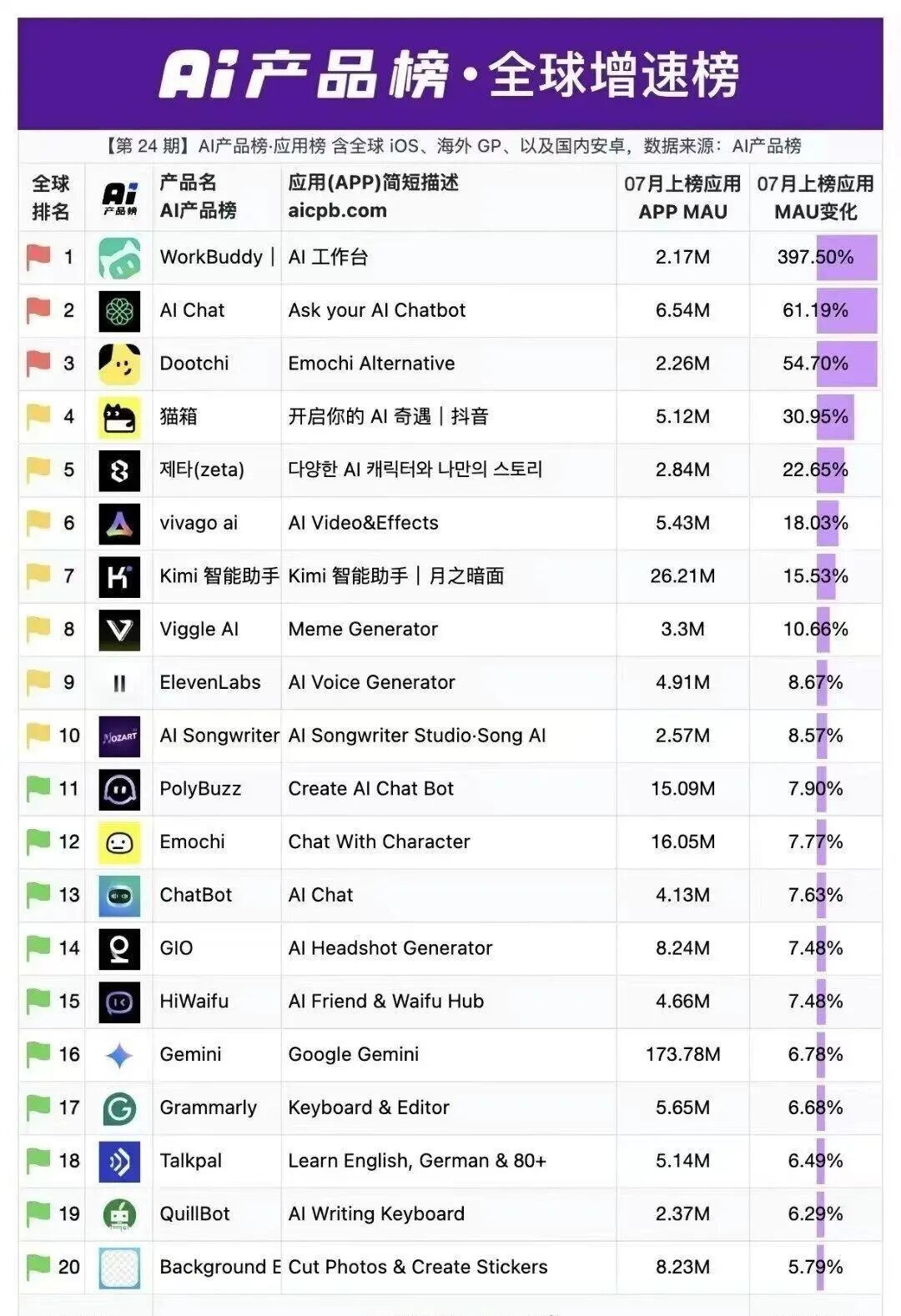
▲Source: AI Product Rankings
For comparison, in July this year, OpenAI's Codex and ChatGPT Work surpassed 10 million MAU.
New product launches, free subsidies, and large-scale marketing can all temporarily boost metrics, but what determines whether an office product has truly gained a foothold is retention.
Tencent is no stranger to this. Earlier this year, Yuanbao saw a rapid surge in popularity thanks to marketing, but as Qianwen ramped up its own campaigns, Yuanbao quickly faded from view.
Especially since Tencent's proprietary models don't hold a clear advantage.
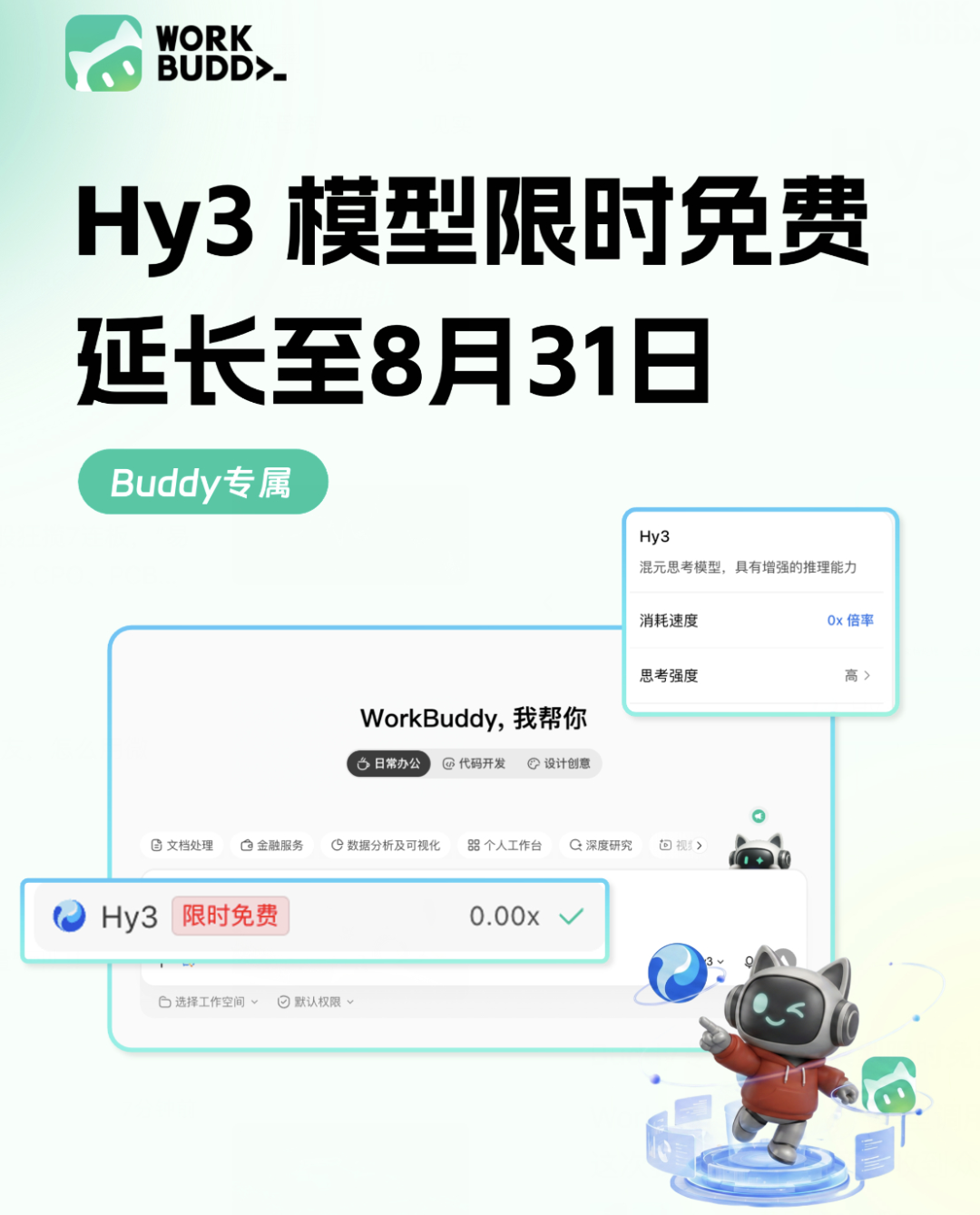
▲WorkBuddy announces the extension of free access to the Hy3 model
Algorithm engineer Qiu Feng told
Admittedly, once office software is integrated into daily workflows, the cost of finding alternatives and adapting to new operations can be significant. However, project files can be migrated, skills can be replicated, and models can be replaced. What is truly difficult to migrate are the data, permissions, and processes that an organization has built around the tools.
To our knowledge, WorkBuddy is making strides in this direction. An AI office sales agent explained that companies can place colleagues and multiple Agents in the same project space to share tasks, intermediate files, Skills, and connectors. The backend also allows for unified management of data security, disk permissions, network blacklists and whitelists, and retains logs of conversations, task execution, and tool invocations.
Some companies have already begun integrating their work methods into the platform. A white-collar worker whose company has uniformly adopted WorkBuddy told us that the company's IT department develops Skills based on internal needs and then makes them available to employees. These Skills incorporate the company's work rules and materials, and employees log in using their WeCom accounts.
But this wall isn't fully built yet, and the competition is already closing in.
Recently, Alibaba and ByteDance have been consolidating their AI office businesses. Alibaba has integrated Agent capabilities originally scattered across teams like QoderWork, Wukong, and MuleRun into "Qianwen Office," which is now under the unified leadership of DingTalk CEO Chen Yusen. Qianwen Office began testing at the end of July, subsequently launched on desktop platforms, and will later be integrated into DingTalk.
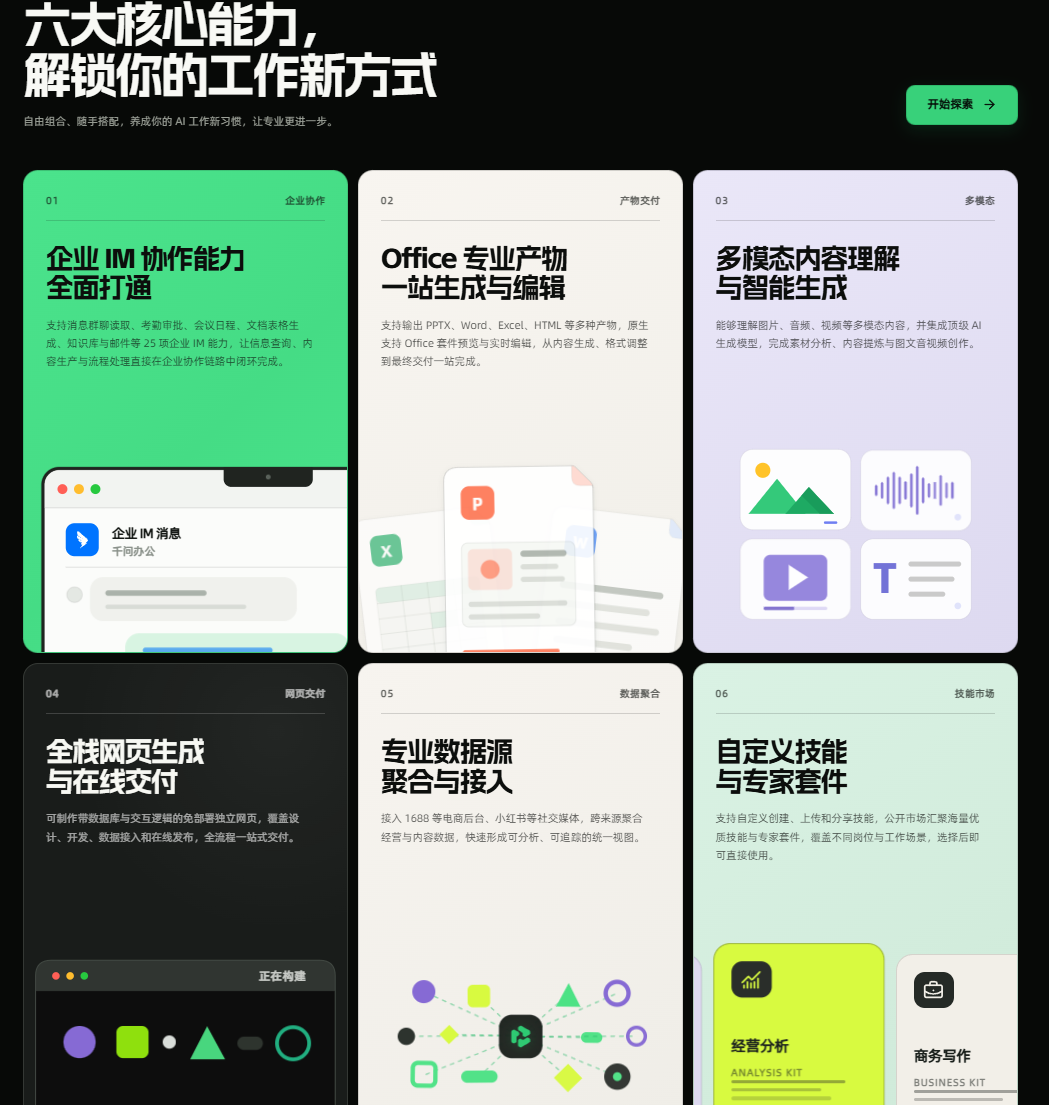
▲ The six core capabilities of Qianwen Office as promoted on its official website
ByteDance has integrated its Feishu product team with the Doubao team, and Feishu GTM has also been merged into Volcano Engine's To B sales system. Meanwhile, the internal testing version of Doubao Enterprise Edition has already begun natively integrating with Feishu documents, spreadsheets, meetings, and group chats.
Currently, both companies hold cards comparable to Tencent's. Alibaba's strengths lie in DingTalk's enterprise access point and the To B customer base accumulated by Alibaba Cloud over the long term. As of the end of March 2026, Alibaba disclosed that over 7.83 million enterprises and organizations had adopted or integrated AI capabilities on DingTalk. ByteDance, on the other hand, is connected to a large number of individual users of Doubao and holds the collaborative office scenarios of Feishu, with Volcano Engine handling model and enterprise commercialization.
An AI entrepreneur stated that WorkBuddy is currently just "temporarily ahead." After recently experiencing Qianwen Office, he felt that although the product is still unstable, overall it is "not much worse than WorkBuddy," with PPT effects even exceeding expectations.
The previous round of AI assistant battles has already proven that securing a seat at the traffic table does not equate to securing a spot in commercialization. Now, with the AI office battle imminent, if the substantial investments Tencent is making today do not translate into revenue and barriers, they may only amount to securing a ticket to a costly battle.
-
![]()
Behind Two Renewed Agreements: Joint Venture Automakers Choose Long-Term Presence in China's New Energy Sector
-
![]()
Will Zunjie’s Launch of Two L3-Ready MPVs Spell the End of the ‘Price Markup Era’ for Alphard and Its Peers?
-
![]()
17 Strategies, 1.8 Billion Parcels, 12.5 Billion Yuan: Huizhou, Guangdong, Paves the Way for Autonomous Vehicle and Drone Delivery
-
![]()
Manus to Regain Independence, Former Shareholders Including Tencent to Repurchase Shares from Meta for $2 Billion
-
![]()
Starting at 99,900 yuan, the Updated Seal 06 Hits the Market. How Should Family Buyers Decide?
-
![]()
In-Depth Analysis of Volkswagen CARIZON’s Proprietary Intelligent Driving Technology
-
![]()
Can a car priced at 80,000 yuan really have LiDAR? Features once exclusive to 300,000-yuan models now available at rock-bottom prices
-
![]()
He Shocked Silicon Valley, Yet Felt Every Day That the Company Was on the Brink