R&D Cycle Cut in Half Following Trends: Joint Venture Automakers Now Producing Quick-Turnaround Vehicles
 08/12 2026
 533
533
Nissan Won’t Be the Last
Author|Wang Lei
Editor|Qin Zhangyong
Are Arrogant Joint Venture Automakers Now Bowing Their Heads?
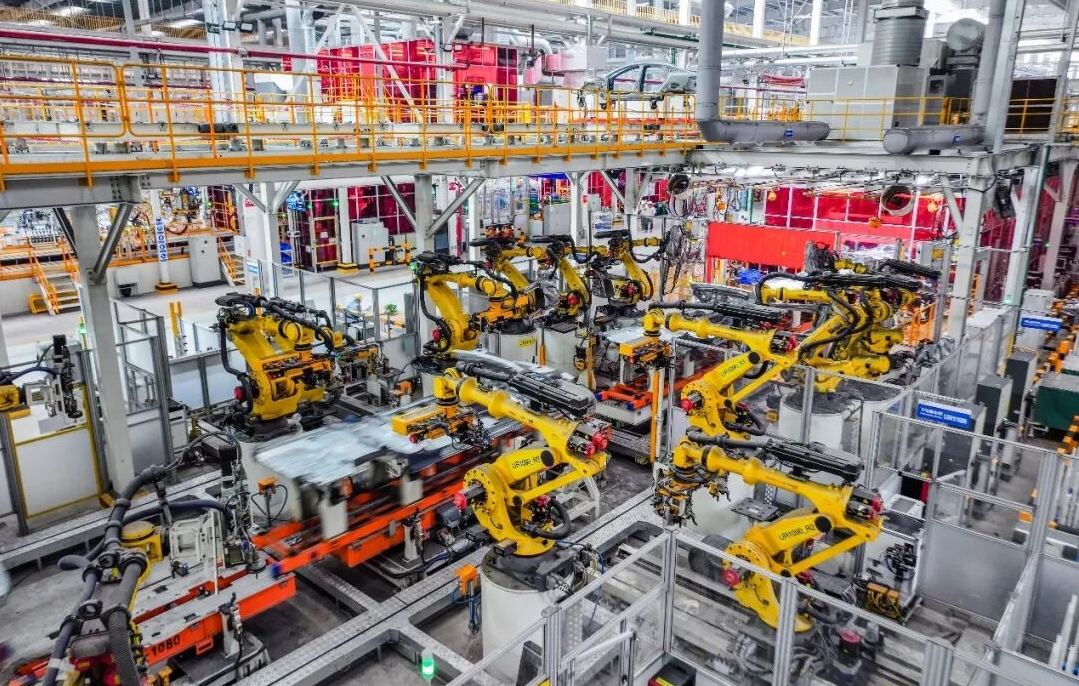
Previously, Nissan took 55 months from project initiation to mass production for a new vehicle—now, it takes just 37 months.
This isn’t due to technological breakthroughs but rather the veteran automaker actively learning from Chinese automakers.
Not only that, but facelift models have also seen their R&D cycles compressed from 50 months to 30 months, representing an overall acceleration of about 40%. This is the latest outcome of Nissan's R&D system reform, as disclosed at its Yokohama headquarters.
As the flagship product of the new process, the upcoming all-new Skyline took just 26 months from project initiation to completion, significantly shorter than the 55-month R&D cycle of the current model.
According to the plan, Nissan will roll out this efficient R&D process to 90% of its vehicle projects by the 2026 fiscal year.
Nissan’s acceleration is not an isolated case.
Stellantis also plans to shorten its vehicle development cycle from up to 40 months to 24 months, while Renault has compressed its new model development cycle to 21 months. Earlier, Volkswagen also accelerated its R&D cycle from 50 months to 36 months, and even the first architecture jointly developed by Volkswagen and Xpeng took just 18 months.
As for why they are all learning from their Chinese counterparts, the response from Nissan executive Kazuyuki Yamaguchi perhaps explains it best: “If the company cannot bring new products to market faster, it cannot survive.”
Many might say this is a victory for the Chinese automotive industry—even century-old brands are copying our homework. However, let’s not forget that amid the ongoing rise of “quick-turnaround vehicles” in China, these veteran automakers are acting against the grain.
01 The R&D Cycle Has Indeed Shortened
Let’s start with a question: How long do you think it takes to build a car?
During the era of internal combustion engine vehicles, the answer was three to four years.
From blueprint to mass production, the process involves design verification, engineering support, bench testing, and real-world road testing across two winters and two summers... Just reliability testing alone requires hundreds of thousands of kilometers.
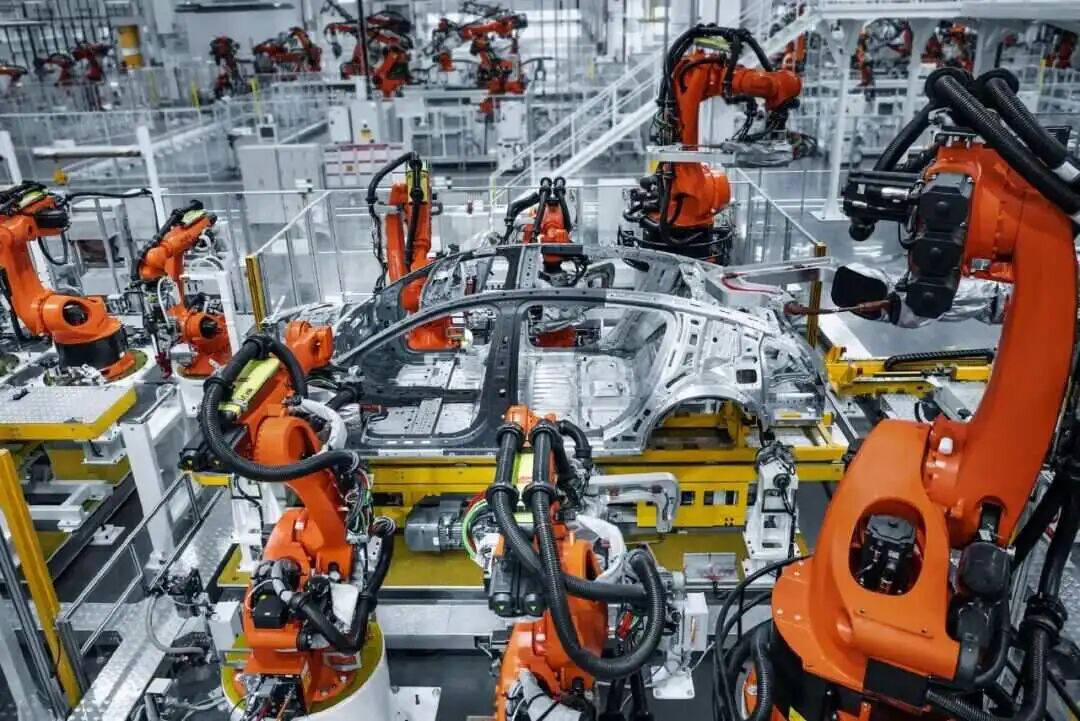
Take Nissan, for example—previously, a brand-new model took 55 months from project initiation to mass production, with multiple design proposals evaluated and selected one by one. Even facelift models required nearly 50 months.
However, with the passage of time and industrial progress, the automotive industry is evolving rapidly, especially with the swift rise of new energy vehicles (NEVs). The automotive market is now advancing at an even faster pace.
Against this backdrop, the iteration rhythm of new vehicles continues to accelerate, with configuration updates happening before launch, monthly OTA upgrades, and increasingly rapid market introductions... Such high-speed operations seem to have become the mainstream development rhythm in today’s automotive market.
Development cycles that once took 3–4 years have now been shortened to 20–30 months, and some NEV manufacturers have even reduced their product cycles to around 18 months. This has completely shattered the traditional consensus of the internal combustion engine era—“minor changes every three years, major updates every five years”—and even cases of “three major updates in one year” have occurred.
More intriguingly, this fast-moving vehicle manufacturing logic, akin to fast-moving consumer goods (FMCG), is now being packaged as advanced experience from the Chinese automotive industry and exported globally. Global veteran automakers like Nissan and Volkswagen are following suit, seemingly marking another milestone in the globalization of Chinese automotive culture.
However, the reality is that China’s automotive culture itself has not yet fully taken shape. Instead, what is being strongly exported first is this FMCG-style vehicle manufacturing culture—characterized by rapid model changes, rapid depreciation, and pressuring consumers to chase the latest trends.
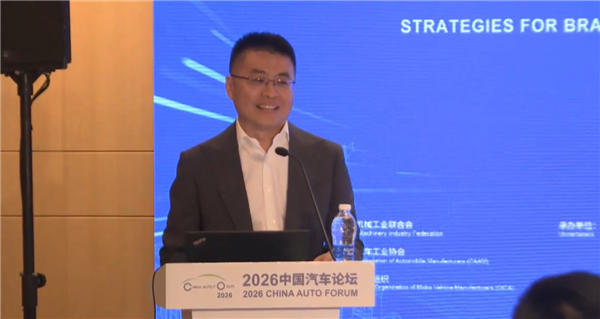
At the 2026 China Auto Forum not long ago, Beijing Hyundai General Manager Li Fenggang publicly criticized this model, giving it a harsh name—“quick-turnaround vehicles.”
In his view, some automakers deliberately skip necessary testing phases to seize market opportunities and accelerate launch timelines, effectively turning consumers into involuntary test drivers and creating serious safety hazards.
02 Backlash Begins
A significant reduction in development cycles also implies simplified processes.
According to Beijing Hyundai General Manager Li Fenggang, vehicle development is divided into two core stages: Design Verification (DV) and Production Verification (PV). DV focuses on verifying the feasibility of design proposals, while PV emphasizes validating the stable production capabilities of mass-production molds and assembly lines. Skipping either stage leads to poor production consistency and significant quality fluctuations.
However, some brands only complete one stage, inevitably leading to deficiencies—which is why some brands suffer from poor production consistency and large quality variations.
Additionally, Fu Yuwu, Honorary Chairman of the Chinese Society of Automotive Engineers and Deputy Director of the China Automotive Industry Consultative Committee, has stated that while recent advancements like simulation technology, platform-based development, and modular design have genuinely improved automotive product development efficiency and reduced costs, allowing for shorter development cycles, he also expressed concerns: “With over 500 new models launched in half a year, can all of them truly go through a complete, systematic development process?” He warned that some companies might adopt a short-term mindset, cutting corners in certain areas to ensure products reach the market as quickly as possible.
As early as last year, multiple employees from a well-known automaker revealed that to meet aggressive production schedules, assembly line workers had to take various shortcuts, even skipping previously required vehicle testing procedures.

Industry insiders also disclosed: “In the past, a fuel-powered vehicle (internal combustion engine vehicle) project would take several years to complete from start to finish. Now, an NEV project is expected to be wrapped up within six months from initiation to completion—the market is so competitive that there’s no time for careful refinement.”
When a third of the development cycle is forcibly cut, what’s eliminated is never “inefficient internal friction” but rather the necessary depth of verification—and the consequences are already emerging.
Lifan serves as a cautionary tale. Early on, to capitalize on NEV subsidies and ride-hailing opportunities, Lifan extremely compressed its verification processes, leading to a single recall of 3,651 units of its 650EV model.
Recently, some NEV models experienced widespread breakdowns during high-temperature weather, with owners questioning whether extreme heat testing had been conducted before launch. Additionally, batteries installed in some commercial vehicles have Centralized occurrence of faults (concentrated failures), with industry insiders speculating that manufacturers, in their rush to seize the market, hastily assembled components and drastically shortened verification testing times.
According to data from the State Administration for Market Regulation, in the first half of 2026, 50 automotive recall announcements were issued nationwide, involving 26 brands and approximately 1.65 million vehicles. Recall volumes for domestic brands surged by 681.2% year-on-year.
03 How Long Should It Take to Build a Car?
Under the industry’s false premise that rapid new product launches equate to “fast market responsiveness,” “strong R&D capabilities,” and “short cycles = competitiveness,” another set of alarming data emerges.
According to Li Yanwei, an expert from the China Automobile Dealers Association, 165 all-new models were launched domestically from January to June 2026. If different configuration variants are included, over 600 new models hit the market during this period, averaging more than 100 per month and at least three per day.
This unprecedented surge in new models has been met with an unprecedented collapse in sales. From a terminal perspective, only 40 out of 768 available models achieved average monthly sales exceeding 10,000 units, accounting for just 5.2%. Less than one-tenth of models shoulder the majority of industry sales, while most “quick-turnaround vehicles” ultimately become market casualties, exacerbating industry resource wastage.
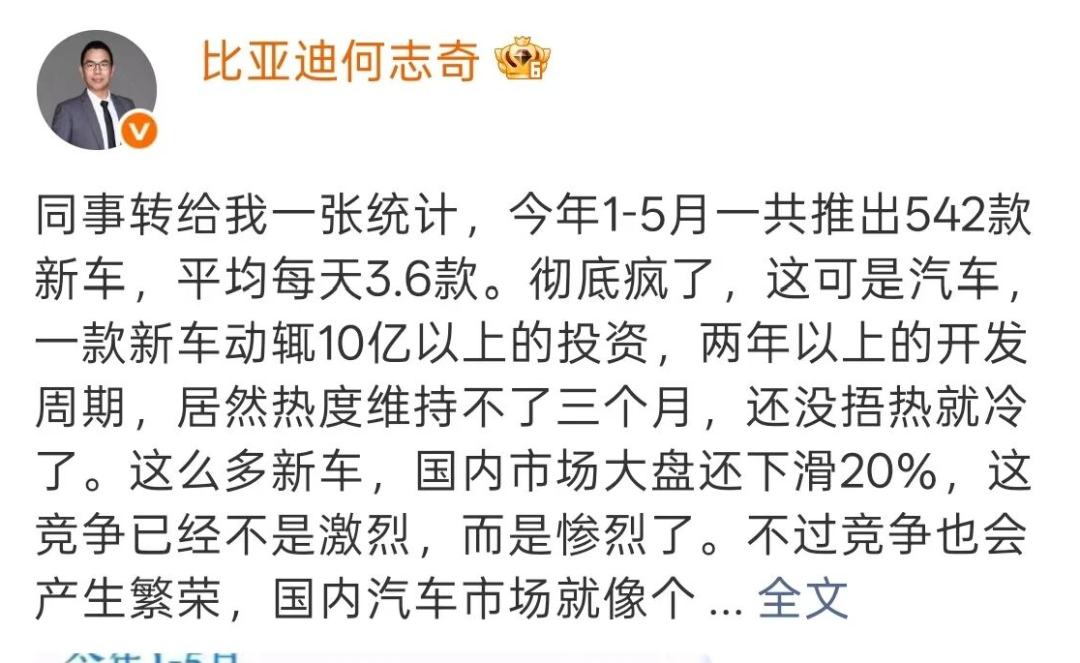
Developing a new vehicle model typically requires over 1 billion yuan in investment and a development cycle exceeding two years, yet market enthusiasm rarely lasts beyond three months, admitted He Zhiqi, Executive Vice President of BYD. Not long ago, Li Bin expressed similar concerns, noting that despite significant spending, new models are highly prone to entering a “valley of death.”
Even more glaring is profitability. In the first half of this year, the automotive industry’s profit reached 195.4 billion yuan, down 20% year-on-year, with a industry profit margin of just 3.8%. Profitability remains weak.
Fortunately, the wheels have begun to turn against “quick-turnaround vehicles.” The National Technical Committee on Automotive Standardization recently opened three NEV approval test regulations for public comment.
The proposed regulations aim to uniformly raise the total reliability driving test mileage for NEV models to no less than 30,000 kilometers, fully aligning with traditional internal combustion engine vehicle standards.
Among them, driving mileage under DC charging should account for ≥90% of the total reliability mileage, i.e., 27,000 kilometers. Plug-in hybrid electric vehicles must complete no less than 10,000 kilometers of reliability testing in pure electric mode. The regulations also specifically note that certain previous national standards no longer meet technological development needs.
Given these consequences, should veteran automakers truly take pride in borrowing the Chinese model and drastically shortening their R&D cycles? Nevertheless, this model must be viewed dialectically, as shorter R&D cycles can indeed serve as a “remedy.”
This requires distinguishing between “slow iteration” and “efficient R&D.” Take Nissan, for example—its executives admit, “If the company cannot bring new products to market faster, it cannot survive.”

Essentially, Nissan’s past R&D cycles were too slow—a vehicle took 55 months (about 4.5 years) from project initiation to mass production. This meant newly launched models were based on market judgments from four years prior, but with shifting consumer preferences and technological advancements, the products always lagged behind.
Moreover, Nissan previously assigned a separate project director, product planning manager, and chief engineer to each new model. Disagreements among the three would lead to conflicts, stalling projects.
Now, Nissan has eliminated redundant executive positions, no longer assigning a project director, product planning manager, and chief vehicle engineer to each new model. Instead, the project director now has the final say, while the chief engineer focuses solely on vehicle production.
Additionally, models are now grouped into hardpoint-shared family platforms, with vehicles on the same platform sharing chassis architectures and key components, significantly shortening design cycles.
This approach is already common among domestic automakers, such as Great Wall’s Guiyuan Platform, Geely’s SEA Architecture, and BYD’s e-Platform 3.0—all of which leverage a single platform to reduce R&D costs and time. Finally, AI and virtual technologies are replacing physical testing, eliminating the need for constant manufacturing and testing of physical models and prototypes.
Thus, more accurately, Nissan’s learning from Chinese automakers is about ensuring its product R&D cycles no longer lag behind market rhythms. In this regard, China’s automotive industry has indeed transitioned from student to teacher.
-
![]()
Behind Two Renewed Agreements: Joint Venture Automakers Choose Long-Term Presence in China's New Energy Sector
-
![]()
Will Zunjie’s Launch of Two L3-Ready MPVs Spell the End of the ‘Price Markup Era’ for Alphard and Its Peers?
-
![]()
17 Strategies, 1.8 Billion Parcels, 12.5 Billion Yuan: Huizhou, Guangdong, Paves the Way for Autonomous Vehicle and Drone Delivery
-
![]()
Manus to Regain Independence, Former Shareholders Including Tencent to Repurchase Shares from Meta for $2 Billion
-
![]()
Starting at 99,900 yuan, the Updated Seal 06 Hits the Market. How Should Family Buyers Decide?
-
![]()
In-Depth Analysis of Volkswagen CARIZON’s Proprietary Intelligent Driving Technology
-
![]()
Can a car priced at 80,000 yuan really have LiDAR? Features once exclusive to 300,000-yuan models now available at rock-bottom prices
-
![]()
He Shocked Silicon Valley, Yet Felt Every Day That the Company Was on the Brink