How Did Anthropic Achieve a $2 Trillion Valuation?
 08/14 2026
 451
451
This article is crafted based on publicly accessible information and serves purely as a platform for informational exchange, not as investment advice.
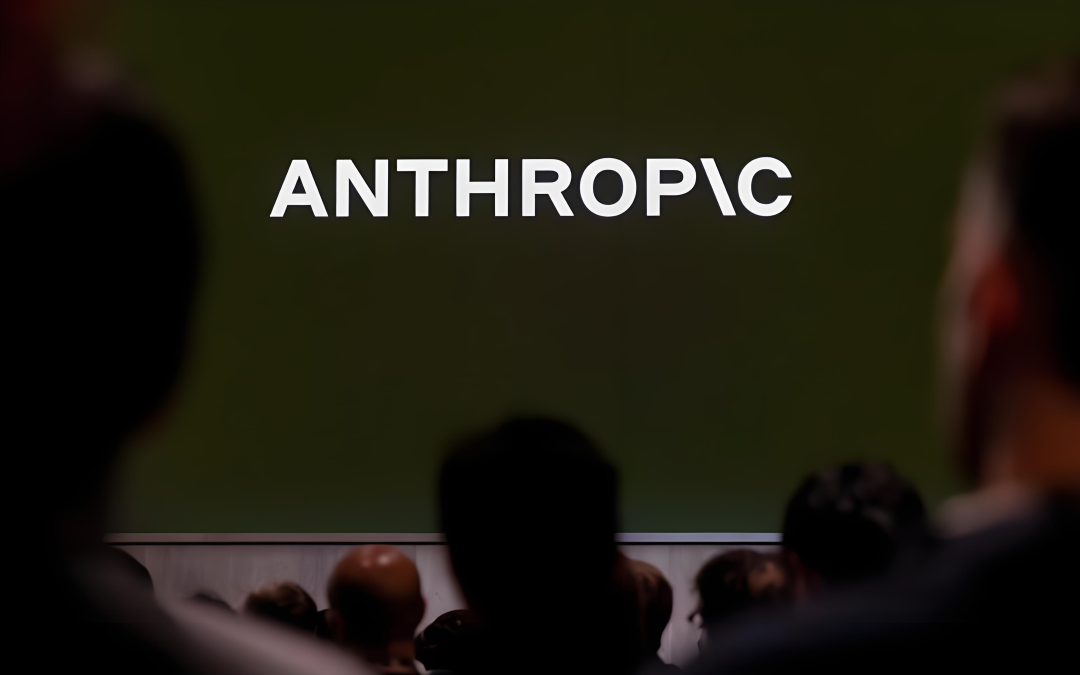
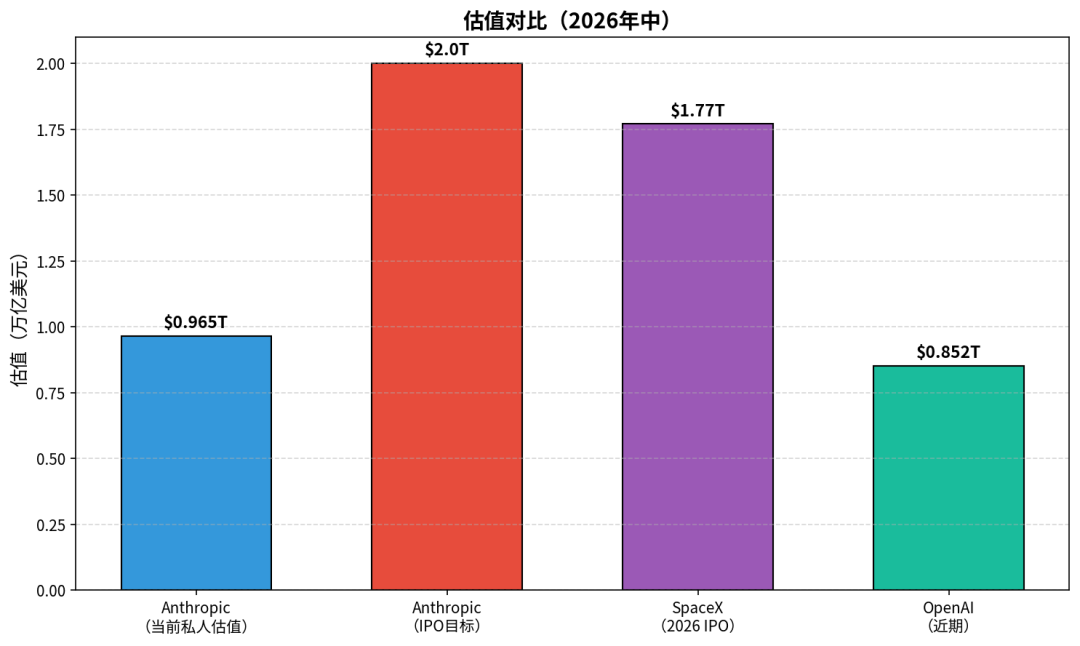
A company that had an annualized revenue of $1 billion just 18 months ago is now projected by investors to achieve a staggering $2 trillion valuation at its IPO.
This valuation surpasses SpaceX's $1.77 trillion and any previous global IPO record.
The question remains: How did this valuation come to fruition?
01 A Unique Growth Trajectory
Anthropic's ARR (Annual Recurring Revenue) growth curve is unprecedented.
Early 2024: $87 million. End of 2025: $9 billion. May 2026: $47 billion. Investors anticipate year-end figures to reach $100-120 billion. All amounts are in USD.
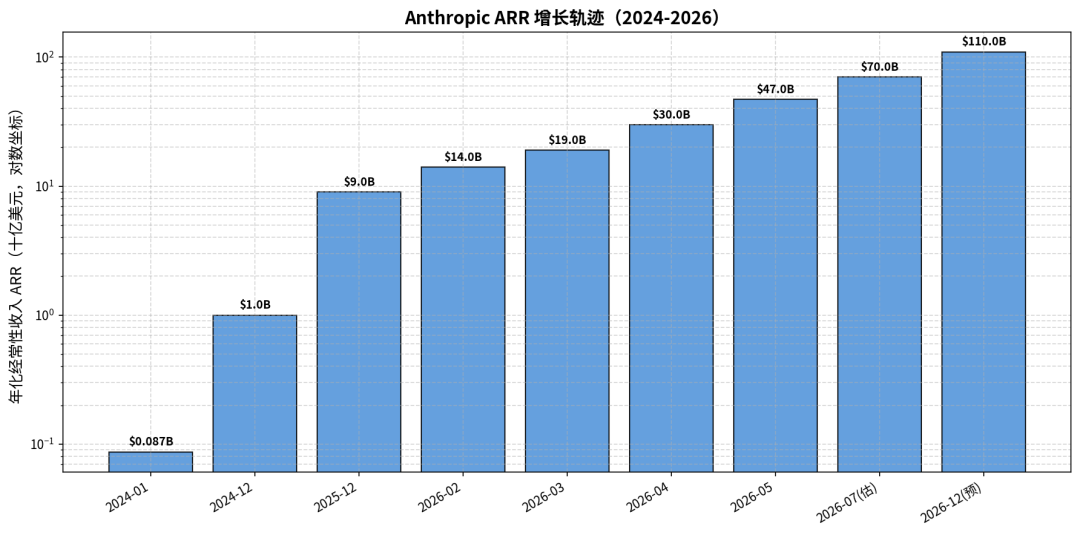
A remarkable 47-fold increase in 18 months.
Q2 quarterly revenue hit $10.9 billion, marking a 130% increase quarter-over-quarter. Operating profit reached $559 million, two years ahead of the company's projections to investors.
The more crucial metric: gross margin.
A year ago, Anthropic's gross margin was -94%, meaning it lost nearly $2 for every $1 earned. In Q2, this figure transformed to +70%. The compute cost per $1 of revenue dropped from 71 cents to 56 cents.
This is no longer a narrative of "burning money for growth." It signifies the inflection point where scale effects start to outweigh unit costs.
02 A Simple Valuation Formula
The $2 trillion valuation algorithm is straightforward:
Year-end ARR × P/S (Price-to-Sales) multiple = Valuation
Investors project a year-end ARR of $100-120 billion. Thus, $2 trillion ÷ $100-120 billion = a P/S ratio of 17-20x.
For comparison, Palantir and Nebius, two AI-beneficiary public companies, currently trade at a 55x P/S ratio with revenue growth significantly lower than Anthropic's.
Investor rationale: A company growing at 800% annually deserves a 30x P/S ratio, implying a $3 trillion valuation. Therefore, the $2 trillion figure is actually "conservative."
Does this rationale hold water? It hinges on whether one believes in the $100 billion year-end ARR projection.
03 A Detailed Breakdown
Delving into the $2 trillion valuation reveals more about its composition than its total.
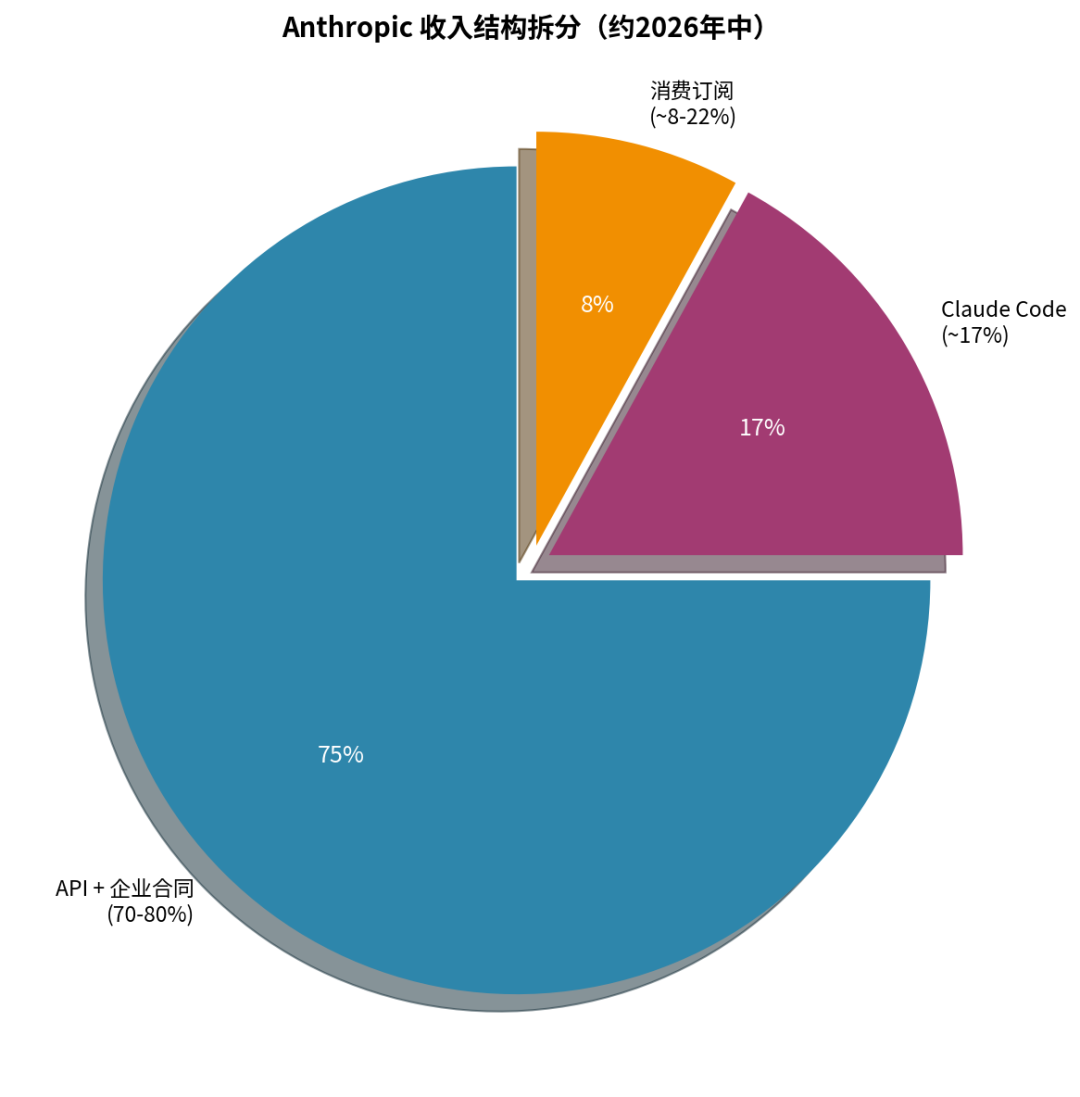
API + Enterprise Contracts (70-80% of revenue): Projected year-end ARR of $70-90 billion. Valued at 18-20x, this segment alone justifies a valuation of $1.3-1.8 trillion. Eight of the Fortune 10 companies are clients, with over 1,000 enterprises spending more than $1 million annually. Anthropic holds a 32% market share in the enterprise-grade LLM API market, surpassing OpenAI's 25%. This is Anthropic's "main engine" and a fundamental divergence from OpenAI, which derives 70% of its revenue from consumer ChatGPT subscriptions, whereas Anthropic derives 70% from B2B token-based billing.
Claude Code (~17% of revenue): ARR surged from $2.5 billion in February to $8 billion, tripling in nine months. Approximately 4% of public GitHub code submissions are now generated by it. A product that didn't exist 14 months ago now annualizes $8 billion, valued at 25-30x for $200-300 billion.
Consumer Subscriptions (~8-22% of revenue): The most stable but slowest-growing segment, valued at 12-15x for $120-225 billion.
Total: The central valuation range falls between $1.7-2.3 trillion.
Of course, this excludes substantial compute infrastructure and future discounted valuations of equity stakes in numerous industrial chain startups.
04 Potential Cracks in the Valuation
The $2 trillion valuation also exhibits clear vulnerabilities.
Firstly, pricing power is questionable. Anthropic's flagship model costs 2.5 times that of OpenAI's, while Chinese open-source models cost a fraction. Payment data from Ramp indicates that enterprise AI spending has "hit a ceiling" and begun migrating to cheaper models. When customers start comparing prices, high pricing ceases to be a competitive advantage.
Secondly, the July bill. Q2's profit window coincided with discounted periods in xAI Colossus's compute agreement. Starting in July, full-price bills of $1.25 billion per month commence. The company itself warned that full-year profitability may not be sustainable. Q2's $559 million profit may prove to be a "discount window illusion."
Thirdly, revenue quality. Anthropic's largest clients are also its investors and compute suppliers—Amazon invested $8 billion, Google over $1 billion. Both are also the largest cloud distribution channels. Portions of revenue essentially carry related-party transaction attributes. Fully market-driven growth quality requires a full cycle to verify.
Fourthly, governance tensions. As a Public Benefit Corporation (PBC), Anthropic is legally required to balance the interests of all stakeholders, not just shareholders. CEO Amodei rejected a Defense Department directive this year to remove Claude's safety guards, resulting in classification as a supply chain risk. Public market investors are buying into a company legally permitted to "sacrifice revenue for safety."
05 A Judgment Call
Is a $2 trillion valuation excessive?
If the year-end ARR truly reaches $100 billion, a 17-20x P/S ratio is not unreasonable in the AI sector. Palantir, with far inferior growth, enjoys a 55x P/S ratio.
The issue lies not with the P/S multiple but with the numerator: The $100 billion ARR assumption requires doubling from $47 billion within seven months—a projection based on investment banks and optimistic investors, not the company's own guidance.
The real risk is that "the growth curve bends in some quarter." Once growth shifts from vertical to merely steep, the pricing logic changes from "30x is reasonable" to "10x is the floor." Public markets, unlike private ones, reprice in the quarter growth slows.
Anthropic has proven in 18 months that AI can grow at software-like speeds. Now it must demonstrate over a longer period that this growth translates to profits, not just larger compute bills.
06 The Most Critical Conclusion
To put it euphemistically, this $2 trillion valuation essentially represents a bet on "AI reasoning becoming the next infrastructure of human civilization."
But to speak frankly, this $2 trillion figure likely represents strategic leakage from Anthropic and its investment banks to gauge market reactions before the IPO, aiming to establish a super-premium pricing ceiling.
Ultimately, whether you believe in or follow this valuation depends on your perspective.

-
![]()
Did Zhong Shanshan Make a Mistake?
-
![]()
Flash Charging and 'Celestial Eye': Standard Features in Qin MAX, Positioned to Challenge B-Class Sedans
-
![]()
Wey's Quandary: Can't Afford to Lose Blue Mountain, Yet V Series Struggles to Gain Ground
-
![]()
Google AI Sees Personnel Turmoil: Full-Stack as a Moat, but Also a Source of Conflict
-
![]()
Lenovo Group is Making Big Moves: Server Business Takes Off, AI Server Backlog Orders Reach 360 Billion Yuan!
-
![]()
WPS: A Future Plugin in the Making?
-
![]()
Zhang Xue Motorcycle Secures Sole Investment from Sequoia China, Valuation Soars to 6 Billion Yuan Post-Investment
-
![]()
Online Buzz: Alleged Leak of 'Little Blue Light' Rectification Blueprint