Online Buzz: Alleged Leak of 'Little Blue Light' Rectification Blueprint
 08/14 2026
 353
353
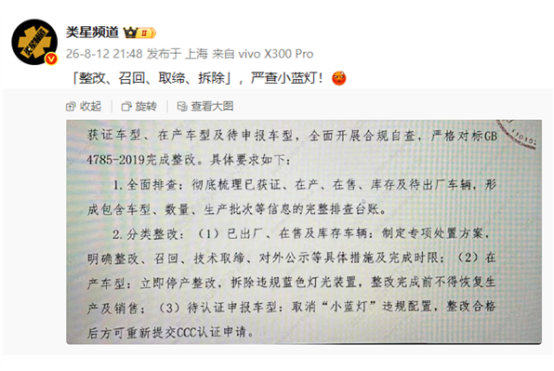
A purported rectification strategy for the 'Little Blue Light' has recently been making waves across the automotive sector. Based on the disclosed information, the overhaul will encompass certified vehicles, models currently in production, and those awaiting certification. Automakers are mandated to promptly undertake a thorough self-audit for compliance and execute rectifications in strict adherence to the GB4785-2019 guidelines.
The specific rectification measures are categorized into three:
● For vehicles already produced, on sale, or in stock, a tailored plan must be devised, outlining steps for rectification, recall, technical discontinuation, and public disclosure, along with specified deadlines for completion.
● Models in production must cease manufacturing immediately for rectification, remove unauthorized blue light devices, and refrain from resuming production and sales until rectification is verified.
● Models pending certification will have their unauthorized 'Little Blue Light' configurations nullified and can only reapply for CCC certification post-rectification approval.
In essence, necessary stops will be made, removals will be executed, and recalls will be initiated. However, as of this moment, no official directive from the relevant authorities has been made public concerning these specific rectification particulars. The ultimate scope and implementation strategies are still pending official validation.
The 'Little Blue Light' was initially tested by Mercedes-Benz on autonomous driving test vehicles. Since 2022, it has been widely adopted in production by brands like Li Auto, Zeekr, and NIO. Mounted on rearview mirrors, grilles, roofs, or rear sections, the blue light activates automatically when assisted driving is engaged, signaling to nearby vehicles that 'this vehicle is in intelligent driving mode.' Nevertheless, post-implementation, it has been increasingly misused, leading to a host of issues.
Firstly, it breaches regulatory boundaries. The current mandatory national standard, 'Installation Requirements for External Lighting and Light Signalling Devices of Motor Vehicles and Their Trailers' (GB 4785-2019), specifies that external lights on civilian vehicles can only utilize white, red, yellow, and amber hues. Blue is exclusively designated for special vehicles like police cars and ambulances. The 'Little Blue Lights' installed by automakers have never been sanctioned by the standard and have long operated in a regulatory gray area.
Secondly, safety concerns arise. Assisted driving systems tend to be cautious and yield to merging traffic. Some drivers, upon seeing the blue light, may intentionally merge or test the limits of assisted driving, thereby heightening the likelihood of scrapes and rear-end collisions. Furthermore, the brightness and flashing patterns of 'Little Blue Lights' vary significantly, potentially causing glare at night and interfering with other drivers' judgment, thus objectively escalating road risks.
In July, the prohibition of the 'Little Blue Light' was unveiled. According to numerous media sources, due to non-compliance with GB 4785-2019, the 'Little Blue Light' has been banned for newly certified vehicle models starting from July 27, 2026.
On July 29, the China Automotive Technology and Research Center (CATARC) officially responded, stating that it would revise pertinent standards and tighten oversight of 'aggressive' innovative design endeavors.
Overall, a fresh round of revisions to GB4785 has commenced, with the plan number 20262535-Q-339. It is anticipated that an official document will be issued shortly. From an industry development standpoint, the ban on the 'Little Blue Light' does not herald the end of intelligent driving lighting but rather a redefinition of the boundaries between intelligent vehicle innovation and road safety standard frameworks. Automakers cannot arbitrarily devise a set of light signals that infiltrate the public signaling system under the guise of market innovation. Moving forward, the industry may introduce compliant external warning solutions for intelligent driving.
-
![]()
Did Zhong Shanshan Make a Mistake?
-
![]()
Flash Charging and 'Celestial Eye': Standard Features in Qin MAX, Positioned to Challenge B-Class Sedans
-
![]()
Wey's Quandary: Can't Afford to Lose Blue Mountain, Yet V Series Struggles to Gain Ground
-
![]()
Google AI Sees Personnel Turmoil: Full-Stack as a Moat, but Also a Source of Conflict
-
![]()
Lenovo Group is Making Big Moves: Server Business Takes Off, AI Server Backlog Orders Reach 360 Billion Yuan!
-
![]()
WPS: A Future Plugin in the Making?
-
![]()
Zhang Xue Motorcycle Secures Sole Investment from Sequoia China, Valuation Soars to 6 Billion Yuan Post-Investment
-
![]()
Online Buzz: Alleged Leak of 'Little Blue Light' Rectification Blueprint