CoreWeave, Nebius: Compute Power Price Hikes, Backing from 'Godfathers' – How Long Can NVIDIA's 'Adopted Sons' Thrive?
 08/14 2026
 338
338
Behind the recent surge of new cloud platforms like Nebius and CoreWeave, combined with their performance and earnings calls, it is clear that the current industry demand for AI cloud computing significantly outstrips supply.
Take Nebius as an example. For medium- to long-term contracts spanning 1-3 years, the compute power price stands at $20-25 billion/GW. However, to secure better pricing, the company intentionally reserves some retail capacity and employs an auction-based approach, allowing customers to bid competitively, with the highest bidder winning. Pricing can reach $50 billion/GW through this method.
Historically, enterprise projects have seen cloud providers bidding competitively. The reversal of this dynamic, not to mention the 2X price difference between long-term and spot prices, underscores the current severe seller's market in the AI cloud computing sector.
I. How Long Can the Significant Mismatch in AI Compute Supply and Demand Last?
In this scenario, whether for emerging cloud providers or established cloud giants, the prevailing logic suggests that cloud providers with operational capacity this year should be rewarded.
Due to this, SpaceX supports approximately $200 billion in capital expenditures with projected revenue of less than $50 billion by 2026 (calculated based on the company's targeted compute capacity increase); similarly, Meta has shifted from building in-house compute capacity to meet internal demand to continuing heavy investment in AI model development, albeit not outstandingly, and transitioning to cloud computing rental businesses.
After all, when linearly extrapolating compute power prices based on this year's pricing, the $25-50 billion/GW pricing allows cloud providers to recoup their investments within 1-2 years. Subsequent rental income and residual value from decommissioned equipment represent additional earnings.
The essence of this supply-demand mismatch lies in the fact that model training, a software engineering capability, can advance non-linearly; however, AI compute capacity involves physical-world construction, production, and manufacturing.
Models can undergo major iterations every six months, directly increasing token demand by 10X, but physical-world construction and commissioning follow a linear 1.5-2 year timeline. The rapid advancement of the virtual world, constrained by the physical world's limitations, results in a significant supply-demand mismatch.
Therefore, I personally dare not linearly extrapolate next year's compute pricing based on 2026's pricing. Based on the current capital expenditure progress of major players, such as Meta and SpaceX, which both aim for 6-8 GW commissioning plans by 2027, I estimate that compute capacity will enter a period of concentrated deployment in 2027.
From a safety perspective, I believe the focus should be on identifying major players with early and large-scale Capex investments, such as Amazon and Microsoft. During the period of certain supply-demand mismatches, these companies are the ones with tangible revenue inflows.
II. NVIDIA's 'Godfather' Steps In
The recent surge in new cloud providers is not only a market reward for these players in a buyer's market but also backed by NVIDIA's $500 billion financing platform.
Initially, major cloud providers supported their enormous capital expenditures with operational cash flows. Once these were exhausted, they turned to on-hand reserves, followed by financing when reserves ran low.
The financing options follow a sequence: first, on-balance-sheet debt issuance; then, off-balance-sheet debt; followed by convertible debt; and finally, equity financing. The stronger the equity component, the higher the financing costs. However, as a capital-intensive business, major players enjoy significantly lower financing costs than emerging cloud providers.
Emerging cloud providers like CoreWeave face interest rates as high as 8-9% (vs. around 5% for major players) when issuing debt, secured by their purchased GPU equipment or customer contract cash flows. Alternatively, like Nebius, they may opt for convertible debt + equity issuance, resulting in significantly higher financing costs.
The issue is that with annual revenues of $10-20 billion and capital expenditures of $30-40 billion, bond financing secured by assets is insufficient, while heavily diluted equity financing proves too costly.
At this juncture, NVIDIA, the 'godfather' of emerging cloud providers, has stepped in to make a significant move. It has formed a consortium with six financial institutions—Apollo, BlackRock, Blackstone, Brookfield, Goldman Sachs, and KKR—signing a memorandum of understanding to establish a $500 billion financing pool through an independent platform, helping emerging cloud providers overcome financing bottlenecks.
Details remain scarce, but based on various clues, the arrangement is likely similar to Meta's off-balance-sheet financing logic. However, key terms, such as NVIDIA's residual value or project guarantee ratios, as well as specific interest payment schedules, await further details in NVIDIA's earnings report.
The following image, created during my analysis of Meta's off-balance-sheet financing, provides a rough estimate. Replacing the minority funding partners in the joint venture with NVIDIA + NeoClouds and shifting the residual value guarantee responsibility from Meta to NVIDIA would yield a similar structure.
The core of this arrangement is the residual value guarantee: NVIDIA's involvement and endorsement are essential to attract capital from funds like BlackRock and Blackstone, which prioritize certain and priority returns.
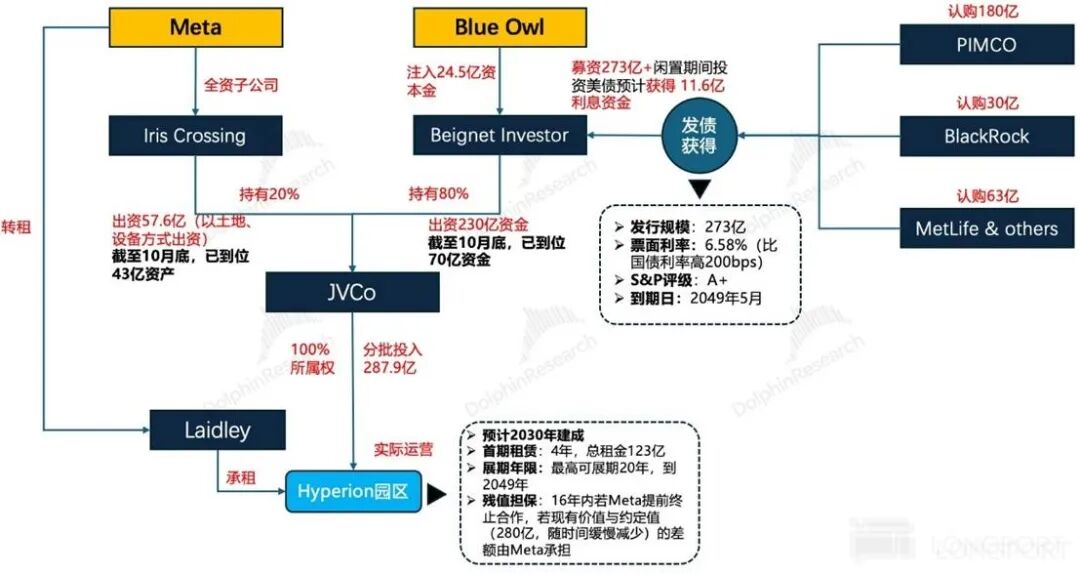
For these funds, the recovery of principal and interest has only two sources: a. Stable rental income from AI factory leases; b. Liquidation value of factory equipment in case of tenant default, with factory buildings experiencing minimal depreciation, while IT equipment showing greater variability.
The first scenario poses no concern; the primary issue arises in the second scenario, where the combined a + b must first ensure capital preservation and ideally some guaranteed return for funds like Blackrock.
Since emerging cloud providers lack the capability to develop in-house ASICs and rely entirely on NVIDIA GPUs + networking equipment, the core variable in equipment liquidation is the GPU. NVIDIA's residual value guarantee ensures sufficient recovery from equipment sales to preserve capital, which is crucial for the $500 billion financing pool.
From NVIDIA's perspective, while selling GPUs at a $100 price point (with a $25 cost) previously represented clean revenue, this new sales approach introduces an off-balance-sheet contingent liability when recognizing income and profits.
Given the declining moat of NVIDIA GPUs in the inference era, the additional cost NVIDIA pays to secure $100 in certain revenue is aimed at ensuring GPU market share amid widespread in-house ASIC development by major cloud providers. NVIDIA supports emerging cloud providers through financing to narrow the cost gap between emerging and major cloud players.
NVIDIA must ensure that the guarantee amount does not erode the $75 gross profit from this revenue. NVIDIA's willingness to provide such guarantees indicates its belief, amid hardware upgrades, that CUDA system improvements and software performance enhancements can extend the service life of older-generation GPUs, providing liquidation opportunities even if a single data center underperforms.
Under this arrangement, NVIDIA effectively mobilizes social capital to finance GPU compute factories, expanding the footprint of emerging cloud providers to compete with ASICs.
Depending on the payment terms for data center leases, securing this funding would be a boon for emerging cloud providers, most of which hold substantial backlogs of orders but lack the capacity to fulfill them. With on-balance-sheet leverage already high, this move safely shifts leverage off-balance-sheet, alleviating balance sheet and equity dilution pressures—a clear positive.
In the competition between emerging and established cloud providers, the cost gap between ASICs and GPUs persists, and established players' advantages, such as cross-border multi-cloud deployments, remain. However, at least in terms of financing, the $500 billion financing platform narrows the financing cost gap between the two camps, reducing financial pressure on emerging cloud providers and allowing them to focus more on project execution.
- END -
// Reprint Authorization
This article is an original piece by Dolphin Research. Reproduction requires authorization.
// Disclaimer and General Disclosure
This report is intended for general comprehensive data purposes, providing Dolphin Research and its affiliated institutions' users with general browsing and data reference. It does not consider the specific investment objectives, investment product preferences, risk tolerance, financial status, or special needs of any individual receiving this report. Investors must consult with independent professional advisors before making investment decisions based on this report. Any investment decisions made using or referring to the content or information in this report are at the investor's own risk. Dolphin Research shall not be liable for any direct or indirect responsibilities or losses arising from the use of the data contained in this report. The information and data in this report are based on publicly available sources and are for reference purposes only. Dolphin Research strives to ensure but does not guarantee the reliability, accuracy, and completeness of the information and data.
The information or viewpoints mentioned in this report shall not be considered or construed as an offer to sell securities or an invitation to buy or sell securities in any jurisdiction. They also do not constitute recommendations, inquiries, or endorsements of relevant securities or related financial instruments. The information, tools, and data in this report are not intended for or intended to be distributed to jurisdictions where distribution, publication, provision, or use of such information, tools, and data conflicts with applicable laws or regulations or requires Dolphin Research and/or its subsidiaries or affiliates to comply with any registration or licensing requirements in such jurisdictions, nor to citizens or residents of such jurisdictions.
This report reflects only the personal viewpoints, insights, and analytical methods of the relevant creators and does not represent the stance of Dolphin Research and/or its affiliated institutions.
This report is produced by Dolphin Research, and the copyright is solely owned by Dolphin Research. Without prior written consent from Dolphin Research, no institution or individual may (i) produce, copy, duplicate, reproduce, forward, or create any form of copies or replicas in any manner, and/or (ii) directly or indirectly redistribute or transfer them to other unauthorized persons. Dolphin Research reserves all relevant rights.
-
![]()
The 'Lin Junyang Phenomenon' in AI Venture Capital
-
![]()
JD's Profit Increases While Revenue Stagnates: What is Liu Qiangdong After?
-
![]()
Creating "Liquid Lenses" with 70-Millisecond Focal Length Switching: Is XR Headset Zooming on the Horizon?
-
![]()
Xingyun Technology’s Remarkable Surge Over the Past Six Months
-
![]()
Chery Enters Korean Market with $75 Million Investment: A Strategic Model Combining Defense and Offense
-
![]()
JD Delivers an 'Above Expectations' Earnings Report, but the Market Doesn't Buy It
-
![]()
The 'Boxy' SUV Market Welcomes a 'Behemoth': Can the Great Wall H10 Stand Its Ground?
-
![]()
Half-Year Report | In the first half of 2026, sales volume of China's smart glasses market soared by 85.5%, with sales amount doubling; full-year sales volume forecast to reach 2.5 million units