Half-Year Report | In the first half of 2026, sales volume of China's smart glasses market soared by 85.5%, with sales amount doubling; full-year sales volume forecast to reach 2.5 million units
 08/14 2026
 535
535
This article is approximately 3,000 words long and will take 15 minutes to read. It is recommended to bookmark it first or choose to read specific chapters.
According to the
Quarterly Sales Volume Trends in China's Smart Glasses Market from 2025 to the First Half of 2026 (H1 2026)
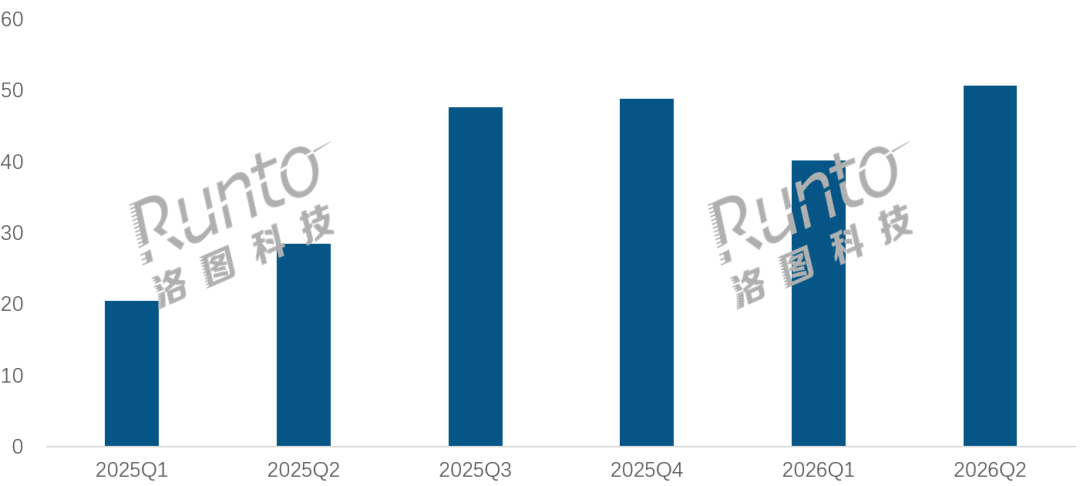
Data source: Runto omni-channel data, unit: 10,000 units, %
The core driving force first comes from changes on the supply side. The unprecedented enrichment of brands, products, and technologies has directly activated consumer demand. Home appliances/consumer electronics, display panel, and major internet companies have all rushed into the market, continuously expanding the number of market participants. By the end of June, both new and established players such as Thunderbird Innovation, Rokid, VITURE, Huawei, and iFLYTEK have launched flagship new products.
The explosion on the demand side is the result of the combined effect of policy dividends and price reductions. In 2026, smart glasses were included in the national consumer goods trade-in subsidy categories for the first time, allowing individual consumers to enjoy a subsidy of “15% of the selling price, with a cap of 500 yuan,” directly lowering the threshold for the public to try them out. Coupled with the continuous price reductions of mainstream products, offline large models can now be equipped at prices around 1,000 yuan, accelerating the penetration of smart glasses from the geek community to the mass market.
Overall, Runto believes that currently, the smart glasses sector is in a high-growth dividend (dividend) Explosion period (outbreak period), representing one of the most certain growth poles in the global and Chinese consumer electronics fields.
I. Segmented Category Scale: AR Glasses Lead in Scale, Camera Glasses See Significant Growth, Audio Glasses Growth Slows Down
According to product form and function, Runto classifies smart glasses into AR glasses (with display + audio), audio glasses (without display + with audio), and camera glasses (without display + with camera).
In the first half of 2026, there was a certain differentiation in the market performance of various segments in China's smart glasses market: AR glasses and camera glasses achieved significant growth, while the growth of AI audio glasses slowed down. Runto believes that this reflects differences in the commercialization maturity of different technology routes and also indicates that the future market will further concentrate on tracks with high scenario value and high AI empowerment.
According to Runto's omni-channel data, the sales volume shares of AR glasses and camera glasses increased by 5.1 and 9.7 percentage points, respectively, to 44.9% and 34.4%; correspondingly, the sales volume share of audio glasses decreased to 20.7%.
Changes in the Sales Volume Structure by Product Type in China's Smart Glasses Market in the First Half of 2026 (H1 2026)
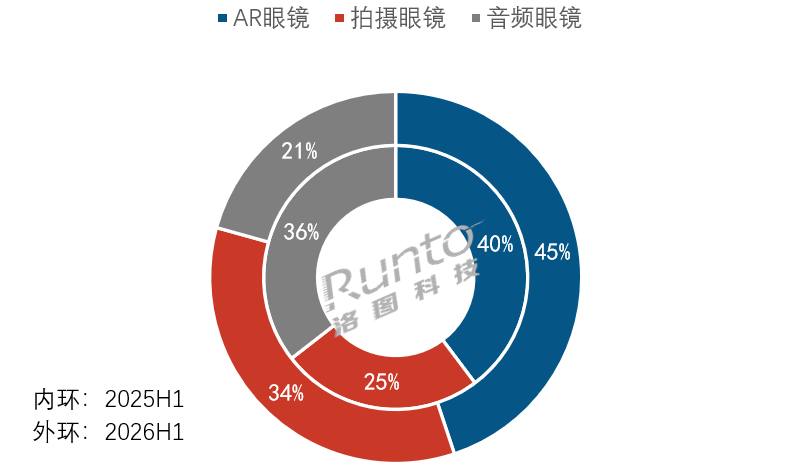
Data source: Runto omni-channel data, unit: %
China's AR glasses market saw sales volume of 408,000 units in the first half of 2026, up 109.4% year-on-year. Among them, all-in-one AR glasses continued the 37.7% quarter-on-quarter growth rate from the first quarter, becoming the core engine driving category growth. Their sales volume share with tethered AR glasses surged from 9:91 in the first quarter of 2025 to 47:53 in the second quarter of 2026. Behind this explosive growth is the intense product offensive by leading brands in the first half of the year. In terms of technology routes, the market share of the single-green waveguide solution quickly increased from 9.1% in the same period in 2025 to 57.3% this year, gradually surpassing the traditional Birdbath solution, with product pricing also dropping to the mainstream range of 2,000-2,999 yuan. AR glasses have been able to expand from the tech enthusiast community to a broader young consumer group.
Camera glasses saw market sales volume of 313,000 units in the first half of 2026, up 158.2% year-on-year, making it the fastest-growing track among the three categories. This high growth stems from both the continuous expansion of rigidity demand scenarios such as Vlog creation and outdoor sports, as well as the precise breakthroughs by leading brands in product definition. Camera glasses are evolving from a single functional tool to a fusion carrier of “fashion accessory + smart device,” with fashionable design and scenario segmentation strategies continuously activating consumer demand and pushing the category boundaries outward.
Audio glasses saw market sales volume of 188,000 units in the first half of 2026, up 8% year-on-year, with the growth rate significantly slowing down from its previous high-speed growth trend. This slowdown is not accidental but the result of multiple factors superposition . Audio glasses were once the earliest and most mature category in the smart glasses market in terms of commercialization, but currently, their functions appear single and highly homogeneous, being replaced by “audio + camera” and lightweight AR glasses, and lacking irreplaceable rigid demand scenarios. More importantly, the strategic focus of mainstream brands is undergoing a systematic shift, with significantly reduced resource investment and market priority for audio glasses.
II. Brand Competition: Intense Ranking Competition, No Stable Landscape Formed Yet
Despite the overall high-speed growth of the market in the first half of 2026, the smart glasses track is far from forming a stable brand competition landscape; instead, it is in the most intense reshuffling cycle in recent years.
According to Runto data, in the first half of 2026, in China's online smart glasses market, the top four brands in terms of sales volume were Thunderbird, Rokid, Qianwen, and Huawei; their combined share was 56% in the first quarter and decreased to 53% in the second quarter.
Thunderbird Innovation and Rokid together accounted for more than 30% of shipments, leading the industry; Qianwen and Huawei are close in share and, along with Xreal, Kuake, and Xiaomi, form a middle tier based on different positioning.
Brand Sales Volume Share in China's Online Smart Glasses Market in the First Half of 2026 (H1 2026)
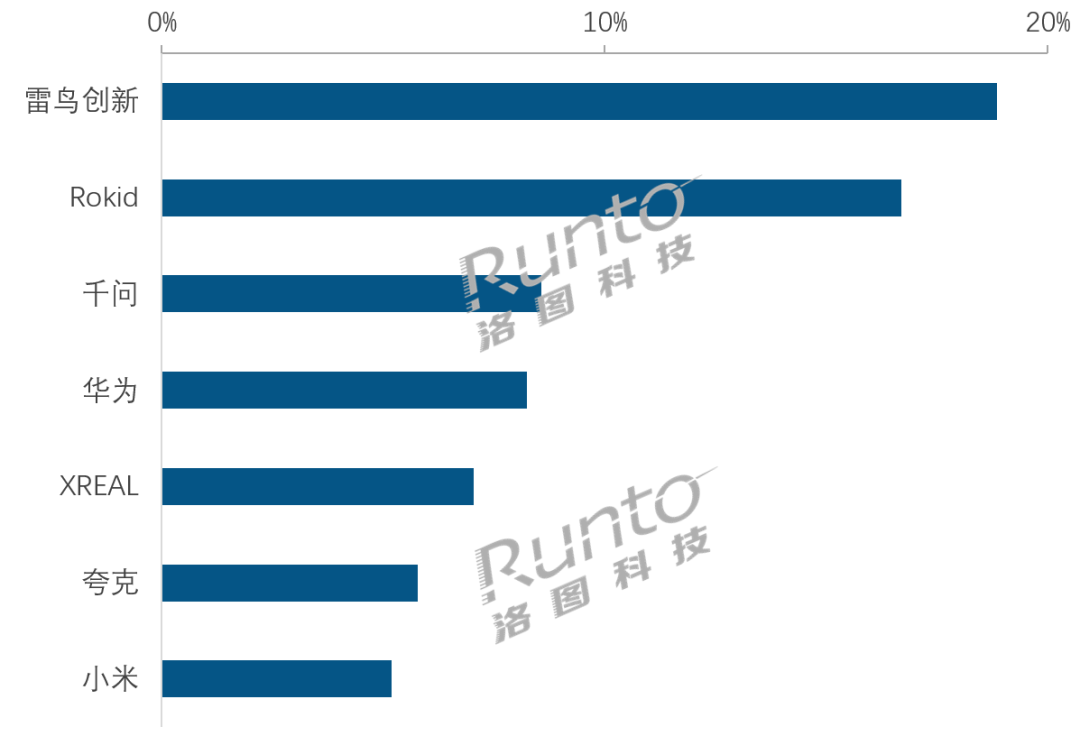
Data source: Runto online omni-channel data, unit: %
Thunderbird Innovation holds an 18.9% sales volume share in the overall online market, ranking first; its sales volume share in the AR glasses category is even as high as 28.5%. Besides its first-mover advantage, Thunderbird is currently one of the few companies in the industry that has achieved full-link self-control capabilities for core optical solutions, from design and manufacturing to complete machine production, and has gained leading advantages in capacity assurance and cost control by building its own optical factory and complete machine production line. At the product level, Thunderbird has built a full-category, multi-price-segment product matrix covering AR cinema glasses (Air/X/GT series) and camera glasses (V series). According to industry chain information, it will also launch a new AI glasses model, “Thunderbird iO,” in August this year, focusing on lightweight design and daily wear experience, further expanding its layout in the smart glasses market.
Rokid holds a 16.7% sales volume share, ranking second in the overall online market, but its product premium capability is strong, with a higher share in terms of sales amount than sales volume. Rokid's core competitiveness lies in its hit product strategy and open ecosystem. Firstly, its hit product, Rokid Glasses, integrates functions such as real-time translation, AI Q&A, and AR navigation in a lightweight body; secondly, its differentiated barrier of a fully open AI ecosystem strategy supports free switching among multiple models such as Qianwen and Doubao, and it released the AI operating system YodaOS for smart glasses in June, while also integrating the two major payment systems of Alipay and WeChat.
Qianwen ranks third in the overall online market with an 8.6% sales volume share. Qianwen deeply cultivates the camera glasses segment and ranked first in the online market in this track in the first half of the year, with a sales volume share of 23.3%, representing a “dark horse breakthrough” empowered by the Alibaba ecosystem. Its competitiveness lies in the synergy of “large model + ecosystem,” deeply integrating Alibaba-owned applications such as Taobao, Gaode, Alipay, and Kuake Cloud Disk, allowing users to complete operations such as ordering takeout, tracking logistics, and scanning code payments through voice, forming a cross-terminal behavior closed loop (closed loop).
Huawei ranks fourth in the overall online market with an 8.2% sales volume share. In April this year, Huawei officially launched its first HarmonyOS AI camera glasses, leveraging its cross-device interconnection capabilities and large mobile phone user base to achieve a 16.5% sales volume share in the camera glasses market in the first half of the year, ranking second. In addition, Huawei also became the first in the online audio glasses market with a 23.7% sales volume share. In terms of ecosystem synergy, Huawei AI glasses are deeply integrated into the HarmonyOS full-scenario system, building a seamless interaction experience with multi-terminal linkage among “glasses - mobile phone - watch - car machine.”
Xiaomi ranks fifth in the overall online market in terms of sales volume. Xiaomi's product focus is shifting from audio to camera glasses, achieving an 11.7% sales volume share in the camera glasses market in the first half of the year, ranking third; it also ranks second in the audio glasses segment. Its core competitiveness lies in its deep binding with the Mi Home ecosystem, relying on the built-in “Super Xiao Ai” to achieve cross-terminal IoT linkage, positioning itself as a smart entry point in all scenarios such as home, travel, and payment, upgrading Xiaomi AI glasses from a single camera tool to a home control center.
In addition, iFLYTEK, ASUS, BleeqUp, Vidda, and other cross-border brands have quickly entered the market in the first half of the year and seized a certain share by leveraging their differentiated advantages in AI technology, vertical scenarios, and other fields.
Runto believes that in the smart glasses field, the moat of leading brands has not yet been truly established. The current development status is: technology routes have not converged, product forms are still diversifying, and killer applications have not been established; next, any player with unique scenario cut into (entry) capabilities will have the opportunity to rewrite the rankings within the window period.
III. Market Forecast
The second half of the year will see the peak of annual sales, with the full-year sales volume expected to reach 2.5 million units
Considering the concentrated sales volume effect of traditional online shopping festivals in the second half of the year (Double 11, Double 12), coupled with the topic heat brought by the expected release of Apple Apple Glasses at the end of the year and the dense (intense) release of flagship new products by various brands, Runto judges that sales volume in the second half of the year will be significantly higher than that in the first half; it is predicted that the omni-channel sales volume of China's smart glasses market in 2026 may reach 2.5 million units, up 71.9% year-on-year.
At the same time, the “battle of a hundred glasses” is accelerating into the knockout stage, with small and medium-sized brands lacking core technology barriers and ecosystem capabilities being quickly eliminated. The industry's competitive logic is shifting from “having a product is enough to enter the game” to “only those with an ecosystem can stay.”
For detailed information on the Chinese market, please refer to Runto's
For detailed information on the global market, please follow Runto's upcoming
Runto's
Runto's
-
![]()
The 'Lin Junyang Phenomenon' in AI Venture Capital
-
![]()
JD's Profit Increases While Revenue Stagnates: What is Liu Qiangdong After?
-
![]()
Creating "Liquid Lenses" with 70-Millisecond Focal Length Switching: Is XR Headset Zooming on the Horizon?
-
![]()
Xingyun Technology’s Remarkable Surge Over the Past Six Months
-
![]()
Chery Enters Korean Market with $75 Million Investment: A Strategic Model Combining Defense and Offense
-
![]()
JD Delivers an 'Above Expectations' Earnings Report, but the Market Doesn't Buy It
-
![]()
The 'Boxy' SUV Market Welcomes a 'Behemoth': Can the Great Wall H10 Stand Its Ground?
-
![]()
Half-Year Report | In the first half of 2026, sales volume of China's smart glasses market soared by 85.5%, with sales amount doubling; full-year sales volume forecast to reach 2.5 million units