What’s the Cost of Remaking ‘Cow Comes’ Using MiniMax Design?
 08/18 2026
 457
457
With its rough animation and outrageous dialogue, the indie film ‘Cow Comes’—made by just two people over five years—has sparked curiosity. Who wouldn’t want to quickly create their own version using AI?
I was tempted too.
First, let’s check out the final result. Below is the famous “calling mom” scene from ‘Cow Comes’.
Let me be clear upfront: our technical skills are nothing special, so bear with us, dear viewers.
To create this video, Seedance seemed like the obvious choice—effective results, but not exactly budget-friendly. Ideally, we wanted something more economical, since ‘Cow Comes’ doesn’t require high-end video capabilities. For a beginner like me, an easy-to-use tool would be ideal.
Fortunately, MiniMax’s newly released MiniMax Design workbench, launched at the end of July, integrates image, video, and sound models with simple editing on a single platform. It’s perfect for spontaneous projects like ours. Users don’t need to master a range of models first; just state what you want to do, and the Agent selects the tools automatically.
This setup sounded perfect for ‘Cow Comes’: no need for movie-quality fur or chaotic scenes with a dozen characters—just a few low-polygon figures, a couple of ten-second skits, focusing on being cheap, fast, and absurd. So, following the low-cost principle of “use AI first before involving anyone else,” I decided to give it a try.
The first step wasn’t scripting but telling the model what a cow looks like. I found some online references—though unauthorized filming isn’t ideal, we’ll proceed for now.
The first advantage of the workbench: materials don’t scatter. Each session handles one character at a time. Select five reference images that best define the character, and have the Agent generate five-view diagrams. When creating videos, reference both the character’s five-view diagrams and scene images together. New results automatically link to related materials, eventually forming an impressive node map.
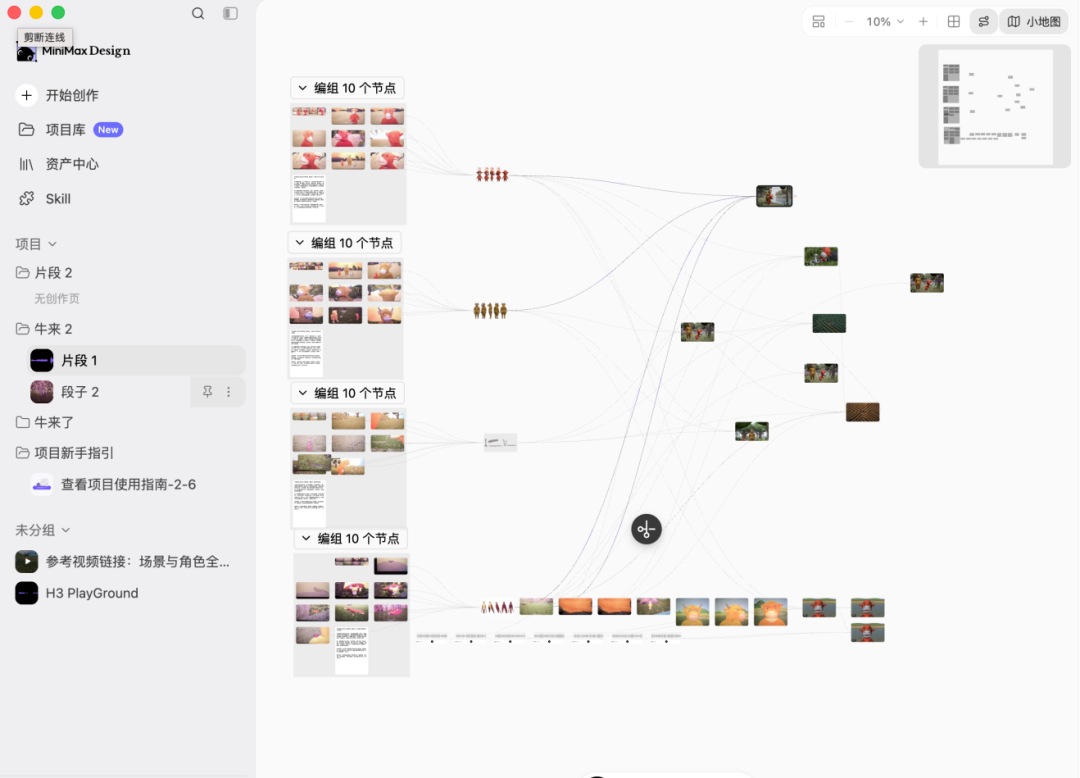
Figure | Characters, scenes, five-view diagrams, and videos connected on a single workbench
This time, the Agent used G Image 2 and four instances of Banana Pro, consuming only 450 MiniMax design points (approximately 3.15 yuan). We created basic models for several main characters seen in the original—truly budget-friendly: Cow Mother’s five angles are mostly consistent, but her distinctive nasal ring structure was smoothed out, resulting in a standard cow face.
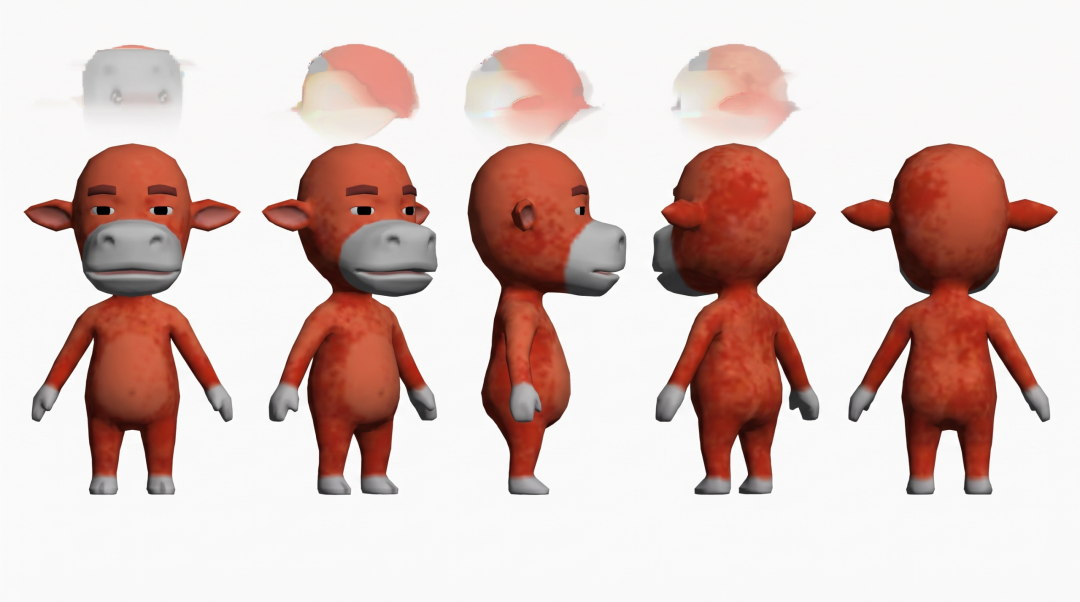
Figure | Five-view diagram of ‘Cow Comes’
The issue with five-view diagrams isn’t their ugliness but their tendency to “normalize” characters. Check the silhouette and head-to-body ratio first, then the mouth, nose, horns, hands, and feet, and finally the texture. Since better references weren’t available, the character design was tentatively finalized.
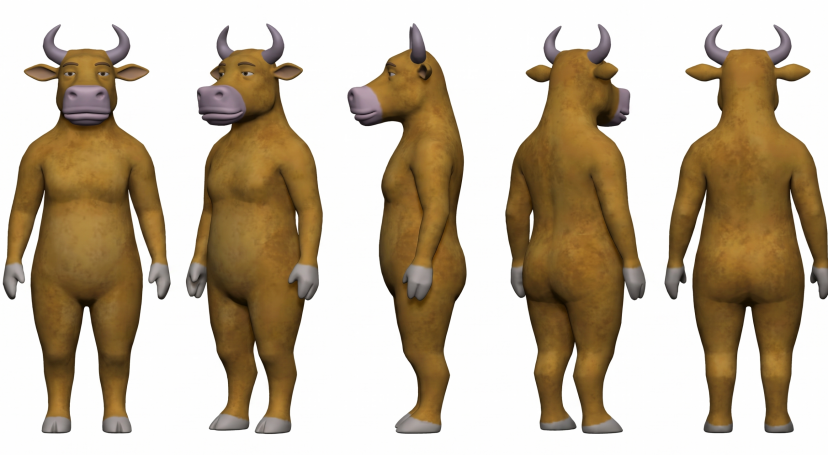
Figure | The five-view diagrams unified angles but also “fixed” Cow Mother’s nose
Creating characters first ensures consistency in subsequent videos; otherwise, deformations may occur. Indeed, MiniMax Design maintained character consistency well during standardized operations, with no major deformations across multiple videos. Then, I inserted a few skits and let the model generate content.
The second advantage of the workbench: seamless, rapid startup. Keep model selection on “auto,” and the Agent will use MiniMax H3 or Seedance 2.0 Fast as needed, then link videos back to character and scene images. The generated timeline allows cropping, speed adjustment, audio separation, and direct export—basic editing without needing CapCut or Premiere.
However, it differs significantly from text-based Agents: tasks are nearly single-threaded. A 10-second video takes about 15 minutes to generate, forcing other projects to wait in line—a limitation across the entire app. While Codex and Claude Code support multi-threading within sessions and have multimodal capabilities, MiniMax Design leaves creators idle at their computers whenever a video is processing.
For video production workflows, single-threading reduces efficiency. Even with excellent model performance, video production requires constant “tweaking” to meet quality standards, so single-threading drastically lengthens overall production time.
The visual consistency of the finished product exceeded expectations: Cow Comes remained red and small, and Mother retained her brown-yellow body and horns.
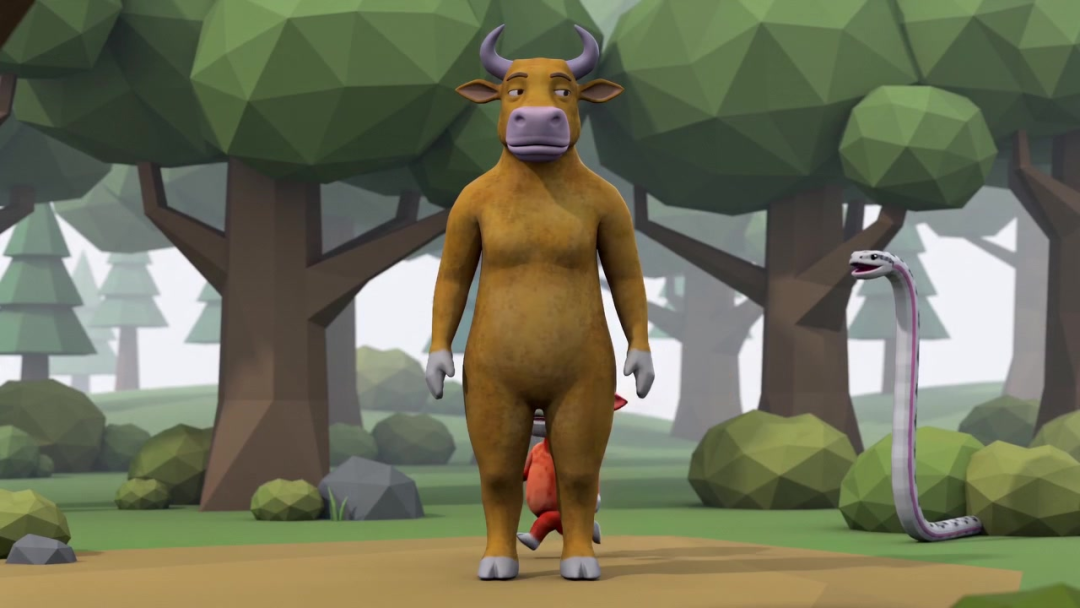
Figure | Visual identity maintained well when multiple characters appear together
What truly frustrated me was revisions.
I only wanted to change “Chinese people can fly” to “Chinese cows can fly” in ‘Cow Comes Jumps into River.’ The Agent called Seedance video editing but failed: seedance task failed [cloud.upstream_200], then automatically switched to Speech-2.8-HD to add audio.
The Agent’s strategy of swapping models was clever, but the actual output was subpar. The visuals remained unchanged, but another voice suddenly interrupted, with abrupt shifts in tone and volume. The task was “complete” for the Agent, but for viewers, the cow had simply changed voice actors midway.
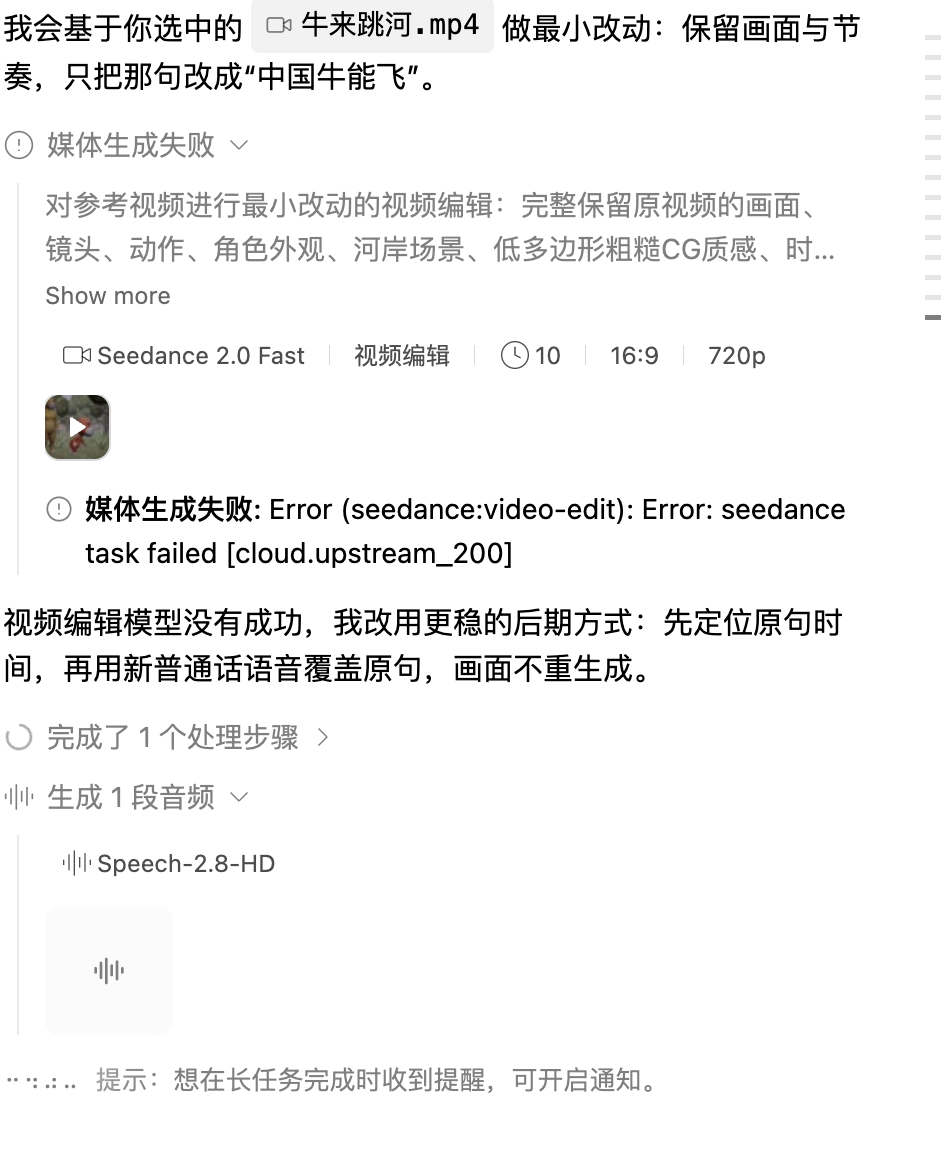
Figure | After Seedance editing failed, the Agent automatically switched to a voice model
Adjusting the iconic “calling mom” scene also didn’t go well, primarily due to voice accuracy.
Adjusting audio almost always requires reworking the entire video’s sound via prompts, but the resulting video-sound alignment is often poor and unusable. The only option is to remake the entire video, which still consumes tokens.
Voice adjustments were tricky, but MiniMax’s visual adjustment capabilities were decent. In the “Maze Navigation” skit, the initial video failed to show Cow Comes and the snake in the same maze, undermining the logic. After two targeted revisions, the “maze” feel was achieved, making the visuals usable.
Let’s tally the bill.
What? You want the full AI ‘Cow Comes’? Creating these clips exhausted me—a complete version is impossible.
But now, we can review the bills and estimate the AI production cost for ‘Cow Comes.’
MiniMax’s Chinese website lists: 30 yuan for 4,285 points, 150 yuan for 21,430 points, and 500 yuan for 71,435 points—all roughly 0.007 yuan per point. The site also notes that Agent consumption cannot be pre-estimated and depends on actual usage.

Figure | MiniMax China website point pricing
This project incurred 72 deductions totaling 12,826 points (approximately 89.78 yuan). Video models consumed 11,680 points (91.1%). Excluding a failed 1,680-point edit, ten complete video generations cost 10,000 points—about 7 yuan per button press.
No universal “tweaking rate” exists, but based on this bill: five videos succeeding on the first try, plus images and Agent usage, would cost ~43 yuan; averaging two tries ~78 yuan; three tries ~113 yuan. This project generated ten complete versions for five target scenes (two tries each) plus the failed edit, totaling ~90 yuan.
In practice, I only needed a basic 65-yuan recharge since free credits lasted until the fourth video version. Buying points from scratch would require three 30-yuan starter packs (12,855 points), covering the experiment.
This test produced five target clips (~50 seconds) using 12,826 points (89.78 yuan). Extrapolating:
- One successful generation: ~4,440 yuan.
- Two tries per segment: ~8,052 yuan.
- Replicating this test (including failed edits and voice rework): ~1.3236 million points (9,266 yuan); buying points from scratch costs at least ~9,270 yuan.
- Three tries per segment: ~11,700 yuan.
If you truly plan an AI version of ‘Cow Comes,’ consider that feature films demand higher consistency in characters, actions, and voices. A budget of 10,000–12,000 yuan is more realistic. For unified dubbing, precise editing, soundtracks, and manual frame-by-frame review, prepare ~15,000 yuan.
This excludes labor. At ~15 minutes per 10-second task and 2.2 calls on average, single-threaded generation requires ~284 hours—nearly 12 days of continuous queuing. The actual cost already far exceeds reported manual production costs for ‘Cow Comes.’
Overall, my experience with MiniMax Design was decent: materials, scripts, videos, and rough edits coexisted in one place, the Agent selected models automatically, and character visuals remained consistent.
However, the product’s flaws are critical: single-threaded tasks, inconsistent voices, and revisions feeling like re-tweaking. Whether actions and dialogue align still requires manual verification for each clip.
Thus, creating ‘Cow Comes’ with MiniMax Design isn’t difficult, but costs may not undercut manual methods. For now, AI might not be cheaper than human labor.
Special thanks to renowned screenwriter Teacher Yang Feifei for their invaluable support.
-
![]()
New Energy Vehicle Penetration Soars to Record High in July, Triggering Accelerated Industry Transformation
-
![]()
Why Has the Pricing Strategy of Leading AI Models Shifted: GPT Goes Free While DeepSeek Raises Prices?
-
![]()
Luxury Fuel Vehicles Struggle to Compete: Audi A6L Prices Plummet Below 250,000 Yuan. Are BBA Trapped in a Downward Spiral?
-
![]()
Geely Automobile Bolsters 'One Geely' Initiative with Management Team Realignment, Including Shift in Li Shufu's Role
-
![]()
[In-depth Report] Building a Solid Foundation of Quality to Lead the New Development of the New Energy Vehicle Industry
-
![]()
VOYAH Pursuit S Seeks to Outshine YU7? VOYAH Aims for Top 3 in BEV Market with Spiral Growth Strategy | Mingjingpro
-
![]()
6 Years, 7 Models, 2 Generations, 3 Major Categories: VOYAH Is Not Missing Any Battle
-
![]()
Will Gasoline Vehicle Owners Opt for Electric Vehicles with a 1,000-Kilometer Range?