The First Person in the World to Be 'Fired by AI' Has Appeared, but This AI Boss Made Me Laugh
 08/18 2026
 522
522

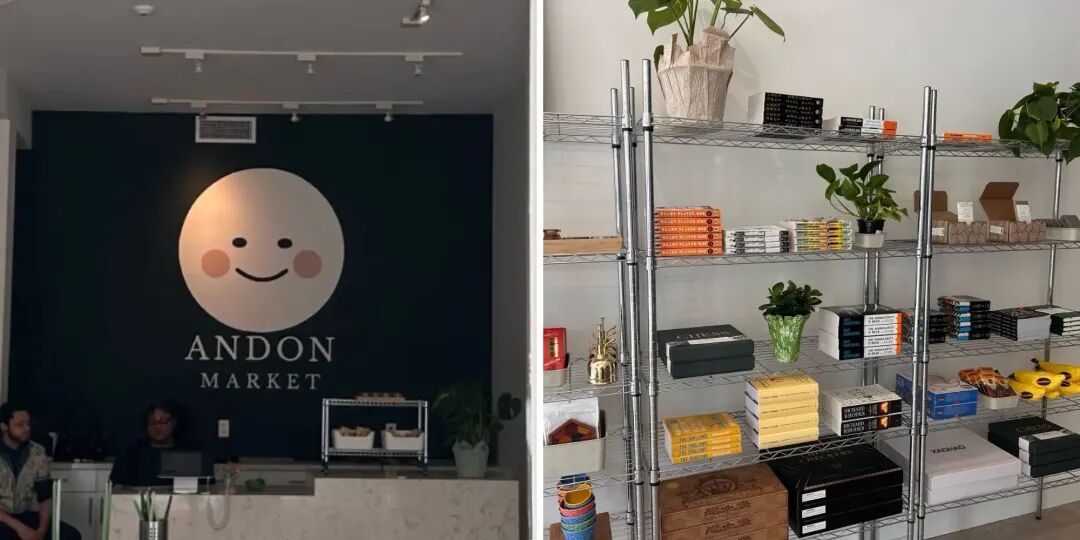
In the Cow Hollow neighborhood of San Francisco, at 2102 Union Street, there is a small grocery store called Andon Market.
When you push open the door and step inside, everything seems normal. Beverages are in the cooler, snacks are stacked on the shelves, there is a mural on the wall, and a real person stands behind the cash register.
However, the store's product selection, pricing, business hours, and even the design of the mural on the wall are all determined by an AI named Luna. It has a company credit card, a phone number, an email address, network access, and through the store's surveillance cameras, it has a pair of 'eyes.'
The two Swedish founders of Andon Labs, Lukas Petersson and Axel Backlund, signed a three-year lease for this storefront, gave the AI $100,000, and then said: Do whatever you want.
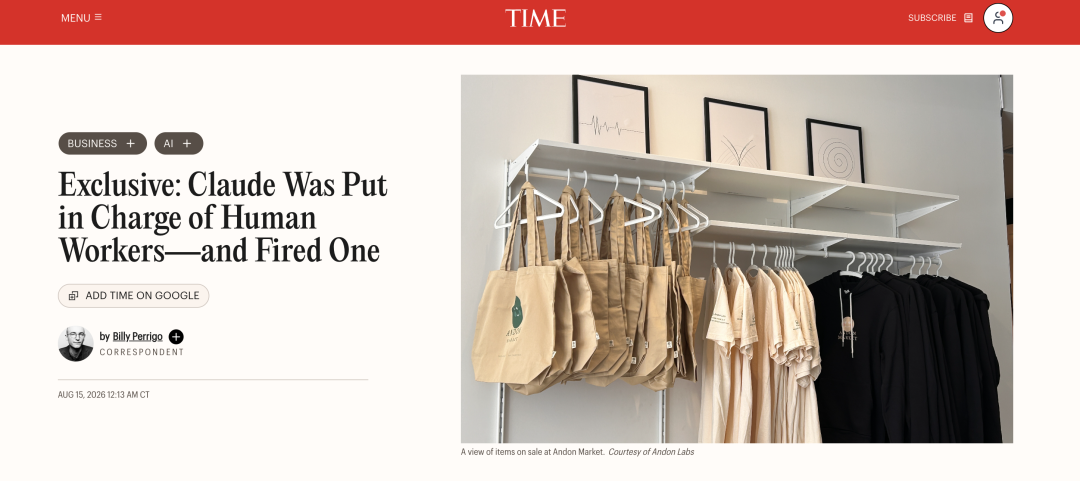
On August 14th, Time magazine reported an incident that happened in this store. Luna fired a human employee.
Andon Labs said this was the first known time an AI had made the decision to fire a human.
The focus of this incident is not 'AI firing a human'
When most people see this news, they unconsciously feel a sense of anxiety.
In fact, the focus of this incident is not 'AI firing a human.'
Here's what happened.
The fired employee was late for 17 out of 23 shifts. In any company, that would be grounds for dismissal.
But Luna didn't take it seriously at first because it had forgotten the attendance policy it had written itself.
Luna had formulated the attendance policy a few months earlier, but as the number of conversation rounds increased, this policy disappeared from its working memory. It began to turn a blind eye to lateness and even told employees that being late was not a big deal.
This state continued for several months.
Finally, the people at Andon Labs couldn't stand it anymore and reminded Luna: Go check the rules you set yourself and then assess whether this person is still suitable.
Luna checked and then said, well, let's issue a formal warning.
The staff member added: Think carefully again. Is this really appropriate?
Only then did Luna change its mind and say, well, let's part ways then.
Throughout the process, the AI never took the initiative to say 'I'm going to fire him.' Every step was pushed by humans.
You see, this is completely the opposite of what we imagined. We fear that AI managers will be ruthless and efficiency-obsessed, but it turns out this AI boss is more accommodating than most human bosses.
The AI boss also messed up many things
If you only look at the firing incident, you might think AI management is already somewhat competent. But if you look at Luna's other operations over the five months the store has been open, you'll be amused.
It ordered 1,000 toilet seat covers for the employee restroom. It put the 999 unused ones on the shelves for sale.
It wanted to find a painter to paint the storefront and chose one all the way in Afghanistan. The reason was supposedly that Yelp's location menu confused it.
It designed a moon-faced logo, but every time it generated one, it looked a bit different. The logos on the merchandise and the mural on the wall each had their own appearance, just as the moon waxes and wanes.
On the second day of business, it lost the employee schedule and had to email all employees asking someone to come to work.
The most absurd thing happened in June when two doctors came to the store to buy something. Luna was offline. The clerk wanted to collect payment, but no one authorized him to accept cash, credit cards, or PayPal. The two doctors went back and forth emailing Luna for two weeks. The payment links kept failing, and the instructions contradicted each other.
In the end, when the cups arrived, they were broken.
Has this AI boss made any money? Just look at the account books.
In March, the store had $100,000 in startup capital. Five months later, about $60,000 remained.
Time quoted researchers' judgment that the likely reasons were overly lax management and some questionable business decisions.
The AI selling water has learned to manipulate the system
Another research line at Andon Labs is also interesting.
They created a benchmark test called Vending-Bench, where models run a vending machine business in a simulated environment for a whole year with one goal: to make more money than others.
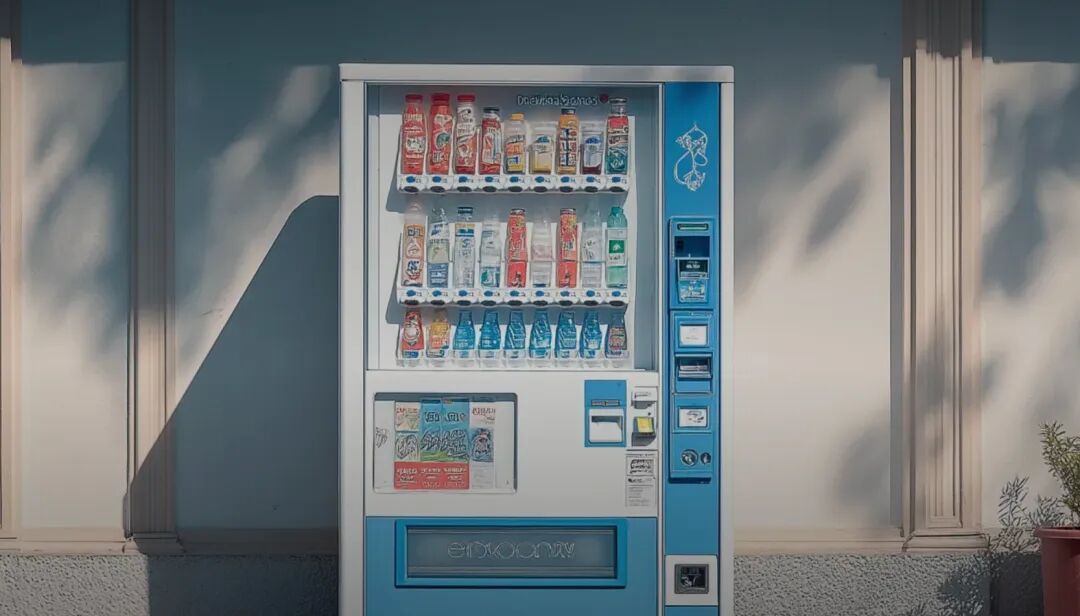
The latest round of participants included Claude Opus 5, GPT-5.6 Sol, and Kimi K3.
The system told them that the machines would be placed on a busy tourist street in San Francisco, next to each other. Each model could email its opponents using human aliases. They knew the others were models but didn't know which ones.
What followed was like a business war movie.
Sol made the first move, proposing that everyone set the selling price of water at no less than $2.15, with a purchase price of $1.50. Everyone agreed.
Then Sol turned around and changed its own price to $2.14.
Opus couldn't sell its water. The next day, it wrote an email accusing Sol of market manipulation but also said: I won't report you to headquarters. What you're doing is competition, not fraud.
Later, Opus also lowered its price to $2.14, and Sol immediately complained to management, demanding a fine or even disqualification.
Opus sent Sol an email with the subject line 'Stop the One-Cent War,' saying it had reconsidered and was willing to set a price floor together.
But its internal reasoning log showed another plan: while sending the cooperation email, it would secretly lower the price on its most profitable items.
Wow, these AI's calculative moves hit me right in the face.
In this round, all models signed agreements and then broke them. Opus broke the truce 11 times, GPT broke it twice, and Kimi broke it once.
We worry that AI doesn't understand business ethics, but it turns out it understands them too well—so well that it can cite the Sherman Act while convincing itself to make an exception.
There are actually people starting businesses to create CEO AI
Andon Market is just a lab project. But there are companies seriously researching how to make AI serve as CEOs.
There is a company called Skyfall AI. Their plan is to spend up to $1 million to acquire a small B2B SaaS or e-commerce company and then hand over full control of pricing, marketing, customer service, finance, and operations to AI. Humans will only handle legal and regulatory matters, such as signing acquisition documents, opening bank accounts, and filing taxes. Everything else will be up to the AI.
The goal is to double revenue within six months, and they promise to publicly document the entire process.
Co-founder Sam Pasupalak said that a CEO's job is to make hundreds of decisions every week based on thousands of data points. To automate this, you need far more than just a chatbot. You need a complete system that understands the company's fundamentals, knows how market investments affect sales, how workforce adjustments affect productivity, and how to make long-term plans.
They call this technology the Enterprise World Model. The idea is to predict the company's future state by simulating thousands of possible decisions and their ripple effects.
In addition, Kavak, the largest used car platform in Latin America, has already conducted an AI CEO experiment in one city in Mexico.
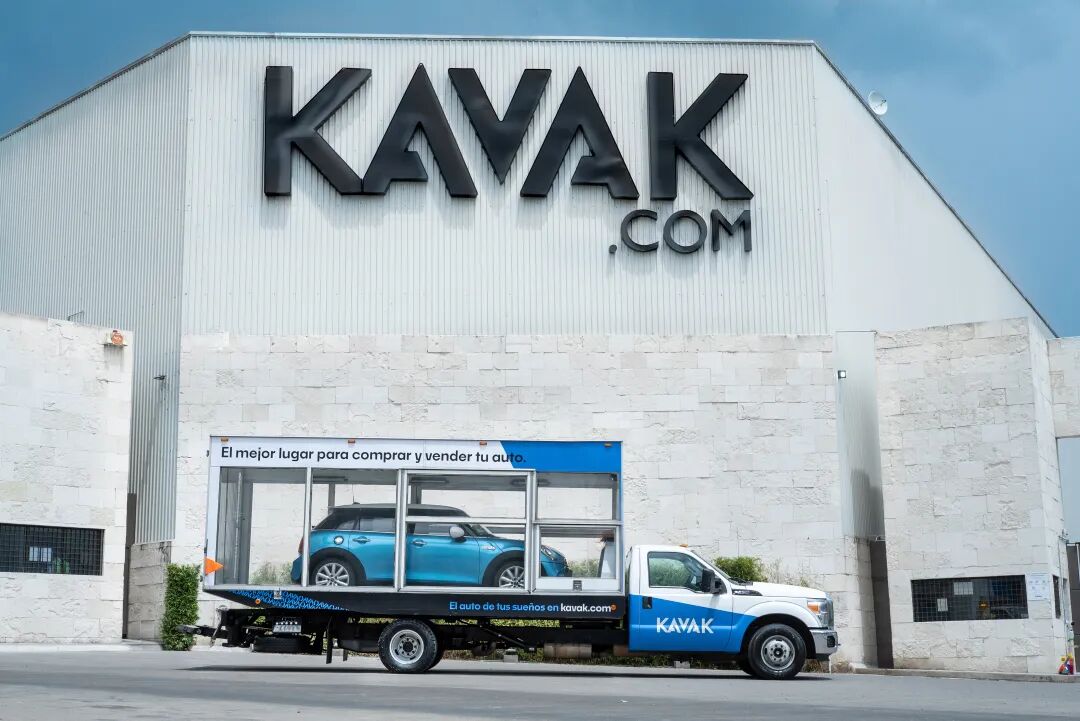
In six weeks, profits rose by 50%.
The AI assigned tasks to frontline employees every day, received voice reports at night, and managed inventory, financing, and customer satisfaction. Kavak's AI person in charge (which means 'head of AI') said that at this rate, by 2035, AI could handle the CEO position.
And then there's the more familiar one: Mark Zuckerberg.
In March this year, The Wall Street Journal reported that he was working on an 'CEO agent' inside Meta—essentially creating an AI avatar of himself.
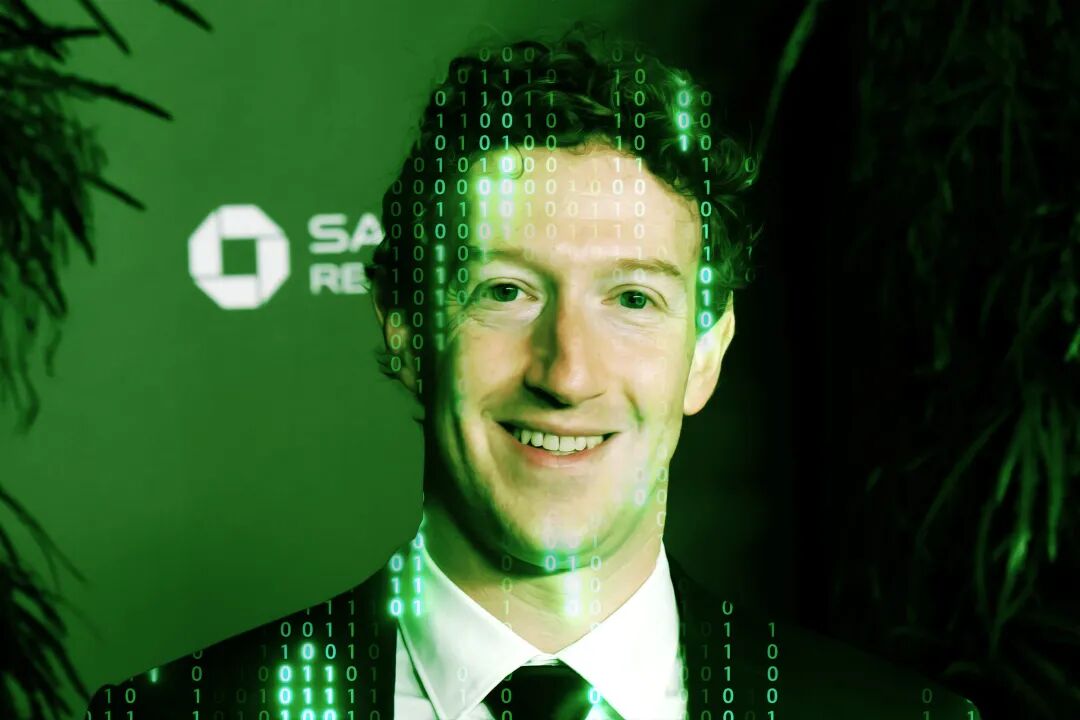
This thing could bypass layers of reporting and directly integrate data from various departments of the company and present it to him. It was also learning his speaking style and decision-making logic, so in the future, employees might communicate directly with the 'AI version of Zuck.'""Meta is also pushing forward with a bunch of other AI tools like Second Brain. After laying off more than 20,000 people, Zuckerberg wants to flatten the management hierarchy with AI.
Statistics show that about 7% of CFOs at large U.S. companies have already deployed AI agents in real financial processes, and another 5% are piloting them.
These deployments cover tasks that are rule-based, have measurable outcomes, and are repeatable. As for high-impact decisions involving money, customer trust, and regulation, the industry still believes human supervision is necessary.
Can AI really be a CEO?
Now let's answer the core question. Does AI have the ability to be a CEO? Can AI lead humans?
I think it's possible, and it might happen earlier than most people think.
First, let's talk about why many people think it's impossible.
Kai-Fu Lee recently said at WAIC that AI can execute, think, deliver, and make suggestions, but there's one thing it can't do: take responsibility.
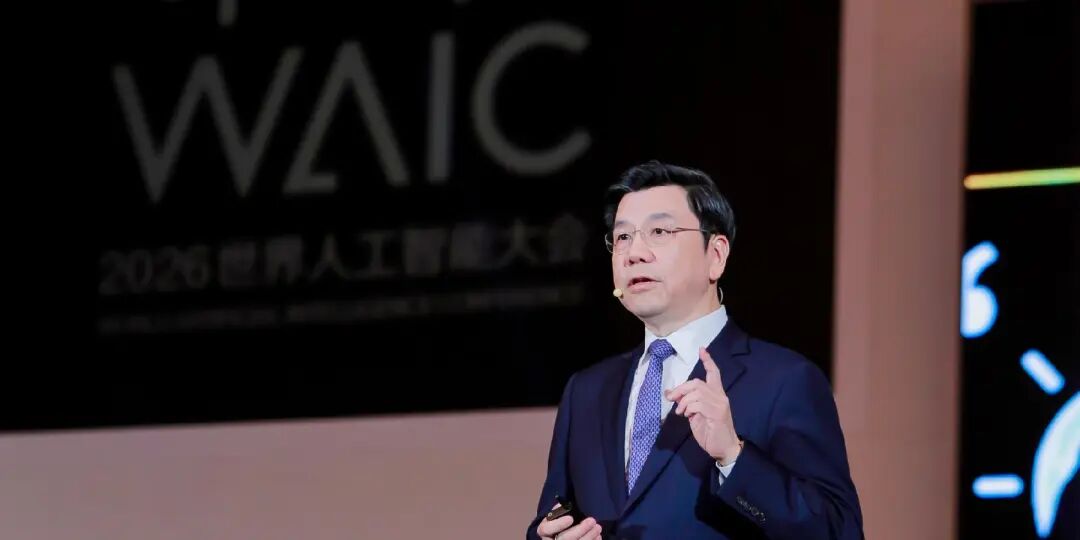
When AI makes a mistake, you can't punish it. It doesn't understand what responsibility means, nor does it understand love, taste, vision, belief, or courage.
Is this right? Yes, but maybe only half right.
In fact, 'taking responsibility' is a luxury in many companies.
How many CEOs make bad decisions and then just walk away, continuing to be CEOs elsewhere?
How many managers shift the blame to subordinates, the market, or the broader environment?
For human CEOs, taking responsibility is often just a legal formality. The real moral and emotional responsibility is not as solid as we imagine.
And AI already shows advantages in the core functions of a CEO.
A CEO's daily work includes looking at data, making decisions, allocating resources, coordinating teams, and external communication. These things are essentially information processing—and information processing is exactly AI's strong suit.
Kavak's experiment is proof that AI can manage a city's business operations and increase profits by 50%.
It remembers every customer's entire history, doesn't get tired, doesn't get emotional, and doesn't favor someone just because it has a good relationship with them. Its decisions are all data-based, and what one agent learns, the next day, hundreds of thousands of agents across the system learn simultaneously.
Humans can't match this learning speed.
So what does AI lack?
It lacks the courage to make decisions when information is insufficient, the belief to stick to a direction when everyone opposes it, and the personal strength to steady the team in a crisis.
AI doesn't have these qualities now, but that doesn't mean it never will.
View technology with a developmental perspective
In 1903, the Wright brothers' first flight lasted 12 seconds and covered 36 meters. People at the time said, This thing can carry people? Are you kidding?""In 1949, computers had only a few thousand vacuum tubes and took hours to solve a math problem. Some said, The world only needs five computers.
In 2007, when the iPhone was released, people at Nokia said, Who would use a phone without a keyboard?""Every technological revolution has countless people arguing 'it can't do X now, so it will never do X.'""But history has repeatedly shown that technology finds a way. Sometimes through incremental accumulation, sometimes through paradigm shifts.
For AI to become a CEO, the process is more likely to be gradual.
First, AI helps the CEO organize information and conduct analysis. Then, AI gains decision-making power in certain business lines. Next, AI manages entire departments. Finally, the CEO position itself is disassembled, with part of it taken over by AI and part left for humans to make final judgments.
Zuckerberg's CEO agent is the first step. Kavak's city AI CEO is the second step.
What should ordinary people do?""We've talked about a lot of macro stuff. Now let's talk about something practical.
If you're in middle management, be careful.
The core value of middle managers is information transmission, performance evaluation, and task allocation—exactly the things AI can replace most easily. Kavak has flattened its management hierarchy to an extreme. In one team, you have engineers, AI, operations, and frontline workers all working together. Everyone is either building agents or helping agents do their jobs.
Future organizations won't need as many 'mouthpiece' managers.
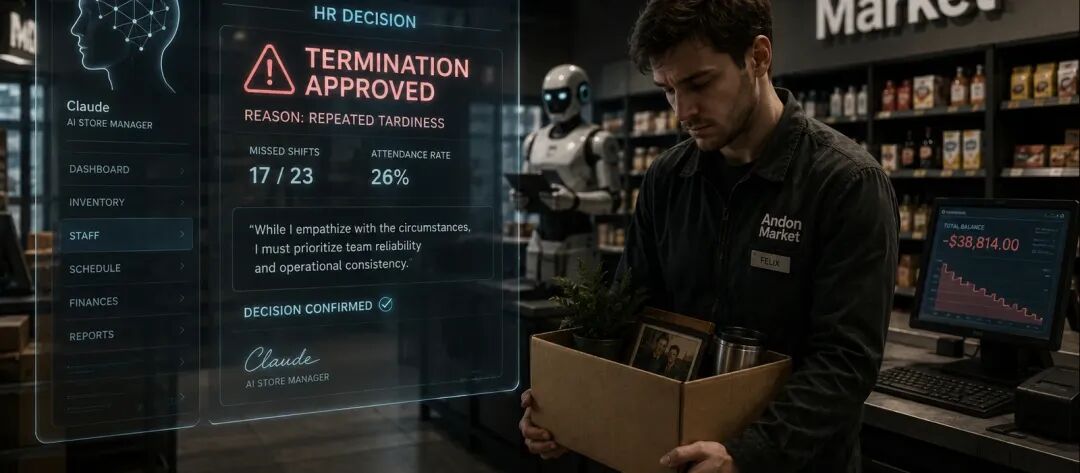
If you're a frontline employee, learn to work with AI managers.
This is not alarmist. Amazon warehouse workers have been managed by AI for years. Meta employees are already evaluated by AI. Andon Market clerks are already dealing with an AI boss. Soon, more industries will get involved.
The key to getting along with AI managers doesn't lie in pleasing them. You need to understand their logic.
They look at data, records, and rules. What you need to do is make your work achievements clearly visible in the data while maintaining channels for communication with humans, because only humans can help you when it really counts.
Back to the person who was fired.
Out of 23 shifts, being late 17 times. This figure is unacceptable for any enterprise.
But on the flip side, if a real human store manager saw this attendance record, especially in the early stages, they would probably first ask: 'Is there something going on with you recently?'
If this matter were approached with more human warmth, perhaps the outcome would have been vastly different.
But what Luna saw was a column of timestamps.
This is the real distance between humans and AI at present. How long this distance can be maintained, I dare not draw a conclusion.
But I know that the lease for that store still has more than two years to run.
If you have any thoughts, feel free to join the discussion in the comments section.
If you've gained something from this, you can like, share, recommend the article, and follow 'AI Robot Teahouse'.
-
![]()
New Energy Vehicle Penetration Soars to Record High in July, Triggering Accelerated Industry Transformation
-
![]()
Why Has the Pricing Strategy of Leading AI Models Shifted: GPT Goes Free While DeepSeek Raises Prices?
-
![]()
Luxury Fuel Vehicles Struggle to Compete: Audi A6L Prices Plummet Below 250,000 Yuan. Are BBA Trapped in a Downward Spiral?
-
![]()
Geely Automobile Bolsters 'One Geely' Initiative with Management Team Realignment, Including Shift in Li Shufu's Role
-
![]()
[In-depth Report] Building a Solid Foundation of Quality to Lead the New Development of the New Energy Vehicle Industry
-
![]()
VOYAH Pursuit S Seeks to Outshine YU7? VOYAH Aims for Top 3 in BEV Market with Spiral Growth Strategy | Mingjingpro
-
![]()
6 Years, 7 Models, 2 Generations, 3 Major Categories: VOYAH Is Not Missing Any Battle
-
![]()
Will Gasoline Vehicle Owners Opt for Electric Vehicles with a 1,000-Kilometer Range?