Exclusive | OpenAI's First Hardware Product Unveiled: A Robot for the ToB Market with Annual Shipment Target of 25 Million, Luxshare and AAC Technologies Join In
 02/24 2026
 611
611
01
OpenAI Launches Hardware Manufacturing, Targeting ToB Market
According to an XR Institute member who revealed the information to 'AR Circle,' OpenAI has commenced the manufacturing process for its smart hardware. Notably, the first product to market (tentatively referred to as 'O1' in this article) is not a consumer (ToC) product but is positioned for the ToB market. The product is slated for release this year with an ambitious annual shipment target of 25 million units. Following this, OpenAI plans to launch a pair of smart glasses (tentatively referred to as 'O2') with an annual shipment target of 10 million units.
On the supply chain front, OpenAI has formed deep partnerships with key industry players: Luxshare Precision will handle the assembly of the complete device, AAC Technologies will supply the haptic motor module (priced at approximately $10), and Qualcomm will provide core computing power support. It is reported that the total bill of materials (BOM) cost for the O1 device is around $200.
In terms of core chips, Qualcomm will supply two chips: the existing 5100 chip (designed for low-power wearables such as smartwatches) and a new generation upgraded chip (possibly named 6100) expected to be released this year.
02
Strategic Insights: Why Target the ToB Market First?
To understand why OpenAI has positioned its first hardware product in the ToB market, we need to examine three dimensions: structural changes in market demand, historical patterns in the tech industry, and the practical obstacles facing the ToC path.
Hybrid Work: An Irreversible Structural Market Shift
Post-pandemic, the global work ecosystem has undergone significant regional differentiation: while China has gradually returned to offline norms, Western markets, led by the United States, have experienced a profound structural transformation, establishing a new model of 'Hybrid Work.'
This model is particularly evident in the tech industry. Apple has implemented a '3+2' policy, requiring employees to be on-site on Tuesdays, Thursdays, and team-designated days, with the remaining two days allowing for flexible remote work. Google follows a similar '3+2' framework, while Microsoft offers even greater flexibility, permitting employees to arrange up to 50% of their work time remotely without special approval.
Data from Stanford University's WFH Research Project and the U.S. Bureau of Labor Statistics (BLS) support the irreversibility of this trend: the U.S. work model has not reverted to pre-2019 levels but has entered a long-term stable 'plateau phase.' The proportion of remote work nationwide has surged from 5% before the pandemic to a stable 20%-25%. It is projected that by 2026, 34 to 36 million Americans will be engaged in hybrid work on a long-term basis; this trend is also significant in European countries such as the Netherlands, Sweden, and the UK.
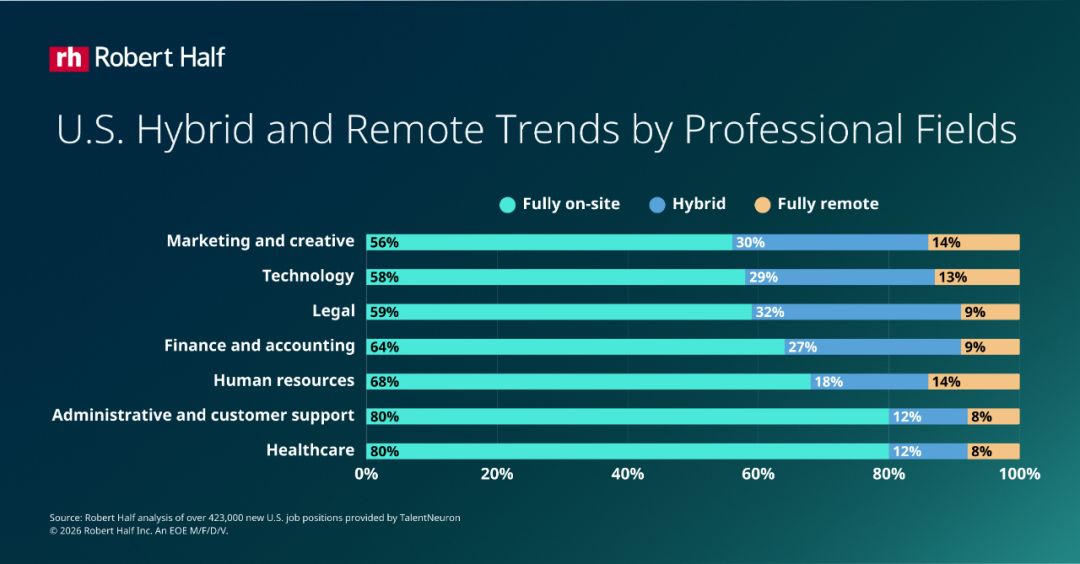 Proportion of work models across different job roles in the U.S., with 13% fully remote and 29% hybrid in the tech industry. Source: roberthalf
Historical Precedent: B-End as the First Adopter of Technological Revolutions
Beyond demand, historical patterns strongly support OpenAI's ToB strategy. A review of the tech industry's evolution reveals that every major hardware revolution or software paradigm shift has typically first gained traction in the B-end office sector.
In the 1970s, the Apple II didn't truly initiate the personal computer era because it could run games but because the introduction of VisiCalc spreadsheet software allowed enterprise users to see, for the first time, the efficiency gains from digital office solutions. The IBM PC later became the industry standard precisely because it addressed the standardized office needs of enterprise clients. When a new computing platform emerges, B-end clients—who are most sensitive to efficiency and have the strongest willingness to pay—are often the first to adopt. OpenAI's hardware strategy echoes this historical logic.
 VisiCalc spreadsheet software was the wings that enabled Apple's computer takeoff. Source: Better Sheets
Practical Obstacles: The Dual Privacy Dilemmas of the ToC Path
In addition to demand-driven factors and historical inertia, practical privacy compliance challenges may be the most decisive factor in OpenAI's decision to prioritize the ToB market. These challenges arise from two dimensions.
The first is the privacy infringement on third parties by AI hardware in public spaces. Currently, AI hardware targeting the ToC market (such as smart glasses and AI pendants) often has continuous audio recording and even video recording capabilities. Once these devices enter public spaces, they inherently carry societal anxiety about 'potentially collecting others' information at any time.' Bystanders cannot determine whether the device is actively recording, and this asymmetry of information power can easily lead to legal risks and social resistance. In contrast, in office scenarios, meeting recordings and collaboration are informed behaviors based on 'professional contracts,' naturally resolving the ethical dilemmas of recording.
The second is the challenge of controlling corporate confidential data on consumer-grade devices. The real security risk is not data flowing into a cloud but into employees' personal devices. When an employee uses a consumer-grade AI device to record an internal meeting involving business decisions, the complete meeting data—whether audio, text summaries, or AI-generated action lists—will remain on the personal device, entirely outside the enterprise's IT management framework. This is the core concern of enterprise CIOs regarding 'Shadow IT.'
 'Shadow IT' poses a core security challenge for enterprises. Source: JumpCloud
OpenAI's dedicated ToB hardware provides enterprises with a manageable and controllable 'physical sandbox': data collection, storage, and flow are all under unified enterprise control, with sensitive information never settling on any personal device. For enterprise decision-makers, this 'buy hardware, gain compliance' solution is far more strategically attractive than uncontrollable consumer-grade devices.
Establishing trust, accumulating data, and refining the experience in office scenarios with ToB products before extending to the ToC market may not only be the most efficient commercial path but also the socially least resistant one.
03
Form Factor Speculation: Modular Design and the 'Desktop Robot' Hypothesis
Based on the supply of dual chips (5100 and 6100) and components like haptic motors, we can roughly outline the product form of O1. It is highly likely a desktop smart terminal featuring a 'modular design'—a symbiotic system consisting of a 'portable sub-terminal' and an 'enhanced dock.' This form factor logic has precedents in consumer electronics, similar to the Insta360 GO series or DJI Action 2, but OpenAI has imbued it with stronger computing capabilities and deeper office scenario adaptation.
Sub-Terminal (Portable): A thumb-camera-sized module equipped with a low-power Qualcomm 5100 chip, built-in microphone array, and camera, focusing on efficient, long-lasting audio-video collection with independent operation capabilities. Users can carry it wherever they go—whether in external meetings, on business trips, or moving between workstations—as a personal 'AI sensing node.'
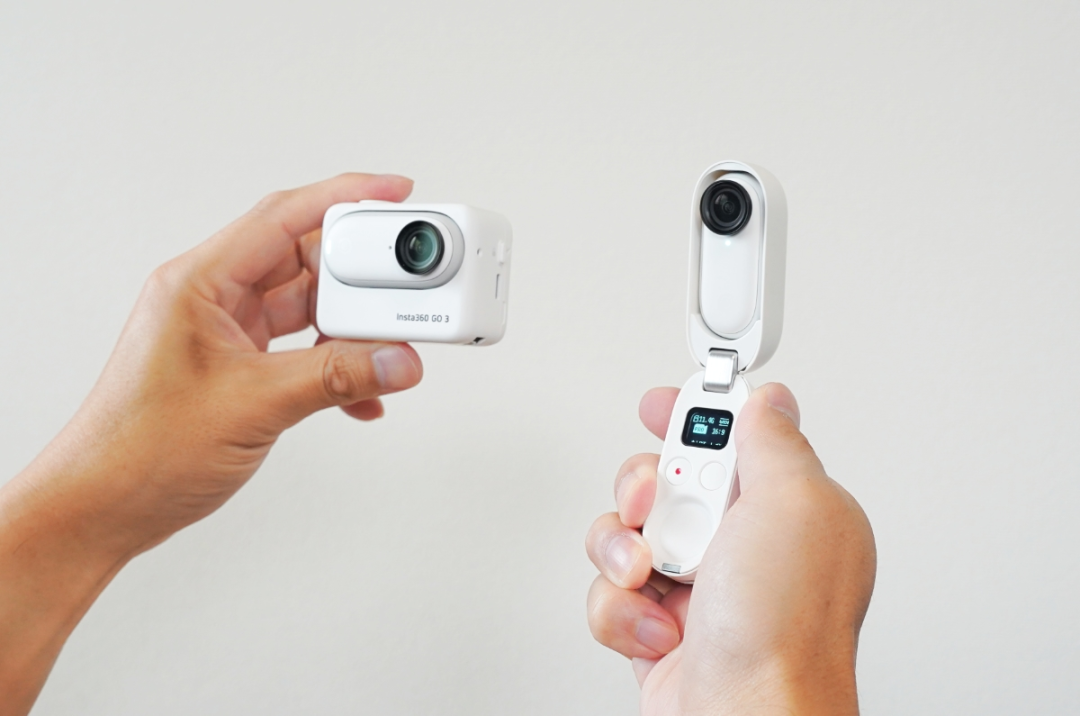 Insta360 GO. Source: Insta360
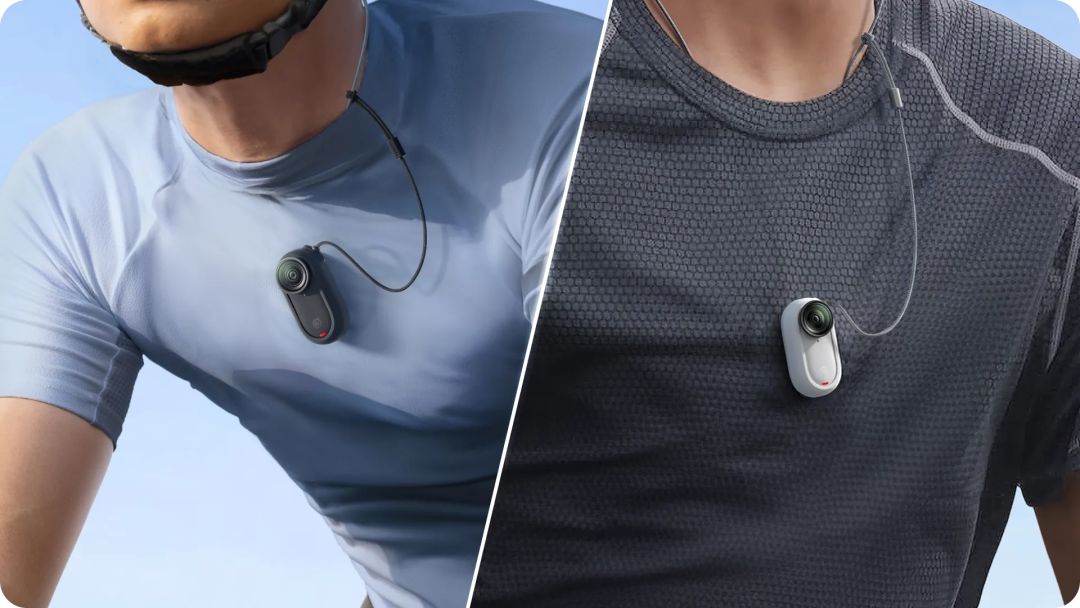 Insta360 GO. Source: Insta360
Mother Terminal (Dock): A desktop device resembling a cylindrical speaker, equipped with a more powerful Qualcomm 6100 chip. When the sub-terminal docks, the two become one—the dock not only provides continuous power but also takes over more intensive computing tasks via the 6100 chip.
Based on supply chain information about the haptic motor module, we speculate three possible form factor solutions for the product in its desktop configuration:
Solution 1: Static Docking, Computing Relay
The most basic form. The sub-terminal connects to the dock via magnetic contacts, resembling a smart speaker with a camera. When docked, the system automatically switches to desktop mode, using the dock's high-performance computing power for tasks like meeting minute organization and real-time multilingual translation. In this form, the haptic motor serves only as a vibration feedback component for the sub-terminal. However, this contradicts supply chain information—ordinary vibration motors cost far less than $10, making this solution unlikely.
Solution 2: Pan-Tilt Rotation, Dynamic Tracking (Head, No Legs)
The form factor most consistent with the '$10 motor' configuration logic and the most probable in the industry. The sub-terminal docks atop the base, which houses a precision motor and rotational mechanism capable of multi-axis movement—like a robot's head, keeping the speaker centered in the frame at all times.
This design precisely addresses the core pain point of traditional video conferencing: the rigid, fixed perspective. Whether the user moves around the office, writes on a whiteboard, or takes turns speaking in a group, the device actively tracks and dynamically adjusts the frame. More importantly, this continuous 'gaze' imbues the device with a humanized interaction temperature—it's not just a camera but a presence listening to you.
Solution 3: Desktop Roaming, Proactive Service (Head Rotates, Legs Move)
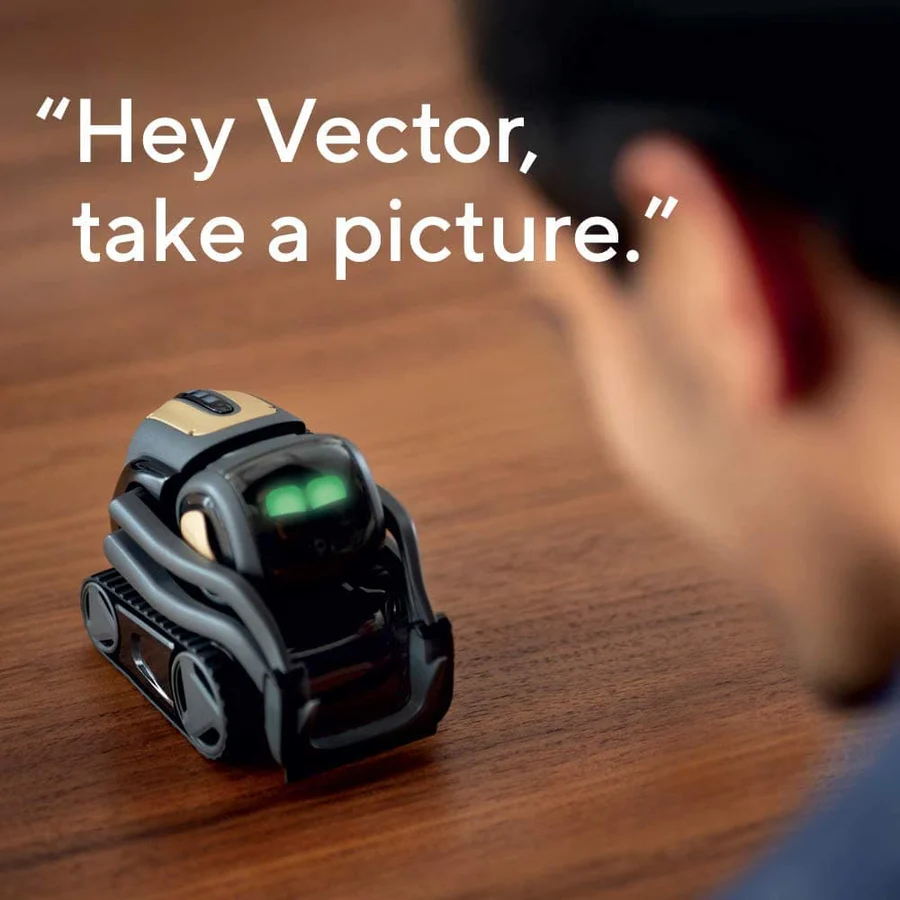 Desktop robot Anki Vector. Source: Anki Vector
The most radical and futuristic form factor among the three speculations. In addition to sub-terminal rotation, the dock itself may incorporate omnidirectional wheels or other mobility components, enabling autonomous movement within the two-dimensional space of a desktop.
This design upgrades the terminal from 'passive waiting' to 'proactive service': the device can autonomously find the best camera angle on the desktop, move out of the user's blind spot when they are focused, and only approach when there is important information. This design philosophy aligns with desktop robots like Anki Vector, but OpenAI focuses its capabilities on productivity scenarios, making it a truly physical desktop AI assistant.
The three solutions represent three progressive product philosophies: from passive response to active perception, from smart peripherals to spatial agents. The brilliance of this modular architecture lies in its ability to cover the full spectrum of hybrid work needs with a single hardware solution—separated, it's a portable 'AI sensing module'; combined, it's a 'desktop intelligence hub.' It bridges the inherent shortcomings of wearables in computing power and battery life while breaking the physical constraints of traditional desktop devices.
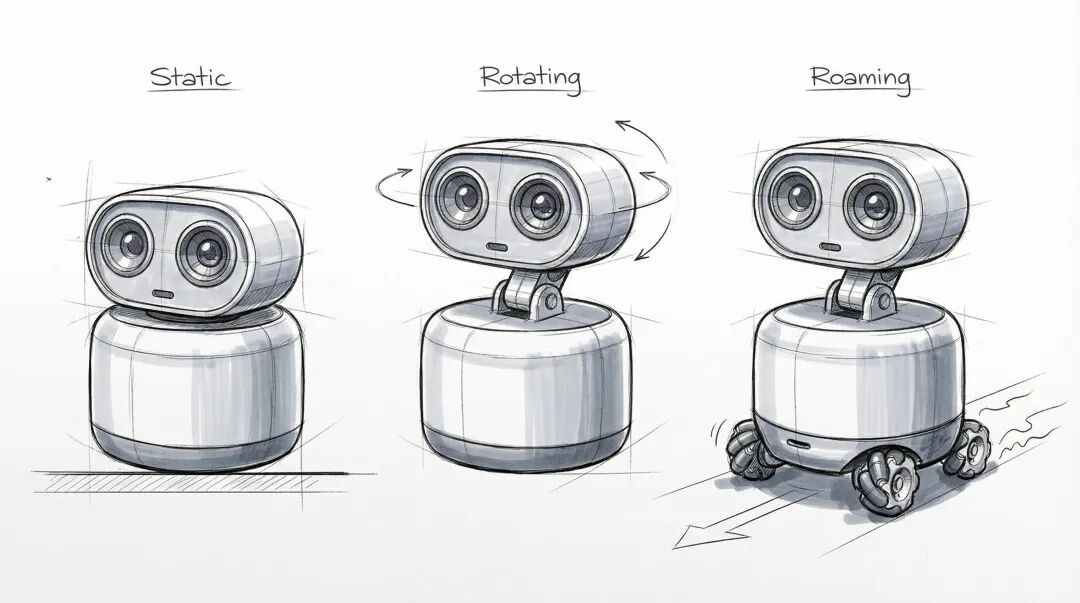 Speculative design solutions for OpenAI's first hardware. Created by Gemini. Source: AR Circle
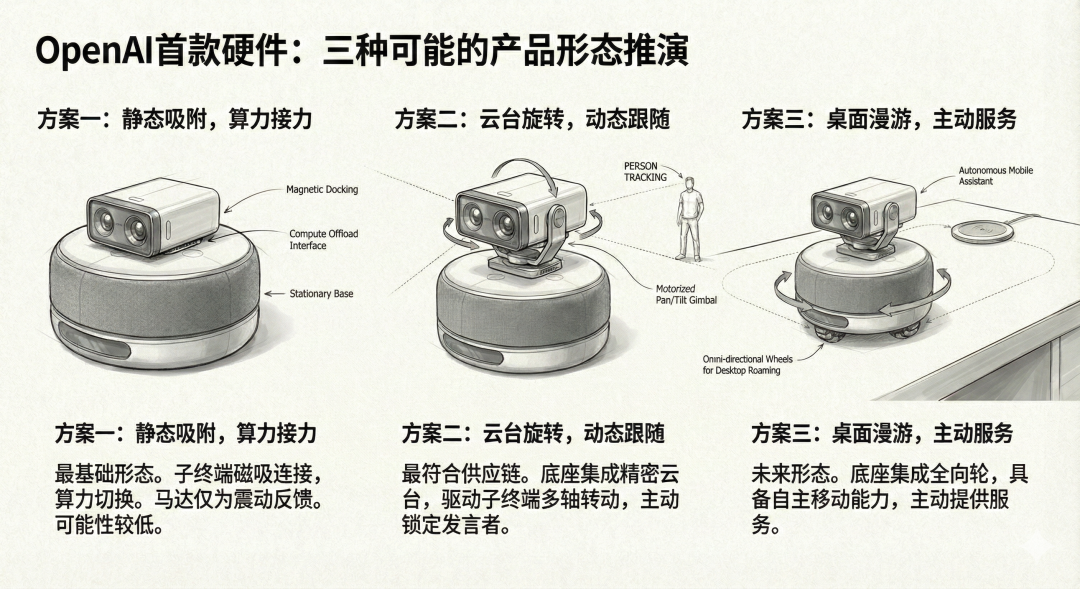 Speculative design solutions for OpenAI's first hardware. Created by Gemini. Source: AR Circle
04
OpenAI Goes Left, Apple Goes Right: Who Has the Edge?
While OpenAI has chosen the ToB desktop terminal as its entry point, we must not view this product in isolation. O1 is merely the first 'beachhead' in OpenAI's hardware strategy; its roadmap is already clear: smart glasses (O2) with an annual shipment target of 10 million units are on the way, and wearable devices similar to AI Pin are also in planning. OpenAI's strategy is to first conquer your office desk, build data trust and interaction habits, and then seamlessly extend into personal life scenarios.
Meanwhile, consumer electronics giant Apple is accelerating its layout (layout). Just recently, Bloomberg's renowned journalist Mark Gurman reported that Apple's smart glasses development has entered the fast lane. Unlike OpenAI's 'B-then-C' strategy, Apple's new product, codenamed N50, is a pure ToC consumer device, adopting a screenless design that relies on Visual Intelligence and a dual-camera system (RGB+AI) to capture life moments and understand the environment, aiming to become the iPhone's 'external senses.'
Thus, two clear main storyline (main threads) have emerged in the AI hardware landscape: one is OpenAI's 'dimensional reduction strike' approach—using high-frequency, Rigid demand (rigid demand), and compliance-focused ToB office scenarios as a pivot point, solving productivity pain points with a 'desktop robot,' and then gradually infiltrating personal life through glasses and wearables to build a full-scenario AI physical ecosystem. The other is Apple's 'experience upgrade' route—staying firmly in the ToC arena, using ultimate (ultimate) industrial design and lightweight smart glasses to directly invade daily life, striving to become your 'digital organ' for perceiving the world.
In 2026, will you be more optimistic about OpenAI's 'desk revolution' or Apple's 'lifestyle invasion'? Let's discuss in the comments.
END
-
![]()
Hardware is the skeleton, AI is the soul, and data integrates the two
-
![]()
China’s AI Industry: A Unified Pivot Towards Monetization?
-
![]()
New Progress! Infineon Completes Acquisition of ams OSRAM's Non-Optical Sensor Business
-
![]()
35 Million Bet on an Optical Future! Tengjing Technology Makes a Move in AR
-
![]()
Why World Models Get Stuck on Construction Roads in Autonomous Driving Applications
-
Alibaba Initiates Cultural Transformation: Is Jack Ma Making a Strategic Comeback?
-
Tianfeng Heads to Hong Kong for IPO with RMB 3.8 Billion in Funds: Xingyu's Cross-Border Foray into Embodied AI Faces Uncertain Future
-
![]()
Mengshi Auto’s High-End Aspirations Dashed: Huawei Partnership Fails to Revive Sales, New Model’s Entry Price Dips Below 300,000 Yuan