Upstream Cost Surge Drives Price Increases Across Industrial Chain: Who's Eroding Smartphone Makers' Margins?
 03/19 2026
 544
544
China's smartphone market has recently seen a sweeping wave of price hikes, with OPPO and vivo leading the charge in price adjustments, swiftly followed by Xiaomi and Honor. These adjustments span a broad spectrum, from entry-level models priced at a few hundred yuan to premium flagship devices costing tens of thousands of yuan. This round of price increases stems not from proactive market strategies by the companies but rather as a reactive measure to the relentless rise in upstream costs. The cascading effect of these rising costs is gradually permeating the lower tiers of the industrial chain, placing listed smartphone manufacturers in a precarious position marked by intersecting risks and triggering a profound reshuffling of the industry's competitive dynamics.
1
Industry-Wide Price Hikes Leave No Model Unaffected 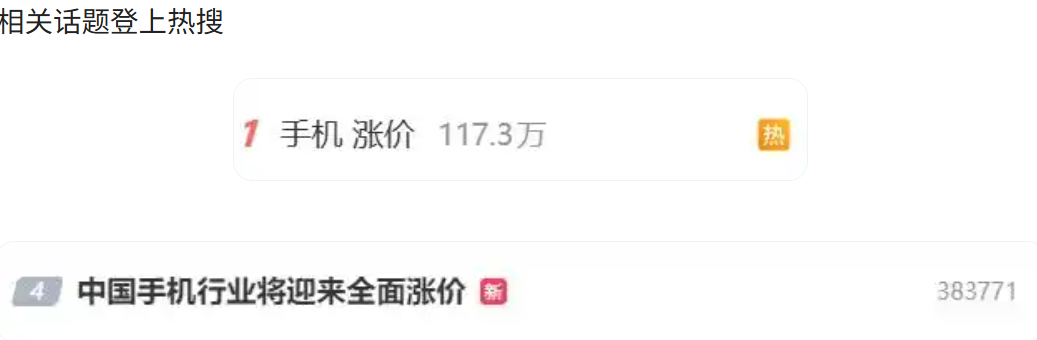
Since March of this year, a price surge led by listed smartphone manufacturers has spread comprehensively, marked by "complete coverage and high synchronization." On March 10, OPPO took the lead in announcing a price adjustment, specifying that starting from March 16, prices of its A-series, K-series, and OnePlus brand products already on the market would be adjusted, covering mid-range and entry-level price segments. On March 16, vivo issued an official announcement, synchronizing its price adjustments (vivo made a synchronized announcement) to take effect from 10:00 AM on March 18, with its sub-brand iQOO following suit. The pricing strategies of vivo and OPPO were highly coordinated, with core high-volume models experiencing simultaneous price increases.
Honor did not issue a formal price adjustment announcement but indirectly joined the price hike trend by launching its foldable flagship Magic V6 on March 10 with a starting price of 8,999 yuan, effectively implementing a price increase through product iteration. Xiaomi has not officially announced a price hike, but its founder, Lei Jun, publicly stated in March 2026 that the explosive demand for AI has triggered a sharp rise in memory chip prices, imposing significant cost pressures on the smartphone business. Xiaomi has achieved implicit price increases by adjusting model configurations and reducing discounts, a strategy widely recognized within the industry. According to data from the Tonghuashun Financial Database, Xiaomi's Hong Kong-listed shares have seen a cumulative decline of 10.59% from the beginning of 2026 to March 18, reflecting significant fluctuations influenced by market sentiment.
Unlike previous instances where only high-end flagship models experienced minor price adjustments, this round of price hikes represents the largest and most extensive in the past five years, leaving no model unaffected, from entry-level devices priced at a few hundred yuan to high-end flagships costing tens of thousands of yuan. This phenomenon signals the official end of the era of low-price competition in the smartphone industry, intensifying operational pressures on listed companies and further squeezing the survival space for small and medium-sized manufacturers.
2
Memory Price Surge Forces Reactive Measures
The collective price hikes by listed smartphone manufacturers are primarily a reactive measure to mitigate damage amid escalating cost pressures, rather than an active pursuit of profit. Three core factors have converged to drive these price adjustments. The most critical is the capacity absorption effect in the memory chip market triggered by the AI industry's explosive growth—AI servers have a far higher demand for memory chips than ordinary smartphones and offer significantly higher profit margins, directly altering the capacity allocation landscape for memory chips.
The three global memory giants—Samsung, SK Hynix, and Micron—have all reduced their production capacity for smartphone memory chips to focus on high-end AI memory products. This has directly led to a tight supply and soaring prices for LPDDR series memory and UFS flash storage used in smartphones. According to data from TrendForce, contract prices for conventional DRAM rose by 90% to 95% in the first quarter of 2026, while NAND Flash contract prices increased by 55% to 60%. Data from CFM Flash Market shows that DRAM and NAND prices rose by 386% and 207%, respectively, throughout 2025. Data from the Price Monitoring Center of the National Development and Reform Commission reveals that as of January 2026, prices for DRAM and NAND Flash, the two main products in the global memory chip market, reached their highest levels since records began in 2016.
Coupled with rising costs across the entire industrial chain and increased R&D investment, corporate cost pressures have further intensified. Supply chain sources indicate that foundry quotes for TSMC's 5nm, 4nm, and 3nm processes have risen significantly compared to the previous year. Costs for core components such as high-end screens and metal frames, as well as logistics, have also increased year-on-year. Continuous investment in R&D for on-device AI functions has further driven up overall costs. Additionally, after five years of cutthroat low-price competition, corporate profits have hit rock bottom. Under the weight of these multiple pressures, listed companies have had no choice but to initiate price adjustments.
3
End of Low-Price Competition, Transformation of Profit Models
This round of price hikes represents an inevitable turning point after years of cutthroat low-price competition in the smartphone industry. Over the past five years, the domestic smartphone market has been mired in a vicious cycle of "spec wars and price bloodbaths." To capture market share, major manufacturers have excessively compressed profit margins, with most listed brands operating on thin net profit margins, relying entirely on "small profits but high volumes" to sustain operations. Among them, mid-range models priced around 2,000 yuan have been hit hardest by rising memory costs, with profit margins nearly entirely eroded.
Under this competitive landscape, companies have had virtually no profit buffer. Once costs for core components rise, they immediately face the dilemma of "producing at a loss." With memory chip prices soaring, already thin profits have been completely wiped out, and some entry-level models have even slipped into negative gross margins. The low-price competition model has become unsustainable and is now officially coming to an end.
This marks the smartphone industry's formal transition from "low-price competition" to "value competition." Listed smartphone manufacturers must also shift their profit models from "small profits but high volumes" to "high quality, high price." This round of price hikes is a temporary measure to alleviate short-term cost pressures and adapt to industry transformation.
4
Risk Chain Propagates Layer by Layer, Manufacturers Face Multiple Challenges
Smartphone price hikes are not merely adjustments to terminal selling prices but have formed a risk propagation chain that runs through the entire operational process of listed companies, squeezing their survival space across four dimensions: sales volume, profits, users, and cash flow. This poses a severe impact on corporate performance and long-term development.
Declining sales and revenue pressure are the primary risks. Consumers are highly sensitive to smartphone prices, and price increases in the mid-to-low-end market directly suppress their willingness to upgrade devices. According to industry analysis, the global smartphone market faces contractionary pressure due to memory chip shortages. In a research report published in March 2026, Nomura pointed out that Xiaomi's smartphone shipments for the full year of 2026 are expected to decline by approximately 20% year-on-year.
Shrinking profits and unstable profitability have also become prominent. The magnitude of price hikes by listed companies generally lags behind the pace of cost increases. Coupled with increased promotional subsidies and channel investments, gross profit margins continue to decline. In a research report published in March 2026, J.P. Morgan noted that due to soaring memory costs, Xiaomi's gross profit margin for its smartphone business may fall to a dangerous range of 8% to 9%. The bank also downgraded its earnings per share estimates for Xiaomi for 2026-2027 by 16%. Samsung's MX Business Division has initiated cost control measures due to climbing memory chip procurement costs. At the CFO meeting of Samsung Electronics' DX Department in March 2026, a double-digit percentage cost reduction target compared to the previous year was set to alleviate profitability pressures.
User attrition, brand weakening, inventory backlog, and cash flow tightness have further exacerbated corporate operational risks. Xiaomi's core cost-conscious users have shifted to niche brands due to implicit price hikes, while Samsung has seen significant user attrition in the mid-to-low-end market. Before the price hikes, listed companies had stockpiled large quantities of old-priced models, which have now formed inventory backlogs due to rising consumer wait-and-see sentiment. Given the rapid iteration cycle of smartphones, this inventory quickly depreciates, forcing companies to liquidate it through price cuts to recoup funds. This further compresses profit margins, ultimately creating a vicious cycle of "price hikes → declining sales → inventory backlog → cash flow tightness." During a livestream in January 2026, Lei Jun revealed that memory chip prices rose by 40%-50% in the fourth quarter of 2025, with cost pressures continuing to propagate to the terminal market.
5
Exploring Multiple Paths for Breakthroughs, Rational Adaptation by Consumers
For listed smartphone manufacturers, price hikes are merely a short-term self-rescue measure. Proactive breakthroughs are key to achieving long-term development. On one hand, companies need to optimize their supply chain systems by expanding procurement scales and signing long-term cooperation agreements with core suppliers. Simultaneously, they should accelerate the localization of memory chip substitutes to reduce procurement costs for core components. Currently, Xiaomi is increasing its procurement from domestic manufacturers such as Yangtze Memory Technologies and ChangXin Memory Technologies, steadily advancing its layout for localized memory chip substitutes. On the other hand, companies need to increase R&D investment in core technologies, drive product premiumization, enhance brand premium capabilities, and reduce over-reliance on cost-effectiveness.
At the same time, listed companies must expand their business boundaries by venturing into emerging fields such as AI, the Internet of Things, and smart wearables to cultivate new profit growth points. Xiaomi's "Human-Vehicle-Home Ecosystem" layout and Samsung's synergistic development of smartphones and semiconductors leveraging its semiconductor business advantages are both viable paths for breaking through. Additionally, companies need to accelerate inventory liquidation and optimize cash flow management to alleviate liquidity pressures. Samsung Electronics' DX Department has implemented cost control measures to compress expenditures and alleviate operational pressures through refined management. Lu Weibing, Partner and President of Xiaomi Group, has explicitly stated that the current memory price surge is a relatively long-cycle event, with new supply expected only by 2027. (Produced by Zitai)
-
![]()
Hardware is the skeleton, AI is the soul, and data integrates the two
-
![]()
China’s AI Industry: A Unified Pivot Towards Monetization?
-
![]()
New Progress! Infineon Completes Acquisition of ams OSRAM's Non-Optical Sensor Business
-
![]()
35 Million Bet on an Optical Future! Tengjing Technology Makes a Move in AR
-
![]()
Why World Models Get Stuck on Construction Roads in Autonomous Driving Applications
-
Alibaba Initiates Cultural Transformation: Is Jack Ma Making a Strategic Comeback?
-
Tianfeng Heads to Hong Kong for IPO with RMB 3.8 Billion in Funds: Xingyu's Cross-Border Foray into Embodied AI Faces Uncertain Future
-
![]()
Mengshi Auto’s High-End Aspirations Dashed: Huawei Partnership Fails to Revive Sales, New Model’s Entry Price Dips Below 300,000 Yuan