Apple’s All-Time Legendary CEO Bows Out: 15-Year Reign Witnesses Market Cap Surge 13-Fold, Profits Quadruple
 04/24 2026
 441
441
Who stands as the greatest CEO in Apple’s storied history? For many, the answer would undoubtedly be Steve Jobs. As the visionary founder of Apple, Jobs was the mastermind behind a slew of revolutionary products that reshaped the world, most notably the iPhone, which firmly cemented Apple’s dominant position in the tech industry.
However, when viewed through the lens of investors and shareholders, Tim Cook emerges as the preeminent CEO.
Why so? For investors and shareholders, the paramount criterion for judging a CEO’s greatness is their ability to drive Apple’s profitability and, consequently, enrich their coffers—a feat that Cook has accomplished with remarkable success.
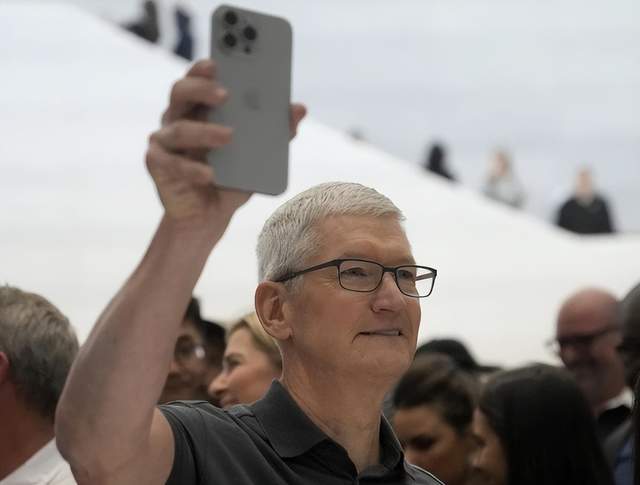
Cook assumed the mantle of Apple’s CEO in August 2011, succeeding the iconic Steve Jobs.
Although Cook had previously served as interim CEO on two occasions in 2009 and 2010 due to Jobs’s medical absences, those were temporary stints. This time, he stepped into the role with full authority.
By this juncture, Jobs was already gravely ill, making Cook’s appointment akin to taking the helm amidst a storm.
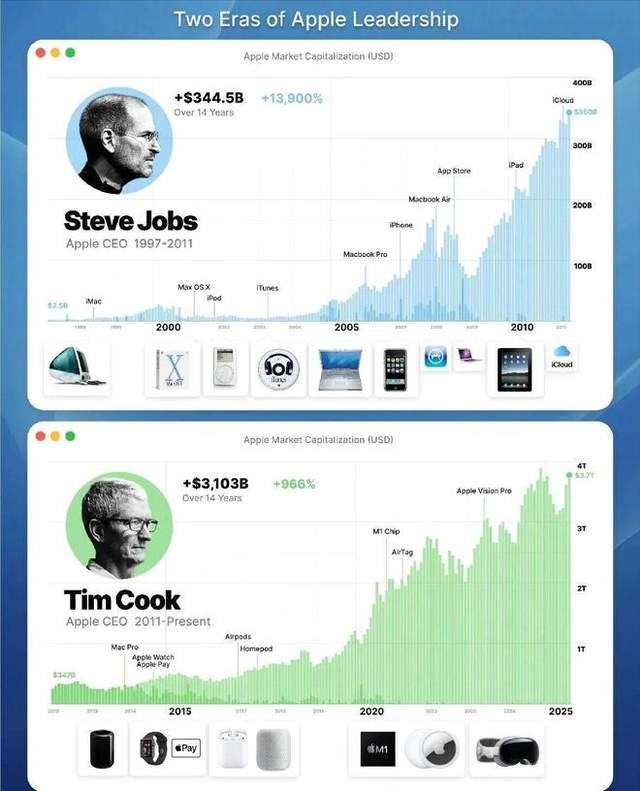
In 2011, Apple was already a colossus in the tech industry, boasting stellar financial performance.
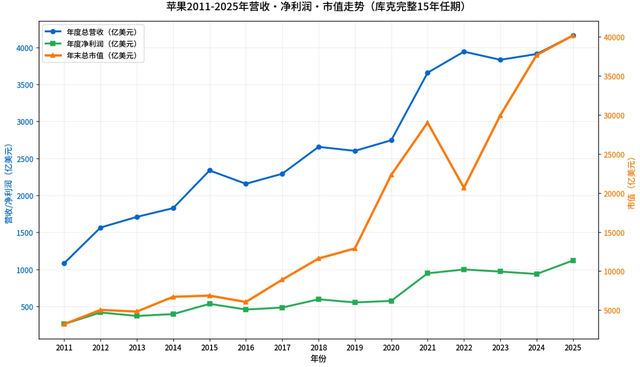
At that time, Apple’s annual revenue surpassed $100 billion, with total revenue for the 2011 fiscal year reaching $108.25 billion and profits hitting $25.92 billion. Its market capitalization stood at approximately $300 billion.
Yet, under Cook’s astute leadership over the ensuing decade and beyond, this already formidable consumer electronics giant continued to flourish and expand.
By the 2025 fiscal year, Apple’s revenue had soared to $416.161 billion, roughly quadrupling its 2011 figure, while profits reached $112 billion, also quadrupling the previous year’s earnings.
The most astonishing aspect of this growth, however, was undoubtedly the surge in market capitalization. In 2011, Apple’s market cap was $300 billion; today, it stands at a staggering $4 trillion, more than 13 times higher.
That’s precisely why I contend that Cook is the greatest CEO for investors—he has made them exceedingly wealthy. For them, profitability reigns supreme.
While Cook may not possess the same charismatic brilliance as Jobs, sustaining success is no mean feat. Moreover, building upon Jobs’s foundation, Cook introduced groundbreaking products like the Apple Watch, AirPods, HomePod, and Vision Pro.
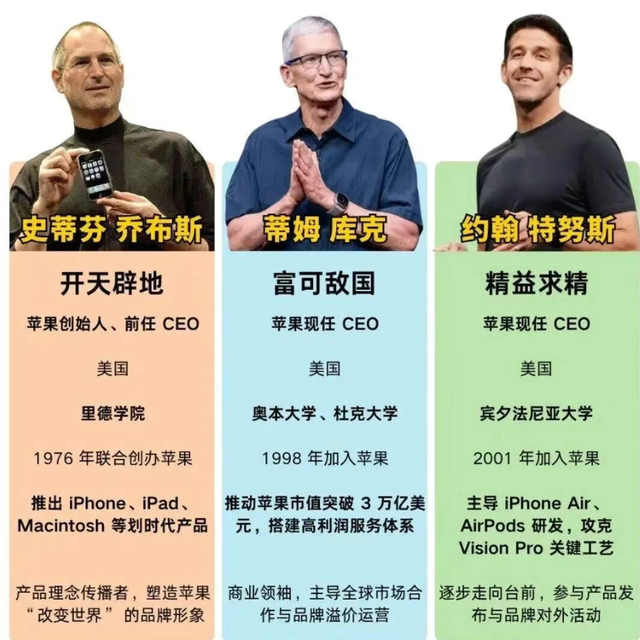
However, after 15 years at the helm as CEO, Cook has finally announced his retirement. Apple’s current Senior Vice President of Hardware Engineering will succeed him, officially taking over on September 1. Thus, Cook steps down from his illustrious tenure.
Why is Cook leaving?
On one hand, it’s related to his health. At 65, Cook is no longer in the prime of his youth, and there have been persistent rumors about his declining health. The new CEO, at 50, is in the peak of his career and clearly possesses more vigor and energy.
On the other hand, Cook’s limitations have become increasingly evident. Hailing from a marketing background, he lacks the technical prowess required for major innovations.
Under Cook’s leadership, innovation has largely revolved around refining existing products like the iPhone, building upon Jobs’s legacy with incremental improvements and expansions rather than pioneering groundbreaking changes.
Consequently, Apple has fallen behind in several key areas, particularly in the realm of artificial intelligence (AI).
Now that smartphone technology has reached its zenith and AI is assuming increasing importance, Cook clearly no longer aligns with Apple’s current developmental needs. John Ternus, with his technical expertise, is seen as the CEO Apple requires now to spearhead true innovation.
The question that remains is: Will Ternus propel Apple to even greater heights, or will his performance fall short of Cook’s illustrious legacy? Only time will reveal the answer.
-
![]()
Has UBTECH Embarked on a Path of 'Harsh Delight'?
-
Three Parts Storytelling, Seven Parts Strategy: Trillion-Yuan Zhipu and Its Strategic Gambit
-
![]()
990,000 Yuan for Emotional Value? UBTECH Debuts Bionic Robots in Consumer Market, Accelerating Divergence in Embodied AI Race
-
![]()
Hardware is the skeleton, AI is the soul, and data integrates the two
-
![]()
China’s AI Industry: A Unified Pivot Towards Monetization?
-
![]()
New Progress! Infineon Completes Acquisition of ams OSRAM's Non-Optical Sensor Business
-
![]()
35 Million Bet on an Optical Future! Tengjing Technology Makes a Move in AR
-
![]()
Why World Models Get Stuck on Construction Roads in Autonomous Driving Applications