HONOR Unveils New Logo as Part of AI-Centric Strategic Shift
 07/27 2026
 372
372
Twelve years since its founding, HONOR has updated its logo for the second time.

On July 23, 2026, HONOR CEO Li Jian announced the launch of a new brand visual identity, the "HONOR Loop," along with a new brand slogan, "Dare to Imagine, Dare to Be Different." Following this announcement, HONOR's official website, Weibo account, and online store all began showcasing the new logo.
Interestingly, after the unveiling of the "HONOR Loop," public attention shifted away from the logo itself. Some netizens observed that HONOR's new logo, featuring a "ring with a gap," bears a resemblance to both the 10th-anniversary logo of "Honor of Kings" and the icon of Elon Musk's AI product, Grok.
However, when considering the logo in the context of HONOR's development history, the adoption of the "HONOR Loop" represents more than just a visual refresh; it signifies a strategic pivot for the brand.
In December 2018, HONOR transitioned from its lowercase "honor" logo, which had been in use for five years, to an uppercase "HONOR" gradient logo, removing the Chinese characters "荣耀" (Glory) in the process. This move marked its evolution from an internet-focused brand to a global technology brand.
Now, with the introduction of the "HONOR Loop" logo, HONOR is further advancing its "Alpha Strategy"—shifting from a smartphone manufacturer to a global AI terminal ecosystem company.
From a technological development standpoint, as AI matures, technology companies should indeed proactively invest in related technologies. However, given HONOR's recent product performance, its exploration of AI smartphones has yet to yield the anticipated results, leaving significant uncertainty about its ability to transform into a "native AI" enterprise.
HONOR Faces Growth Challenges Amid Rising Memory Costs
HONOR's decision to introduce a new logo and fully commit to becoming an AI terminal ecosystem company is largely driven by its struggle to reverse fortunes in the smartphone market.

At one point, following Huawei's sanctions and setbacks, HONOR, leveraging its "Huawei concept," significantly filled the market void left by Huawei's smartphone hiatus, becoming a leading player in the Chinese smartphone market. According to IDC data, in 2023, HONOR held a 17.1% share of the Chinese smartphone market, ranking first among Chinese brands.
However, Huawei's smartphone business proved resilient. In August 2023, with the launch of flagship products featuring next-generation Kirin chips, Huawei made a strong comeback in the Chinese smartphone market. IDC research indicates that in 2024, Huawei's smartphone shipments in China increased by 50.1% year-on-year, ranking second only to vivo. By 2025, Huawei reclaimed the top spot in smartphone shipments.
Given the significant overlap in product positioning and target audiences between HONOR and Huawei smartphones, Huawei's resurgence intensified competitive pressure on HONOR, leading to a decline in shipments.
IDC data reveals that in 2024, HONOR's smartphone shipments in China fell by 8.1% year-on-year, tying with OPPO for fourth place. By 2025, HONOR had dropped out of the top five.
As 2026 began, a sudden surge in memory costs exerted tremendous downward pressure on the smartphone industry. In the first half of 2026, cumulative smartphone shipments in China reached approximately 134 million units, down 4.2% year-on-year.
The impact of the memory "crisis" varied across smartphone brands. Due to their scale advantages, Huawei and Apple viewed the rising memory costs as a strategic opportunity to expand their market influence, absorbing upstream cost pressures internally and thus maintaining growth in smartphone shipments against the trend.
IDC data shows that in Q2 2026, Huawei's and Apple's smartphone shipments in China increased by 19.4% and 24.4%, respectively, making them the only two brands among the top ten smartphone manufacturers to achieve positive growth.
In contrast, smartphone manufacturers like HONOR, with limited shipment scales, increasingly passed upstream cost pressures onto the market, making it harder to persuade consumers to make purchases.

In Q1-Q2 2026, HONOR's smartphone shipments in China fell by 2% and 9.5% year-on-year, respectively, with the decline widening and market ranking dropping from fifth to sixth.
Overall, under industry pressures such as rising memory prices, the Chinese smartphone market has begun to differentiate, presenting a competitive landscape where "the strong get stronger, and the weak get weaker." In this context, maintaining HONOR's existing market share is no easy feat, let alone expanding against the trend.
However, HONOR is currently pursuing an IPO, and relying solely on its smartphone business is insufficient to instill confidence in the capital market. Therefore, HONOR needs to actively explore new business avenues.
After 500 Days of All-In on AI, HONOR Has Yet to Achieve Its "iPhone Moment"
As we all know, since the emergence of ChatGPT at the end of 2022, AI has gradually become a focal point of attention in the technology industry. To unlock growth opportunities, HONOR has embarked on an "all-in on AI" strategy.

At MWC 2025 held in March 2025, HONOR announced its "Alpha Strategy," planning to invest $10 billion over five years to transform from a smartphone manufacturer into a globally leading AI terminal ecosystem company.
Based on this strategy, in October 2025, HONOR launched the Honor Magic8 series, positioned as the "most powerful self-evolving AI-native smartphone," equipped with the YOYO intelligent agent capable of automating tasks in over 3,000 scenarios.

In response, Li Jian stated, "The launch of the Honor Magic8 series marks the official entry of the smartphone industry into the AI Phone era. Self-evolving intelligent agents can inject soul into smartphones, achieving harmonious resonance between silicon-based and carbon-based life forms."
However, paradoxically, despite achieving Agent capabilities, the Honor Magic8 series did not experience a market explosion akin to the original iPhone.

Data disclosed by digital blogger "RD Observation" shows that as of the 28th week of 2026 (July 6-July 12), the Honor Magic8 series had sold 1.4721 million units, far below the 7.7597 million units of the Huawei Mate 80 series and ranking last among the flagship models of the six major brands.
The reason is that the Honor Magic8 series primarily calls external applications through the MCP protocol. However, in the mobile internet era, various platforms have built deep ecological barriers around traffic, data, and commercial interests and are unlikely to easily open up core functionalities to external parties.
Therefore, the Agent capabilities of the Honor Magic8 series are constrained by the openness of third-party applications, making it difficult to achieve true "all-scenario intelligence." Before using the Agent, users need to determine whether the relevant task falls within its supported range, facing higher usage barriers.
Betting on Robot Phone, HONOR's AI Transformation Still Faces Challenges
Given the difficulty of breaking through mobile internet ecological barriers in the short term, HONOR chose to make a breakthrough from the hardware perspective.

In October 2025, HONOR unveiled the world's first robot smartphone, the Honor Robot Phone. The most notable feature of this product is the integration of a four-degree-of-freedom titanium alloy mechanical gimbal system at the top of the device, supporting one-click pop-up and intelligent camera movement.
In response, Li Jian stated, "A smartphone should not just be a boring black box with a touchscreen. We decided to give it a brain and even limbs, resulting in a bold, avant-garde, and exploratory product design like the Honor Robot Phone."
As OpenAI CEO Sam Altman said, "The iPhone is the greatest consumer hardware product of all time, but this device was not designed for AGI." HONOR's courage to break away from traditional smartphone forms and create innovative products deserves recognition.
However, considering the product's characteristics, the Honor Robot Phone is unlikely to become an "AI Phone." This is because the product resembles a hybrid of a smartphone and a pocket gimbal camera and does not fully align with the direction of AI Agent development.
Official information shows that the Honor Robot Phone is equipped with a rear-mounted 200-megapixel primary camera with an F1.6 aperture and an equivalent 23mm 4D gimbal, as well as a 50-megapixel ultra-wide-angle lens and a 200-megapixel periscope telephoto lens. Focusing on outstanding imaging capabilities, HONOR aims to enhance the product's video shooting capabilities.

It is reported that HONOR has reached a global in-depth imaging strategic cooperation with German film equipment manufacturer ARRI, and the technical integration results will first be applied to the Robot Phone. Relying on ARRI's professional imaging algorithms, the product natively supports LogC3 film curves and exclusive film LUT color grading files.
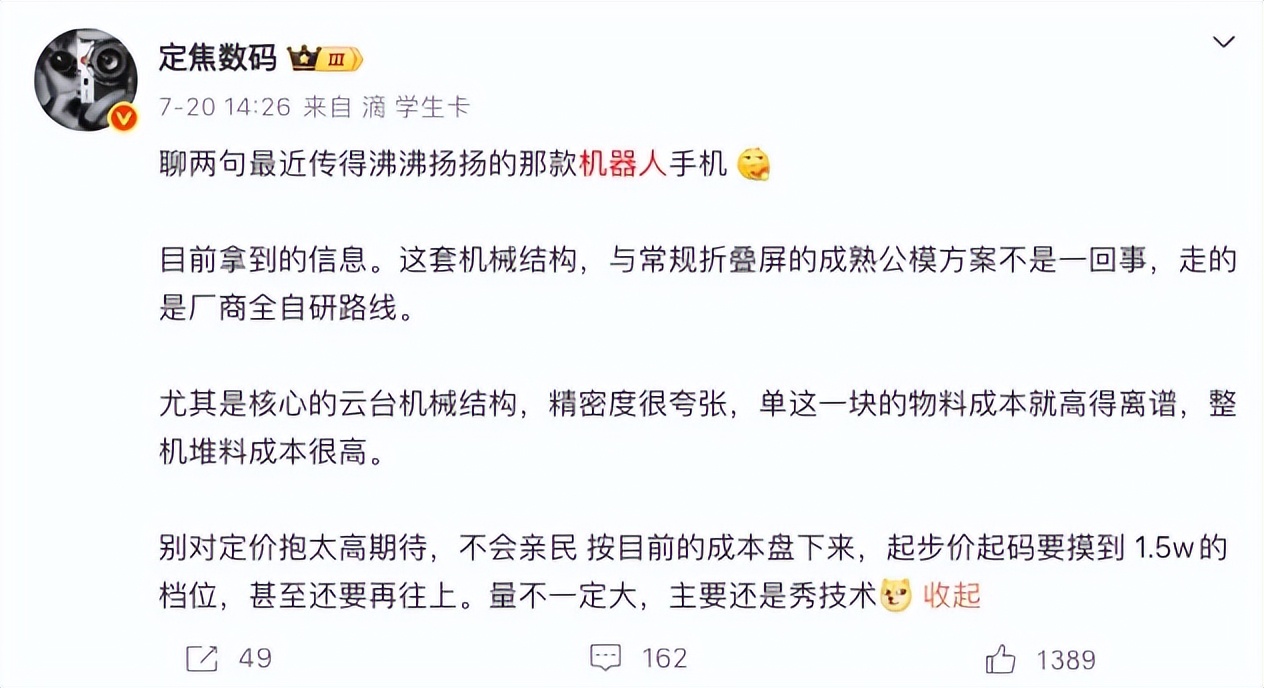
Perhaps due to its positioning as a productivity device, the price of the Honor Robot Phone is not consumer-friendly. According to digital blogger "Focus Digital," the starting price of the Robot Phone "is likely to reach the 15,000 yuan range or even higher."
The problem is that ordinary users do not have strong video shooting needs and are unlikely to accept a smartphone priced at 15,000 yuan. The Honor Robot Phone is unlikely to become a blockbuster product like the original iPhone by meeting the essential needs of mass users.
However, it is worth noting that HONOR is not solely betting on innovative hardware like the Robot Phone but is also simultaneously developing an operating system for the AI era.

In June 2026, HONOR released the next-generation partner-type multimodal intelligent agent operating system, Agentic OS, featuring intention-driven, natural interaction, proactive intelligence, and native cross-device capabilities, evolving mobile terminals from "tools" to "partners."
Official information shows that Agentic OS will rely on Magic GUI, Magic Agent large models, and system-level sensors to enable the YOYO intelligent agent with system-level perception capabilities.
The technical path of Magic GUI is noteworthy. As many apps do not open their interfaces, HONOR may use Magic GUI to allow AI to directly recognize app interfaces, thereby achieving cross-app operations.
However, the Doubao smartphone has sounded an alarm for HONOR. Due to its use of GUI simulation click technology, which breached app traffic entry points, data sovereignty, and security risk control systems, the Doubao smartphone was once "banned" by leading internet platforms. If HONOR rashly adopts Magic GUI technology, it may also be "blacklisted" by leading apps.
In summary, amid rising memory prices and intensifying competition in the smartphone market, whether to alleviate business growth pressures or to find new imagination space for its IPO, HONOR's bet on AI has become an inevitable choice.
However, AI smartphones are not simply about adding functions to traditional smartphones. Currently, mobile internet ecological barriers remain robust. For AI Agents to truly become intelligent entry points for users, they not only require reliable large models but also necessitate the ability of smartphone manufacturers to integrate fragmented ecosystems and restructure the industrial chain.
HONOR's exploration in both software and hardware deserves recognition, but whether it can break through ecological dilemmas and translate AI from a concept into real user value remains to be seen over time.
For HONOR and other manufacturers, the path to AI transformation is still full of challenges, but this exploration itself has initiated the prelude to a transformation in the smartphone industry. In the future, smartphone competition may no longer be limited to parameters, configurations, and hardware innovations but will revolve around "who can better understand users and more efficiently meet their needs."
What is certain is that AI will reshape smartphones, devices that have accompanied users for decades, and redefine the interaction between users and intelligent devices.
-
![]()
Still Thrivings: Top Fuel-Powered Cars with Over 10,000 Sales in June
-
![]()
Surprise! 17 Fuel-Powered Vehicles Surpass 10,000 Units in Sales for June
-
![]()
Mercedes-Benz Halts Production of Electric CLA L in China Less Than a Year After Launch
-
![]()
China's Top 10 Provincial Economies: A Major Reshuffle Underway
-
![]()
Tesla: Building Cars Against the Odds, but AI Promises Remain Unfulfilled?
-
![]()
Shocking! 60 Car Models Fail to Reach Double-Digit Sales in Six Months
-
![]()
Fuel Vehicles, Once Deemed 'Unviable,' Are Making a Surprising Comeback
-
![]()
JAC Motors Ascends to High-End Market, Leaves Individual Investors in the Lurch